Quadrilaterals & Polygons — CAT Previous-Year Questions
58 previous-year questions on Quadrilaterals & Polygons from CAT, with full solutions. Practise free — check answers as you go; sign in to save your progress.
Quadrilaterals & Polygons · CAT PYQs
If the length of a side of a rhombus is 36 cm and the area of the rhombus is 396 sq. cm, then the absolute value of the difference between the lengths, in cm, of the diagonals of the rhombus is
Let ABCDEF be a regular hexagon and P and Q be the midpoints of AB and CD, respectively. Then, the ratio of the areas of trapezium PBCQ and hexagon ABCDEF is
ABCD is a trapezium in which AB is parallel to is perpendicular to AB , and . If a circle inscribed in the trapezium touching all the sides has a radius of 3 cm , then the area, in sq. cm , of the trapezium is
ABCD is a trapezium in which AB is parallel to CD. The sides AD and BC when extended, intersect at point E.
If AB = 2 cm, CD = 1 cm, and perimeter of ABCD is 6 cm, then the perimeter, in cm, of ∆AEB is
A regular octagon ABCDEFGH has sides of length 6 cm each. Then, the area, in sq. cm, of the square ACEG is
A quadrilateral ABCD is inscribed in a circle such that AB : CD = 2 : 1 and BC : AD = 5 : 4. If AC and BD intersect at the point E, then AE : CE equals
In a rectangle ABCD, AB = 9 cm and BC = 6 cm. P and Q are two points on BC such that the areas of the figures ABP, APQ, and AQCD are in geometric progression. If the area of the figure AQCD is four times the area of triangle ABP, then BP : PQ : QC is:
A rectangle with the largest possible area is drawn inside a semicircle of radius 2 cm. Then, the ratio of the lengths of the largest to the smallest side of this rectangle is?
In a regular polygon, any interior angle exceeds the exterior angle by 120 degrees. Then, the number of diagonals of this polygon is
A trapezium ABCD has side AD parallel to BC. ∠BAD = 90°, BC = 3 cm and AD = 8 cm. If the perimeter of this trapezium is 36 cm, then its area, in sq. cm, is
Regular polygons A and B have number of sides in the ratio 1 : 2 and interior angles in the ratio 3 : 4. Then the number of sides of B equals
The lengths of all four sides of a quadrilateral are integer valued. If three of its sides are of length 1 cm, 2 cm and 4 cm, then the total number of possible lengths of the fourth side is
Suppose the length of each side of a regular hexagon ABCDEF is 2 cm. If T is the mid point of CD, then the length of AT, in cm, is
The sides AB and CD of a trapezium ABCD are parallel, with AB being the smaller side. P is the midpoint of CD and ABPD is a parallelogram. If the difference between the areas of the parallelogram ABPD and the triangle BPC is 10 sq cm, then the area, in sq cm, of the trapezium ABCD is
If a rhombus has area 12 sq cm and side length 5 cm, then the length, in cm, of its longer diagonal is
A park is shaped like a rhombus and has area 96 sq m. If 40 m of fencing is needed to enclose the park, the cost, in INR, of laying electric wires along its two diagonals, at the rate of ₹125 per m, is
Let ABCD be a parallelogram. The lengths of the side AD and the diagonal AC are 10 cm and 20 cm, respectively. If the angle ∠ADC is equal to 30° then the area of the parallelogram is sq. cm. is
A circle is inscribed in a rhombus with diagonals 12 cm and 16 cm. The ratio of the area of circle to the area of rhombus is
The sum of the perimeters of an equilateral triangle and a rectangle is 90 cm. The area, T, of the triangle and the area, R, of the rectangle, both in sq cm, satisfy the relationship R = T². If the sides of the rectangle are in the ratio 1 : 3, then the length, in cm, of the longer side of the rectangle, is
In a trapezium ABCD, AB is parallel to DC, BC is perpendicular to DC and ∠BAD = 45°. If DC = 5 cm, BC = 4 cm, the area of the trapezium in sq.cm is
Let A and B be two regular polygons having a and b sides, respectively. If b = 2a and each interior angle of B is 3/2 times each interior angle of A, then each interior angle, in degrees, of a regular polygon with a + b sides is
Points E, F, G, H lie on the sides AB, BC, CD, and DA, respectively, of a square ABCD. If EFGH is also a square whose area is 62.5% of that of ABCD and CG is longer than EB, then the ratio of length of EB to that of CG is
In a parallelogram ABCD of area 72 sq cm, the sides CD and AD have lengths 9 cm and 16 cm, respectively. Let P be a point on CD such that AP is perpendicular to CD. Then the area, in sq cm, of triangle APD is
Let ABCD be a rectangle inscribed in a circle of radius 13 cm. Which one of the following pairs can represent, in cm, the possible length and breadth of ABCD?
A parallelogram ABCD has area 48 sqcm. If the length of CD is 8 cm and that of AD is s cm, then which one of the following is necessarily true?
The area of a rectangle and the square of its perimeter are in the ratio 1 ∶ 25. Then the lengths of the shorter and longer sides of the rectangle are in the ratio ?
Let ABCDEF be a regular hexagon with each side of length 1 cm. The area (in sq cm) of a square with AC as one side is
ABCD is a quadrilateral inscribed in a circle with centre O. If ∠COD = 120 degrees and ∠BAC = 30 degrees, then the value of ∠BCD (in degrees) is
Consider a square ABCD with midpoints E, F, G, H of AB, BC, CD and DA respectively. Let L denote the line passing through F and H. Consider points P and Q, on L and inside ABCD, such that the angles APD and BQC both equal 120°. What is the ratio of the area of ABQCDP to the remaining area inside ABCD?
Each question is followed by two statements A and B. Answer each question using the following instructions.
Mark (1) if the question can be answered by using statement A alone but not by using statement B alone.
Mark (2) if the question can be answered by using statement B alone but not by using statement A alone.
Mark (3) if the question can be answered by using both the statements together but not by using either of the statements alone.
Mark (4) if the question cannot be answered on the basis of the two statements.
Rahim plans to draw a square JKLM with a point O on the side JK but is not successful. Why is Rahim unable to draw the square?
A. The length of OM is twice that of OL.
B. The length of OM is 4 cm.
An equilateral triangle BPC is drawn inside a square ABCD. What is the value of the angle APD in degrees?
Each side of a given polygon is parallel to either the X or the Y axis. A corner of such a polygon is said to be convex if the internal angle is 90° or concave if the internal angle is 270°. If the number of convex corners in such a polygon is 25, the number of concave corners must be
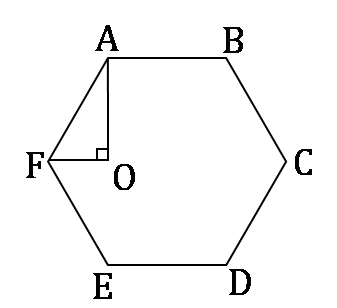
In the figure below, ABCDEF is a regular hexagon and ∠AOF = 90°. FO is parallel to ED. What is the ratio of the area of the triangle AOF to that of the hexagon ABCDEF?
A square tin sheet of side 12 inches is converted into a box with open top in the following steps – the sheet is placed horizontally. Then, equal sized squares, each of side x inches, are cut from the four corners of the sheet. Finally, the four resulting sides are bent vertically upwards in the shape of a box. If x is an integer, then what value of x maximizes the volume of the box?
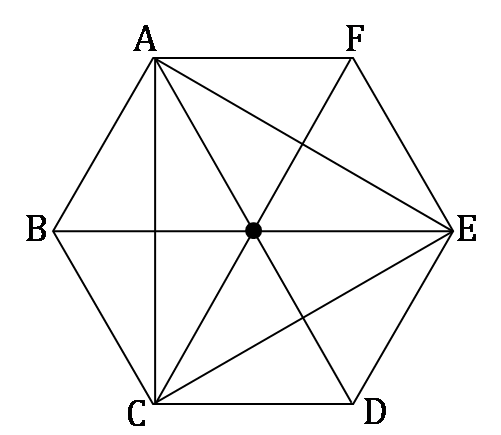
Let ABCDEF be a regular hexagon. What is the ratio of the area of the triangle ACE to that of the hexagon ABCDEF?
The length of the circumference of a circle equals the perimeter of a triangle of equal sides, and also the perimeter of a square. The areas covered by the circle, triangle, and square are c, t, and s, respectively. Then,
Let S1 be a square of side a. Another square S2 is formed by joining the mid-points of the sides of S1. The same process is applied to S2 to form yet another square S3, and so on. If A1, A2, A3... are the areas and P1, P2, P3... are the perimeters of S1, S2, S3... respectively,
then the ratio equals:
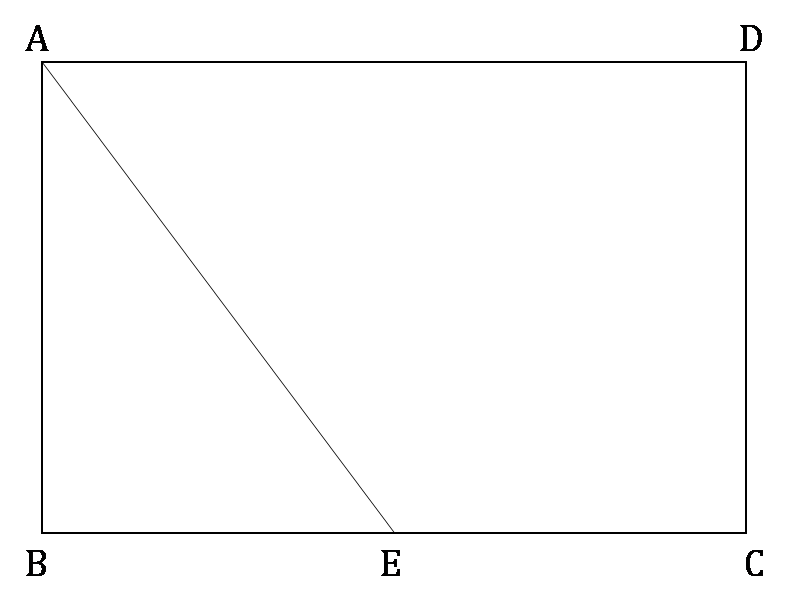
In the following figure, the area of the isosceles right triangle ABE is 7 sq.cm. If EC = 3BE, then the area of rectangle ABCD (in sq. cm.) is
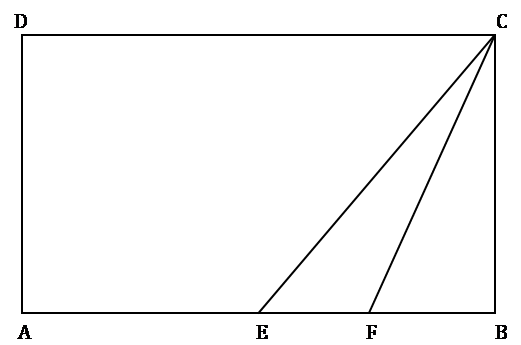
In the above diagram, ABCD is a rectangle with AE = EF = FB. What is the ratio of the area of the triangle CEF and that of the rectangle?
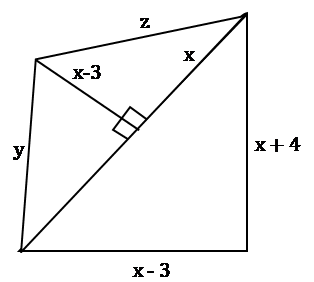
Based on the figure below, what is the value of x, if y = 10?
ABCD is a rhombus with the diagonals AC and BD intersecting at the origin on the x-y plane. The equation of the straight line AD is x + y = 1. What is the equation of BC?
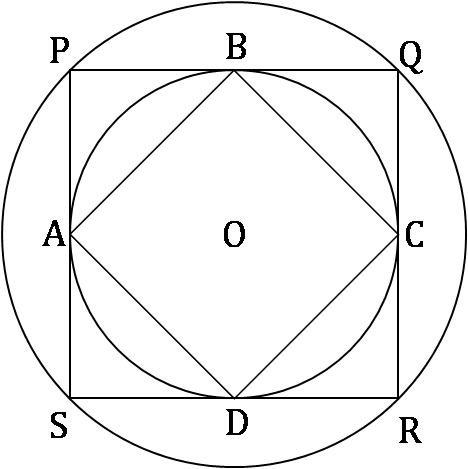
The figure below shows two concentric circles with centre O. PQRS is a square inscribed in the outer circle. It also circumscribes the inner circle, touching it at points B, C, D and A. What is the ratio of the perimeter of the outer circle to that of polygon ABCD?
There is a circle of radius 1 cm. Each member of a sequence of regular polygons S1(n), n = 4, 5, 6, …, where n is the number of sides of the polygon, is circumscribing the circle: and each member of the sequence of regular polygons S2(n), n = 4, 5, 6, … here n is the number of sides of the polygon, is inscribed in the circle. Let L1(n) and L2(n) denote the perimeters of the corresponding
polygons of S1(n) and S2(n), then is
Passage / Data
Directions : Answer the questions based on the following information.
A rectangle PRSU, is divided into two smaller rectangles PQTU, and QRST by the line TQ. PQ = 10 cm. QR = 5 cm and RS = 10 cm. Points A, B, F are within rectangle PQTU, and points C, D, E are within the rectangle QRST. The closest pair of points among the pairs (A, C), (A, D), (A, E), (F, C), (F, D), (F, E), (B, C), (B, D), (B, E) are cm apart.
Which of the following statements is necessarily true?
Passage / Data
Directions : Answer the questions based on the following information.
A rectangle PRSU, is divided into two smaller rectangles PQTU, and QRST by the line TQ. PQ = 10 cm. QR = 5 cm and RS = 10 cm. Points A, B, F are within rectangle PQTU, and points C, D, E are within the rectangle QRST. The closest pair of points among the pairs (A, C), (A, D), (A, E), (F, C), (F, D), (F, E), (B, C), (B, D), (B, E) are cm apart.
AB > AF > BF ; CD > DE >CE ; and BF = 6 cm. Which is the closest pair of points among all the six given points?
Directions: Each question is followed by two statements I and II. Mark:
1. if the question can be answered by any one of the statements alone, but cannot be answered by using the other statement alone.
2. if the question can be answered by using either statement alone.
3. if the question can be answered by using both the statements together, but cannot be answered by using either statement alone.
4. if the question cannot be answered even by using both the statements together.
Mr X starts walking northwards along the boundary of a field from point A on the boundary, and after walking for 150 m reaches B, and then walks westwards, again along the boundary, for another 100 m when he reaches C. What is the maximum distance between any pair of points on the boundary of the field?
I. The field is rectangular in shape.
II. The field is a polygon, with C as one of its vertices and A as the mid-point of a side.
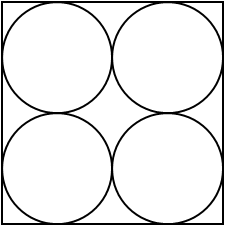
Four identical coins are placed in a square. For each coin the ratio of area to circumference is same as the ratio of circumference to area. Then find the area of the square that is not covered by the coins.
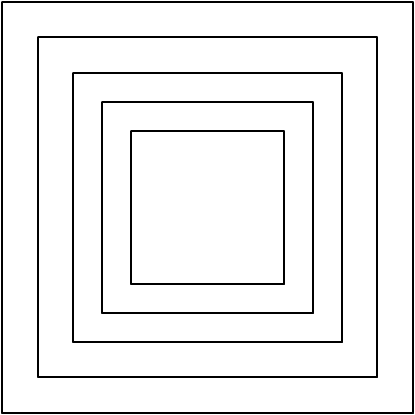
The adjoining figure shows a set of concentric squares. If the diagonal of the innermost square is 2 units, and if the distance between the corresponding corners of any two successive squares is 1 unit, find the difference between the areas of the eighth and the seventh squares, counting from the innermost square.
In a rectangle, the difference between the sum of the adjacent sides and the diagonal is half the length of the longer side. What is the ratio of the shorter to the longer side?
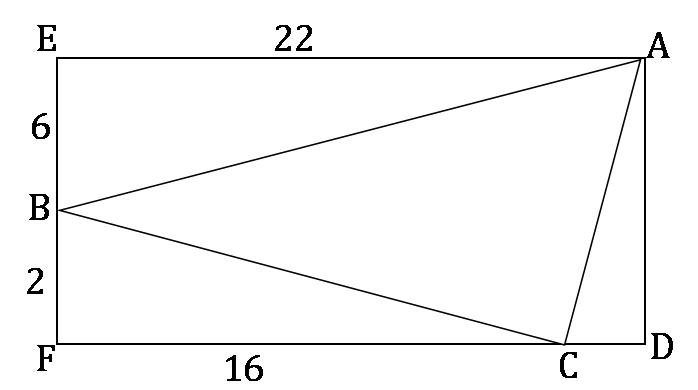
In the given figure, EADF is a rectangle and ABC is a triangle whose vertices lie on the sides of EADF and AE = 22, BE = 6, CF = 16 and BF = 2. Find the length of the line joining the mid-points of the sides AB and BC.
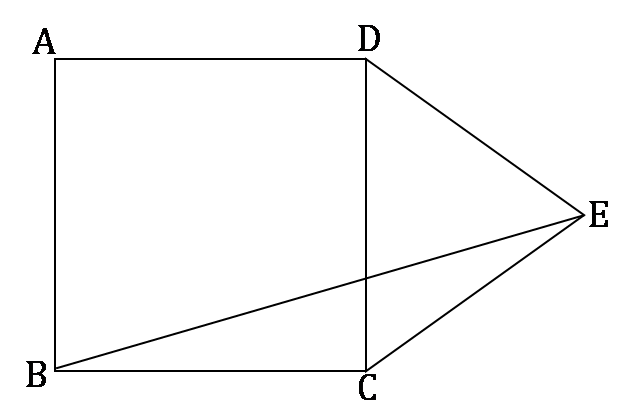
If ABCD is a square and BCE is an equilateral triangle, what is the measure of ∠DEC?
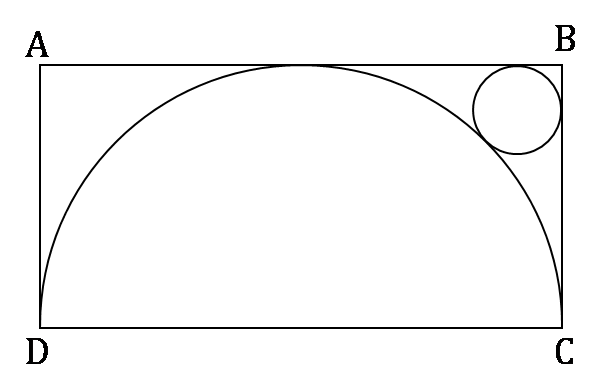
The figure shows the rectangle ABCD with a semicircle and a circle inscribed inside in it as shown. What is the ratio of the area of the circle to that of the semicircle?
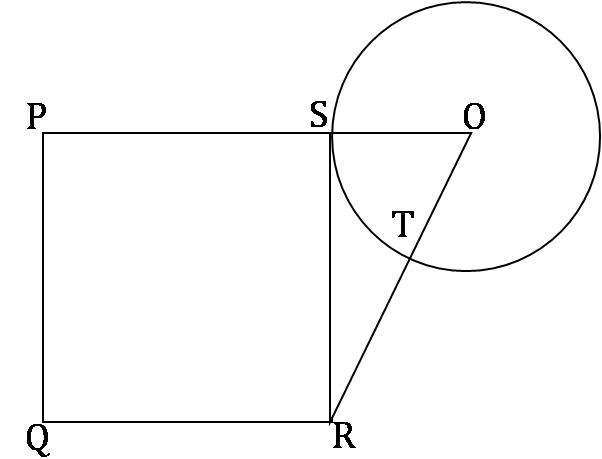
PQRS is a square. SR is a tangent (at point S) to the circle with centre O and TR = OS. Then the ratio of area of the circle to the area of the square is
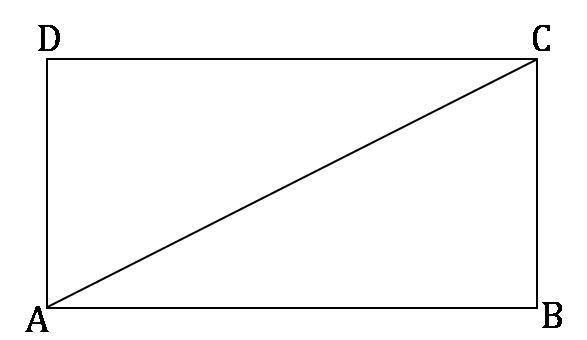
In the adjoining figure, AC+ AB = 5AD and AC – AD = 8. Then the area of the rectangle ABCD is
Four friends start from four towns, which are at the four corners of an imaginary rectangle. They meet at a point which falls inside the rectangle, after travelling distances of 40, 50 and 60 metres. The maximum distance that the fourth could have traveled is (approximately) ….
Data is provided followed by two statements – I and II – both resulting in a value, say I and II.
As your answer,
Type 1, if I > II.
Type 2, if I < II.
Type 3, if I = II.
Type 4, if nothing can be said.
In ΔACD, AD = AC and ∠C = 2∠E. The distance between parallel lines AB and CD is h. Then
I. Area of parallelogram ABCD
II. Area of ΔADE
Consider the five points comprising of the vertices of a square and the intersection point of its diagonals. How many triangles can be formed using these points?
Let the consecutive vertices of a square S be A, B, C & D. Let E, F & G be the mid-points of the sides AB, BC & AD respectively of the square. Then the ratio of the area of the quadrilateral EFDG to that of the square S is nearest to