Board Games — CAT Previous-Year Questions
25 previous-year questions on Board Games from CAT, with full solutions. Practise free — check answers as you go; sign in to save your progress.
Board Games · CAT PYQs
Passage / Data
Answer the following questions based on the information given below.
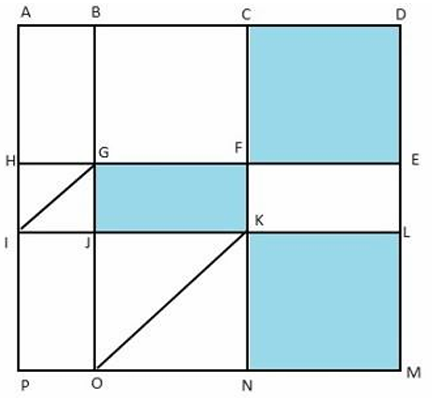
The above is a schematic diagram of walkways (indicated by all the straight-lines) and lakes (3 of them, each in the shape of rectangles – shaded in the diagram) of a gated area. Different points on the walkway are indicated by letters (A through P) with distances being OP = 150 m, ON = MN = 300 m, ML = 400 m, EL = 200 m, DE = 400 m.
The following additional information about the facilities in the area is known.
1. The only entry/exit point is at C.
2. There are many residences within the gated area; all of them are located on the path AH and ML with four of them being at A, H, M, and L.
3. The post office is located at P and the bank is located at B.
| Segment | Length (m) | Segment | Length (m) |
|---|---|---|---|
| AB, HG, IJ, PO | 150 | HI, GJ, FK, EL | 200 |
| BC, CD | 300 | GF, FE | 300 |
| JK, KL | 300 | ON, NM | 300 |
| AH, IP, BG, JO | 400 | CF, KN, DE, LM | 400 |
| GI (diagonal) | 250 | OK (diagonal) | 500 |
Coordinates (m), origin at P, taking the grid columns at x = 0, 150, 450, 750 and rows at y = 0, 400, 600, 1000: A(0,1000) B(150,1000) C(450,1000) D(750,1000); H(0,600) G(150,600) F(450,600) E(750,600); I(0,400) J(150,400) K(450,400) L(750,400); P(0,0) O(150,0) N(450,0) M(750,0). Lakes: C-D-E-F, G-F-K-J, K-L-M-N.
One resident whose house is located at L, needs to visit the post office as well as the bank. What is the minimum distance (in m) he has to walk starting from his residence and returning to his residence after visiting both the post office and the bank?
Passage / Data
Answer the following questions based on the information given below.
The above is a schematic diagram of walkways (indicated by all the straight-lines) and lakes (3 of them, each in the shape of rectangles – shaded in the diagram) of a gated area. Different points on the walkway are indicated by letters (A through P) with distances being OP = 150 m, ON = MN = 300 m, ML = 400 m, EL = 200 m, DE = 400 m.
The following additional information about the facilities in the area is known.
1. The only entry/exit point is at C.
2. There are many residences within the gated area; all of them are located on the path AH and ML with four of them being at A, H, M, and L.
3. The post office is located at P and the bank is located at B.
| Segment | Length (m) | Segment | Length (m) |
|---|---|---|---|
| AB, HG, IJ, PO | 150 | HI, GJ, FK, EL | 200 |
| BC, CD | 300 | GF, FE | 300 |
| JK, KL | 300 | ON, NM | 300 |
| AH, IP, BG, JO | 400 | CF, KN, DE, LM | 400 |
| GI (diagonal) | 250 | OK (diagonal) | 500 |
Coordinates (m), origin at P, taking the grid columns at x = 0, 150, 450, 750 and rows at y = 0, 400, 600, 1000: A(0,1000) B(150,1000) C(450,1000) D(750,1000); H(0,600) G(150,600) F(450,600) E(750,600); I(0,400) J(150,400) K(450,400) L(750,400); P(0,0) O(150,0) N(450,0) M(750,0). Lakes: C-D-E-F, G-F-K-J, K-L-M-N.
One person enters the gated area and decides to walk as much as possible before leaving the area without walking along any path more than once and always walking next to one of the lakes. Note that he may cross a point multiple times. How much distance (in m) will he walk within the gated area?
Passage / Data
Answer the following questions based on the information given below.
The above is a schematic diagram of walkways (indicated by all the straight-lines) and lakes (3 of them, each in the shape of rectangles – shaded in the diagram) of a gated area. Different points on the walkway are indicated by letters (A through P) with distances being OP = 150 m, ON = MN = 300 m, ML = 400 m, EL = 200 m, DE = 400 m.
The following additional information about the facilities in the area is known.
1. The only entry/exit point is at C.
2. There are many residences within the gated area; all of them are located on the path AH and ML with four of them being at A, H, M, and L.
3. The post office is located at P and the bank is located at B.
| Segment | Length (m) | Segment | Length (m) |
|---|---|---|---|
| AB, HG, IJ, PO | 150 | HI, GJ, FK, EL | 200 |
| BC, CD | 300 | GF, FE | 300 |
| JK, KL | 300 | ON, NM | 300 |
| AH, IP, BG, JO | 400 | CF, KN, DE, LM | 400 |
| GI (diagonal) | 250 | OK (diagonal) | 500 |
Coordinates (m), origin at P, taking the grid columns at x = 0, 150, 450, 750 and rows at y = 0, 400, 600, 1000: A(0,1000) B(150,1000) C(450,1000) D(750,1000); H(0,600) G(150,600) F(450,600) E(750,600); I(0,400) J(150,400) K(450,400) L(750,400); P(0,0) O(150,0) N(450,0) M(750,0). Lakes: C-D-E-F, G-F-K-J, K-L-M-N.
One resident takes a walk within the gated area starting from A and returning to A without going through any point (other than A) more than once. What is the maximum distance (in m) she can walk in this way?
Passage / Data
Answer the following questions based on the information given below.
The above is a schematic diagram of walkways (indicated by all the straight-lines) and lakes (3 of them, each in the shape of rectangles – shaded in the diagram) of a gated area. Different points on the walkway are indicated by letters (A through P) with distances being OP = 150 m, ON = MN = 300 m, ML = 400 m, EL = 200 m, DE = 400 m.
The following additional information about the facilities in the area is known.
1. The only entry/exit point is at C.
2. There are many residences within the gated area; all of them are located on the path AH and ML with four of them being at A, H, M, and L.
3. The post office is located at P and the bank is located at B.
| Segment | Length (m) | Segment | Length (m) |
|---|---|---|---|
| AB, HG, IJ, PO | 150 | HI, GJ, FK, EL | 200 |
| BC, CD | 300 | GF, FE | 300 |
| JK, KL | 300 | ON, NM | 300 |
| AH, IP, BG, JO | 400 | CF, KN, DE, LM | 400 |
| GI (diagonal) | 250 | OK (diagonal) | 500 |
Coordinates (m), origin at P, taking the grid columns at x = 0, 150, 450, 750 and rows at y = 0, 400, 600, 1000: A(0,1000) B(150,1000) C(450,1000) D(750,1000); H(0,600) G(150,600) F(450,600) E(750,600); I(0,400) J(150,400) K(450,400) L(750,400); P(0,0) O(150,0) N(450,0) M(750,0). Lakes: C-D-E-F, G-F-K-J, K-L-M-N.
Visitors coming for morning walks are allowed to enter as long as they do not pass by any of the residences and do not cross any point (except C) more than once. What is the maximum distance (in m) that such a visitor can walk within the gated area?
Passage / Data
Answer the following questions based on the information given below.
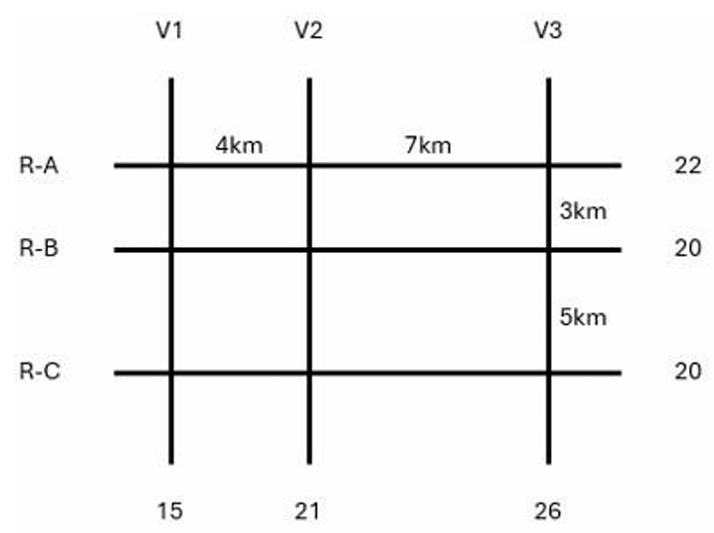
The figure below shows a network with three parallel roads represented by horizontal lines R-A, R-B, and R-C and another three parallel roads represented by vertical lines V1, V2, and V3. The figure also shows the distance (in km) between two adjacent intersections. Six ATMs are placed at six of the nine road intersections. Each ATM has a distinct integer cash requirement (in Rs. Lakhs), and the numbers at the end of each line in the figure indicate the total cash requirements of all ATMs placed on the corresponding road. For example, the total cash requirement of the ATM(s) placed on road R-A is Rs. 22 Lakhs.
| Road / total (Rs. Lakhs) | V1 | V2 | V3 | Row total |
|---|---|---|---|---|
| R-A | · | · | · | 22 |
| R-B | · | · | · | 20 |
| R-C | · | · | · | 20 |
| Column total | 15 | 21 | 26 | 62 |
Distances between adjacent intersections (in km): along R-A, V1–V2 = 4 km and V2–V3 = 7 km; along V3, R-A–R-B = 3 km and R-B–R-C = 5 km.
The following additional information is known.
1. The ATMs with the minimum and maximum cash requirements of Rs. 7 Lakhs and Rs. 15 Lakhs are placed on the same road.
2. The road distance between the ATM with the second highest cash requirement and the ATM located at the intersection of R-C and V3 is 12 km.
Which of the following statements is correct?
Passage / Data
Answer the following questions based on the information given below.
The figure below shows a network with three parallel roads represented by horizontal lines R-A, R-B, and R-C and another three parallel roads represented by vertical lines V1, V2, and V3. The figure also shows the distance (in km) between two adjacent intersections. Six ATMs are placed at six of the nine road intersections. Each ATM has a distinct integer cash requirement (in Rs. Lakhs), and the numbers at the end of each line in the figure indicate the total cash requirements of all ATMs placed on the corresponding road. For example, the total cash requirement of the ATM(s) placed on road R-A is Rs. 22 Lakhs.
| Road / total (Rs. Lakhs) | V1 | V2 | V3 | Row total |
|---|---|---|---|---|
| R-A | · | · | · | 22 |
| R-B | · | · | · | 20 |
| R-C | · | · | · | 20 |
| Column total | 15 | 21 | 26 | 62 |
Distances between adjacent intersections (in km): along R-A, V1–V2 = 4 km and V2–V3 = 7 km; along V3, R-A–R-B = 3 km and R-B–R-C = 5 km.
The following additional information is known.
1. The ATMs with the minimum and maximum cash requirements of Rs. 7 Lakhs and Rs. 15 Lakhs are placed on the same road.
2. The road distance between the ATM with the second highest cash requirement and the ATM located at the intersection of R-C and V3 is 12 km.
How many ATMs have cash requirements of Rs. 10 Lakhs or more?
Passage / Data
Answer the following questions based on the information given below.
The figure below shows a network with three parallel roads represented by horizontal lines R-A, R-B, and R-C and another three parallel roads represented by vertical lines V1, V2, and V3. The figure also shows the distance (in km) between two adjacent intersections. Six ATMs are placed at six of the nine road intersections. Each ATM has a distinct integer cash requirement (in Rs. Lakhs), and the numbers at the end of each line in the figure indicate the total cash requirements of all ATMs placed on the corresponding road. For example, the total cash requirement of the ATM(s) placed on road R-A is Rs. 22 Lakhs.
| Road / total (Rs. Lakhs) | V1 | V2 | V3 | Row total |
|---|---|---|---|---|
| R-A | · | · | · | 22 |
| R-B | · | · | · | 20 |
| R-C | · | · | · | 20 |
| Column total | 15 | 21 | 26 | 62 |
Distances between adjacent intersections (in km): along R-A, V1–V2 = 4 km and V2–V3 = 7 km; along V3, R-A–R-B = 3 km and R-B–R-C = 5 km.
The following additional information is known.
1. The ATMs with the minimum and maximum cash requirements of Rs. 7 Lakhs and Rs. 15 Lakhs are placed on the same road.
2. The road distance between the ATM with the second highest cash requirement and the ATM located at the intersection of R-C and V3 is 12 km.
Which of the following two statements is/are DEFINITELY true?
Statement A: Each of R-A, R-B, and R-C has two ATMs.
Statement B: Each of V1, V2, and V3 has two ATMs.
Passage / Data
Answer the following questions based on the information given below.
The figure below shows a network with three parallel roads represented by horizontal lines R-A, R-B, and R-C and another three parallel roads represented by vertical lines V1, V2, and V3. The figure also shows the distance (in km) between two adjacent intersections. Six ATMs are placed at six of the nine road intersections. Each ATM has a distinct integer cash requirement (in Rs. Lakhs), and the numbers at the end of each line in the figure indicate the total cash requirements of all ATMs placed on the corresponding road. For example, the total cash requirement of the ATM(s) placed on road R-A is Rs. 22 Lakhs.
| Road / total (Rs. Lakhs) | V1 | V2 | V3 | Row total |
|---|---|---|---|---|
| R-A | · | · | · | 22 |
| R-B | · | · | · | 20 |
| R-C | · | · | · | 20 |
| Column total | 15 | 21 | 26 | 62 |
Distances between adjacent intersections (in km): along R-A, V1–V2 = 4 km and V2–V3 = 7 km; along V3, R-A–R-B = 3 km and R-B–R-C = 5 km.
The following additional information is known.
1. The ATMs with the minimum and maximum cash requirements of Rs. 7 Lakhs and Rs. 15 Lakhs are placed on the same road.
2. The road distance between the ATM with the second highest cash requirement and the ATM located at the intersection of R-C and V3 is 12 km.
What best can be said about the road distance (in km) between the ATMs having the second highest and the second lowest cash requirements?
Passage / Data
Answer the following questions based on the information given below.
The figure below shows a network with three parallel roads represented by horizontal lines R-A, R-B, and R-C and another three parallel roads represented by vertical lines V1, V2, and V3. The figure also shows the distance (in km) between two adjacent intersections. Six ATMs are placed at six of the nine road intersections. Each ATM has a distinct integer cash requirement (in Rs. Lakhs), and the numbers at the end of each line in the figure indicate the total cash requirements of all ATMs placed on the corresponding road. For example, the total cash requirement of the ATM(s) placed on road R-A is Rs. 22 Lakhs.
| Road / total (Rs. Lakhs) | V1 | V2 | V3 | Row total |
|---|---|---|---|---|
| R-A | · | · | · | 22 |
| R-B | · | · | · | 20 |
| R-C | · | · | · | 20 |
| Column total | 15 | 21 | 26 | 62 |
Distances between adjacent intersections (in km): along R-A, V1–V2 = 4 km and V2–V3 = 7 km; along V3, R-A–R-B = 3 km and R-B–R-C = 5 km.
The following additional information is known.
1. The ATMs with the minimum and maximum cash requirements of Rs. 7 Lakhs and Rs. 15 Lakhs are placed on the same road.
2. The road distance between the ATM with the second highest cash requirement and the ATM located at the intersection of R-C and V3 is 12 km.
What is the number of ATMs whose locations and cash requirements can both be uniquely determined?
Passage / Data
Answer the next 4 questions based on the information given below.
Twenty-five coloured beads are to be arranged in a grid comprising of five rows and five columns. Each cell in the grid must contain exactly one bead. Each bead is coloured either Red, Blue or Green.
While arranging the beads along any of the five rows or along any of the five columns, the rules given below are to be followed:
- Two adjacent beads along the same row or column are always of different colors.
- There is at least one Green bead between any two Blue beads along the same row or column.
- There is at least one Blue and at least one Green bead between any two Red beads along the same row or column.
Every unique, complete arrangement of twenty-five beads is called a configuration.
The total number of possible configurations using beads of only two colors is:
Passage / Data
Answer the next 4 questions based on the information given below.
Twenty-five coloured beads are to be arranged in a grid comprising of five rows and five columns. Each cell in the grid must contain exactly one bead. Each bead is coloured either Red, Blue or Green.
While arranging the beads along any of the five rows or along any of the five columns, the rules given below are to be followed:
- Two adjacent beads along the same row or column are always of different colors.
- There is at least one Green bead between any two Blue beads along the same row or column.
- There is at least one Blue and at least one Green bead between any two Red beads along the same row or column.
Every unique, complete arrangement of twenty-five beads is called a configuration.
What is the maximum possible number of Red beads that can appear in any configuration?
Passage / Data
Answer the next 4 questions based on the information given below.
Twenty-five coloured beads are to be arranged in a grid comprising of five rows and five columns. Each cell in the grid must contain exactly one bead. Each bead is coloured either Red, Blue or Green.
While arranging the beads along any of the five rows or along any of the five columns, the rules given below are to be followed:
- Two adjacent beads along the same row or column are always of different colors.
- There is at least one Green bead between any two Blue beads along the same row or column.
- There is at least one Blue and at least one Green bead between any two Red beads along the same row or column.
Every unique, complete arrangement of twenty-five beads is called a configuration.
What is the minimum number of Blue beads in any configuration?
Passage / Data
Answer the next 4 questions based on the information given below.
Twenty-five coloured beads are to be arranged in a grid comprising of five rows and five columns. Each cell in the grid must contain exactly one bead. Each bead is coloured either Red, Blue or Green.
While arranging the beads along any of the five rows or along any of the five columns, the rules given below are to be followed:
- Two adjacent beads along the same row or column are always of different colors.
- There is at least one Green bead between any two Blue beads along the same row or column.
- There is at least one Blue and at least one Green bead between any two Red beads along the same row or column.
Every unique, complete arrangement of twenty-five beads is called a configuration.
Two Red beads have been placed in ‘second row, third column’ and ‘third row, second column’. How many more Red beads can be placed so as to maximize the number of Red beads used in the configuration?
Passage / Data
Answer the following questions based on the information given below.

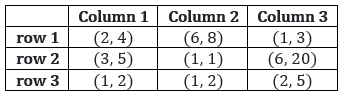
Three pouches (each represented by a filled circle) are kept in each of the nine slots in a 3 × 3 grid, as shown in the figure. Every pouch has a certain number of one-rupee coins. The minimum and maximum amounts of money (in rupees) among the three pouches in each of the nine slots are given in the table. For example, we know that among the three pouches kept in the second column of the first row, the minimum amount in a pouch is Rs. 6 and the maximum amount is Rs. 8.
There are nine pouches in any of the three columns, as well as in any of the three rows. It is known that the average amount of money (in rupees) kept in the nine pouches in any column or in any row is an integer. It is also known that the total amount of money kept in the three pouches in the first column of the third row is Rs. 4.
What is the total amount of money (in rupees) in the three pouches kept in the first column of the second row?
Passage / Data
Answer the following questions based on the information given below.
Three pouches (each represented by a filled circle) are kept in each of the nine slots in a 3 × 3 grid, as shown in the figure. Every pouch has a certain number of one-rupee coins. The minimum and maximum amounts of money (in rupees) among the three pouches in each of the nine slots are given in the table. For example, we know that among the three pouches kept in the second column of the first row, the minimum amount in a pouch is Rs. 6 and the maximum amount is Rs. 8.
There are nine pouches in any of the three columns, as well as in any of the three rows. It is known that the average amount of money (in rupees) kept in the nine pouches in any column or in any row is an integer. It is also known that the total amount of money kept in the three pouches in the first column of the third row is Rs. 4.
How many pouches contain exactly one coin?
Passage / Data
Answer the following questions based on the information given below.
Three pouches (each represented by a filled circle) are kept in each of the nine slots in a 3 × 3 grid, as shown in the figure. Every pouch has a certain number of one-rupee coins. The minimum and maximum amounts of money (in rupees) among the three pouches in each of the nine slots are given in the table. For example, we know that among the three pouches kept in the second column of the first row, the minimum amount in a pouch is Rs. 6 and the maximum amount is Rs. 8.
There are nine pouches in any of the three columns, as well as in any of the three rows. It is known that the average amount of money (in rupees) kept in the nine pouches in any column or in any row is an integer. It is also known that the total amount of money kept in the three pouches in the first column of the third row is Rs. 4.
What is the number of slots for which the average amount (in rupees) of its three pouches is an integer?
Passage / Data
Answer the following questions based on the information given below.
Three pouches (each represented by a filled circle) are kept in each of the nine slots in a 3 × 3 grid, as shown in the figure. Every pouch has a certain number of one-rupee coins. The minimum and maximum amounts of money (in rupees) among the three pouches in each of the nine slots are given in the table. For example, we know that among the three pouches kept in the second column of the first row, the minimum amount in a pouch is Rs. 6 and the maximum amount is Rs. 8.
There are nine pouches in any of the three columns, as well as in any of the three rows. It is known that the average amount of money (in rupees) kept in the nine pouches in any column or in any row is an integer. It is also known that the total amount of money kept in the three pouches in the first column of the third row is Rs. 4.
The number of slots for which the total amount in its three pouches strictly exceeds Rs. 10 is
Passage / Data
Answer the following question based on the information given below.
You are given an n × n square matrix to be filled with numerals so that no two adjacent cells have the same numeral. Two cells are called adjacent if they touch each other horizontally, vertically or diagonally. So a cell in one of the four corners has three cells adjacent to it, and a cell in the first or last row or column which is not in the corner has five cells adjacent to it. Any other cell has eight cells adjacent to it.
What is the minimum number of different numerals needed to fill a 3×3 square matrix?
Passage / Data
Answer the following question based on the information given below.
You are given an n × n square matrix to be filled with numerals so that no two adjacent cells have the same numeral. Two cells are called adjacent if they touch each other horizontally, vertically or diagonally. So a cell in one of the four corners has three cells adjacent to it, and a cell in the first or last row or column which is not in the corner has five cells adjacent to it. Any other cell has eight cells adjacent to it.
What is the minimum number of different numerals needed to fill a 5 × 5 square matrix?
Passage / Data
Answer the following question based on the information given below.
You are given an n × n square matrix to be filled with numerals so that no two adjacent cells have the same numeral. Two cells are called adjacent if they touch each other horizontally, vertically or diagonally. So a cell in one of the four corners has three cells adjacent to it, and a cell in the first or last row or column which is not in the corner has five cells adjacent to it. Any other cell has eight cells adjacent to it.
Suppose you are allowed to make one mistake, that is, one pair of adjacent cells can have the same numeral. What is the minimum number of different numerals required to fill a 5×5 matrix?
Passage / Data
Answer the following question based on the information given below.
You are given an n × n square matrix to be filled with numerals so that no two adjacent cells have the same numeral. Two cells are called adjacent if they touch each other horizontally, vertically or diagonally. So a cell in one of the four corners has three cells adjacent to it, and a cell in the first or last row or column which is not in the corner has five cells adjacent to it. Any other cell has eight cells adjacent to it.
Suppose that all the cells adjacent to any particular cell must have different numerals. What is the minimum number of different numerals needed to fill a 5×5 square matrix?
Passage / Data
Answer the following question based on the information given below.
In an 8 × 8 chessboard a queen placed anywhere can attack another piece if the piece is present in the same row, or in the same column or in any diagonal position in any possible 4 directions, provided there is no other piece in between in the path from the queen to that piece.
The columns are labelled a to h (left to right) and the rows are numbered 1 to 8 (bottom to top). The position of a piece given by the combination of column and row labels. For example, position c5 means that the piece is cth column and 5th row.
If the queen is at c5, and the other pieces at positions c2, g1, g3, g5 and a3, how many are under attack by the queen? There are no other pieces on the board.
Passage / Data
Answer the following question based on the information given below.
In an 8 × 8 chessboard a queen placed anywhere can attack another piece if the piece is present in the same row, or in the same column or in any diagonal position in any possible 4 directions, provided there is no other piece in between in the path from the queen to that piece.
The columns are labelled a to h (left to right) and the rows are numbered 1 to 8 (bottom to top). The position of a piece given by the combination of column and row labels. For example, position c5 means that the piece is cth column and 5th row.
If the other pieces are only at positions a1, a3, b4, d7, h7 and h8, then which of the following positions of the queen results in the maximum number of pieces being under attack?
Passage / Data
Answer the following question based on the information given below.
In an 8 × 8 chessboard a queen placed anywhere can attack another piece if the piece is present in the same row, or in the same column or in any diagonal position in any possible 4 directions, provided there is no other piece in between in the path from the queen to that piece.
The columns are labelled a to h (left to right) and the rows are numbered 1 to 8 (bottom to top). The position of a piece given by the combination of column and row labels. For example, position c5 means that the piece is cth column and 5th row.
If the other pieces are only at positions a1, a3, b4, d7, h7 and h8, then from how many positions the queen cannot attack any of the pieces?
Passage / Data
Answer the following question based on the information given below.
In an 8 × 8 chessboard a queen placed anywhere can attack another piece if the piece is present in the same row, or in the same column or in any diagonal position in any possible 4 directions, provided there is no other piece in between in the path from the queen to that piece.
The columns are labelled a to h (left to right) and the rows are numbered 1 to 8 (bottom to top). The position of a piece given by the combination of column and row labels. For example, position c5 means that the piece is cth column and 5th row.
Suppose the queen is the only piece on the board and it is at position d5.
In how many positions can another piece be placed on the board such that it is safe from attack from the queen?