Miscellaneous — CAT Previous-Year Questions
35 previous-year questions on Miscellaneous from CAT, with full solutions. Practise free — check answers as you go; sign in to save your progress.
Miscellaneous · CAT PYQs
The numbers 1,2, …, 9 are arranged in a 3 × 3 square grid in a such way that each number occurs once and the entries along each column, each row, and each of the two diagonals add up to the same value.
If the top left and the top right entries of the grid are 6 and 2, respectively, then the bottom middle entry is
Passage / Data
Answer the following question based on the information given below.
Five horses, Red, White, Grey, Black and Spotted participated in a race. As per the rules of the race, the persons betting on the winning horse get four times the bet amount and those betting on the horse that came in second get thrice the bet amount. Moreover, the bet amount is returned to those betting on the horse that came in third, and the rest lose the bet amount. Raju bets Rs. 3000, Rs. 2000 Rs. 1000 on Red, White and Black horses respectively and ends up with no profit and no loss.
Suppose, in addition, it is known that Grey came in fourth. Then which of the following cannot be true?
Passage / Data
Answer the following question based on the information given below.
Five horses, Red, White, Grey, Black and Spotted participated in a race. As per the rules of the race, the persons betting on the winning horse get four times the bet amount and those betting on the horse that came in second get thrice the bet amount. Moreover, the bet amount is returned to those betting on the horse that came in third, and the rest lose the bet amount. Raju bets Rs. 3000, Rs. 2000 Rs. 1000 on Red, White and Black horses respectively and ends up with no profit and no loss.
Which of the following cannot be true?
Each question is followed by two statements, I and II. Answer each question using the following instructions:
Mark (1) if the question can be answered by using statement I alone but not by using statement II alone.
Mark (2) if the question can be answered by using statement II alone but not by using statement I alone.
Mark (3) if the question can be answered by using either of the statements alone.
Mark (4) if the question can be answered by using both the statements together but not by either of the statements alone.
Mark (5) if the question cannot be answered by using any of the statements.
In a football match, at the half-time, Mahindra and Mahindra Club was trailing by three goals. Did it win the match?
I. In the second-half Mahindra and Mahindra Club scored four goals.
II. The opponent scored four goals in the match.
Three Englishmen and three Frenchmen work for the same company. Each of them knows a secret not known to others. They need to exchange these secrets over person-to-person phone calls so that eventually each person knows all six secrets. None of the Frenchmen knows English, and only one Englishman knows French. What is the minimum number of phone calls needed for the above purpose?
Each family in a locality has at most two adults, and no family has fewer than 3 children. Considering all the families together, there are more adults than boys, more boys than girls, and more girls than families. Then the minimum possible number of families in the locality is:
Passage / Data
Each question is followed by two statements, A and B. Answer each question using the following instructions
Choose 1 if the question can be answered by using one of the statements alone but not by using the other statement alone.
Choose 2 if the question can be answered by using either of the statements alone.
Choose 3 if the question can be answered by using both statements together but not by either statement alone.
Choose 4 if the question cannot be answered on the basis of the two statements.
In each question there are two statements: A and B.
Choose 1 if the question can be answered by one of the statements alone but not by the other.
Choose 2 if the question can be answered by using either statement alone.
Choose 3 if the question can be answered by using both the statements together but cannot be answered using either statement alone.
Choose 4 if the question cannot be answered even by using both the statements A and B.
A game consists of tossing a coin successively. There is an entry fee of Rs. 10 and an additional fee of Re. 1 for each toss of the coin. The game is considered to have ended normally when the coin turns heads on two consecutive throws. In this case the player is paid Rs. 100. Alternatively, the player can choose to terminate the game prematurely after any of the tosses. Ram has incurred a loss of Rs. 50 by playing this game. How many times did he toss the coin?
A. The game ended normally.
B. The total number of tails obtained in the game was 138.
Passage / Data
Each question is followed by two statements, A and B. Answer each question using the following instructions
Choose 1 if the question can be answered by using one of the statements alone but not by using the other statement alone.
Choose 2 if the question can be answered by using either of the statements alone.
Choose 3 if the question can be answered by using both statements together but not by either statement alone.
Choose 4 if the question cannot be answered on the basis of the two statements.
In each question there are two statements: A and B.
Choose 1 if the question can be answered by one of the statements alone but not by the other.
Choose 2 if the question can be answered by using either statement alone.
Choose 3 if the question can be answered by using both the statements together but cannot be answered using either statement alone.
Choose 4 if the question cannot be answered even by using both the statements A and B.
Each packet of SOAP costs Rs. 10. Inside each packet is a gift coupon labelled with one of the letters S, O, A, and P. If a customer submits four such coupons that make up the word SOAP, the customer gets a free SOAP packet. Ms. X kept buying packet after packet of SOAP till she could get one set of coupons that formed the word SOAP. How many coupons with label P did she get in the above process?
A. The last label obtained by her was S and the total amount spent was Rs. 210.
B. The total number of vowels obtained was 18.
Passage / Data
Answer the following question based on the information given below.
Two binary operations ⊕ and * are defined over the set {a, e, f, g, h} as per the following tables:
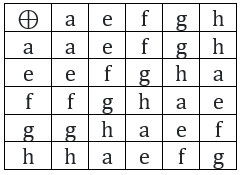
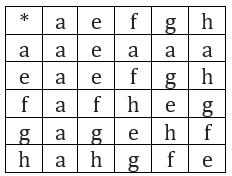
Thus, according to the first table f ⊕ g = a, while according to the second table g * h = f, and so on.
Also, let f2 = f * f, g3 = g * g * g, and so on.
What is the smallest positive integer n such that gn = e?
Passage / Data
Answer the following question based on the information given below.
Two binary operations ⊕ and * are defined over the set {a, e, f, g, h} as per the following tables:
Thus, according to the first table f ⊕ g = a, while according to the second table g * h = f, and so on.
Also, let f2 = f * f, g3 = g * g * g, and so on.
Upon simplification, f ⊕ [f * {f ⊕ (f * f)}] equals:
Passage / Data
Answer the following question based on the information given below.
Two binary operations ⊕ and * are defined over the set {a, e, f, g, h} as per the following tables:
Thus, according to the first table f ⊕ g = a, while according to the second table g * h = f, and so on.
Also, let f2 = f * f, g3 = g * g * g, and so on.
Upon simplification, (a10 * (f10 ⊕ g9)} ⊕ e8 equals
Passage / Data
Answer the following question based on the information given below.
The seven basic symbols in a certain numeral system and their respective values are as follows:
I = 1, V = 5, X = 10, L = 50, C = 100, D = 500, and M = 1000
In general, the symbols in the numeral system are read from left to right, starting with the symbol representing the largest value; the same symbol cannot occur continuously more than three times; the value of the numeral is the sum of the values of the symbols.
For example, XXVII = 10 + 10 + 5 + 1 + 1 = 27.
An exception to the left-to-right reading occurs when a symbol is followed immediately by a symbol of greater value; then, the smaller value is subtracted from the larger.
For example, XLVI = (50 – 10) + 5 + 1 = 46.
The value of the numeral MDCCLXXXVII is:
Passage / Data
Answer the following question based on the information given below.
The seven basic symbols in a certain numeral system and their respective values are as follows:
I = 1, V = 5, X = 10, L = 50, C = 100, D = 500, and M = 1000
In general, the symbols in the numeral system are read from left to right, starting with the symbol representing the largest value; the same symbol cannot occur continuously more than three times; the value of the numeral is the sum of the values of the symbols.
For example, XXVII = 10 + 10 + 5 + 1 + 1 = 27.
An exception to the left-to-right reading occurs when a symbol is followed immediately by a symbol of greater value; then, the smaller value is subtracted from the larger.
For example, XLVI = (50 – 10) + 5 + 1 = 46.
The value of the numeral MCMXCIX is
Passage / Data
Answer the following question based on the information given below.
The seven basic symbols in a certain numeral system and their respective values are as follows:
I = 1, V = 5, X = 10, L = 50, C = 100, D = 500, and M = 1000
In general, the symbols in the numeral system are read from left to right, starting with the symbol representing the largest value; the same symbol cannot occur continuously more than three times; the value of the numeral is the sum of the values of the symbols.
For example, XXVII = 10 + 10 + 5 + 1 + 1 = 27.
An exception to the left-to-right reading occurs when a symbol is followed immediately by a symbol of greater value; then, the smaller value is subtracted from the larger.
For example, XLVI = (50 – 10) + 5 + 1 = 46.
Which of the following can represent the numeral for 1995?
a. MCMLXXV
b. MCMXCV
c. MVD
d. MVM
Passage / Data
Answer the following question based on the information given below.
A boy is supposed to put a mango into a basket if ordered 1, an orange if ordered 2 and an apple if ordered 3. He took out 1 mango and 1 orange if ordered 4. He was given the following sequence of orders.
12332142314223314113234
At the end of the sequence, what will be the number of oranges in the basket?
Passage / Data
Answer the following question based on the information given below.
A boy is supposed to put a mango into a basket if ordered 1, an orange if ordered 2 and an apple if ordered 3. He took out 1 mango and 1 orange if ordered 4. He was given the following sequence of orders.
12332142314223314113234
At the end of the sequence, what will be the total number of fruits in the basket?
Choose 1; if the question can be answered by using one of the statements alone, but cannot be answered using the other statement alone.
Choose 2; if the question can be answered by using either statement alone.
Choose 3; if the question can be answered by using both statements together, but cannot be answered using either statement alone.
Choose 4; if the question cannot be answered even by using both statements together.
On a given day a boat ferried 1500 passengers across the river in twelve hours. How many round trips did it make?
- The boat can carry two hundred passengers at any time.
- It takes 40 minutes each way and 20 minutes of waiting time at each terminal.
Passage / Data
Answer the following question based on the information given below.
There are five machines A, B C, D and E situated on a straight line at distances of 10 metres, 20 metres, 30 metres, 40 metres and 50 metres respectively from the origin of the line. A robot is stationed at the origin of the line. The robot serves the machines with raw material whenever a machine becomes idle. All the raw material is located at the origin. The robot is in an idle state at the origin at the beginning of a day. As soon as one or more machines become idle, they send messages to the robot-station and the robot starts and serves all the machines from which it received messages. If a message is received at the station while the robot is away from it, the robot takes notice of the message only when it returns to the station. While moving, it serves the machines in the sequence in which they are encountered, and then returns to the origin. If any messages are pending at the station when it returns, it repeats the process again. Otherwise, it remains idle at the origin till the next message(s) is received.
Suppose on a certain day, machines A and D have sent the first two messages to the origin at the beginning of the first second, and C has sent a message at the beginning of the 5th second and B at the beginning of the 6th second, and E at the beginning of the 10th second. How much distance in metres has the robot travelled since the beginning of the day, when it notices the message of E? Assume that the speed of movement of the robot is 10 metres per second.
Passage / Data
Answer the following question based on the information given below.
There are five machines A, B C, D and E situated on a straight line at distances of 10 metres, 20 metres, 30 metres, 40 metres and 50 metres respectively from the origin of the line. A robot is stationed at the origin of the line. The robot serves the machines with raw material whenever a machine becomes idle. All the raw material is located at the origin. The robot is in an idle state at the origin at the beginning of a day. As soon as one or more machines become idle, they send messages to the robot-station and the robot starts and serves all the machines from which it received messages. If a message is received at the station while the robot is away from it, the robot takes notice of the message only when it returns to the station. While moving, it serves the machines in the sequence in which they are encountered, and then returns to the origin. If any messages are pending at the station when it returns, it repeats the process again. Otherwise, it remains idle at the origin till the next message(s) is received.
Suppose there is a second station with raw material for the robot at the other extreme of the line which is 60 metres from the origin, that is, 10 metres from E. After finishing the services in a trip, the robot returns to the nearest station. If both stations are equidistant, it chooses the origin as the station to return to. Assuming that both stations receive the messages sent by the machines and that all the other data remains the same, what would be the answer to the above question?
There is a vertical stack of books marked 1, 2, and 3 on Table-A, with 1 at the bottom and 3 on top. These are to be placed vertically on Table-B with 1 at the bottom and 2 on the top, by making a series of moves from one table to the other. During a move, the topmost book, or the topmost two books, or all the three, can be moved from one of the tables to the other. If there are any books on the other table, the stack being transferred should be placed on top of the existing books, without changing the order of books in the stack that is being moved in that move. If there are no books on the other table, the stack is simply placed on the other table without disturbing the order of books in it. What is the minimum number of moves in which the above task can be accomplished?
For two positive integers a and b define the function h(a,b) as the greatest common factor (G.C.F) of a, b. Let A be a set of n positive integers. G(A), the G.C.F of the elements of set A is computed by repeatedly using the function h. The minimum number of times h is required to be used to compute G is
Three labelled boxes containing red and white cricket balls are all mislabelled. It is known that one of the boxes contains only white balls and another one contains only red balls. The third contains a mixture of red and white balls. You are required to correctly label the boxes with the labels red, white and red and white by picking a sample of one ball from only one box. What is the label on the box you should sample?
Passage / Data
Answer the next 2 questions based on the following information.
There are blue vessels with known volumes v1, v2..., vm, arranged in ascending order of volume, v1 > 0.5 litre, and vm < 1 litre. Each of these is full of water initially. The water from each of these is emptied into a minimum number of empty white vessels, each having volume 1 litre. The water from a blue vessel is not emptied into a white vessel unless the white vessel has enough empty volume to hold all the water of the blue vessel. The number of white vessels required to empty all the blue vessels according to the above rules was n.
Among the four values given below, which is the least upper bound on e, where e is the total empty volume in the white vessels at the end of the above process?
Passage / Data
Answer the next 2 questions based on the following information.
There are blue vessels with known volumes v1, v2..., vm, arranged in ascending order of volume, v1 > 0.5 litre, and vm < 1 litre. Each of these is full of water initially. The water from each of these is emptied into a minimum number of empty white vessels, each having volume 1 litre. The water from a blue vessel is not emptied into a white vessel unless the white vessel has enough empty volume to hold all the water of the blue vessel. The number of white vessels required to empty all the blue vessels according to the above rules was n.
Let the number of white vessels needed be n1 for the emptying process described above, if the volume of each white vessel is 2 litres. Among the following values, which is the least upper bound on n1?
Passage / Data
Direction: Answer the questions based on the following information.
Production pattern for number of units (in cubic feet) per day.

For a truck that can carry 2,000 cubic ft, hiring cost per day is Rs. 1,000. Storing cost per cubic feet is Rs. 5 per day.
If all the units should be sent to the market, then on which days should the trucks be hired to minimize the cost?
Passage / Data
Direction: Answer the questions based on the following information.
Production pattern for number of units (in cubic feet) per day.
For a truck that can carry 2,000 cubic ft, hiring cost per day is Rs. 1,000. Storing cost per cubic feet is Rs. 5 per day.
If the storage cost is reduced to Re 0.80 per cubic feet per day, then on which day(s), should the truck be hired?
Find the value of
A, B, C and D are four towns, any three of which are non-collinear. Then the number of ways to construct three roads each joining a pair of towns so that the roads do not form a triangle is
139 persons have signed up for an elimination tournament. All players are to be paired up for the first round, but because 139 is an odd number one player gets a bye, which promotes him to the second round, without actually playing in the first round. The pairing continues on the next round, with a bye to any player left over. If the schedule is planned so that a minimum number of matches is required to determine the champion, the number of matches which must be played is
There are ten 50 paise coins placed on a table. Six of these show tails, four show heads. A coin is chosen at random and flipped over (not tossed). This operation is performed seven times. One of the coins is then covered. Of the remaining nine coins, five show tails and four show heads. The covered coin shows
Passage / Data
The following functions have been defined for three numbers A, B and C:
@ (A, B) = average of A and B
*(A, B) = product of A and B
/(A, B) = A divided by B
Answer these questions with the above data.
If A = 2 and B = 4, the value of @(/(*(A, B), B), A) would be
Passage / Data
The following functions have been defined for three numbers A, B and C:
@ (A, B) = average of A and B
*(A, B) = product of A and B
/(A, B) = A divided by B
Answer these questions with the above data.
The sum of A and B is given by
Passage / Data
The following functions have been defined for three numbers A, B and C:
@ (A, B) = average of A and B
*(A, B) = product of A and B
/(A, B) = A divided by B
Answer these questions with the above data.
The sum of A, B, and C is given by
A calculator has two memory buttons, A and B. Value 1 is initially stored in both memory locations.
The following sequence of steps is carried out five times:
- add 1 to B
- multiply A to B
- store the result in A
What is the value stored in memory location A after this procedure?
In a six-node network, two nodes are connected to all the other nodes. Of the remaining four, each is connected to four nodes. What is the total number of links in the network?