XAT 2014 — Decision Making Question 4
Read the following case – let and answer the questions that follow.
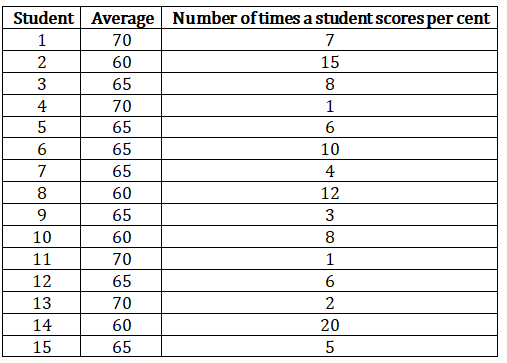
Ms. Banerjee, class teacher for 12th standard, wants to send teams (based on past performance) of three students each to district, state, national, and international competition in mathematics. Till now, every student of the class has appeared in 100 school level tests. The students had following distribution of marks in the tests, in terms of “average” and “number of times a student scored cent per cent marks”.
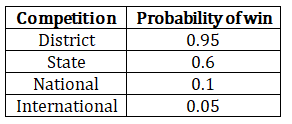
Ms. Banerjee has carefully studied chances of her school winning each of the competitions. Based on in-depth calculations, she realized that her school is quite likely to win district level competition but has low chances of winning the international competition. She listed down the following probabilities of wins for different competitions. Prize was highest for international competition and lowest for district level competition (in that order).
All the students are studying in the school for last twelve years. She wanted to select the best team for all four competitions (Ms. Banerjee had no other information to select students).
The main issues of interpretation arising from the work of professionally trained anthropologists are that they are late in colonial/post – colonial trajectories, because professional training shapes their interpretations. However, within field of interest and training, their works are most thorough and systematic
The best conclusion drawn from the above paragraph is analogous to:
Answer & solution
Correct answer: Heisenberg uncertainty principle, which states that speed and position cannot be determined simultaneously.
Heisenberg uncertainty principle, which states that speed and position cannot be determined simultaneously.
- B
Cultural relativism, which states that two or more than two cultures cannot be compared.
- C
Personal relativism, which states that one should not study anthropological phenomenon for personal gains.
- D
Conclusive relativism, which states that anthropologists should not knowingly color their findings.
- E
Communicative relativism, which states that anthropologists should not be selective in communicating their findings.
According to the information provided, the issues of interpretation arise from the fact that anthropologists cannot dissociate the influence of their training from their projection of colonial/ post-colonial trajectories.
Therefore, it would be very difficult to evaluate the work of an anthropologist without evaluating their professional training and vice-versa. This is analogous to the conclusion drawn from Heisenberg's uncertainty principle which indicates that one cannot evaluate speed without determining the position and vice-versa. This vindicates option 1. Options 2, 4 and 5 are beyond the scope of the analogy put forth in the question. Option 4 puts forth the conclusion drawn from the passage but is not analogous to it.
Hence, the correct answer is option 1.
Related Decision Making questions
- Consider merit pay for teachers. Schools face constant pressure to change their …
- In a new study by Harvard School of Public Health (HSPH), researchers explored h…
- A group of nine runners will finish the 400 meters race in a certain order. The …
- How much profit can the company expect to earn if it launches the new drug(suppo…
- Now, Reddy and Rao were in a quandary whether the company should go ahead and ma…
- Now, Reddy and Rao were in a quandary whether the company should go ahead and ma…