XAT 2022 — QA & DI Question 23
Read the following scenario and answer the THREE questions that follow.
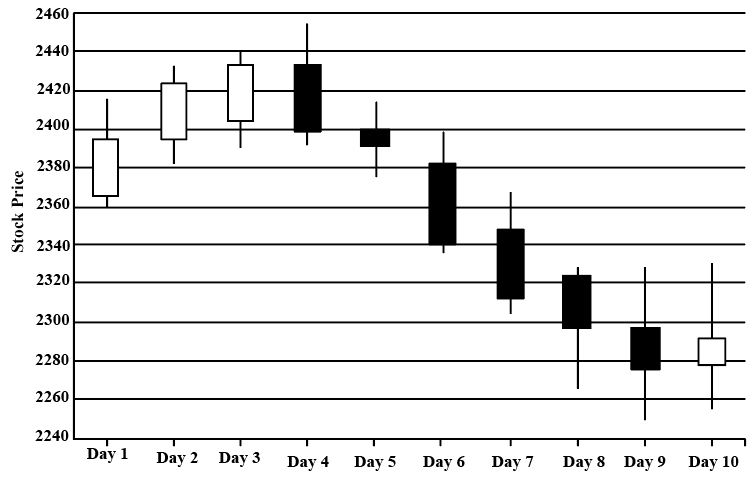
The given candlestick chart depicts the prices of a particular stock over 10 consecutive days. A candlestick comprises of a rectangular box pieced by a line. The top and bottom ends of the line respectively indicate the maximum and minimum prices of the stock on that day, while the horizontal edges of the rectangle correspond to the stock's opening and closing prices. If the rectangle is white, the opening price is lower than the closing price, but if the rectangle is black, then it is the other way around.
Using the above information, answer the questions that follow:
If both the sequences x, a1, a2, y and x, b1, b2, z are in A.P. and it is given that y > x and z < x, then which of the following values can possibly take?
Answer & solution
Correct answer: -3
- A
2
- B
5
-3
- D
1
- E
0
The two given sequences in AP are:
x, a1, a2, y and x, b1, b2, z.
Additionally, it is given that : y > x and z < x.
Hence the common difference is not zero for both the series :
Since y > x the common difference is positive for the first series. (Considering the common difference to be d1)
Similarly z < x the common difference is negative for the given series. (Considering the common difference to be d2)
Now for the given value:
The value of a1 - a2 is negative and b1 - b2 is positive.
Hence the value of takes a negative value.
The only possible option is -3.
The answer is option C.