CAT 2004 — QA Question 22
Composite FunctionsEasy
Passage / Data
Answer the following question based on the information given below.
f1(x) = x 0 ≤ x ≤ 1
= 1 x ≥ 1
= 0 otherwise
f2(x) = f1(–x) for all x
f3(x) = –f2(x) for all x
f4(x) = f3(–x) for all x
How many of the following products are necessarily zero for every x
f1(x)f2(x), f2(x)f3(x), f2(x)f4(x)?
Answer & solution
Correct answer: 2
- A
0
- B
1
2
- D
3
Solution
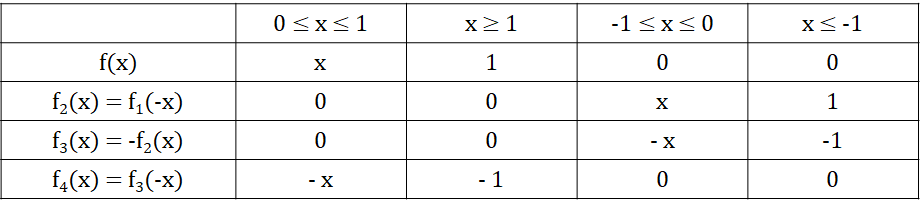
f1(x) = x 0 ≤ x ≤ 1
= 1 x ≥ 1
= 0 –1 ≤ x < 0
= 0 x ≤ –1
The table is written after defining the given function as above.
From the table, only f1(x) × f2(x) and f2(x) × f4(x) are necessarily zero for every x.
Hence, option (c).