Functions & Graphs — CAT Previous-Year Questions
85 previous-year questions on Functions & Graphs from CAT, with full solutions. Practise free — check answers as you go; sign in to save your progress.
Functions & Graphs · CAT PYQs
Let and , where is the greatest integer not exceeding . If set S represents all feasible values of , then a possible subset of S is
Let and . Then, the domain of the function is all real numbers except
For real values of , the range of the function is
Consider two sets A = {2, 3, 5, 7, 11, 13} and B = {1, 8, 27}. Let f be a function from A to B such that for every element b in B, there is at least one element a in A such that f(a) = b. Then, the total number of such function f is
A function f maps the set of natural numbers to whole numbers, such that f(xy) = f(x)f(y) + f(x) + f(y) for all x, y and f(p) = 1 for every prime number p. Then, the value of f(160000) is
For any non-zero real number x, let f(x) + 2f(1/x) = 3x. Then, the sum of all possible values of x for which f(x) = 3, is
Suppose f(x, y) is a real-valued function such that f(3x + 2y, 2x - 5y) = 19x, for all real numbers x and y. The value of x for which f(x, 2x) = 27, is
For any real number x, let [x] be the largest integer less than or equal to x. If = 25, then N is
Suppose for all integers x, there are two functions f and g such that f(x) + f(x - 1) - 1 = 0 and g(x) = x2. If f(x2 - x) = 5, then the value of the sum f(g(5)) + g(f(5)) is
Let r be a real number and f(x) = Then, the equation f(x) = f(f(x)) holds for all real values of x where
f(x) = is negative if and only if
If f(x) = x2 – 7x and g(x) = x + 3, then the minimum value of f(g(x)) – 3x is
Among 100 students, x1 have birthdays in January, x2 have birthdays in February, and so on. If x0 = max(x1, x2, …., x12), then the smallest possible value of x0 is
If f(5 + x) = f(5 - x) for every real x, and f(x) = 0 has four distinct real roots, then the sum of these roots is
The area of the region satisfying the inequalities |x| - y ≤ 1, y ≥ 0 and y ≤ 1 is
Let f(x) = x² + ax + b and g(x) = f(x + 1) – f(x – 1). If f(x) ≥ 0 for all real x, and g(20) = 72, then the smallest possible value of b is
If f(x + y) = f(x)f(y) and f(5) = 4, then f(10) – f(-10) is equal to
For any positive integer n, let f(n) = n(n + 1) if n is even, and f(n) = n + 3 if n is odd. If m is a positive integer such that 8 f(m + 1) − f(m) = 2, then m equals
Consider a function f satisfying f(x + y) = f(x) f(y) where x, y are positive integers and f(1) = 2. If f(a + 1) + f(a + 2) +…+ f(a + n) = 16(2n – 1) then a is equal to
Let f be a function such that f(mn) = f(m) × f(n) for every positive integers m and n. If f(1), f(2) and f(3) are positive integers, f(1) < f(2), and f(24) = 54, then f(18) equals
If f(x + 2) = f(x) + f(x + 1) for all positive integers x, and f(11) = 91, f(15) = 617, then f(10) equals
Let f(x) = min {2x2, 52 − 5x}, where x is any positive real number. Then the maximum possible value of f(x) is
Let f(x) = max {5x, 52 – 2x2}, where x is any positive real number. Then the minimum possible value of f(x) is
The shortest distance of the point (1/2,1) from the curve y = |x - 1| + |x + 1| is
If f(x) = (5x+2)/(3x-5) and g(x) = x2 – 2x – 1, then the value of g(f(f(3))) is:
Let f(x) = x2 and g(x) = 2x, for all real x. Then the value of f(f(g(x)) + g(f(x))) at x = 1 is
If f(ab) = f(a)f(b) for all positive integers a and b, then the largest possible value of f(1) is
Let f(x) = 2x – 5 and g(x) = 7 – 2x. Then |f(x) + g(x)| = |f(x)| + |g(x)| if and only if
Let f(x) be a function satisfying f(x) × f(y) = f(xy) for all real x, y. Let f(2) = 4, then what is the value of
A function f(x) satisfies f(1) = 3600, and f(1) + f(2) + ... + f(n) = n²f(n), for all positive integers n > 1. What is the value of f(9)?
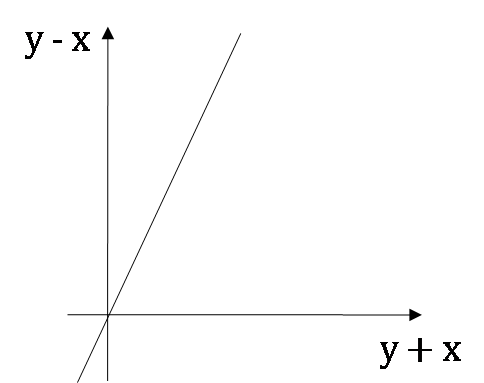
The graph of y – x against y + x is as shown below. (All graphs in this question are drawn to scale and the same scale has been used on each axis). Then, which of the options given shows the graph of y against x.
Let f(x) = max (2x + 1, 3 − 4x), where x is any real number. Then the minimum possible value of f(x) is:
In the X-Y plane, the area of the region bounded by the graph of |x + y| + |x – y| = 4 is
Let g(x) be a function such that g(x + 1) + g(x – 1) = g(x) for every real x. Then for what value of p is the relation g(x + p) = g(x) necessarily true for every real x?
Let f(x) = ax2 – b|x|, where a and b are constants. Then at x = 0, f(x) is
Passage / Data
Answer the following question based on the information given below.
f1(x) = x 0 ≤ x ≤ 1
= 1 x ≥ 1
= 0 otherwise
f2(x) = f1(–x) for all x
f3(x) = –f2(x) for all x
f4(x) = f3(–x) for all x
How many of the following products are necessarily zero for every x
f1(x)f2(x), f2(x)f3(x), f2(x)f4(x)?
Passage / Data
Answer the following question based on the information given below.
f1(x) = x 0 ≤ x ≤ 1
= 1 x ≥ 1
= 0 otherwise
f2(x) = f1(–x) for all x
f3(x) = –f2(x) for all x
f4(x) = f3(–x) for all x
Which of the following is necessarily true?
The number of non-negative real roots of 2x – x – 1 = 0 equals
When the curves, y = log10 x and y = x−1 are drawn in the X-Y plane, how many times do they intersect for values of x ≥ 1?
Let g(x) = max(5 − x, x + 2). The smallest possible value of g(x) is
The function f(x) = |x − 2| + |2.5 − x| + |3.6 − x|, where x is a real number, attains a minimum at
Consider the following two curves in the X-Y plane
y = x3 + x2 + 5
y = x2 + x + 5
Which of the following statements is true for −2 ≤ x ≤ 2?
If then f(x) + f(y) =
Suppose, for any real number x, [x] denotes the greatest integer less than or equal to x. Let L(x, y) = [x] + [y] + [x + y] and R(x, y) = [2x] + [2y]. Then it’s impossible to find any two positive real numbers x and y for which of the following?
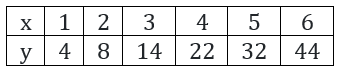
In the above table, for suitably chosen constants a, b and c, which one of the following best describes the relation between y and x?
Passage / Data
Answer the following question based on the information given below.
For real numbers x, y, let
f(x, y) = Positive square-root of (x + y), if (x + y)0.5 is real
= (x + y)2, otherwise
g(x, y) = (x + y)2, if (x + y)0.5 is real
= –(x + y), otherwise
Which of the following expressions yields a positive value for every pair of non-zero real number (x, y)?
Passage / Data
Answer the following question based on the information given below.
For real numbers x, y, let
f(x, y) = Positive square-root of (x + y), if (x + y)0.5 is real
= (x + y)2, otherwise
g(x, y) = (x + y)2, if (x + y)0.5 is real
= –(x + y), otherwise
Under which of the following conditions is f(x, y) necessarily greater than g(x, y)?
Passage / Data
Answer the following question based on the information given below.
For three distinct positive real numbers x, y and z, let
f(x, y, z) = min(max(x, y), max(y, z), max(z, x))
g(x, y, z) = max(min(x, y), min(y, z), min(z, x))
h(x, y, z) = max(max(x, y), max(y, z), max(z, x))
j(x, y, z) = min(min(x, y), min(y, z), min(z, x))
m(x, y, z) = max(x, y, z)
n(x, y, z) = min(x, y, z)
Which of the following expressions is necessarily equal to 1?
Passage / Data
Answer the following question based on the information given below.
For three distinct positive real numbers x, y and z, let
f(x, y, z) = min(max(x, y), max(y, z), max(z, x))
g(x, y, z) = max(min(x, y), min(y, z), min(z, x))
h(x, y, z) = max(max(x, y), max(y, z), max(z, x))
j(x, y, z) = min(min(x, y), min(y, z), min(z, x))
m(x, y, z) = max(x, y, z)
n(x, y, z) = min(x, y, z)
Which of the following expressions is indeterminate?
Passage / Data
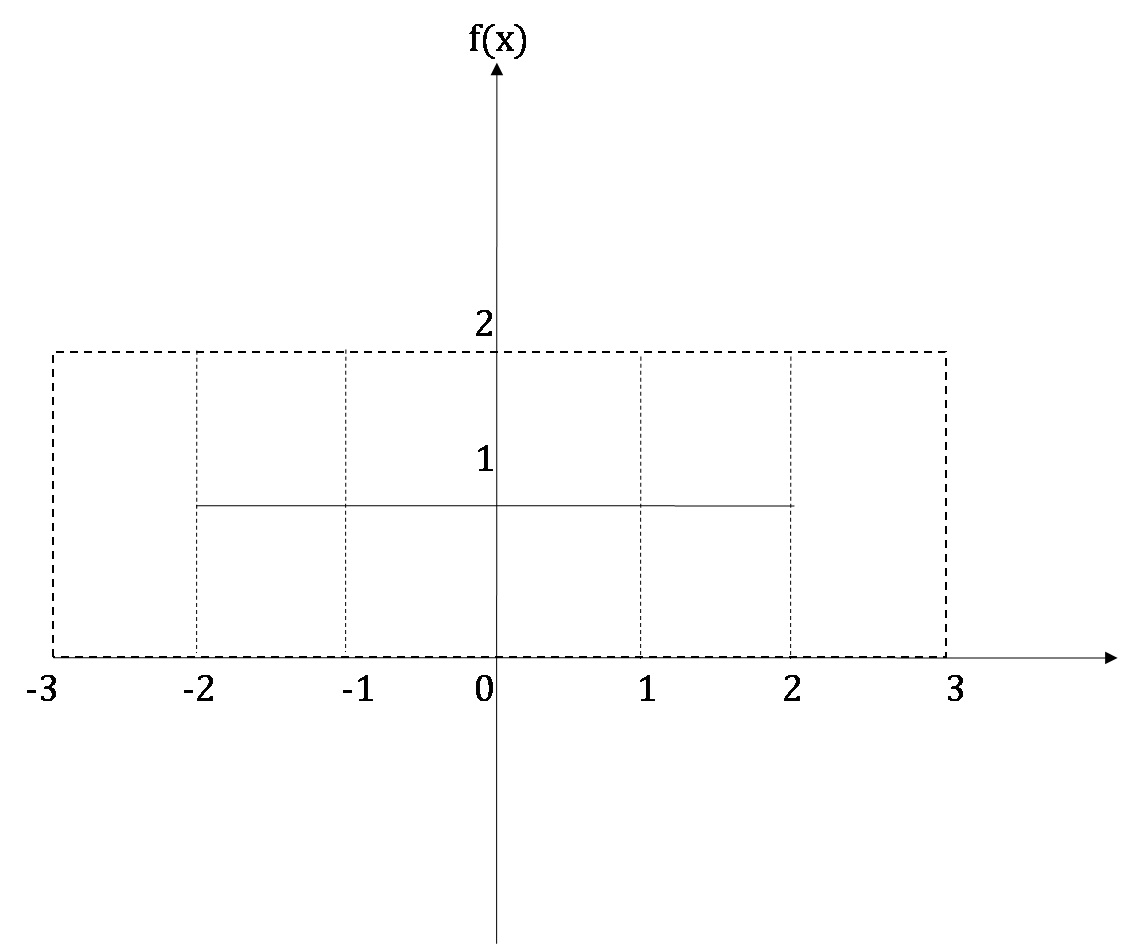
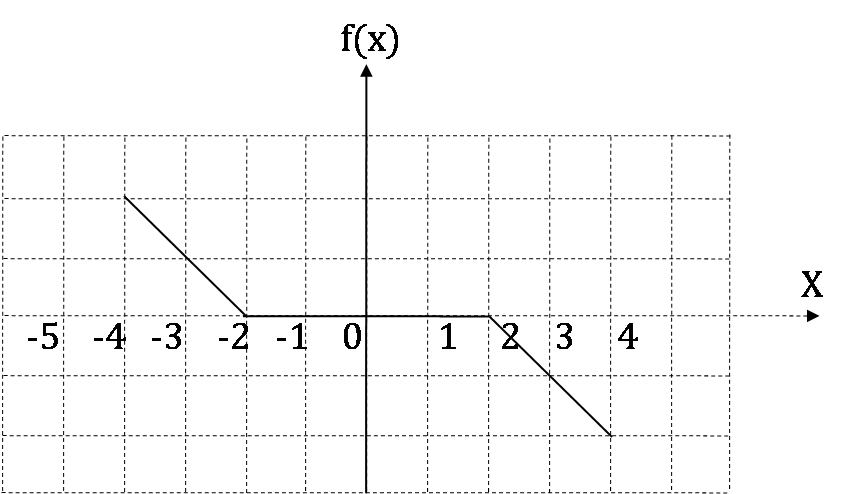
Given below are three graphs made up of straight-line segments shown as thick lines. In each case choose the answer as
1. if f(x) = 3 f(–x);
2. if f(x) = –f(–x);
3. if f(x) = f(–x); and
4. if 3 f(x) = 6 f(–x), for x ≥ 0.
Passage / Data
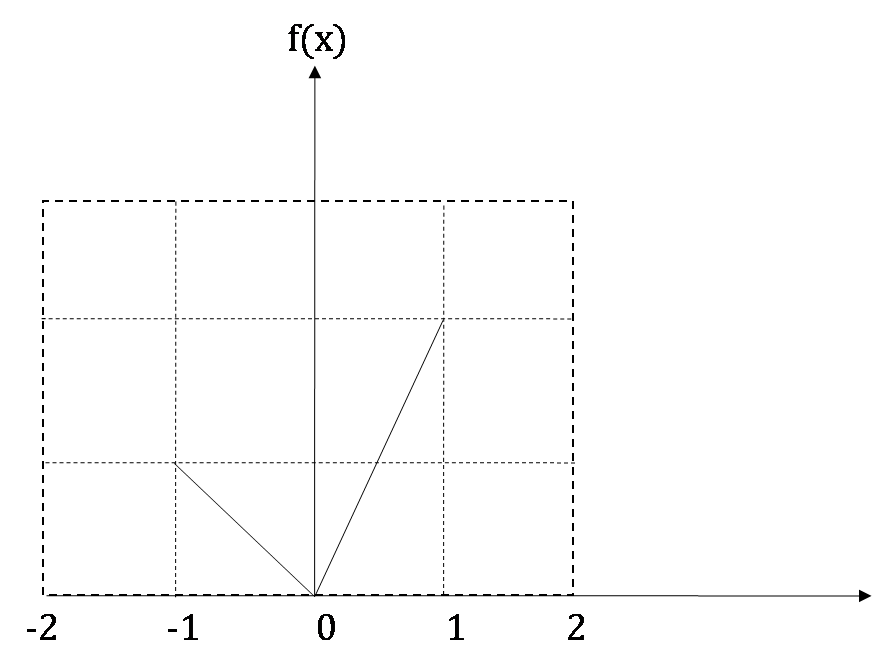
Given below are three graphs made up of straight-line segments shown as thick lines. In each case choose the answer as
1. if f(x) = 3 f(–x);
2. if f(x) = –f(–x);
3. if f(x) = f(–x); and
4. if 3 f(x) = 6 f(–x), for x ≥ 0.
Passage / Data
Given below are three graphs made up of straight-line segments shown as thick lines. In each case choose the answer as
1. if f(x) = 3 f(–x);
2. if f(x) = –f(–x);
3. if f(x) = f(–x); and
4. if 3 f(x) = 6 f(–x), for x ≥ 0.
Passage / Data
Answer the following question based on the information given below.
For a real number x, let
f(x) = 1/(1 + x), if x is non-negative
= 1+ x, if x is negative
f n(x) = f(f n – 1(x)), n = 2, 3, ....
What is the value of the product, f(2)f2(2)f3(2)f4(2)f5(2)?
Passage / Data
Answer the following question based on the information given below.
For a real number x, let
f(x) = 1/(1 + x), if x is non-negative
= 1+ x, if x is negative
f n(x) = f(f n – 1(x)), n = 2, 3, ....
r is an integer > 2. Then, what is the value of f r – 1(–r) + f r(–r)+ f r + 1 (–r)?
The set of all positive integers is the union of two disjoint subsets
{f(1), f(2) ....f(n),......} and {g(1), g(2),......,g(n),......}, where
f (1) < f(2) <...< f(n) ....., and g(1) < g(2) <...< g(n) ......., and
g(n) = f(f(n)) + 1 for all n ≥ 1.
What is the value of g(1)?
For all non-negative integers x and y, f(x, y) is defined as below
f(0, y) = y + 1
f(x + 1, 0) = f(x, 1)
f(x + 1,y + 1) = f(x, f(x + 1, y))
Then, what is the value of f(1, 2)?
Passage / Data
Answer the next 4 questions based on the following information.
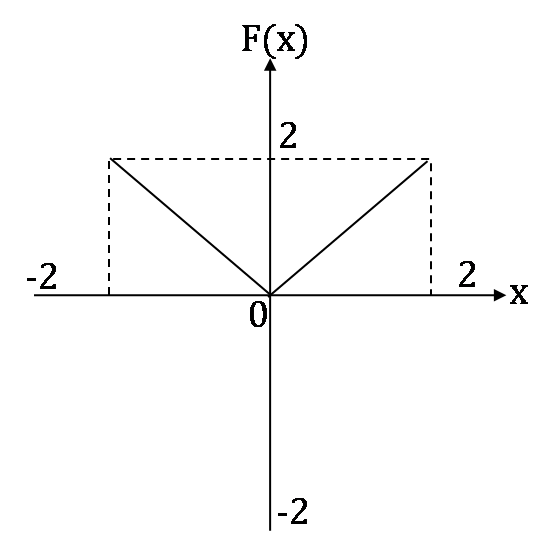
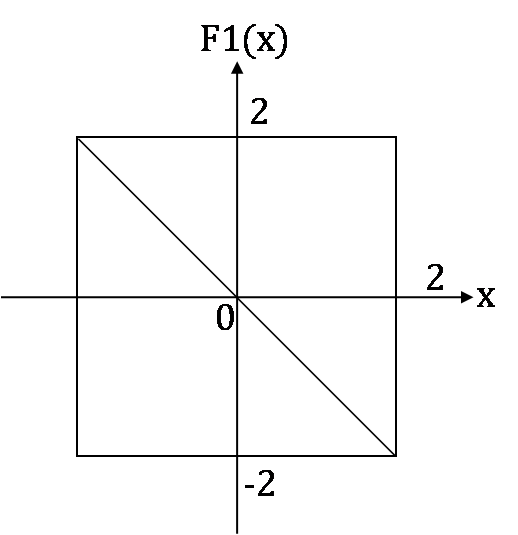
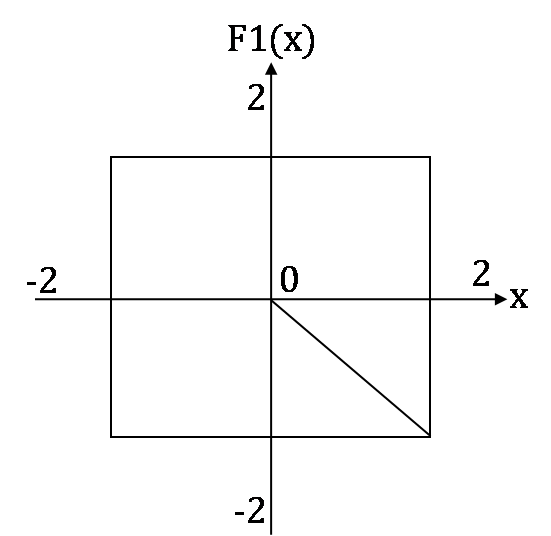
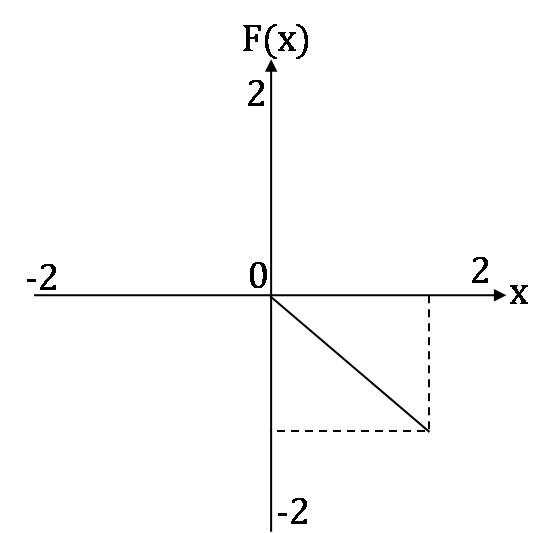
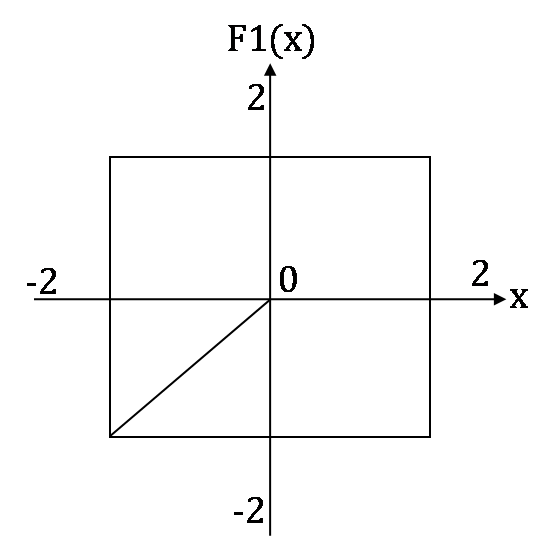
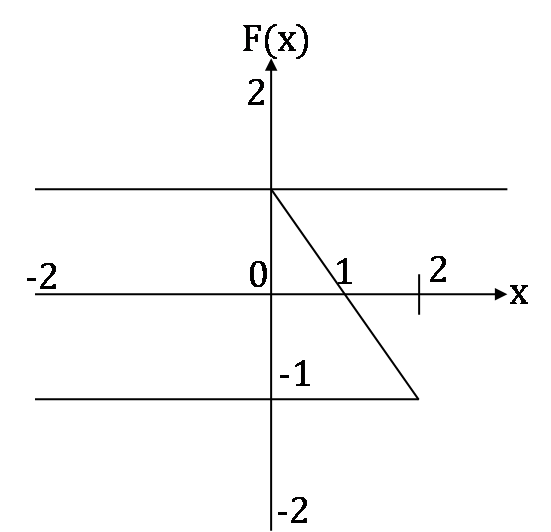
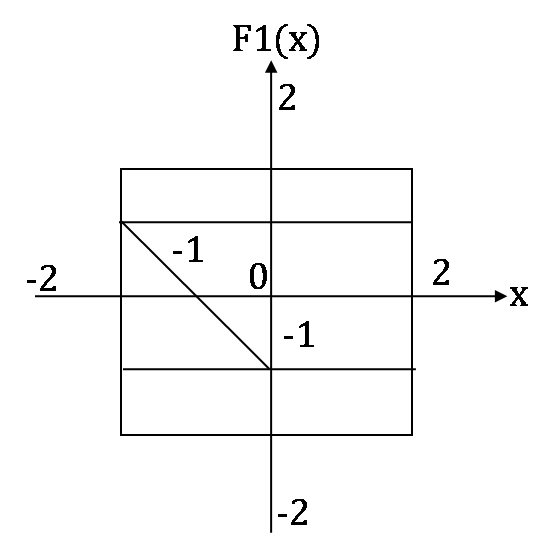
In each of the following questions, a pair of graphs F(x) and F1(x) is given. These are composed of straightline segments, shown as solid lines, in the domain x ∈ (−2, 2).
Choose the answer as
a. if F1(x) = –F(x)
b. if F1(x) = F(–x)
c. if F1(x) = –F(–x)
d. if none of the above is true
Passage / Data
Answer the next 4 questions based on the following information.
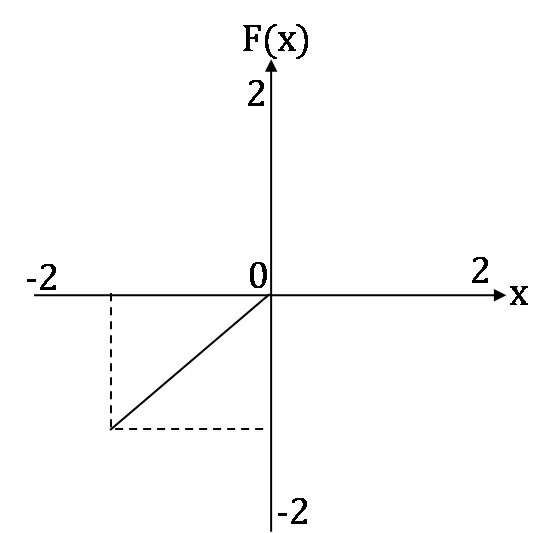
In each of the following questions, a pair of graphs F(x) and F1(x) is given. These are composed of straightline segments, shown as solid lines, in the domain x ∈ (−2, 2).
Choose the answer as
a. if F1(x) = –F(x)
b. if F1(x) = F(–x)
c. if F1(x) = –F(–x)
d. if none of the above is true
Passage / Data
Answer the next 4 questions based on the following information.
In each of the following questions, a pair of graphs F(x) and F1(x) is given. These are composed of straightline segments, shown as solid lines, in the domain x ∈ (−2, 2).
Choose the answer as
a. if F1(x) = –F(x)
b. if F1(x) = F(–x)
c. if F1(x) = –F(–x)
d. if none of the above is true
Passage / Data
Answer the next 4 questions based on the following information.
In each of the following questions, a pair of graphs F(x) and F1(x) is given. These are composed of straightline segments, shown as solid lines, in the domain x ∈ (−2, 2).
Choose the answer as
a. if F1(x) = –F(x)
b. if F1(x) = F(–x)
c. if F1(x) = –F(–x)
d. if none of the above is true
Passage / Data
Directions: Answer the questions based on the following information.
Let x and y be real numbers and let
f (x,y) = |x + y| , F(f (x,y)) = −f (x,y)
and G(f (x, y)) = −F(f (x, y))
Which of the following statements is true?
Passage / Data
Directions: Answer the questions based on the following information.
Let x and y be real numbers and let
f (x,y) = |x + y| , F(f (x,y)) = −f (x,y)
and G(f (x, y)) = −F(f (x, y))
What is the value of f(G(f(1, 0)), f(F(f(1, 2)), G(f(1, 2))))?
Passage / Data
Directions: Answer the questions based on the following information.
Let x and y be real numbers and let
f (x,y) = |x + y| , F(f (x,y)) = −f (x,y)
and G(f (x, y)) = −F(f (x, y))
Which of the following expressions yields x2 as its result?
Passage / Data
Direction: Answer the questions based on the following information.
For these questions the following functions have been defined.
la(x, y, z) = min(x + y, y + z)
le(x, y, z) = max (x − y, y − z)
ma(x, y, z) = [le(x, y, z) + la(x, y, z)]
Given that x > y > z > 0. Which of the following is necessarily true?
Passage / Data
Direction: Answer the questions based on the following information.
For these questions the following functions have been defined.
la(x, y, z) = min(x + y, y + z)
le(x, y, z) = max (x − y, y − z)
ma(x, y, z) = [le(x, y, z) + la(x, y, z)]
What is the value of ma(10, 4, le(la(10, 5, 3), 5, 3))?
Passage / Data
Direction: Answer the questions based on the following information.
For these questions the following functions have been defined.
la(x, y, z) = min(x + y, y + z)
le(x, y, z) = max (x − y, y − z)
ma(x, y, z) = [le(x, y, z) + la(x, y, z)]
For x = 15, y = 10 and z = 9 , find the value of le(x, min(y, x − z), le (9, 8, ma(x, y, z))).
Passage / Data
Direction: Answer the questions based on the following information.
A, S, M and D are functions of x and y, and they are defined as follows.
A(x, y) = x + y
S(x, y) = x – y
M(x, y) = xy
D(x, y) = , y ≠ 0
What is the value of M(M(A(M(x, y), S(y, x)), x), A(y, x)) for x = 2, y = 3?
Passage / Data
Direction: Answer the questions based on the following information.
A, S, M and D are functions of x and y, and they are defined as follows.
A(x, y) = x + y
S(x, y) = x – y
M(x, y) = xy
D(x, y) = , y ≠ 0
What is the value of S[M(D(A(a, b), 2), D(A(a, b), 2)), M(D(S(a, b), 2), D(S(a, b), 2))]?
Largest value of min(2 + x2, 6 – 3x), when x > 0, is
Passage / Data
Directions for next 4 questions: Answer the questions based on the following information.
le(x, y) = Least of (x, y)
mo(x) = |x|
me(x, y) = Maximum of (x, y)
Find the value of me(a + mo(le(a, b)); mo(a + me(mo(a), mo(b))), at a = –2 and b = –3.
Passage / Data
Directions for next 4 questions: Answer the questions based on the following information.
le(x, y) = Least of (x, y)
mo(x) = |x|
me(x, y) = Maximum of (x, y)
Which of the following must always be correct for a, b > 0?
Passage / Data
Directions for next 4 questions: Answer the questions based on the following information.
le(x, y) = Least of (x, y)
mo(x) = |x|
me(x, y) = Maximum of (x, y)
For what values of ‘a’ is me(a2 – 3a, a – 3) < 0?
Passage / Data
Directions for next 4 questions: Answer the questions based on the following information.
le(x, y) = Least of (x, y)
mo(x) = |x|
me(x, y) = Maximum of (x, y)
For what values of ‘a’ is le(a2 – 3a, a – 3) < 0?
Passage / Data
Answer the next 2 questions based on the following information:
If
md(x) = x ,
mn(x,y) = minimum of x and y and
Ma(a,b,c,...) = maximum of a,b,c…
Value of Ma[md(a),mn(md(b),a),mn(ab,md(ac))] where a = -2, b = -3, c = 4 is
Passage / Data
Answer the next 2 questions based on the following information:
If
md(x) = x ,
mn(x,y) = minimum of x and y and
Ma(a,b,c,...) = maximum of a,b,c…
Given that a > b then the relation Ma[md(a), mn(a,b)] = mn[a, md(Ma(a,b))] does not hold if
Passage / Data
Answer the next 4 questions based on the information given below:
If f (x) = 2x + 3 and g(x) = then
fog(x) is equal to
Passage / Data
Answer the next 4 questions based on the information given below:
If f (x) = 2x + 3 and g(x) = then
For what value of x; f (x) = g(x −3)?
Passage / Data
Answer the next 4 questions based on the information given below:
If f (x) = 2x + 3 and g(x) = then
What is the value of (gofofogogof)(x) × (fogofog)(x)?
Passage / Data
Answer the next 4 questions based on the information given below:
If f (x) = 2x + 3 and g(x) = then
What is the value of fo(fog)o(gof)(x)?
Passage / Data
Answer the next 2 questions based on the information given below:
A function f(x) is said to be even if f(–x) = f(x), and odd if f(–x) = –f(x). Thus, for example, the function given by f(x) = x2 is even, while the function given by f(x) = x3 is odd. Using this definition, answer the following questions.
The function given by f(x) = |x|3 is
Passage / Data
Answer the next 2 questions based on the information given below:
A function f(x) is said to be even if f(–x) = f(x), and odd if f(–x) = –f(x). Thus, for example, the function given by f(x) = x2 is even, while the function given by f(x) = x3 is odd. Using this definition, answer the following questions.
The sum of two odd functions
The maximum possible value of y = min (1/2 – 3x2/4, 5x2/4) for the range 0 < x < 1 is
A function can sometimes reflect on itself, i.e. if y = f(x), then x = f(y). Both of them retain the same structure and form. Which of the following functions has this property?
If y = f(x) and f(x) = , which of the following is true?
Let Y = minimum of {(x + 2), (3 – x)}. What is the maximum value of Y for 0 ≤ x ≤ 1?