CAT 2023 Slot 2 — DILR Question 16
Answer the following questions based on the information given below:
There are nine boxes arranged in a 3×3 array as shown in Tables 1 and 2. Each box contains three sacks. Each sack has a certain number of coins, between 1 and 9, both inclusive.
The average number of coins per sack in the boxes are all distinct integers. The total number of coins in each row is the same. The total number of coins in each column is also the same.
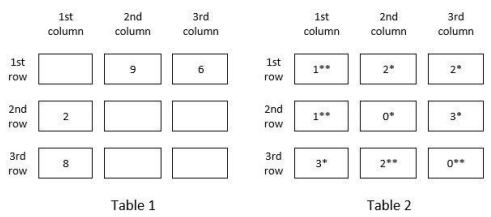
Table 1 gives information regarding the median of the numbers of coins in the three sacks in a box for some of the boxes. In Table 2 each box has a number which represents the number of sacks in that box having more than 5 coins. That number is followed by a * if the sacks in that box satisfy exactly one among the following three conditions, and it is followed by ** if two or more of these conditions are satisfied.
- The minimum among the numbers of coins in the three sacks in the box is 1.
- The median of the numbers of coins in the three sacks is 1.
- The maximum among the numbers of coins in the three sacks in the box is 9.
What is the total number of coins in all the boxes in the 3rd row?
Answer & solution
Correct answer: 45
- A
36
- B
30
- C
15
45
Easy
This is one logic puzzle that powers all five questions — so we crack the whole grid once, then just read answers off it. Each box holds three sacks; write each box's three sack-counts in ascending order. Table 1 fixes the middle value (median) of four boxes; Table 2's number is "how many sacks hold coins", and its / flag tells us how many of the three conditions hold. Layer on "all averages are distinct integers" and "every row-total = every column-total" to nail every sack.
The two given tables (transcribed):
Table 1 — median of the three sacks (blank = unknown):
| Col 1 | Col 2 | Col 3 | |
|---|---|---|---|
| Row 1 | — | 9 | 6 |
| Row 2 | 2 | — | — |
| Row 3 | 8 | — | — |
Table 2 — count of sacks with coins, plus condition flag ( = exactly one of the three conditions holds, = two or more hold):
| Col 1 | Col 2 | Col 3 | |
|---|---|---|---|
| Row 1 | |||
| Row 2 | |||
| Row 3 |
The three conditions: (i) min sack ; (ii) median ; (iii) max sack .
Use medians + the count to fix the "easy" boxes. Write each box as (low, median, high).
C2R1: median high . Table 2 says exactly sacks , so high two are ; flag means exactly one condition (here max ). The low sack is and the total must be a multiple of : gives average . So .
C2R3: median rules out condition (ii); flag but with sacks we get conditions (i) and (iii): low , high . Middle with integer average . So , average .
C1R3: sacks kills (i) and (ii); flag only (iii): high . With median and integer average and low : , average . So .
The "double-flag" () boxes need two conditions.
C1R2: median , so condition (ii) fails; with sack , two conditions (i)&(iii): low , high . So , average .
C2R2: sacks kills (iii); median would satisfy two conditions but flag is (exactly one), so only (i) holds: low , all . Resolved below to , average .
C1R1: sack , flag and integer average either or .
Break the C1R1 tie with the equal-column rule. Every column sums to the same total.
If C1R1 (sum ): C1 , forcing C2R2 — impossible ( each, sacks ). So C1R1 (sum ): column total , and C2R2 , i.e. its other two sacks total with min . Confirmed.
Finish Column 3 with the distinct-average rule. Averages so far: — used .
C3R3: sacks and (i)&(ii): low median ; third sack must keep the average integer and distinct, giving , average .
C3R1 & C3R2 must take the two leftover averages and . Average needs all sacks (only C3R2 allows it: ). So C3R1 has average , total ; median , one condition: .
The fully solved grid (each box = its three sacks, ascending):
| Col 1 | Col 2 | Col 3 | |
|---|---|---|---|
| Row 1 | 1, 1, 7 | 3, 9, 9 | 1, 6, 8 |
| Row 2 | 1, 2, 9 | 1, 2, 3 | 9, 9, 9 |
| Row 3 | 7, 8, 9 | 1, 8, 9 | 1, 1, 1 |
Check: every row and every column sums to . ✓
Answer this question — total coins in the 3rd row:
Related Mixed Practice questions
- If the author of the passage were to write a book on the Battle of Hastings alon…
- According to this passage, which one of the following statements best describes …
- All of the following, if true, can weaken the passage’s claim that facts d…
- All of the following describe the “common-sense view” of history, EX…
- Based only on information provided in the passage, which one of the following hy…
- The author sees the rise of Netflix in Europe as:…