CAT 2024 Slot 3 — DILR Question 10
Answer the following questions based on the information given below.
The figure below shows a network with three parallel roads represented by horizontal lines R-A, R-B, and R-C and another three parallel roads represented by vertical lines V1, V2, and V3. The figure also shows the distance (in km) between two adjacent intersections. Six ATMs are placed at six of the nine road intersections. Each ATM has a distinct integer cash requirement (in Rs. Lakhs), and the numbers at the end of each line in the figure indicate the total cash requirements of all ATMs placed on the corresponding road. For example, the total cash requirement of the ATM(s) placed on road R-A is Rs. 22 Lakhs.
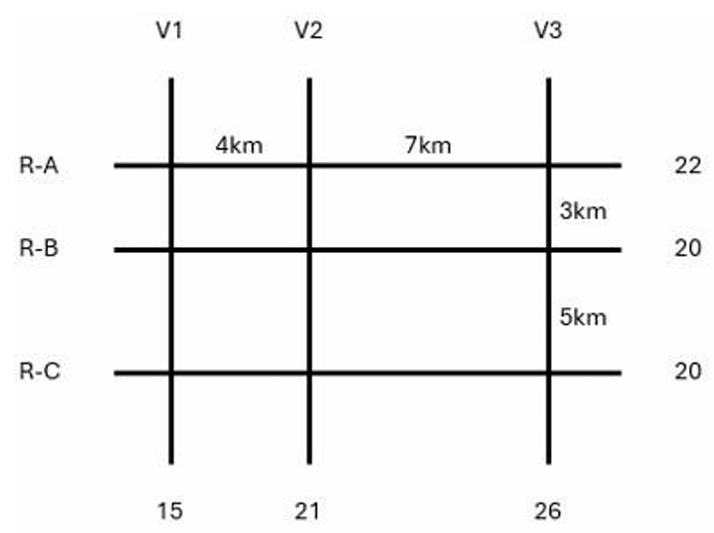
| Road / total (Rs. Lakhs) | V1 | V2 | V3 | Row total |
|---|---|---|---|---|
| R-A | · | · | · | 22 |
| R-B | · | · | · | 20 |
| R-C | · | · | · | 20 |
| Column total | 15 | 21 | 26 | 62 |
Distances between adjacent intersections (in km): along R-A, V1–V2 = 4 km and V2–V3 = 7 km; along V3, R-A–R-B = 3 km and R-B–R-C = 5 km.
The following additional information is known.
1. The ATMs with the minimum and maximum cash requirements of Rs. 7 Lakhs and Rs. 15 Lakhs are placed on the same road.
2. The road distance between the ATM with the second highest cash requirement and the ATM located at the intersection of R-C and V3 is 12 km.
Which of the following statements is correct?
Answer & solution
Correct answer: The ATM placed at the (R-C, V2) intersection has a cash requirement of Rs. 9 Lakhs.
- A
The cash requirement of the ATM placed at the (R-C, V2) intersection cannot be uniquely determined.
- B
The ATM placed at the (R-C, V2) intersection has a cash requirement of Rs. 8 Lakhs.
The ATM placed at the (R-C, V2) intersection has a cash requirement of Rs. 9 Lakhs.
- D
There is no ATM placed at the (R-C, V2) intersection.
Hard
Min (7) + max (15) = 22 = the R-A total, so R-A must hold exactly those two. The other four values split into row sums of 20, and Fact 2 pins the second-highest value to (R-B, V2).
Row totals R-A=22, R-B=20, R-C=20; column totals V1=15, V2=21, V3=26 (grand total 62). Six distinct integers, two per row. Coordinates (km): V1=0, V2=4, V3=11; R-A=0, R-B=3, R-C=8.
Road distance to (R-C,V3)=(11,8) equals 12 only at (R-B,V2)=(4,3): .
Fix the value sets. Only places min & max together (Fact 1), so they sit on R-A. The leftover four distinct values (8–14) form two pairs each summing 20.
Place the second-highest value. Sorted, the values give second-highest , which Fact 2 fixes at (R-B,V2); hence R-B and R-C .
Use column V2 = 21. The only way to add to from the remaining values is (from R-C), so (R-C,V2) and R-A has no ATM in V2.
The ATM at the (R-C, V2) intersection has a cash requirement of Rs. 9 Lakhs.
Related Mixed Practice questions
- The author’s overall tone in the first paragraph can be described as…
- The author is unlikely to disagree with any of the following EXCEPT:…
- The contrasting reactions to the Chinese and Israeli “contaminations&rdquo…
- The author mentions all of the following reasons to dismiss concerns about conta…
- Which one of the following is both a reason for Moutai’s success as well a…
- In the context of the passage we can infer that to succeed in the liquor industr…