Logical Reasoning — CAT Previous-Year Questions
651 previous-year questions on Logical Reasoning from CAT, with full solutions. Practise free — check answers as you go; sign in to save your progress.
Logical Reasoning · CAT PYQs
Passage / Data
A train travels from Station A to Station E, passing through stations B, C, and D, in that order. The train has a seating capacity of 200. A ticket may be booked from any station to any other station ahead on the route, but not to any earlier station.
A ticket from one station to another reserves one seat on every intermediate segment of the route. For example, a ticket from B to E reserves a seat in the intermediate segments B – C, C – D, and D – E.
The occupancy factor for a segment is the total number of seats reserved in the segment as a percentage of the seating capacity. The total number of seats reserved for any segment cannot exceed 200.
The following information is known.
1. Segment C – D had an occupancy factor of 95%. Only segment B – C had a higher occupancy factor.
2. Exactly 40 tickets were booked from B to C and 30 tickets were booked from B to E.
3. Among the seats reserved on segment D – E, exactly four-sevenths were from stations before C.
4. The number of tickets booked from A to C was equal to that booked from A to E, and it was higher than that from B to E.
5. No tickets were booked from A to B, from B to D and from D to E.
6. The number of tickets booked for any segment was a multiple of 10.
What was the occupancy factor for segment D – E?
Passage / Data
A train travels from Station A to Station E, passing through stations B, C, and D, in that order. The train has a seating capacity of 200. A ticket may be booked from any station to any other station ahead on the route, but not to any earlier station.
A ticket from one station to another reserves one seat on every intermediate segment of the route. For example, a ticket from B to E reserves a seat in the intermediate segments B – C, C – D, and D – E.
The occupancy factor for a segment is the total number of seats reserved in the segment as a percentage of the seating capacity. The total number of seats reserved for any segment cannot exceed 200.
The following information is known.
1. Segment C – D had an occupancy factor of 95%. Only segment B – C had a higher occupancy factor.
2. Exactly 40 tickets were booked from B to C and 30 tickets were booked from B to E.
3. Among the seats reserved on segment D – E, exactly four-sevenths were from stations before C.
4. The number of tickets booked from A to C was equal to that booked from A to E, and it was higher than that from B to E.
5. No tickets were booked from A to B, from B to D and from D to E.
6. The number of tickets booked for any segment was a multiple of 10.
How many tickets were booked from Station A to Station E?
Passage / Data
A train travels from Station A to Station E, passing through stations B, C, and D, in that order. The train has a seating capacity of 200. A ticket may be booked from any station to any other station ahead on the route, but not to any earlier station.
A ticket from one station to another reserves one seat on every intermediate segment of the route. For example, a ticket from B to E reserves a seat in the intermediate segments B – C, C – D, and D – E.
The occupancy factor for a segment is the total number of seats reserved in the segment as a percentage of the seating capacity. The total number of seats reserved for any segment cannot exceed 200.
The following information is known.
1. Segment C – D had an occupancy factor of 95%. Only segment B – C had a higher occupancy factor.
2. Exactly 40 tickets were booked from B to C and 30 tickets were booked from B to E.
3. Among the seats reserved on segment D – E, exactly four-sevenths were from stations before C.
4. The number of tickets booked from A to C was equal to that booked from A to E, and it was higher than that from B to E.
5. No tickets were booked from A to B, from B to D and from D to E.
6. The number of tickets booked for any segment was a multiple of 10.
How many tickets were booked from Station C?
Passage / Data
A train travels from Station A to Station E, passing through stations B, C, and D, in that order. The train has a seating capacity of 200. A ticket may be booked from any station to any other station ahead on the route, but not to any earlier station.
A ticket from one station to another reserves one seat on every intermediate segment of the route. For example, a ticket from B to E reserves a seat in the intermediate segments B – C, C – D, and D – E.
The occupancy factor for a segment is the total number of seats reserved in the segment as a percentage of the seating capacity. The total number of seats reserved for any segment cannot exceed 200.
The following information is known.
1. Segment C – D had an occupancy factor of 95%. Only segment B – C had a higher occupancy factor.
2. Exactly 40 tickets were booked from B to C and 30 tickets were booked from B to E.
3. Among the seats reserved on segment D – E, exactly four-sevenths were from stations before C.
4. The number of tickets booked from A to C was equal to that booked from A to E, and it was higher than that from B to E.
5. No tickets were booked from A to B, from B to D and from D to E.
6. The number of tickets booked for any segment was a multiple of 10.
What is the difference between the number of tickets booked to Station C and the number of tickets booked to Station D?
Passage / Data
A train travels from Station A to Station E, passing through stations B, C, and D, in that order. The train has a seating capacity of 200. A ticket may be booked from any station to any other station ahead on the route, but not to any earlier station.
A ticket from one station to another reserves one seat on every intermediate segment of the route. For example, a ticket from B to E reserves a seat in the intermediate segments B – C, C – D, and D – E.
The occupancy factor for a segment is the total number of seats reserved in the segment as a percentage of the seating capacity. The total number of seats reserved for any segment cannot exceed 200.
The following information is known.
1. Segment C – D had an occupancy factor of 95%. Only segment B – C had a higher occupancy factor.
2. Exactly 40 tickets were booked from B to C and 30 tickets were booked from B to E.
3. Among the seats reserved on segment D – E, exactly four-sevenths were from stations before C.
4. The number of tickets booked from A to C was equal to that booked from A to E, and it was higher than that from B to E.
5. No tickets were booked from A to B, from B to D and from D to E.
6. The number of tickets booked for any segment was a multiple of 10.
How many tickets were booked to travel in exactly one segment?
Passage / Data
At InnovateX, six employees, Asha, Bunty, Chintu, Dolly, Eklavya, and Falguni, were split into two groups of three each: Elite led by Manager Kuku, and Novice led by Manager Lalu.
At the end of each quarter, Kuku and Lalu handed out ratings to all members in their respective groups. In each group, each employee received a distinct integer rating from 1 to 3.
The score for an employee at the end of a quarter is defined as their cumulative rating from the beginning of the year. At the end of each quarter the employee in Novice with the highest score was promoted to Elite, and the employee in Elite with the minimum score was demoted to Novice. If there was a tie in scores, the employee with a higher rating in the latest quarter was ranked higher.
1. Asha, Bunty, and Chintu were in Elite at the beginning of Quarter 1. All of them were in Novice at the beginning of Quarter 4.
2. Dolly and Falguni were the only employees who got the same rating across all the quarters.
3. The following is known about ratings given by Lalu:
• Bunty received a rating of 1 in Quarter 2.
• Asha and Dolly received ratings of 1 and 2, respectively, in Quarter 3.
What was Eklavya's score at the end of Quarter 2?
Passage / Data
At InnovateX, six employees, Asha, Bunty, Chintu, Dolly, Eklavya, and Falguni, were split into two groups of three each: Elite led by Manager Kuku, and Novice led by Manager Lalu.
At the end of each quarter, Kuku and Lalu handed out ratings to all members in their respective groups. In each group, each employee received a distinct integer rating from 1 to 3.
The score for an employee at the end of a quarter is defined as their cumulative rating from the beginning of the year. At the end of each quarter the employee in Novice with the highest score was promoted to Elite, and the employee in Elite with the minimum score was demoted to Novice. If there was a tie in scores, the employee with a higher rating in the latest quarter was ranked higher.
1. Asha, Bunty, and Chintu were in Elite at the beginning of Quarter 1. All of them were in Novice at the beginning of Quarter 4.
2. Dolly and Falguni were the only employees who got the same rating across all the quarters.
3. The following is known about ratings given by Lalu:
• Bunty received a rating of 1 in Quarter 2.
• Asha and Dolly received ratings of 1 and 2, respectively, in Quarter 3.
How many employees changed groups more than once up to the beginning of Quarter 4?
Passage / Data
At InnovateX, six employees, Asha, Bunty, Chintu, Dolly, Eklavya, and Falguni, were split into two groups of three each: Elite led by Manager Kuku, and Novice led by Manager Lalu.
At the end of each quarter, Kuku and Lalu handed out ratings to all members in their respective groups. In each group, each employee received a distinct integer rating from 1 to 3.
The score for an employee at the end of a quarter is defined as their cumulative rating from the beginning of the year. At the end of each quarter the employee in Novice with the highest score was promoted to Elite, and the employee in Elite with the minimum score was demoted to Novice. If there was a tie in scores, the employee with a higher rating in the latest quarter was ranked higher.
1. Asha, Bunty, and Chintu were in Elite at the beginning of Quarter 1. All of them were in Novice at the beginning of Quarter 4.
2. Dolly and Falguni were the only employees who got the same rating across all the quarters.
3. The following is known about ratings given by Lalu:
• Bunty received a rating of 1 in Quarter 2.
• Asha and Dolly received ratings of 1 and 2, respectively, in Quarter 3.
What was Bunty's score at the end of Quarter 3?
Passage / Data
At InnovateX, six employees, Asha, Bunty, Chintu, Dolly, Eklavya, and Falguni, were split into two groups of three each: Elite led by Manager Kuku, and Novice led by Manager Lalu.
At the end of each quarter, Kuku and Lalu handed out ratings to all members in their respective groups. In each group, each employee received a distinct integer rating from 1 to 3.
The score for an employee at the end of a quarter is defined as their cumulative rating from the beginning of the year. At the end of each quarter the employee in Novice with the highest score was promoted to Elite, and the employee in Elite with the minimum score was demoted to Novice. If there was a tie in scores, the employee with a higher rating in the latest quarter was ranked higher.
1. Asha, Bunty, and Chintu were in Elite at the beginning of Quarter 1. All of them were in Novice at the beginning of Quarter 4.
2. Dolly and Falguni were the only employees who got the same rating across all the quarters.
3. The following is known about ratings given by Lalu:
• Bunty received a rating of 1 in Quarter 2.
• Asha and Dolly received ratings of 1 and 2, respectively, in Quarter 3.
For how many employees can the scores at the end of Quarter 3 be determined with certainty?
Passage / Data
At InnovateX, six employees, Asha, Bunty, Chintu, Dolly, Eklavya, and Falguni, were split into two groups of three each: Elite led by Manager Kuku, and Novice led by Manager Lalu.
At the end of each quarter, Kuku and Lalu handed out ratings to all members in their respective groups. In each group, each employee received a distinct integer rating from 1 to 3.
The score for an employee at the end of a quarter is defined as their cumulative rating from the beginning of the year. At the end of each quarter the employee in Novice with the highest score was promoted to Elite, and the employee in Elite with the minimum score was demoted to Novice. If there was a tie in scores, the employee with a higher rating in the latest quarter was ranked higher.
1. Asha, Bunty, and Chintu were in Elite at the beginning of Quarter 1. All of them were in Novice at the beginning of Quarter 4.
2. Dolly and Falguni were the only employees who got the same rating across all the quarters.
3. The following is known about ratings given by Lalu:
• Bunty received a rating of 1 in Quarter 2.
• Asha and Dolly received ratings of 1 and 2, respectively, in Quarter 3.
Which of the following statements is/are NECESSARILY true?
I. Asha received a rating of 2 in Quarter 1.
II. Asha received a rating of 1 in Quarter 2.
Passage / Data
A round table has seven chairs around it. The chairs are numbered 1 through 7 in a clockwise direction. Four friends, Aslam, Bashir, Chhavi, and Davies, sit on four of the chairs. In the starting position, Aslam and Chhavi are sitting next to each other, while for Bashir as well as Davies, there are empty chairs on either side of the chairs that are sitting on.
The friends take turns moving either clockwise or counterclockwise from their chair. The friend who has to move in a turn occupies the first empty chair in whichever direction (s)he chooses to move. Aslam moves first (Turn 1), followed by Bashir, Chhavi, and Davies (Turns 2, 3, and 4, respectively). Then Aslam moves again followed by Bashir, and Chhavi (Turns 5, 6, and 7, respectively).
The following information is known.
1. The four friends occupy adjacent chairs only at the end of Turn 2 and Turn 6.
2. Davies occupies Chair 2 after Turn 1 and Chair 4 after Turn 5, and Chhavi occupies Chair 7 after Turn 2.
What is the number of the chair initially occupied by Bashir?
Passage / Data
A round table has seven chairs around it. The chairs are numbered 1 through 7 in a clockwise direction. Four friends, Aslam, Bashir, Chhavi, and Davies, sit on four of the chairs. In the starting position, Aslam and Chhavi are sitting next to each other, while for Bashir as well as Davies, there are empty chairs on either side of the chairs that are sitting on.
The friends take turns moving either clockwise or counterclockwise from their chair. The friend who has to move in a turn occupies the first empty chair in whichever direction (s)he chooses to move. Aslam moves first (Turn 1), followed by Bashir, Chhavi, and Davies (Turns 2, 3, and 4, respectively). Then Aslam moves again followed by Bashir, and Chhavi (Turns 5, 6, and 7, respectively).
The following information is known.
1. The four friends occupy adjacent chairs only at the end of Turn 2 and Turn 6.
2. Davies occupies Chair 2 after Turn 1 and Chair 4 after Turn 5, and Chhavi occupies Chair 7 after Turn 2.
Who sits on the chair numbered 4 at the end of Turn 3?
Passage / Data
A round table has seven chairs around it. The chairs are numbered 1 through 7 in a clockwise direction. Four friends, Aslam, Bashir, Chhavi, and Davies, sit on four of the chairs. In the starting position, Aslam and Chhavi are sitting next to each other, while for Bashir as well as Davies, there are empty chairs on either side of the chairs that are sitting on.
The friends take turns moving either clockwise or counterclockwise from their chair. The friend who has to move in a turn occupies the first empty chair in whichever direction (s)he chooses to move. Aslam moves first (Turn 1), followed by Bashir, Chhavi, and Davies (Turns 2, 3, and 4, respectively). Then Aslam moves again followed by Bashir, and Chhavi (Turns 5, 6, and 7, respectively).
The following information is known.
1. The four friends occupy adjacent chairs only at the end of Turn 2 and Turn 6.
2. Davies occupies Chair 2 after Turn 1 and Chair 4 after Turn 5, and Chhavi occupies Chair 7 after Turn 2.
Which of the chairs are occupied at the end of Turn 6?
Passage / Data
A round table has seven chairs around it. The chairs are numbered 1 through 7 in a clockwise direction. Four friends, Aslam, Bashir, Chhavi, and Davies, sit on four of the chairs. In the starting position, Aslam and Chhavi are sitting next to each other, while for Bashir as well as Davies, there are empty chairs on either side of the chairs that are sitting on.
The friends take turns moving either clockwise or counterclockwise from their chair. The friend who has to move in a turn occupies the first empty chair in whichever direction (s)he chooses to move. Aslam moves first (Turn 1), followed by Bashir, Chhavi, and Davies (Turns 2, 3, and 4, respectively). Then Aslam moves again followed by Bashir, and Chhavi (Turns 5, 6, and 7, respectively).
The following information is known.
1. The four friends occupy adjacent chairs only at the end of Turn 2 and Turn 6.
2. Davies occupies Chair 2 after Turn 1 and Chair 4 after Turn 5, and Chhavi occupies Chair 7 after Turn 2.
Which of the following BEST describes the friends sitting on chairs adjacent to the one occupied by Bashir at the end of Turn 7?
Passage / Data
Alia, Badal, Clive, Dilshan, and Ehsaan played a game in which each asks a unique question to all the others and they respond by tapping their feet, either once or twice or thrice. One tap means "Yes", two taps mean "No", and three taps mean "Maybe".
A total of 40 taps were heard across the five questions. Each question received at least one "Yes", one "No", and one "Maybe."
The following information is known.
1. Alia tapped a total of 6 times and received 9 taps to her question. She responded "Yes" to the questions asked by both Clive and Dilshan.
2. Dilshan and Ehsaan tapped a total of 11 and 9 times respectively. Dilshan responded "No" to Badal.
3. Badal, Dilshan, and Ehsaan received equal number of taps to their respective questions.
4. No one responded "Yes" more than twice.
5. No one's answer to Alia's question matched the answer that Alia gave to that person's question. This was also true for Ehsaan.
6. Clive tapped more times in total than Badal.
How many taps did Clive receive for his question?
Passage / Data
Alia, Badal, Clive, Dilshan, and Ehsaan played a game in which each asks a unique question to all the others and they respond by tapping their feet, either once or twice or thrice. One tap means "Yes", two taps mean "No", and three taps mean "Maybe".
A total of 40 taps were heard across the five questions. Each question received at least one "Yes", one "No", and one "Maybe."
The following information is known.
1. Alia tapped a total of 6 times and received 9 taps to her question. She responded "Yes" to the questions asked by both Clive and Dilshan.
2. Dilshan and Ehsaan tapped a total of 11 and 9 times respectively. Dilshan responded "No" to Badal.
3. Badal, Dilshan, and Ehsaan received equal number of taps to their respective questions.
4. No one responded "Yes" more than twice.
5. No one's answer to Alia's question matched the answer that Alia gave to that person's question. This was also true for Ehsaan.
6. Clive tapped more times in total than Badal.
Which two people tapped an equal number of times in total?
Passage / Data
Alia, Badal, Clive, Dilshan, and Ehsaan played a game in which each asks a unique question to all the others and they respond by tapping their feet, either once or twice or thrice. One tap means "Yes", two taps mean "No", and three taps mean "Maybe".
A total of 40 taps were heard across the five questions. Each question received at least one "Yes", one "No", and one "Maybe."
The following information is known.
1. Alia tapped a total of 6 times and received 9 taps to her question. She responded "Yes" to the questions asked by both Clive and Dilshan.
2. Dilshan and Ehsaan tapped a total of 11 and 9 times respectively. Dilshan responded "No" to Badal.
3. Badal, Dilshan, and Ehsaan received equal number of taps to their respective questions.
4. No one responded "Yes" more than twice.
5. No one's answer to Alia's question matched the answer that Alia gave to that person's question. This was also true for Ehsaan.
6. Clive tapped more times in total than Badal.
What was Clive's response to Ehsaan's question?
Passage / Data
Alia, Badal, Clive, Dilshan, and Ehsaan played a game in which each asks a unique question to all the others and they respond by tapping their feet, either once or twice or thrice. One tap means "Yes", two taps mean "No", and three taps mean "Maybe".
A total of 40 taps were heard across the five questions. Each question received at least one "Yes", one "No", and one "Maybe."
The following information is known.
1. Alia tapped a total of 6 times and received 9 taps to her question. She responded "Yes" to the questions asked by both Clive and Dilshan.
2. Dilshan and Ehsaan tapped a total of 11 and 9 times respectively. Dilshan responded "No" to Badal.
3. Badal, Dilshan, and Ehsaan received equal number of taps to their respective questions.
4. No one responded "Yes" more than twice.
5. No one's answer to Alia's question matched the answer that Alia gave to that person's question. This was also true for Ehsaan.
6. Clive tapped more times in total than Badal.
How many "Yes" responses were received across all the questions?
Passage / Data
The two most populous cities and the non-urban region (NUR) of each of three states, Whimshire, Fogglia, and Humbleset, are assigned Pollution Measures (PMs). These nine PMs are all distinct multiples of 10, ranging from 10 to 90. The six cities in increasing order of their PMs are: Blusterburg, Noodleton, Splutterville, Quackford, Mumpypore, Zingaloo.
The Pollution Index (PI) of a state is a weighted average of the PMs of its NUR and cities, with a weight of 50% for the NUR, and 25% each for its two cities.
There is only one pair of an NUR and a city (considering all cities and all NURs) where the PM of the NUR is greater than that of the city. That NUR and the city both belong to Humbleset.
The PIs of all three states are distinct integers, with Humbleset and Fogglia having the highest and the lowest PI respectively.
What is the PI of Whimshire?
Passage / Data
The two most populous cities and the non-urban region (NUR) of each of three states, Whimshire, Fogglia, and Humbleset, are assigned Pollution Measures (PMs). These nine PMs are all distinct multiples of 10, ranging from 10 to 90. The six cities in increasing order of their PMs are: Blusterburg, Noodleton, Splutterville, Quackford, Mumpypore, Zingaloo.
The Pollution Index (PI) of a state is a weighted average of the PMs of its NUR and cities, with a weight of 50% for the NUR, and 25% each for its two cities.
There is only one pair of an NUR and a city (considering all cities and all NURs) where the PM of the NUR is greater than that of the city. That NUR and the city both belong to Humbleset.
The PIs of all three states are distinct integers, with Humbleset and Fogglia having the highest and the lowest PI respectively.
What is the PI of Fogglia?
Passage / Data
The two most populous cities and the non-urban region (NUR) of each of three states, Whimshire, Fogglia, and Humbleset, are assigned Pollution Measures (PMs). These nine PMs are all distinct multiples of 10, ranging from 10 to 90. The six cities in increasing order of their PMs are: Blusterburg, Noodleton, Splutterville, Quackford, Mumpypore, Zingaloo.
The Pollution Index (PI) of a state is a weighted average of the PMs of its NUR and cities, with a weight of 50% for the NUR, and 25% each for its two cities.
There is only one pair of an NUR and a city (considering all cities and all NURs) where the PM of the NUR is greater than that of the city. That NUR and the city both belong to Humbleset.
The PIs of all three states are distinct integers, with Humbleset and Fogglia having the highest and the lowest PI respectively.
What is the PI of Humbleset?
Passage / Data
The two most populous cities and the non-urban region (NUR) of each of three states, Whimshire, Fogglia, and Humbleset, are assigned Pollution Measures (PMs). These nine PMs are all distinct multiples of 10, ranging from 10 to 90. The six cities in increasing order of their PMs are: Blusterburg, Noodleton, Splutterville, Quackford, Mumpypore, Zingaloo.
The Pollution Index (PI) of a state is a weighted average of the PMs of its NUR and cities, with a weight of 50% for the NUR, and 25% each for its two cities.
There is only one pair of an NUR and a city (considering all cities and all NURs) where the PM of the NUR is greater than that of the city. That NUR and the city both belong to Humbleset.
The PIs of all three states are distinct integers, with Humbleset and Fogglia having the highest and the lowest PI respectively.
Which pair of cities definitely belong to the same state?
Passage / Data
The two most populous cities and the non-urban region (NUR) of each of three states, Whimshire, Fogglia, and Humbleset, are assigned Pollution Measures (PMs). These nine PMs are all distinct multiples of 10, ranging from 10 to 90. The six cities in increasing order of their PMs are: Blusterburg, Noodleton, Splutterville, Quackford, Mumpypore, Zingaloo.
The Pollution Index (PI) of a state is a weighted average of the PMs of its NUR and cities, with a weight of 50% for the NUR, and 25% each for its two cities.
There is only one pair of an NUR and a city (considering all cities and all NURs) where the PM of the NUR is greater than that of the city. That NUR and the city both belong to Humbleset.
The PIs of all three states are distinct integers, with Humbleset and Fogglia having the highest and the lowest PI respectively.
For how many of the cities and NURs is it possible to identify their PM and the state they belong to?
Passage / Data
There are six spherical balls, B1, B2, B3, B4, B5, and B6, and four circular hoops H1, H2, H3, and H4.
Each ball was tested on each hoop once, by attempting to pass the ball through the hoop. If the diameter of a ball is not larger than the diameter of the hoop, the ball passes through the hoop and makes a "ping". Any ball having a diameter larger than that of the hoop gets stuck on that hoop and does not make a ping.
The following additional information is known:
1. B1 and B6 each made a ping on H4, but B5 did not.
2. B4 made a ping on H3, but B1 did not.
3. All balls, except B3, made pings on H1.
4. None of the balls, except B2, made a ping on H2.
What was the total number of pings made by B1, B2, and B3?
Passage / Data
There are six spherical balls, B1, B2, B3, B4, B5, and B6, and four circular hoops H1, H2, H3, and H4.
Each ball was tested on each hoop once, by attempting to pass the ball through the hoop. If the diameter of a ball is not larger than the diameter of the hoop, the ball passes through the hoop and makes a "ping". Any ball having a diameter larger than that of the hoop gets stuck on that hoop and does not make a ping.
The following additional information is known:
1. B1 and B6 each made a ping on H4, but B5 did not.
2. B4 made a ping on H3, but B1 did not.
3. All balls, except B3, made pings on H1.
4. None of the balls, except B2, made a ping on H2.
Which of the following statements about the relative sizes of the balls is NOT NECESSARILY true?
Passage / Data
There are six spherical balls, B1, B2, B3, B4, B5, and B6, and four circular hoops H1, H2, H3, and H4.
Each ball was tested on each hoop once, by attempting to pass the ball through the hoop. If the diameter of a ball is not larger than the diameter of the hoop, the ball passes through the hoop and makes a "ping". Any ball having a diameter larger than that of the hoop gets stuck on that hoop and does not make a ping.
The following additional information is known:
1. B1 and B6 each made a ping on H4, but B5 did not.
2. B4 made a ping on H3, but B1 did not.
3. All balls, except B3, made pings on H1.
4. None of the balls, except B2, made a ping on H2.
Which of the following statements about the relative sizes of the hoops is true?
Passage / Data
There are six spherical balls, B1, B2, B3, B4, B5, and B6, and four circular hoops H1, H2, H3, and H4.
Each ball was tested on each hoop once, by attempting to pass the ball through the hoop. If the diameter of a ball is not larger than the diameter of the hoop, the ball passes through the hoop and makes a "ping". Any ball having a diameter larger than that of the hoop gets stuck on that hoop and does not make a ping.
The following additional information is known:
1. B1 and B6 each made a ping on H4, but B5 did not.
2. B4 made a ping on H3, but B1 did not.
3. All balls, except B3, made pings on H1.
4. None of the balls, except B2, made a ping on H2.
What BEST can be said about the total number of pings from all the tests undertaken?
Passage / Data
Ananya Raga, Bhaskar Tala, Charu Veena, and Devendra Sur are four musicians. Each of them started and completed their training as students under each of three Gurus — Pandit Meghnath, Ustad Samiran, and Acharya Raghunath between 2013 and 2024, including both the years. Each Guru trains any student for consecutive years only, for a span of 2, 3, or 4 years, with each Guru having a different span. During some of these years, a student may not have trained under these Gurus; however, they never trained under multiple Gurus in the same year.
In none of these years, any of these Gurus trained more than two of these students at the same time. When two students train under the same Guru at the same time, they are referred to as Gurubhai, irrespective of their gender.
The following additional facts are known.
1. Ustad Samiran never trained more than one of these students in the same year.
2. Acharya Raghunath did not train any of these students during 2015-2018, as well as during 2021-24.
3. Ananya and Devendra were never Gurubhai; neither were Bhaskar and Charu. All other pairs of musicians were Gurubhai for exactly 2 years.
4. In 2013, Ananya and Bhaskar started their trainings under Pandit Meghnath and under Ustad Samiran, respectively.
In which of the following years were Ananya and Bhaskar Gurubhai?
Passage / Data
Ananya Raga, Bhaskar Tala, Charu Veena, and Devendra Sur are four musicians. Each of them started and completed their training as students under each of three Gurus — Pandit Meghnath, Ustad Samiran, and Acharya Raghunath between 2013 and 2024, including both the years. Each Guru trains any student for consecutive years only, for a span of 2, 3, or 4 years, with each Guru having a different span. During some of these years, a student may not have trained under these Gurus; however, they never trained under multiple Gurus in the same year.
In none of these years, any of these Gurus trained more than two of these students at the same time. When two students train under the same Guru at the same time, they are referred to as Gurubhai, irrespective of their gender.
The following additional facts are known.
1. Ustad Samiran never trained more than one of these students in the same year.
2. Acharya Raghunath did not train any of these students during 2015-2018, as well as during 2021-24.
3. Ananya and Devendra were never Gurubhai; neither were Bhaskar and Charu. All other pairs of musicians were Gurubhai for exactly 2 years.
4. In 2013, Ananya and Bhaskar started their trainings under Pandit Meghnath and under Ustad Samiran, respectively.
In which year did Charu begin her training under Pandit Meghnath?
Passage / Data
Ananya Raga, Bhaskar Tala, Charu Veena, and Devendra Sur are four musicians. Each of them started and completed their training as students under each of three Gurus — Pandit Meghnath, Ustad Samiran, and Acharya Raghunath between 2013 and 2024, including both the years. Each Guru trains any student for consecutive years only, for a span of 2, 3, or 4 years, with each Guru having a different span. During some of these years, a student may not have trained under these Gurus; however, they never trained under multiple Gurus in the same year.
In none of these years, any of these Gurus trained more than two of these students at the same time. When two students train under the same Guru at the same time, they are referred to as Gurubhai, irrespective of their gender.
The following additional facts are known.
1. Ustad Samiran never trained more than one of these students in the same year.
2. Acharya Raghunath did not train any of these students during 2015-2018, as well as during 2021-24.
3. Ananya and Devendra were never Gurubhai; neither were Bhaskar and Charu. All other pairs of musicians were Gurubhai for exactly 2 years.
4. In 2013, Ananya and Bhaskar started their trainings under Pandit Meghnath and under Ustad Samiran, respectively.
In which of the following years were Bhaskar and Devendra Gurubhai?
Passage / Data
Ananya Raga, Bhaskar Tala, Charu Veena, and Devendra Sur are four musicians. Each of them started and completed their training as students under each of three Gurus — Pandit Meghnath, Ustad Samiran, and Acharya Raghunath between 2013 and 2024, including both the years. Each Guru trains any student for consecutive years only, for a span of 2, 3, or 4 years, with each Guru having a different span. During some of these years, a student may not have trained under these Gurus; however, they never trained under multiple Gurus in the same year.
In none of these years, any of these Gurus trained more than two of these students at the same time. When two students train under the same Guru at the same time, they are referred to as Gurubhai, irrespective of their gender.
The following additional facts are known.
1. Ustad Samiran never trained more than one of these students in the same year.
2. Acharya Raghunath did not train any of these students during 2015-2018, as well as during 2021-24.
3. Ananya and Devendra were never Gurubhai; neither were Bhaskar and Charu. All other pairs of musicians were Gurubhai for exactly 2 years.
4. In 2013, Ananya and Bhaskar started their trainings under Pandit Meghnath and under Ustad Samiran, respectively.
Which of the following statements is TRUE?
Passage / Data
Ananya Raga, Bhaskar Tala, Charu Veena, and Devendra Sur are four musicians. Each of them started and completed their training as students under each of three Gurus — Pandit Meghnath, Ustad Samiran, and Acharya Raghunath between 2013 and 2024, including both the years. Each Guru trains any student for consecutive years only, for a span of 2, 3, or 4 years, with each Guru having a different span. During some of these years, a student may not have trained under these Gurus; however, they never trained under multiple Gurus in the same year.
In none of these years, any of these Gurus trained more than two of these students at the same time. When two students train under the same Guru at the same time, they are referred to as Gurubhai, irrespective of their gender.
The following additional facts are known.
1. Ustad Samiran never trained more than one of these students in the same year.
2. Acharya Raghunath did not train any of these students during 2015-2018, as well as during 2021-24.
3. Ananya and Devendra were never Gurubhai; neither were Bhaskar and Charu. All other pairs of musicians were Gurubhai for exactly 2 years.
4. In 2013, Ananya and Bhaskar started their trainings under Pandit Meghnath and under Ustad Samiran, respectively.
In how many of the years between 2013-24, were only two of these four musicians training under these three Gurus?
Passage / Data
Aurevia, Brelosia, Cyrenia and Zerathania are four countries with their
currencies being Aurels, Brins, Crowns, and Zentars, respectively. The currencies have
different exchange values. Crown's currency exchange rate with Zentars = 0.5, i.e., 1 Crown
is worth 0.5 Zentars.
Three travelers, Jano, Kira, and Lian set out from
Zerathania visiting exactly two of the countries. Each country is visited by exactly two
travelers. Each traveler has a unique Flight Cost, which represents the total cost of
airfare in traveling to both the countries and back to Zerathania. The Flight Cost of Jano
was 4000 Zentars, while that of the other two travelers were 5000 and 6000 Zentars, not
necessarily in that order.
When visiting a country, a traveler spent either 1000, 2000
or 3000 in the country's local currency. Each traveler had different spends (in the
country's local currency) in the two countries he/she visited. Across all the visits, there
were exactly two spends of 1000 and exactly one spend of 3000 (in the country's local
currency).
The
total "Travel Cost" for a traveler is the sum of his/her Flight Cost and the money spent in
the countries visited.
The citizens of the four countries with knowledge of these
travels made a few observations, with spends measured in their respective local
currencies:
i.
Aurevia citizen: Jano and Kira visited our country, and their Travel Costs were 3500 and
8000, respectively.
ii.
Brelosia citizen: Kira and Lian visited our country, spending 2000 and 3000, respectively.
Kira's Travel Cost was 4000.
iii.
Cyrenia citizen: Lian visited our country and her Travel Cost was 36000.
What is the sum of Travel Costs for all travelers in Zentars?
Passage / Data
Aurevia, Brelosia, Cyrenia and Zerathania are four countries with their
currencies being Aurels, Brins, Crowns, and Zentars, respectively. The currencies have
different exchange values. Crown's currency exchange rate with Zentars = 0.5, i.e., 1 Crown
is worth 0.5 Zentars.
Three travelers, Jano, Kira, and Lian set out from
Zerathania visiting exactly two of the countries. Each country is visited by exactly two
travelers. Each traveler has a unique Flight Cost, which represents the total cost of
airfare in traveling to both the countries and back to Zerathania. The Flight Cost of Jano
was 4000 Zentars, while that of the other two travelers were 5000 and 6000 Zentars, not
necessarily in that order.
When visiting a country, a traveler spent either 1000, 2000
or 3000 in the country's local currency. Each traveler had different spends (in the
country's local currency) in the two countries he/she visited. Across all the visits, there
were exactly two spends of 1000 and exactly one spend of 3000 (in the country's local
currency).
The
total "Travel Cost" for a traveler is the sum of his/her Flight Cost and the money spent in
the countries visited.
The citizens of the four countries with knowledge of these
travels made a few observations, with spends measured in their respective local
currencies:
i.
Aurevia citizen: Jano and Kira visited our country, and their Travel Costs were 3500 and
8000, respectively.
ii.
Brelosia citizen: Kira and Lian visited our country, spending 2000 and 3000, respectively.
Kira's Travel Cost was 4000.
iii.
Cyrenia citizen: Lian visited our country and her Travel Cost was 36000.
How many Zentars did Lian spend in the two countries he visited?
Passage / Data
Aurevia, Brelosia, Cyrenia and Zerathania are four countries with their
currencies being Aurels, Brins, Crowns, and Zentars, respectively. The currencies have
different exchange values. Crown's currency exchange rate with Zentars = 0.5, i.e., 1 Crown
is worth 0.5 Zentars.
Three travelers, Jano, Kira, and Lian set out from
Zerathania visiting exactly two of the countries. Each country is visited by exactly two
travelers. Each traveler has a unique Flight Cost, which represents the total cost of
airfare in traveling to both the countries and back to Zerathania. The Flight Cost of Jano
was 4000 Zentars, while that of the other two travelers were 5000 and 6000 Zentars, not
necessarily in that order.
When visiting a country, a traveler spent either 1000, 2000
or 3000 in the country's local currency. Each traveler had different spends (in the
country's local currency) in the two countries he/she visited. Across all the visits, there
were exactly two spends of 1000 and exactly one spend of 3000 (in the country's local
currency).
The
total "Travel Cost" for a traveler is the sum of his/her Flight Cost and the money spent in
the countries visited.
The citizens of the four countries with knowledge of these
travels made a few observations, with spends measured in their respective local
currencies:
i.
Aurevia citizen: Jano and Kira visited our country, and their Travel Costs were 3500 and
8000, respectively.
ii.
Brelosia citizen: Kira and Lian visited our country, spending 2000 and 3000, respectively.
Kira's Travel Cost was 4000.
iii.
Cyrenia citizen: Lian visited our country and her Travel Cost was 36000.
What was Jano's total spend in the two countries he visited, in Aurels?
Passage / Data
Aurevia, Brelosia, Cyrenia and Zerathania are four countries with their
currencies being Aurels, Brins, Crowns, and Zentars, respectively. The currencies have
different exchange values. Crown's currency exchange rate with Zentars = 0.5, i.e., 1 Crown
is worth 0.5 Zentars.
Three travelers, Jano, Kira, and Lian set out from
Zerathania visiting exactly two of the countries. Each country is visited by exactly two
travelers. Each traveler has a unique Flight Cost, which represents the total cost of
airfare in traveling to both the countries and back to Zerathania. The Flight Cost of Jano
was 4000 Zentars, while that of the other two travelers were 5000 and 6000 Zentars, not
necessarily in that order.
When visiting a country, a traveler spent either 1000, 2000
or 3000 in the country's local currency. Each traveler had different spends (in the
country's local currency) in the two countries he/she visited. Across all the visits, there
were exactly two spends of 1000 and exactly one spend of 3000 (in the country's local
currency).
The
total "Travel Cost" for a traveler is the sum of his/her Flight Cost and the money spent in
the countries visited.
The citizens of the four countries with knowledge of these
travels made a few observations, with spends measured in their respective local
currencies:
i.
Aurevia citizen: Jano and Kira visited our country, and their Travel Costs were 3500 and
8000, respectively.
ii.
Brelosia citizen: Kira and Lian visited our country, spending 2000 and 3000, respectively.
Kira's Travel Cost was 4000.
iii.
Cyrenia citizen: Lian visited our country and her Travel Cost was 36000.
One Brin is equivalent to how many Crowns?
Passage / Data
Aurevia, Brelosia, Cyrenia and Zerathania are four countries with their
currencies being Aurels, Brins, Crowns, and Zentars, respectively. The currencies have
different exchange values. Crown's currency exchange rate with Zentars = 0.5, i.e., 1 Crown
is worth 0.5 Zentars.
Three travelers, Jano, Kira, and Lian set out from
Zerathania visiting exactly two of the countries. Each country is visited by exactly two
travelers. Each traveler has a unique Flight Cost, which represents the total cost of
airfare in traveling to both the countries and back to Zerathania. The Flight Cost of Jano
was 4000 Zentars, while that of the other two travelers were 5000 and 6000 Zentars, not
necessarily in that order.
When visiting a country, a traveler spent either 1000, 2000
or 3000 in the country's local currency. Each traveler had different spends (in the
country's local currency) in the two countries he/she visited. Across all the visits, there
were exactly two spends of 1000 and exactly one spend of 3000 (in the country's local
currency).
The
total "Travel Cost" for a traveler is the sum of his/her Flight Cost and the money spent in
the countries visited.
The citizens of the four countries with knowledge of these
travels made a few observations, with spends measured in their respective local
currencies:
i.
Aurevia citizen: Jano and Kira visited our country, and their Travel Costs were 3500 and
8000, respectively.
ii.
Brelosia citizen: Kira and Lian visited our country, spending 2000 and 3000, respectively.
Kira's Travel Cost was 4000.
iii.
Cyrenia citizen: Lian visited our country and her Travel Cost was 36000.
Which of the following statements is NOT true about money spent in the local currency?
Passage / Data
Seven children, Aarav, Bina, Chirag, Diya, Eshan, Farhan, and Gaurav, are
sitting in a circle facing inside (not necessarily in the same order) and playing a game of
'Passing the Buck'.
The game is played over 10 rounds. In each round, the child
holding the Buck must pass it directly to a child sitting in one of the following
positions:
• Immediately to the left;
• Immediate to the right;
•
Second to the left; or
• Second to the right.
The game starts with Bina
passing the Buck and ends with Chirag receiving the Buck. The table below provides some
information about the pass types and the child receiving the Buck. Some information is
missing and labelled as '?'.
| Round | Position | Name |
|---|---|---|
| 1 | Immediately to the left | Aarav |
| 2 | Second to the right | ? |
| 3 | Immediately to the right | Diya |
| 4 | ? | ? |
| 5 | ? | Aarav |
| 6 | Second to the left | ? |
| 7 | Immediately to the left | Gaurav |
| 8 | Immediately to the left | ? |
| 9 | ? | Farhan |
| 10 | ? | Chirag |
Who is sitting immediately to the right of Bina?
Passage / Data
Seven children, Aarav, Bina, Chirag, Diya, Eshan, Farhan, and Gaurav, are
sitting in a circle facing inside (not necessarily in the same order) and playing a game of
'Passing the Buck'.
The game is played over 10 rounds. In each round, the child
holding the Buck must pass it directly to a child sitting in one of the following
positions:
• Immediately to the left;
• Immediate to the right;
•
Second to the left; or
• Second to the right.
The game starts with Bina
passing the Buck and ends with Chirag receiving the Buck. The table below provides some
information about the pass types and the child receiving the Buck. Some information is
missing and labelled as '?'.
| Round | Position | Name |
|---|---|---|
| 1 | Immediately to the left | Aarav |
| 2 | Second to the right | ? |
| 3 | Immediately to the right | Diya |
| 4 | ? | ? |
| 5 | ? | Aarav |
| 6 | Second to the left | ? |
| 7 | Immediately to the left | Gaurav |
| 8 | Immediately to the left | ? |
| 9 | ? | Farhan |
| 10 | ? | Chirag |
Who is sitting third to the left of Eshan?
Passage / Data
Seven children, Aarav, Bina, Chirag, Diya, Eshan, Farhan, and Gaurav, are
sitting in a circle facing inside (not necessarily in the same order) and playing a game of
'Passing the Buck'.
The game is played over 10 rounds. In each round, the child
holding the Buck must pass it directly to a child sitting in one of the following
positions:
• Immediately to the left;
• Immediate to the right;
•
Second to the left; or
• Second to the right.
The game starts with Bina
passing the Buck and ends with Chirag receiving the Buck. The table below provides some
information about the pass types and the child receiving the Buck. Some information is
missing and labelled as '?'.
| Round | Position | Name |
|---|---|---|
| 1 | Immediately to the left | Aarav |
| 2 | Second to the right | ? |
| 3 | Immediately to the right | Diya |
| 4 | ? | ? |
| 5 | ? | Aarav |
| 6 | Second to the left | ? |
| 7 | Immediately to the left | Gaurav |
| 8 | Immediately to the left | ? |
| 9 | ? | Farhan |
| 10 | ? | Chirag |
For which of the following pass types can the total number of occurrences be uniquely determined?
Passage / Data
Seven children, Aarav, Bina, Chirag, Diya, Eshan, Farhan, and Gaurav, are
sitting in a circle facing inside (not necessarily in the same order) and playing a game of
'Passing the Buck'.
The game is played over 10 rounds. In each round, the child
holding the Buck must pass it directly to a child sitting in one of the following
positions:
• Immediately to the left;
• Immediate to the right;
•
Second to the left; or
• Second to the right.
The game starts with Bina
passing the Buck and ends with Chirag receiving the Buck. The table below provides some
information about the pass types and the child receiving the Buck. Some information is
missing and labelled as '?'.
| Round | Position | Name |
|---|---|---|
| 1 | Immediately to the left | Aarav |
| 2 | Second to the right | ? |
| 3 | Immediately to the right | Diya |
| 4 | ? | ? |
| 5 | ? | Aarav |
| 6 | Second to the left | ? |
| 7 | Immediately to the left | Gaurav |
| 8 | Immediately to the left | ? |
| 9 | ? | Farhan |
| 10 | ? | Chirag |
For which of the following children is it possible to determine how many times they received the Buck?
Passage / Data
Three countries — Pumpland (P), Xiland (X) and Cheeseland (C) — trade among
themselves and with the (other countries in) Rest of World (ROW). All trade volumes are
given in IC (international currency). The following terminology is used:
• Trade
balance = Exports – Imports
• Total trade = Exports + Imports
• Normalized trade
balance = Trade balance / Total trade, expressed in percentage terms
The
following information is known.
1. The normalized trade balances of P, X and C are 0%,
10%, and –20%, respectively.
2. 40% of exports of X are to P. 22% of imports of P are
from X.
3. 90% of exports of C are to P; 4% are to ROW.
4. 12% of exports of ROW
are to X, 40% are to P.
5. The export volumes of P, in IC, to X and C are 600 and 1200,
respectively. P is the only country that exports to C.
How much is exported from C to X, in IC?
Passage / Data
Three countries — Pumpland (P), Xiland (X) and Cheeseland (C) — trade among
themselves and with the (other countries in) Rest of World (ROW). All trade volumes are
given in IC (international currency). The following terminology is used:
• Trade
balance = Exports – Imports
• Total trade = Exports + Imports
• Normalized trade
balance = Trade balance / Total trade, expressed in percentage terms
The
following information is known.
1. The normalized trade balances of P, X and C are 0%,
10%, and –20%, respectively.
2. 40% of exports of X are to P. 22% of imports of P are
from X.
3. 90% of exports of C are to P; 4% are to ROW.
4. 12% of exports of ROW
are to X, 40% are to P.
5. The export volumes of P, in IC, to X and C are 600 and 1200,
respectively. P is the only country that exports to C.
How much is exported from P to ROW, in IC?
Passage / Data
Three countries — Pumpland (P), Xiland (X) and Cheeseland (C) — trade among
themselves and with the (other countries in) Rest of World (ROW). All trade volumes are
given in IC (international currency). The following terminology is used:
• Trade
balance = Exports – Imports
• Total trade = Exports + Imports
• Normalized trade
balance = Trade balance / Total trade, expressed in percentage terms
The
following information is known.
1. The normalized trade balances of P, X and C are 0%,
10%, and –20%, respectively.
2. 40% of exports of X are to P. 22% of imports of P are
from X.
3. 90% of exports of C are to P; 4% are to ROW.
4. 12% of exports of ROW
are to X, 40% are to P.
5. The export volumes of P, in IC, to X and C are 600 and 1200,
respectively. P is the only country that exports to C.
How much is exported from ROW to ROW, in IC?
Passage / Data
Three countries — Pumpland (P), Xiland (X) and Cheeseland (C) — trade among
themselves and with the (other countries in) Rest of World (ROW). All trade volumes are
given in IC (international currency). The following terminology is used:
• Trade
balance = Exports – Imports
• Total trade = Exports + Imports
• Normalized trade
balance = Trade balance / Total trade, expressed in percentage terms
The
following information is known.
1. The normalized trade balances of P, X and C are 0%,
10%, and –20%, respectively.
2. 40% of exports of X are to P. 22% of imports of P are
from X.
3. 90% of exports of C are to P; 4% are to ROW.
4. 12% of exports of ROW
are to X, 40% are to P.
5. The export volumes of P, in IC, to X and C are 600 and 1200,
respectively. P is the only country that exports to C.
What is the trade balance of ROW?
Passage / Data
Three countries — Pumpland (P), Xiland (X) and Cheeseland (C) — trade among
themselves and with the (other countries in) Rest of World (ROW). All trade volumes are
given in IC (international currency). The following terminology is used:
• Trade
balance = Exports – Imports
• Total trade = Exports + Imports
• Normalized trade
balance = Trade balance / Total trade, expressed in percentage terms
The
following information is known.
1. The normalized trade balances of P, X and C are 0%,
10%, and –20%, respectively.
2. 40% of exports of X are to P. 22% of imports of P are
from X.
3. 90% of exports of C are to P; 4% are to ROW.
4. 12% of exports of ROW
are to X, 40% are to P.
5. The export volumes of P, in IC, to X and C are 600 and 1200,
respectively. P is the only country that exports to C.
Which among the countries P, X, and C has/have the least total trade?
Passage / Data
Answer the following questions based on the information given below.
Six web surfers M, N, O, P, X, and Y each had 30 stars which they distributed among four bloggers A, B, C, and D. The number of stars received by A and B from the six web surfers is shown in the figure below.
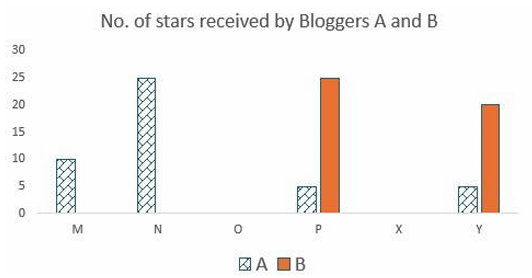
| Surfer | to A | to B |
|---|---|---|
| M | 10 | 0 |
| N | 25 | 0 |
| O | 0 | 0 |
| P | 5 | 25 |
| X | 0 | 0 |
| Y | 5 | 20 |
The following additional facts are known regarding the number of stars received by the bloggers from the surfers.
- The numbers of stars received by the bloggers from the surfers were all multiples of 5 (including 0).
- The total numbers of stars received by the bloggers were the same.
- Each blogger received a different number of stars from M.
- Two surfers gave all their stars to a single blogger.
- D received more stars than C from Y.
What was the total number of stars received by D?
Passage / Data
Answer the following questions based on the information given below.
Six web surfers M, N, O, P, X, and Y each had 30 stars which they distributed among four bloggers A, B, C, and D. The number of stars received by A and B from the six web surfers is shown in the figure below.
| Surfer | to A | to B |
|---|---|---|
| M | 10 | 0 |
| N | 25 | 0 |
| O | 0 | 0 |
| P | 5 | 25 |
| X | 0 | 0 |
| Y | 5 | 20 |
The following additional facts are known regarding the number of stars received by the bloggers from the surfers.
- The numbers of stars received by the bloggers from the surfers were all multiples of 5 (including 0).
- The total numbers of stars received by the bloggers were the same.
- Each blogger received a different number of stars from M.
- Two surfers gave all their stars to a single blogger.
- D received more stars than C from Y.
What was the number of stars received by D from Y?
Passage / Data
Answer the following questions based on the information given below.
Six web surfers M, N, O, P, X, and Y each had 30 stars which they distributed among four bloggers A, B, C, and D. The number of stars received by A and B from the six web surfers is shown in the figure below.
| Surfer | to A | to B |
|---|---|---|
| M | 10 | 0 |
| N | 25 | 0 |
| O | 0 | 0 |
| P | 5 | 25 |
| X | 0 | 0 |
| Y | 5 | 20 |
The following additional facts are known regarding the number of stars received by the bloggers from the surfers.
- The numbers of stars received by the bloggers from the surfers were all multiples of 5 (including 0).
- The total numbers of stars received by the bloggers were the same.
- Each blogger received a different number of stars from M.
- Two surfers gave all their stars to a single blogger.
- D received more stars than C from Y.
How many surfers distributed their stars among exactly 2 bloggers?
Passage / Data
Answer the following questions based on the information given below.
Six web surfers M, N, O, P, X, and Y each had 30 stars which they distributed among four bloggers A, B, C, and D. The number of stars received by A and B from the six web surfers is shown in the figure below.
| Surfer | to A | to B |
|---|---|---|
| M | 10 | 0 |
| N | 25 | 0 |
| O | 0 | 0 |
| P | 5 | 25 |
| X | 0 | 0 |
| Y | 5 | 20 |
The following additional facts are known regarding the number of stars received by the bloggers from the surfers.
- The numbers of stars received by the bloggers from the surfers were all multiples of 5 (including 0).
- The total numbers of stars received by the bloggers were the same.
- Each blogger received a different number of stars from M.
- Two surfers gave all their stars to a single blogger.
- D received more stars than C from Y.
Which of the following can be determined with certainty?
I. The number of stars received by C from M
II. The number of stars received by D from O
Passage / Data
Answer the following questions based on the information given below.
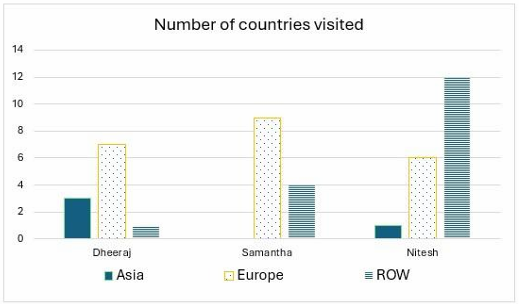
The chart below provides complete information about the number of countries visited by Dheeraj, Samantha and Nitesh, in Asia, Europe and the rest of the world (ROW).
The following additional facts are known about the countries visited by them.
1. 32 countries were visited by at least one of them.
2. USA (in ROW) is the only country that was visited by all three of them.
3. China (in Asia) is the only country that was visited by both Dheeraj and Nitesh, but not by Samantha.
4. France (in Europe) is the only country outside Asia, which was visited by both Dheeraj and Samantha, but not by Nitesh.
5. Half of the countries visited by both Samantha and Nitesh are in Europe.
How many countries in Asia were visited by at least one of Dheeraj, Samantha and Nitesh?
Passage / Data
Answer the following questions based on the information given below.
The chart below provides complete information about the number of countries visited by Dheeraj, Samantha and Nitesh, in Asia, Europe and the rest of the world (ROW).
The following additional facts are known about the countries visited by them.
1. 32 countries were visited by at least one of them.
2. USA (in ROW) is the only country that was visited by all three of them.
3. China (in Asia) is the only country that was visited by both Dheeraj and Nitesh, but not by Samantha.
4. France (in Europe) is the only country outside Asia, which was visited by both Dheeraj and Samantha, but not by Nitesh.
5. Half of the countries visited by both Samantha and Nitesh are in Europe.
How many countries in Europe were visited only by Nitesh?
Passage / Data
Answer the following questions based on the information given below.
The chart below provides complete information about the number of countries visited by Dheeraj, Samantha and Nitesh, in Asia, Europe and the rest of the world (ROW).
The following additional facts are known about the countries visited by them.
1. 32 countries were visited by at least one of them.
2. USA (in ROW) is the only country that was visited by all three of them.
3. China (in Asia) is the only country that was visited by both Dheeraj and Nitesh, but not by Samantha.
4. France (in Europe) is the only country outside Asia, which was visited by both Dheeraj and Samantha, but not by Nitesh.
5. Half of the countries visited by both Samantha and Nitesh are in Europe.
How many countries in the ROW were visited by both Nitesh and Samantha?
Passage / Data
Answer the following questions based on the information given below.
The chart below provides complete information about the number of countries visited by Dheeraj, Samantha and Nitesh, in Asia, Europe and the rest of the world (ROW).
The following additional facts are known about the countries visited by them.
1. 32 countries were visited by at least one of them.
2. USA (in ROW) is the only country that was visited by all three of them.
3. China (in Asia) is the only country that was visited by both Dheeraj and Nitesh, but not by Samantha.
4. France (in Europe) is the only country outside Asia, which was visited by both Dheeraj and Samantha, but not by Nitesh.
5. Half of the countries visited by both Samantha and Nitesh are in Europe.
How many countries in Europe were visited by exactly one of Dheeraj, Samantha and Nitesh?
Passage / Data
Answer the following questions based on the information given below.
Two students, Amiya and Ramya are the only candidates in an election for the position of class representative. Students will vote based on the intensity level of Amiya’s and Ramya’s campaigns and the type of campaigns they run. Each campaign is said to have a level of 1 if it is a staid campaign and a level of 2 if it is a vigorous campaign. Campaigns can be of two types, they can either focus on issues, or on attacking the other candidate.
If Amiya and Ramya both run campaigns focusing on issues, then
- The percentage of students voting in the election will be 20 times the sum of the levels of campaigning of the two students. For example, if Amiya and Ramya both run vigorous campaigns, then 20 × (2+2)%, that is, 80% of the students will vote in the election.
- Among voting students, the percentage of votes for each candidate will be proportional to the levels of their campaigns. For example, if Amiya runs a staid (i.e., level 1) campaign while Ramya runs a vigorous (i.e., level 2) campaign, then Amiya will receive 1/3 of the votes cast, and Ramya will receive the other 2/3. The above-mentioned percentages change as follows if at least one of them runs a campaign attacking their opponent.
- If Amiya runs a campaign attacking Ramya and Ramya runs a campaign focusing on issues, then 10% of the students who would have otherwise voted for Amiya will vote for Ramya, and another 10% who would have otherwise voted for Amiya, will not vote at all.
- If Ramya runs a campaign attacking Amiya and Amiya runs a campaign focusing on issues, then 20% of the students who would have otherwise voted for Ramya will vote for Amiya, and another 5% who would have otherwise voted for Ramya, will not vote at all.
- If both run campaigns attacking each other, then 10% of the students who would have otherwise voted for them had they run campaigns focusing on issues, will not vote at all.
If both of them run staid campaigns attacking the other, then what percentage of students will vote in the election?
Passage / Data
Answer the following questions based on the information given below.
Two students, Amiya and Ramya are the only candidates in an election for the position of class representative. Students will vote based on the intensity level of Amiya’s and Ramya’s campaigns and the type of campaigns they run. Each campaign is said to have a level of 1 if it is a staid campaign and a level of 2 if it is a vigorous campaign. Campaigns can be of two types, they can either focus on issues, or on attacking the other candidate.
If Amiya and Ramya both run campaigns focusing on issues, then
- The percentage of students voting in the election will be 20 times the sum of the levels of campaigning of the two students. For example, if Amiya and Ramya both run vigorous campaigns, then 20 × (2+2)%, that is, 80% of the students will vote in the election.
- Among voting students, the percentage of votes for each candidate will be proportional to the levels of their campaigns. For example, if Amiya runs a staid (i.e., level 1) campaign while Ramya runs a vigorous (i.e., level 2) campaign, then Amiya will receive 1/3 of the votes cast, and Ramya will receive the other 2/3. The above-mentioned percentages change as follows if at least one of them runs a campaign attacking their opponent.
- If Amiya runs a campaign attacking Ramya and Ramya runs a campaign focusing on issues, then 10% of the students who would have otherwise voted for Amiya will vote for Ramya, and another 10% who would have otherwise voted for Amiya, will not vote at all.
- If Ramya runs a campaign attacking Amiya and Amiya runs a campaign focusing on issues, then 20% of the students who would have otherwise voted for Ramya will vote for Amiya, and another 5% who would have otherwise voted for Ramya, will not vote at all.
- If both run campaigns attacking each other, then 10% of the students who would have otherwise voted for them had they run campaigns focusing on issues, will not vote at all.
What is the minimum percentage of students who will vote in the election?
Passage / Data
Answer the following questions based on the information given below.
Two students, Amiya and Ramya are the only candidates in an election for the position of class representative. Students will vote based on the intensity level of Amiya’s and Ramya’s campaigns and the type of campaigns they run. Each campaign is said to have a level of 1 if it is a staid campaign and a level of 2 if it is a vigorous campaign. Campaigns can be of two types, they can either focus on issues, or on attacking the other candidate.
If Amiya and Ramya both run campaigns focusing on issues, then
- The percentage of students voting in the election will be 20 times the sum of the levels of campaigning of the two students. For example, if Amiya and Ramya both run vigorous campaigns, then 20 × (2+2)%, that is, 80% of the students will vote in the election.
- Among voting students, the percentage of votes for each candidate will be proportional to the levels of their campaigns. For example, if Amiya runs a staid (i.e., level 1) campaign while Ramya runs a vigorous (i.e., level 2) campaign, then Amiya will receive 1/3 of the votes cast, and Ramya will receive the other 2/3. The above-mentioned percentages change as follows if at least one of them runs a campaign attacking their opponent.
- If Amiya runs a campaign attacking Ramya and Ramya runs a campaign focusing on issues, then 10% of the students who would have otherwise voted for Amiya will vote for Ramya, and another 10% who would have otherwise voted for Amiya, will not vote at all.
- If Ramya runs a campaign attacking Amiya and Amiya runs a campaign focusing on issues, then 20% of the students who would have otherwise voted for Ramya will vote for Amiya, and another 5% who would have otherwise voted for Ramya, will not vote at all.
- If both run campaigns attacking each other, then 10% of the students who would have otherwise voted for them had they run campaigns focusing on issues, will not vote at all.
If Amiya runs a campaign focusing on issues, then what is the maximum percentage of votes that she can get?
Passage / Data
Answer the following questions based on the information given below.
Two students, Amiya and Ramya are the only candidates in an election for the position of class representative. Students will vote based on the intensity level of Amiya’s and Ramya’s campaigns and the type of campaigns they run. Each campaign is said to have a level of 1 if it is a staid campaign and a level of 2 if it is a vigorous campaign. Campaigns can be of two types, they can either focus on issues, or on attacking the other candidate.
If Amiya and Ramya both run campaigns focusing on issues, then
- The percentage of students voting in the election will be 20 times the sum of the levels of campaigning of the two students. For example, if Amiya and Ramya both run vigorous campaigns, then 20 × (2+2)%, that is, 80% of the students will vote in the election.
- Among voting students, the percentage of votes for each candidate will be proportional to the levels of their campaigns. For example, if Amiya runs a staid (i.e., level 1) campaign while Ramya runs a vigorous (i.e., level 2) campaign, then Amiya will receive 1/3 of the votes cast, and Ramya will receive the other 2/3. The above-mentioned percentages change as follows if at least one of them runs a campaign attacking their opponent.
- If Amiya runs a campaign attacking Ramya and Ramya runs a campaign focusing on issues, then 10% of the students who would have otherwise voted for Amiya will vote for Ramya, and another 10% who would have otherwise voted for Amiya, will not vote at all.
- If Ramya runs a campaign attacking Amiya and Amiya runs a campaign focusing on issues, then 20% of the students who would have otherwise voted for Ramya will vote for Amiya, and another 5% who would have otherwise voted for Ramya, will not vote at all.
- If both run campaigns attacking each other, then 10% of the students who would have otherwise voted for them had they run campaigns focusing on issues, will not vote at all.
If Ramya runs a campaign attacking Amiya, then what is the minimum percentage of votes that she is guaranteed to get?
Passage / Data
Answer the following questions based on the information given below.
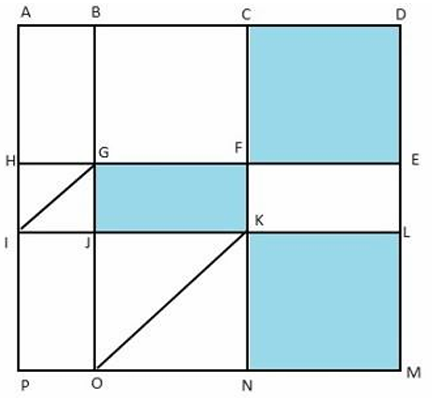
The above is a schematic diagram of walkways (indicated by all the straight-lines) and lakes (3 of them, each in the shape of rectangles – shaded in the diagram) of a gated area. Different points on the walkway are indicated by letters (A through P) with distances being OP = 150 m, ON = MN = 300 m, ML = 400 m, EL = 200 m, DE = 400 m.
The following additional information about the facilities in the area is known.
1. The only entry/exit point is at C.
2. There are many residences within the gated area; all of them are located on the path AH and ML with four of them being at A, H, M, and L.
3. The post office is located at P and the bank is located at B.
| Segment | Length (m) | Segment | Length (m) |
|---|---|---|---|
| AB, HG, IJ, PO | 150 | HI, GJ, FK, EL | 200 |
| BC, CD | 300 | GF, FE | 300 |
| JK, KL | 300 | ON, NM | 300 |
| AH, IP, BG, JO | 400 | CF, KN, DE, LM | 400 |
| GI (diagonal) | 250 | OK (diagonal) | 500 |
Coordinates (m), origin at P, taking the grid columns at x = 0, 150, 450, 750 and rows at y = 0, 400, 600, 1000: A(0,1000) B(150,1000) C(450,1000) D(750,1000); H(0,600) G(150,600) F(450,600) E(750,600); I(0,400) J(150,400) K(450,400) L(750,400); P(0,0) O(150,0) N(450,0) M(750,0). Lakes: C-D-E-F, G-F-K-J, K-L-M-N.
One resident whose house is located at L, needs to visit the post office as well as the bank. What is the minimum distance (in m) he has to walk starting from his residence and returning to his residence after visiting both the post office and the bank?
Passage / Data
Answer the following questions based on the information given below.
The above is a schematic diagram of walkways (indicated by all the straight-lines) and lakes (3 of them, each in the shape of rectangles – shaded in the diagram) of a gated area. Different points on the walkway are indicated by letters (A through P) with distances being OP = 150 m, ON = MN = 300 m, ML = 400 m, EL = 200 m, DE = 400 m.
The following additional information about the facilities in the area is known.
1. The only entry/exit point is at C.
2. There are many residences within the gated area; all of them are located on the path AH and ML with four of them being at A, H, M, and L.
3. The post office is located at P and the bank is located at B.
| Segment | Length (m) | Segment | Length (m) |
|---|---|---|---|
| AB, HG, IJ, PO | 150 | HI, GJ, FK, EL | 200 |
| BC, CD | 300 | GF, FE | 300 |
| JK, KL | 300 | ON, NM | 300 |
| AH, IP, BG, JO | 400 | CF, KN, DE, LM | 400 |
| GI (diagonal) | 250 | OK (diagonal) | 500 |
Coordinates (m), origin at P, taking the grid columns at x = 0, 150, 450, 750 and rows at y = 0, 400, 600, 1000: A(0,1000) B(150,1000) C(450,1000) D(750,1000); H(0,600) G(150,600) F(450,600) E(750,600); I(0,400) J(150,400) K(450,400) L(750,400); P(0,0) O(150,0) N(450,0) M(750,0). Lakes: C-D-E-F, G-F-K-J, K-L-M-N.
One person enters the gated area and decides to walk as much as possible before leaving the area without walking along any path more than once and always walking next to one of the lakes. Note that he may cross a point multiple times. How much distance (in m) will he walk within the gated area?
Passage / Data
Answer the following questions based on the information given below.
The above is a schematic diagram of walkways (indicated by all the straight-lines) and lakes (3 of them, each in the shape of rectangles – shaded in the diagram) of a gated area. Different points on the walkway are indicated by letters (A through P) with distances being OP = 150 m, ON = MN = 300 m, ML = 400 m, EL = 200 m, DE = 400 m.
The following additional information about the facilities in the area is known.
1. The only entry/exit point is at C.
2. There are many residences within the gated area; all of them are located on the path AH and ML with four of them being at A, H, M, and L.
3. The post office is located at P and the bank is located at B.
| Segment | Length (m) | Segment | Length (m) |
|---|---|---|---|
| AB, HG, IJ, PO | 150 | HI, GJ, FK, EL | 200 |
| BC, CD | 300 | GF, FE | 300 |
| JK, KL | 300 | ON, NM | 300 |
| AH, IP, BG, JO | 400 | CF, KN, DE, LM | 400 |
| GI (diagonal) | 250 | OK (diagonal) | 500 |
Coordinates (m), origin at P, taking the grid columns at x = 0, 150, 450, 750 and rows at y = 0, 400, 600, 1000: A(0,1000) B(150,1000) C(450,1000) D(750,1000); H(0,600) G(150,600) F(450,600) E(750,600); I(0,400) J(150,400) K(450,400) L(750,400); P(0,0) O(150,0) N(450,0) M(750,0). Lakes: C-D-E-F, G-F-K-J, K-L-M-N.
One resident takes a walk within the gated area starting from A and returning to A without going through any point (other than A) more than once. What is the maximum distance (in m) she can walk in this way?
Passage / Data
Answer the following questions based on the information given below.
The above is a schematic diagram of walkways (indicated by all the straight-lines) and lakes (3 of them, each in the shape of rectangles – shaded in the diagram) of a gated area. Different points on the walkway are indicated by letters (A through P) with distances being OP = 150 m, ON = MN = 300 m, ML = 400 m, EL = 200 m, DE = 400 m.
The following additional information about the facilities in the area is known.
1. The only entry/exit point is at C.
2. There are many residences within the gated area; all of them are located on the path AH and ML with four of them being at A, H, M, and L.
3. The post office is located at P and the bank is located at B.
| Segment | Length (m) | Segment | Length (m) |
|---|---|---|---|
| AB, HG, IJ, PO | 150 | HI, GJ, FK, EL | 200 |
| BC, CD | 300 | GF, FE | 300 |
| JK, KL | 300 | ON, NM | 300 |
| AH, IP, BG, JO | 400 | CF, KN, DE, LM | 400 |
| GI (diagonal) | 250 | OK (diagonal) | 500 |
Coordinates (m), origin at P, taking the grid columns at x = 0, 150, 450, 750 and rows at y = 0, 400, 600, 1000: A(0,1000) B(150,1000) C(450,1000) D(750,1000); H(0,600) G(150,600) F(450,600) E(750,600); I(0,400) J(150,400) K(450,400) L(750,400); P(0,0) O(150,0) N(450,0) M(750,0). Lakes: C-D-E-F, G-F-K-J, K-L-M-N.
Visitors coming for morning walks are allowed to enter as long as they do not pass by any of the residences and do not cross any point (except C) more than once. What is the maximum distance (in m) that such a visitor can walk within the gated area?
Passage / Data
Answer the following questions based on the information given below.
The numbers 1, 2, 3, 4, 5, 6, 7, 8, 9, and 10 are placed in ten slots of the following grid based on the conditions below.
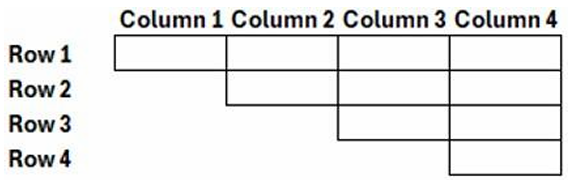
| Column 1 | Column 2 | Column 3 | Column 4 | |
|---|---|---|---|---|
| Row 1 | □ | □ | □ | □ |
| Row 2 | □ | □ | □ | |
| Row 3 | □ | □ | ||
| Row 4 | □ |
(Row 1 has 4 slots in Columns 1–4; Row 2 has 3 slots in Columns 2–4; Row 3 has 2 slots in Columns 3–4; Row 4 has 1 slot in Column 4 — ten slots in all.)
1. Numbers in any row appear in an increasing order from left to right.
2. Numbers in any column appear in a decreasing order from top to bottom.
3. 1 is placed either in the same row or in the same column as 10.
4. Neither 2 nor 3 is placed in the same row or in the same column as 10.
5. Neither 7 nor 8 is placed in the same row or in the same column as 9.
6. 4 and 6 are placed in the same row.
What is the row number which has the least sum of numbers placed in that row?
Passage / Data
Answer the following questions based on the information given below.
The numbers 1, 2, 3, 4, 5, 6, 7, 8, 9, and 10 are placed in ten slots of the following grid based on the conditions below.
| Column 1 | Column 2 | Column 3 | Column 4 | |
|---|---|---|---|---|
| Row 1 | □ | □ | □ | □ |
| Row 2 | □ | □ | □ | |
| Row 3 | □ | □ | ||
| Row 4 | □ |
(Row 1 has 4 slots in Columns 1–4; Row 2 has 3 slots in Columns 2–4; Row 3 has 2 slots in Columns 3–4; Row 4 has 1 slot in Column 4 — ten slots in all.)
1. Numbers in any row appear in an increasing order from left to right.
2. Numbers in any column appear in a decreasing order from top to bottom.
3. 1 is placed either in the same row or in the same column as 10.
4. Neither 2 nor 3 is placed in the same row or in the same column as 10.
5. Neither 7 nor 8 is placed in the same row or in the same column as 9.
6. 4 and 6 are placed in the same row.
Which of the following statements MUST be true?
I. 10 is placed in a slot in Row 1.
II. 1 is placed in a slot in Row 4.
Passage / Data
Answer the following questions based on the information given below.
The numbers 1, 2, 3, 4, 5, 6, 7, 8, 9, and 10 are placed in ten slots of the following grid based on the conditions below.
| Column 1 | Column 2 | Column 3 | Column 4 | |
|---|---|---|---|---|
| Row 1 | □ | □ | □ | □ |
| Row 2 | □ | □ | □ | |
| Row 3 | □ | □ | ||
| Row 4 | □ |
(Row 1 has 4 slots in Columns 1–4; Row 2 has 3 slots in Columns 2–4; Row 3 has 2 slots in Columns 3–4; Row 4 has 1 slot in Column 4 — ten slots in all.)
1. Numbers in any row appear in an increasing order from left to right.
2. Numbers in any column appear in a decreasing order from top to bottom.
3. 1 is placed either in the same row or in the same column as 10.
4. Neither 2 nor 3 is placed in the same row or in the same column as 10.
5. Neither 7 nor 8 is placed in the same row or in the same column as 9.
6. 4 and 6 are placed in the same row.
Which of the following statements MUST be true?
I. 2 is placed in a slot in Column 2.
II. 3 is placed in a slot in Column 3.
Passage / Data
Answer the following questions based on the information given below.
The numbers 1, 2, 3, 4, 5, 6, 7, 8, 9, and 10 are placed in ten slots of the following grid based on the conditions below.
| Column 1 | Column 2 | Column 3 | Column 4 | |
|---|---|---|---|---|
| Row 1 | □ | □ | □ | □ |
| Row 2 | □ | □ | □ | |
| Row 3 | □ | □ | ||
| Row 4 | □ |
(Row 1 has 4 slots in Columns 1–4; Row 2 has 3 slots in Columns 2–4; Row 3 has 2 slots in Columns 3–4; Row 4 has 1 slot in Column 4 — ten slots in all.)
1. Numbers in any row appear in an increasing order from left to right.
2. Numbers in any column appear in a decreasing order from top to bottom.
3. 1 is placed either in the same row or in the same column as 10.
4. Neither 2 nor 3 is placed in the same row or in the same column as 10.
5. Neither 7 nor 8 is placed in the same row or in the same column as 9.
6. 4 and 6 are placed in the same row.
For how many slots in the grid, placement of numbers CANNOT be determined with certainty?
Passage / Data
Answer the following questions based on the information given below.
The numbers 1, 2, 3, 4, 5, 6, 7, 8, 9, and 10 are placed in ten slots of the following grid based on the conditions below.
| Column 1 | Column 2 | Column 3 | Column 4 | |
|---|---|---|---|---|
| Row 1 | □ | □ | □ | □ |
| Row 2 | □ | □ | □ | |
| Row 3 | □ | □ | ||
| Row 4 | □ |
(Row 1 has 4 slots in Columns 1–4; Row 2 has 3 slots in Columns 2–4; Row 3 has 2 slots in Columns 3–4; Row 4 has 1 slot in Column 4 — ten slots in all.)
1. Numbers in any row appear in an increasing order from left to right.
2. Numbers in any column appear in a decreasing order from top to bottom.
3. 1 is placed either in the same row or in the same column as 10.
4. Neither 2 nor 3 is placed in the same row or in the same column as 10.
5. Neither 7 nor 8 is placed in the same row or in the same column as 9.
6. 4 and 6 are placed in the same row.
What is the sum of the numbers placed in Column 4?
Passage / Data
Answer the following questions based on the information given below.
An online e-commerce firm receives daily integer product ratings from 1 through 5 given by buyers. The daily average is the average of the ratings given on that day. The cumulative average is the average of all ratings given on or before that day. The rating system began on Day 1, and the cumulative averages were 3 and 3.1 at the end of Day 1 and Day 2, respectively. The distribution of ratings on Day 2 is given in the figure below.
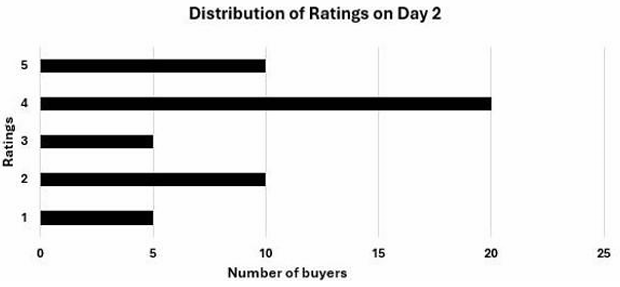
| Rating (Day 2) | 1 | 2 | 3 | 4 | 5 |
|---|---|---|---|---|---|
| Number of buyers | 5 | 10 | 5 | 20 | 10 |
The following information is known about ratings on Day 3.
1. 100 buyers gave product ratings on Day 3.
2. The modes of the product ratings were 4 and 5.
3. The numbers of buyers giving each product rating are non-zero multiples of 10.
4. The same number of buyers gave product ratings of 1 and 2, and that number is half the number of buyers who gave a rating of 3.
How many buyers gave ratings on Day 1?
Passage / Data
Answer the following questions based on the information given below.
An online e-commerce firm receives daily integer product ratings from 1 through 5 given by buyers. The daily average is the average of the ratings given on that day. The cumulative average is the average of all ratings given on or before that day. The rating system began on Day 1, and the cumulative averages were 3 and 3.1 at the end of Day 1 and Day 2, respectively. The distribution of ratings on Day 2 is given in the figure below.
| Rating (Day 2) | 1 | 2 | 3 | 4 | 5 |
|---|---|---|---|---|---|
| Number of buyers | 5 | 10 | 5 | 20 | 10 |
The following information is known about ratings on Day 3.
1. 100 buyers gave product ratings on Day 3.
2. The modes of the product ratings were 4 and 5.
3. The numbers of buyers giving each product rating are non-zero multiples of 10.
4. The same number of buyers gave product ratings of 1 and 2, and that number is half the number of buyers who gave a rating of 3.
What is the daily average rating of Day 3?
Passage / Data
Answer the following questions based on the information given below.
An online e-commerce firm receives daily integer product ratings from 1 through 5 given by buyers. The daily average is the average of the ratings given on that day. The cumulative average is the average of all ratings given on or before that day. The rating system began on Day 1, and the cumulative averages were 3 and 3.1 at the end of Day 1 and Day 2, respectively. The distribution of ratings on Day 2 is given in the figure below.
| Rating (Day 2) | 1 | 2 | 3 | 4 | 5 |
|---|---|---|---|---|---|
| Number of buyers | 5 | 10 | 5 | 20 | 10 |
The following information is known about ratings on Day 3.
1. 100 buyers gave product ratings on Day 3.
2. The modes of the product ratings were 4 and 5.
3. The numbers of buyers giving each product rating are non-zero multiples of 10.
4. The same number of buyers gave product ratings of 1 and 2, and that number is half the number of buyers who gave a rating of 3.
What is the median of all ratings given on Day 3?
Passage / Data
Answer the following questions based on the information given below.
An online e-commerce firm receives daily integer product ratings from 1 through 5 given by buyers. The daily average is the average of the ratings given on that day. The cumulative average is the average of all ratings given on or before that day. The rating system began on Day 1, and the cumulative averages were 3 and 3.1 at the end of Day 1 and Day 2, respectively. The distribution of ratings on Day 2 is given in the figure below.
| Rating (Day 2) | 1 | 2 | 3 | 4 | 5 |
|---|---|---|---|---|---|
| Number of buyers | 5 | 10 | 5 | 20 | 10 |
The following information is known about ratings on Day 3.
1. 100 buyers gave product ratings on Day 3.
2. The modes of the product ratings were 4 and 5.
3. The numbers of buyers giving each product rating are non-zero multiples of 10.
4. The same number of buyers gave product ratings of 1 and 2, and that number is half the number of buyers who gave a rating of 3.
Which of the following is true about the cumulative average ratings of Day 2 and Day 3?
Passage / Data
Answer the following questions based on the information given below.
Eight gymnastics players numbered 1 through 8 underwent a training camp where they were coached by three coaches - Xena, Yuki, and Zara. Each coach trained at least two players. Yuki trained only even numbered players, while Zara trained only odd numbered players. After the camp, the coaches evaluated the players and gave integer ratings to the respective players trained by them on a scale of 1 to 7, with 1 being the lowest rating and 7 the highest.
The following additional information is known.
1. Xena trained more players than Yuki.
2. Player-1 and Player-4 were trained by the same coach, while the coaches who trained Player-2, Player-3 and Player-5 were all different.
3. Player-5 and Player-7 were trained by the same coach and got the same rating. All other players got a unique rating.
4. The average of the ratings of all the players was 4.
5. Player-2 got the highest rating.
6. The average of the ratings of the players trained by Yuki was twice that of the players trained by Xena and two more than that of the players trained by Zara.
7. Player-4's rating was double of Player-8's and less than Player-5's.
What best can be concluded about the number of players coached by Zara?
Passage / Data
Answer the following questions based on the information given below.
Eight gymnastics players numbered 1 through 8 underwent a training camp where they were coached by three coaches - Xena, Yuki, and Zara. Each coach trained at least two players. Yuki trained only even numbered players, while Zara trained only odd numbered players. After the camp, the coaches evaluated the players and gave integer ratings to the respective players trained by them on a scale of 1 to 7, with 1 being the lowest rating and 7 the highest.
The following additional information is known.
1. Xena trained more players than Yuki.
2. Player-1 and Player-4 were trained by the same coach, while the coaches who trained Player-2, Player-3 and Player-5 were all different.
3. Player-5 and Player-7 were trained by the same coach and got the same rating. All other players got a unique rating.
4. The average of the ratings of all the players was 4.
5. Player-2 got the highest rating.
6. The average of the ratings of the players trained by Yuki was twice that of the players trained by Xena and two more than that of the players trained by Zara.
7. Player-4's rating was double of Player-8's and less than Player-5's.
What was the rating of Player-7?
Passage / Data
Answer the following questions based on the information given below.
Eight gymnastics players numbered 1 through 8 underwent a training camp where they were coached by three coaches - Xena, Yuki, and Zara. Each coach trained at least two players. Yuki trained only even numbered players, while Zara trained only odd numbered players. After the camp, the coaches evaluated the players and gave integer ratings to the respective players trained by them on a scale of 1 to 7, with 1 being the lowest rating and 7 the highest.
The following additional information is known.
1. Xena trained more players than Yuki.
2. Player-1 and Player-4 were trained by the same coach, while the coaches who trained Player-2, Player-3 and Player-5 were all different.
3. Player-5 and Player-7 were trained by the same coach and got the same rating. All other players got a unique rating.
4. The average of the ratings of all the players was 4.
5. Player-2 got the highest rating.
6. The average of the ratings of the players trained by Yuki was twice that of the players trained by Xena and two more than that of the players trained by Zara.
7. Player-4's rating was double of Player-8's and less than Player-5's.
What was the rating of Player-6?
Passage / Data
Answer the following questions based on the information given below.
Eight gymnastics players numbered 1 through 8 underwent a training camp where they were coached by three coaches - Xena, Yuki, and Zara. Each coach trained at least two players. Yuki trained only even numbered players, while Zara trained only odd numbered players. After the camp, the coaches evaluated the players and gave integer ratings to the respective players trained by them on a scale of 1 to 7, with 1 being the lowest rating and 7 the highest.
The following additional information is known.
1. Xena trained more players than Yuki.
2. Player-1 and Player-4 were trained by the same coach, while the coaches who trained Player-2, Player-3 and Player-5 were all different.
3. Player-5 and Player-7 were trained by the same coach and got the same rating. All other players got a unique rating.
4. The average of the ratings of all the players was 4.
5. Player-2 got the highest rating.
6. The average of the ratings of the players trained by Yuki was twice that of the players trained by Xena and two more than that of the players trained by Zara.
7. Player-4's rating was double of Player-8's and less than Player-5's.
For how many players the ratings can be determined with certainty?
Passage / Data
Answer the following questions based on the information given below.
Eight gymnastics players numbered 1 through 8 underwent a training camp where they were coached by three coaches - Xena, Yuki, and Zara. Each coach trained at least two players. Yuki trained only even numbered players, while Zara trained only odd numbered players. After the camp, the coaches evaluated the players and gave integer ratings to the respective players trained by them on a scale of 1 to 7, with 1 being the lowest rating and 7 the highest.
The following additional information is known.
1. Xena trained more players than Yuki.
2. Player-1 and Player-4 were trained by the same coach, while the coaches who trained Player-2, Player-3 and Player-5 were all different.
3. Player-5 and Player-7 were trained by the same coach and got the same rating. All other players got a unique rating.
4. The average of the ratings of all the players was 4.
5. Player-2 got the highest rating.
6. The average of the ratings of the players trained by Yuki was twice that of the players trained by Xena and two more than that of the players trained by Zara.
7. Player-4's rating was double of Player-8's and less than Player-5's.
Who all were the players trained by Xena?
Passage / Data
Answer the following questions based on the information given below.
The air-conditioner (AC) in a large room can be operated either in REGULAR mode or in POWER mode to reduce the temperature.
If the AC operates in REGULAR mode, then it brings down the temperature inside the room (called inside temperature) at a constant rate to the set temperature in 1 hour. If it operates in POWER mode, then this is achieved in 30 minutes.
If the AC is switched off, then the inside temperature rises at a constant rate so as to reach the temperature outside at the time of switching off in 1 hour.
The temperature outside has been falling at a constant rate from 7 pm onward until 3 am on a particular night. The following graph shows the inside temperature between 11 pm (23:00) and 2 am (2:00) that night.
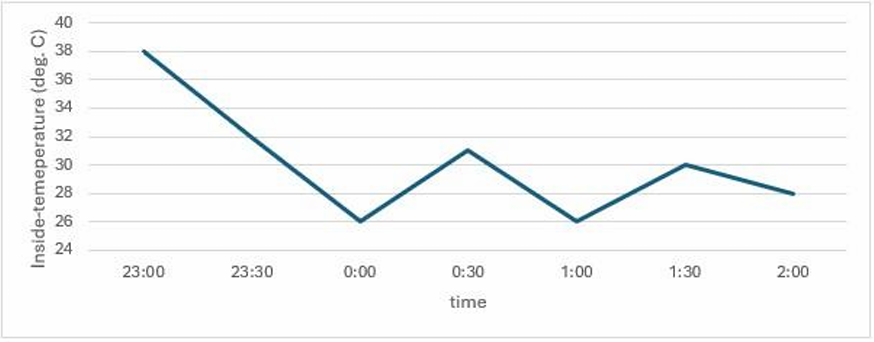
| Time | 23:00 | 23:30 | 0:00 | 0:30 | 1:00 | 1:30 | 2:00 |
|---|---|---|---|---|---|---|---|
| Inside temperature (°C) | 38 | 32 | 26 | 31 | 26 | 30 | 28 |
The following facts are known about the AC operation that night.
• The AC was turned on for the first time that night at 11 pm (23:00).
• The AC setting was changed (including turning it on/off, and/or setting different temperatures) only at the beginning of the hour or at 30 minutes after the hour.
• The AC was used in POWER mode for longer duration than in REGULAR mode during this 3-hour period.
How many times the AC must have been turned off between 11:01 pm and 1:59 am?
Passage / Data
Answer the following questions based on the information given below.
The air-conditioner (AC) in a large room can be operated either in REGULAR mode or in POWER mode to reduce the temperature.
If the AC operates in REGULAR mode, then it brings down the temperature inside the room (called inside temperature) at a constant rate to the set temperature in 1 hour. If it operates in POWER mode, then this is achieved in 30 minutes.
If the AC is switched off, then the inside temperature rises at a constant rate so as to reach the temperature outside at the time of switching off in 1 hour.
The temperature outside has been falling at a constant rate from 7 pm onward until 3 am on a particular night. The following graph shows the inside temperature between 11 pm (23:00) and 2 am (2:00) that night.
| Time | 23:00 | 23:30 | 0:00 | 0:30 | 1:00 | 1:30 | 2:00 |
|---|---|---|---|---|---|---|---|
| Inside temperature (°C) | 38 | 32 | 26 | 31 | 26 | 30 | 28 |
The following facts are known about the AC operation that night.
• The AC was turned on for the first time that night at 11 pm (23:00).
• The AC setting was changed (including turning it on/off, and/or setting different temperatures) only at the beginning of the hour or at 30 minutes after the hour.
• The AC was used in POWER mode for longer duration than in REGULAR mode during this 3-hour period.
What was the temperature outside, in degree Celsius, at 1 am?
Passage / Data
Answer the following questions based on the information given below.
The air-conditioner (AC) in a large room can be operated either in REGULAR mode or in POWER mode to reduce the temperature.
If the AC operates in REGULAR mode, then it brings down the temperature inside the room (called inside temperature) at a constant rate to the set temperature in 1 hour. If it operates in POWER mode, then this is achieved in 30 minutes.
If the AC is switched off, then the inside temperature rises at a constant rate so as to reach the temperature outside at the time of switching off in 1 hour.
The temperature outside has been falling at a constant rate from 7 pm onward until 3 am on a particular night. The following graph shows the inside temperature between 11 pm (23:00) and 2 am (2:00) that night.
| Time | 23:00 | 23:30 | 0:00 | 0:30 | 1:00 | 1:30 | 2:00 |
|---|---|---|---|---|---|---|---|
| Inside temperature (°C) | 38 | 32 | 26 | 31 | 26 | 30 | 28 |
The following facts are known about the AC operation that night.
• The AC was turned on for the first time that night at 11 pm (23:00).
• The AC setting was changed (including turning it on/off, and/or setting different temperatures) only at the beginning of the hour or at 30 minutes after the hour.
• The AC was used in POWER mode for longer duration than in REGULAR mode during this 3-hour period.
What was the temperature outside, in degree Celsius, at 9 pm?
Passage / Data
Answer the following questions based on the information given below.
The air-conditioner (AC) in a large room can be operated either in REGULAR mode or in POWER mode to reduce the temperature.
If the AC operates in REGULAR mode, then it brings down the temperature inside the room (called inside temperature) at a constant rate to the set temperature in 1 hour. If it operates in POWER mode, then this is achieved in 30 minutes.
If the AC is switched off, then the inside temperature rises at a constant rate so as to reach the temperature outside at the time of switching off in 1 hour.
The temperature outside has been falling at a constant rate from 7 pm onward until 3 am on a particular night. The following graph shows the inside temperature between 11 pm (23:00) and 2 am (2:00) that night.
| Time | 23:00 | 23:30 | 0:00 | 0:30 | 1:00 | 1:30 | 2:00 |
|---|---|---|---|---|---|---|---|
| Inside temperature (°C) | 38 | 32 | 26 | 31 | 26 | 30 | 28 |
The following facts are known about the AC operation that night.
• The AC was turned on for the first time that night at 11 pm (23:00).
• The AC setting was changed (including turning it on/off, and/or setting different temperatures) only at the beginning of the hour or at 30 minutes after the hour.
• The AC was used in POWER mode for longer duration than in REGULAR mode during this 3-hour period.
What best can be concluded about the number of times the AC must have either been turned on or the AC temperature setting been altered between 11:01 pm and 1:59 am?
Passage / Data
Answer the following questions based on the information given below.
The air-conditioner (AC) in a large room can be operated either in REGULAR mode or in POWER mode to reduce the temperature.
If the AC operates in REGULAR mode, then it brings down the temperature inside the room (called inside temperature) at a constant rate to the set temperature in 1 hour. If it operates in POWER mode, then this is achieved in 30 minutes.
If the AC is switched off, then the inside temperature rises at a constant rate so as to reach the temperature outside at the time of switching off in 1 hour.
The temperature outside has been falling at a constant rate from 7 pm onward until 3 am on a particular night. The following graph shows the inside temperature between 11 pm (23:00) and 2 am (2:00) that night.
| Time | 23:00 | 23:30 | 0:00 | 0:30 | 1:00 | 1:30 | 2:00 |
|---|---|---|---|---|---|---|---|
| Inside temperature (°C) | 38 | 32 | 26 | 31 | 26 | 30 | 28 |
The following facts are known about the AC operation that night.
• The AC was turned on for the first time that night at 11 pm (23:00).
• The AC setting was changed (including turning it on/off, and/or setting different temperatures) only at the beginning of the hour or at 30 minutes after the hour.
• The AC was used in POWER mode for longer duration than in REGULAR mode during this 3-hour period.
What was the maximum difference between temperature outside and inside temperature, in degree Celsius, between 11:01 pm and 1:59 am?
Passage / Data
Answer the following questions based on the information given below.
The figure below shows a network with three parallel roads represented by horizontal lines R-A, R-B, and R-C and another three parallel roads represented by vertical lines V1, V2, and V3. The figure also shows the distance (in km) between two adjacent intersections. Six ATMs are placed at six of the nine road intersections. Each ATM has a distinct integer cash requirement (in Rs. Lakhs), and the numbers at the end of each line in the figure indicate the total cash requirements of all ATMs placed on the corresponding road. For example, the total cash requirement of the ATM(s) placed on road R-A is Rs. 22 Lakhs.
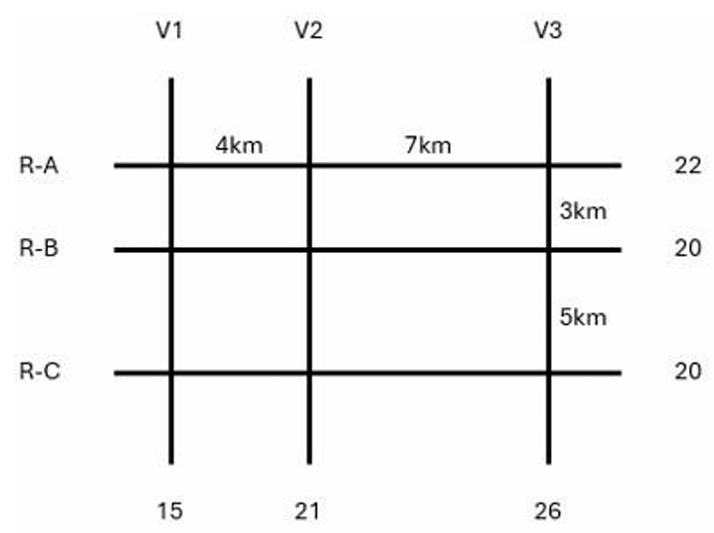
| Road / total (Rs. Lakhs) | V1 | V2 | V3 | Row total |
|---|---|---|---|---|
| R-A | · | · | · | 22 |
| R-B | · | · | · | 20 |
| R-C | · | · | · | 20 |
| Column total | 15 | 21 | 26 | 62 |
Distances between adjacent intersections (in km): along R-A, V1–V2 = 4 km and V2–V3 = 7 km; along V3, R-A–R-B = 3 km and R-B–R-C = 5 km.
The following additional information is known.
1. The ATMs with the minimum and maximum cash requirements of Rs. 7 Lakhs and Rs. 15 Lakhs are placed on the same road.
2. The road distance between the ATM with the second highest cash requirement and the ATM located at the intersection of R-C and V3 is 12 km.
Which of the following statements is correct?
Passage / Data
Answer the following questions based on the information given below.
The figure below shows a network with three parallel roads represented by horizontal lines R-A, R-B, and R-C and another three parallel roads represented by vertical lines V1, V2, and V3. The figure also shows the distance (in km) between two adjacent intersections. Six ATMs are placed at six of the nine road intersections. Each ATM has a distinct integer cash requirement (in Rs. Lakhs), and the numbers at the end of each line in the figure indicate the total cash requirements of all ATMs placed on the corresponding road. For example, the total cash requirement of the ATM(s) placed on road R-A is Rs. 22 Lakhs.
| Road / total (Rs. Lakhs) | V1 | V2 | V3 | Row total |
|---|---|---|---|---|
| R-A | · | · | · | 22 |
| R-B | · | · | · | 20 |
| R-C | · | · | · | 20 |
| Column total | 15 | 21 | 26 | 62 |
Distances between adjacent intersections (in km): along R-A, V1–V2 = 4 km and V2–V3 = 7 km; along V3, R-A–R-B = 3 km and R-B–R-C = 5 km.
The following additional information is known.
1. The ATMs with the minimum and maximum cash requirements of Rs. 7 Lakhs and Rs. 15 Lakhs are placed on the same road.
2. The road distance between the ATM with the second highest cash requirement and the ATM located at the intersection of R-C and V3 is 12 km.
How many ATMs have cash requirements of Rs. 10 Lakhs or more?
Passage / Data
Answer the following questions based on the information given below.
The figure below shows a network with three parallel roads represented by horizontal lines R-A, R-B, and R-C and another three parallel roads represented by vertical lines V1, V2, and V3. The figure also shows the distance (in km) between two adjacent intersections. Six ATMs are placed at six of the nine road intersections. Each ATM has a distinct integer cash requirement (in Rs. Lakhs), and the numbers at the end of each line in the figure indicate the total cash requirements of all ATMs placed on the corresponding road. For example, the total cash requirement of the ATM(s) placed on road R-A is Rs. 22 Lakhs.
| Road / total (Rs. Lakhs) | V1 | V2 | V3 | Row total |
|---|---|---|---|---|
| R-A | · | · | · | 22 |
| R-B | · | · | · | 20 |
| R-C | · | · | · | 20 |
| Column total | 15 | 21 | 26 | 62 |
Distances between adjacent intersections (in km): along R-A, V1–V2 = 4 km and V2–V3 = 7 km; along V3, R-A–R-B = 3 km and R-B–R-C = 5 km.
The following additional information is known.
1. The ATMs with the minimum and maximum cash requirements of Rs. 7 Lakhs and Rs. 15 Lakhs are placed on the same road.
2. The road distance between the ATM with the second highest cash requirement and the ATM located at the intersection of R-C and V3 is 12 km.
Which of the following two statements is/are DEFINITELY true?
Statement A: Each of R-A, R-B, and R-C has two ATMs.
Statement B: Each of V1, V2, and V3 has two ATMs.
Passage / Data
Answer the following questions based on the information given below.
The figure below shows a network with three parallel roads represented by horizontal lines R-A, R-B, and R-C and another three parallel roads represented by vertical lines V1, V2, and V3. The figure also shows the distance (in km) between two adjacent intersections. Six ATMs are placed at six of the nine road intersections. Each ATM has a distinct integer cash requirement (in Rs. Lakhs), and the numbers at the end of each line in the figure indicate the total cash requirements of all ATMs placed on the corresponding road. For example, the total cash requirement of the ATM(s) placed on road R-A is Rs. 22 Lakhs.
| Road / total (Rs. Lakhs) | V1 | V2 | V3 | Row total |
|---|---|---|---|---|
| R-A | · | · | · | 22 |
| R-B | · | · | · | 20 |
| R-C | · | · | · | 20 |
| Column total | 15 | 21 | 26 | 62 |
Distances between adjacent intersections (in km): along R-A, V1–V2 = 4 km and V2–V3 = 7 km; along V3, R-A–R-B = 3 km and R-B–R-C = 5 km.
The following additional information is known.
1. The ATMs with the minimum and maximum cash requirements of Rs. 7 Lakhs and Rs. 15 Lakhs are placed on the same road.
2. The road distance between the ATM with the second highest cash requirement and the ATM located at the intersection of R-C and V3 is 12 km.
What best can be said about the road distance (in km) between the ATMs having the second highest and the second lowest cash requirements?
Passage / Data
Answer the following questions based on the information given below.
The figure below shows a network with three parallel roads represented by horizontal lines R-A, R-B, and R-C and another three parallel roads represented by vertical lines V1, V2, and V3. The figure also shows the distance (in km) between two adjacent intersections. Six ATMs are placed at six of the nine road intersections. Each ATM has a distinct integer cash requirement (in Rs. Lakhs), and the numbers at the end of each line in the figure indicate the total cash requirements of all ATMs placed on the corresponding road. For example, the total cash requirement of the ATM(s) placed on road R-A is Rs. 22 Lakhs.
| Road / total (Rs. Lakhs) | V1 | V2 | V3 | Row total |
|---|---|---|---|---|
| R-A | · | · | · | 22 |
| R-B | · | · | · | 20 |
| R-C | · | · | · | 20 |
| Column total | 15 | 21 | 26 | 62 |
Distances between adjacent intersections (in km): along R-A, V1–V2 = 4 km and V2–V3 = 7 km; along V3, R-A–R-B = 3 km and R-B–R-C = 5 km.
The following additional information is known.
1. The ATMs with the minimum and maximum cash requirements of Rs. 7 Lakhs and Rs. 15 Lakhs are placed on the same road.
2. The road distance between the ATM with the second highest cash requirement and the ATM located at the intersection of R-C and V3 is 12 km.
What is the number of ATMs whose locations and cash requirements can both be uniquely determined?
Passage / Data
Answer the following questions based on the information given below.
Two students, Amiya and Ramya are the only candidates in an election for the position of class representative. Students will vote based on the intensity level of Amiya’s and Ramya’s campaigns and the type of campaigns they run. Each campaign is said to have a level of 1 if it is a staid campaign and a level of 2 if it is a vigorous campaign. Campaigns can be of two types, they can either focus on issues, or on attacking the other candidate.
If Amiya and Ramya both run campaigns focusing on issues, then
- The percentage of students voting in the election will be 20 times the sum of the levels of campaigning of the two students. For example, if Amiya and Ramya both run vigorous campaigns, then 20 × (2+2)%, that is, 80% of the students will vote in the election.
- Among voting students, the percentage of votes for each candidate will be proportional to the levels of their campaigns. For example, if Amiya runs a staid (i.e., level 1) campaign while Ramya runs a vigorous (i.e., level 2) campaign, then Amiya will receive 1/3 of the votes cast, and Ramya will receive the other 2/3. The above-mentioned percentages change as follows if at least one of them runs a campaign attacking their opponent.
- If Amiya runs a campaign attacking Ramya and Ramya runs a campaign focusing on issues, then 10% of the students who would have otherwise voted for Amiya will vote for Ramya, and another 10% who would have otherwise voted for Amiya, will not vote at all.
- If Ramya runs a campaign attacking Amiya and Amiya runs a campaign focusing on issues, then 20% of the students who would have otherwise voted for Ramya will vote for Amiya, and another 5% who would have otherwise voted for Ramya, will not vote at all.
- If both run campaigns attacking each other, then 10% of the students who would have otherwise voted for them had they run campaigns focusing on issues, will not vote at all.
What is the maximum possible voting margin with which one of the candidates can win?
Passage / Data
Answer the following questions based on the information given below:
A visa processing office (VPO) accepts visa applications in four categories – US, UK, Schengen, and Others. The applications are scheduled for processing in twenty 15-minute slots starting at 9:00 am and ending at 2:00 pm. Ten applications are scheduled in each slot.
There are ten counters in the office, four dedicated to US applications, and two each for UK applications, Schengen applications and Others applications. Applicants are called in for processing sequentially on a first-come-first-served basis whenever a counter gets freed for their category. The processing time for an application is the same within each category. But it may vary across the categories. Each US and UK application requires 10 minutes of processing time. Depending on the number of applications in a category and time required to process an application for that category, it is possible that an applicant for a slot may be processed later.
On a particular day, Ira, Vijay and Nandini were scheduled for Schengen visa processing in that order. They had a 9:15 am slot but entered the VPO at 9:20 am. When they entered the office, exactly six out of the ten counters were either processing applications, or had finished processing one and ready to start processing the next.
Mahira and Osman were scheduled in the 9:30 am slot on that day for visa processing in the Others category.
The following additional information is known about that day.
1. All slots were full.
2. The number of US applications was the same in all the slots. The same was true for the other three categories.
3. 50% of the applications were US applications.
4. All applicants except Ira, Vijay and Nandini arrived on time.
5. Vijay was called to a counter at 9:25 am.
How many UK applications were scheduled on that day?
Passage / Data
Answer the following questions based on the information given below:
A visa processing office (VPO) accepts visa applications in four categories – US, UK, Schengen, and Others. The applications are scheduled for processing in twenty 15-minute slots starting at 9:00 am and ending at 2:00 pm. Ten applications are scheduled in each slot.
There are ten counters in the office, four dedicated to US applications, and two each for UK applications, Schengen applications and Others applications. Applicants are called in for processing sequentially on a first-come-first-served basis whenever a counter gets freed for their category. The processing time for an application is the same within each category. But it may vary across the categories. Each US and UK application requires 10 minutes of processing time. Depending on the number of applications in a category and time required to process an application for that category, it is possible that an applicant for a slot may be processed later.
On a particular day, Ira, Vijay and Nandini were scheduled for Schengen visa processing in that order. They had a 9:15 am slot but entered the VPO at 9:20 am. When they entered the office, exactly six out of the ten counters were either processing applications, or had finished processing one and ready to start processing the next.
Mahira and Osman were scheduled in the 9:30 am slot on that day for visa processing in the Others category.
The following additional information is known about that day.
1. All slots were full.
2. The number of US applications was the same in all the slots. The same was true for the other three categories.
3. 50% of the applications were US applications.
4. All applicants except Ira, Vijay and Nandini arrived on time.
5. Vijay was called to a counter at 9:25 am.
What is the maximum possible value of the total time (in minutes, nearest to its integer value) required to process all applications in the Others category on that day?
Passage / Data
Answer the following questions based on the information given below:
A visa processing office (VPO) accepts visa applications in four categories – US, UK, Schengen, and Others. The applications are scheduled for processing in twenty 15-minute slots starting at 9:00 am and ending at 2:00 pm. Ten applications are scheduled in each slot.
There are ten counters in the office, four dedicated to US applications, and two each for UK applications, Schengen applications and Others applications. Applicants are called in for processing sequentially on a first-come-first-served basis whenever a counter gets freed for their category. The processing time for an application is the same within each category. But it may vary across the categories. Each US and UK application requires 10 minutes of processing time. Depending on the number of applications in a category and time required to process an application for that category, it is possible that an applicant for a slot may be processed later.
On a particular day, Ira, Vijay and Nandini were scheduled for Schengen visa processing in that order. They had a 9:15 am slot but entered the VPO at 9:20 am. When they entered the office, exactly six out of the ten counters were either processing applications, or had finished processing one and ready to start processing the next.
Mahira and Osman were scheduled in the 9:30 am slot on that day for visa processing in the Others category.
The following additional information is known about that day.
1. All slots were full.
2. The number of US applications was the same in all the slots. The same was true for the other three categories.
3. 50% of the applications were US applications.
4. All applicants except Ira, Vijay and Nandini arrived on time.
5. Vijay was called to a counter at 9:25 am.
Which of the following is the closest to the time when Nandini’s application process got over?
Passage / Data
Answer the following questions based on the information given below:
A visa processing office (VPO) accepts visa applications in four categories – US, UK, Schengen, and Others. The applications are scheduled for processing in twenty 15-minute slots starting at 9:00 am and ending at 2:00 pm. Ten applications are scheduled in each slot.
There are ten counters in the office, four dedicated to US applications, and two each for UK applications, Schengen applications and Others applications. Applicants are called in for processing sequentially on a first-come-first-served basis whenever a counter gets freed for their category. The processing time for an application is the same within each category. But it may vary across the categories. Each US and UK application requires 10 minutes of processing time. Depending on the number of applications in a category and time required to process an application for that category, it is possible that an applicant for a slot may be processed later.
On a particular day, Ira, Vijay and Nandini were scheduled for Schengen visa processing in that order. They had a 9:15 am slot but entered the VPO at 9:20 am. When they entered the office, exactly six out of the ten counters were either processing applications, or had finished processing one and ready to start processing the next.
Mahira and Osman were scheduled in the 9:30 am slot on that day for visa processing in the Others category.
The following additional information is known about that day.
1. All slots were full.
2. The number of US applications was the same in all the slots. The same was true for the other three categories.
3. 50% of the applications were US applications.
4. All applicants except Ira, Vijay and Nandini arrived on time.
5. Vijay was called to a counter at 9:25 am.
Which of the following statements is false?
Passage / Data
Answer the following questions based on the information given below:
A visa processing office (VPO) accepts visa applications in four categories – US, UK, Schengen, and Others. The applications are scheduled for processing in twenty 15-minute slots starting at 9:00 am and ending at 2:00 pm. Ten applications are scheduled in each slot.
There are ten counters in the office, four dedicated to US applications, and two each for UK applications, Schengen applications and Others applications. Applicants are called in for processing sequentially on a first-come-first-served basis whenever a counter gets freed for their category. The processing time for an application is the same within each category. But it may vary across the categories. Each US and UK application requires 10 minutes of processing time. Depending on the number of applications in a category and time required to process an application for that category, it is possible that an applicant for a slot may be processed later.
On a particular day, Ira, Vijay and Nandini were scheduled for Schengen visa processing in that order. They had a 9:15 am slot but entered the VPO at 9:20 am. When they entered the office, exactly six out of the ten counters were either processing applications, or had finished processing one and ready to start processing the next.
Mahira and Osman were scheduled in the 9:30 am slot on that day for visa processing in the Others category.
The following additional information is known about that day.
1. All slots were full.
2. The number of US applications was the same in all the slots. The same was true for the other three categories.
3. 50% of the applications were US applications.
4. All applicants except Ira, Vijay and Nandini arrived on time.
5. Vijay was called to a counter at 9:25 am.
When did the application processing for all US applicants get over on that day?
Passage / Data
Answer the following questions based on the information given below:
Faculty members in a management school can belong to one of four departments – Finance and Accounting (F&A), Marketing and Strategy (M&S), Operations and Quants (O&Q) and Behaviour and Human Resources (B&H). The numbers of faculty members in F&A, M&S, O&Q and B&H departments are 9, 7, 5 and 3 respectively.
Prof. Pakrasi, Prof. Qureshi, Prof. Ramaswamy and Prof. Samuel are four members of the school's faculty who were candidates for the post of the Dean of the school. Only one of the candidates was from O&Q.
Every faculty member, including the four candidates, voted for the post. In each department, all the faculty members who were not candidates voted for the same candidate. The rules for the election are listed below.
1. There cannot be more than two candidates from a single department.
2. A candidate cannot vote for himself/herself.
3. Faculty members cannot vote for a candidate from their own department.
After the election, it was observed that Prof. Pakrasi received 3 votes, Prof. Qureshi received 14 votes, Prof. Ramaswamy received 6 votes and Prof. Samuel received 1 vote. Prof. Pakrasi voted for Prof. Ramaswamy, Prof. Qureshi for Prof. Samuel, Prof. Ramaswamy for Prof. Qureshi and Prof. Samuel for Prof. Pakrasi.
Which two candidates can belong to the same department?
Passage / Data
Answer the following questions based on the information given below:
Faculty members in a management school can belong to one of four departments – Finance and Accounting (F&A), Marketing and Strategy (M&S), Operations and Quants (O&Q) and Behaviour and Human Resources (B&H). The numbers of faculty members in F&A, M&S, O&Q and B&H departments are 9, 7, 5 and 3 respectively.
Prof. Pakrasi, Prof. Qureshi, Prof. Ramaswamy and Prof. Samuel are four members of the school's faculty who were candidates for the post of the Dean of the school. Only one of the candidates was from O&Q.
Every faculty member, including the four candidates, voted for the post. In each department, all the faculty members who were not candidates voted for the same candidate. The rules for the election are listed below.
1. There cannot be more than two candidates from a single department.
2. A candidate cannot vote for himself/herself.
3. Faculty members cannot vote for a candidate from their own department.
After the election, it was observed that Prof. Pakrasi received 3 votes, Prof. Qureshi received 14 votes, Prof. Ramaswamy received 6 votes and Prof. Samuel received 1 vote. Prof. Pakrasi voted for Prof. Ramaswamy, Prof. Qureshi for Prof. Samuel, Prof. Ramaswamy for Prof. Qureshi and Prof. Samuel for Prof. Pakrasi.
Which of the following can be the number of votes that Prof. Qureshi received from a single department?
Passage / Data
Answer the following questions based on the information given below:
Faculty members in a management school can belong to one of four departments – Finance and Accounting (F&A), Marketing and Strategy (M&S), Operations and Quants (O&Q) and Behaviour and Human Resources (B&H). The numbers of faculty members in F&A, M&S, O&Q and B&H departments are 9, 7, 5 and 3 respectively.
Prof. Pakrasi, Prof. Qureshi, Prof. Ramaswamy and Prof. Samuel are four members of the school's faculty who were candidates for the post of the Dean of the school. Only one of the candidates was from O&Q.
Every faculty member, including the four candidates, voted for the post. In each department, all the faculty members who were not candidates voted for the same candidate. The rules for the election are listed below.
1. There cannot be more than two candidates from a single department.
2. A candidate cannot vote for himself/herself.
3. Faculty members cannot vote for a candidate from their own department.
After the election, it was observed that Prof. Pakrasi received 3 votes, Prof. Qureshi received 14 votes, Prof. Ramaswamy received 6 votes and Prof. Samuel received 1 vote. Prof. Pakrasi voted for Prof. Ramaswamy, Prof. Qureshi for Prof. Samuel, Prof. Ramaswamy for Prof. Qureshi and Prof. Samuel for Prof. Pakrasi.
If Prof. Samuel belongs to B&H, which of the following statements is/are true?
Statement A: Prof. Pakrasi belongs to M&S.
Statement B: Prof. Ramaswamy belongs to O&Q.
Passage / Data
Answer the following questions based on the information given below:
Faculty members in a management school can belong to one of four departments – Finance and Accounting (F&A), Marketing and Strategy (M&S), Operations and Quants (O&Q) and Behaviour and Human Resources (B&H). The numbers of faculty members in F&A, M&S, O&Q and B&H departments are 9, 7, 5 and 3 respectively.
Prof. Pakrasi, Prof. Qureshi, Prof. Ramaswamy and Prof. Samuel are four members of the school's faculty who were candidates for the post of the Dean of the school. Only one of the candidates was from O&Q.
Every faculty member, including the four candidates, voted for the post. In each department, all the faculty members who were not candidates voted for the same candidate. The rules for the election are listed below.
1. There cannot be more than two candidates from a single department.
2. A candidate cannot vote for himself/herself.
3. Faculty members cannot vote for a candidate from their own department.
After the election, it was observed that Prof. Pakrasi received 3 votes, Prof. Qureshi received 14 votes, Prof. Ramaswamy received 6 votes and Prof. Samuel received 1 vote. Prof. Pakrasi voted for Prof. Ramaswamy, Prof. Qureshi for Prof. Samuel, Prof. Ramaswamy for Prof. Qureshi and Prof. Samuel for Prof. Pakrasi.
What best can be concluded about the candidate from O&Q?
Passage / Data
Answer the following questions based on the information given below:
Faculty members in a management school can belong to one of four departments – Finance and Accounting (F&A), Marketing and Strategy (M&S), Operations and Quants (O&Q) and Behaviour and Human Resources (B&H). The numbers of faculty members in F&A, M&S, O&Q and B&H departments are 9, 7, 5 and 3 respectively.
Prof. Pakrasi, Prof. Qureshi, Prof. Ramaswamy and Prof. Samuel are four members of the school's faculty who were candidates for the post of the Dean of the school. Only one of the candidates was from O&Q.
Every faculty member, including the four candidates, voted for the post. In each department, all the faculty members who were not candidates voted for the same candidate. The rules for the election are listed below.
1. There cannot be more than two candidates from a single department.
2. A candidate cannot vote for himself/herself.
3. Faculty members cannot vote for a candidate from their own department.
After the election, it was observed that Prof. Pakrasi received 3 votes, Prof. Qureshi received 14 votes, Prof. Ramaswamy received 6 votes and Prof. Samuel received 1 vote. Prof. Pakrasi voted for Prof. Ramaswamy, Prof. Qureshi for Prof. Samuel, Prof. Ramaswamy for Prof. Qureshi and Prof. Samuel for Prof. Pakrasi.
Which of the following statements is/are true?
Statement A: Non-candidates from M&S voted for Prof. Qureshi.
Statement B: Non-candidates from F&A voted for Prof. Qureshi.
Passage / Data
Answer the following questions based on the information given below:
The schematic diagram below shows 12 rectangular houses in a housing complex. House numbers are mentioned in the rectangles representing the houses. The houses are located in six columns – Column-A through Column-F, and two rows – Row-1 and Row-2. The houses are divided into two blocks - Block XX and Block YY. The diagram also shows two roads, one passing in front of the houses in Row-2 and another between the two blocks.
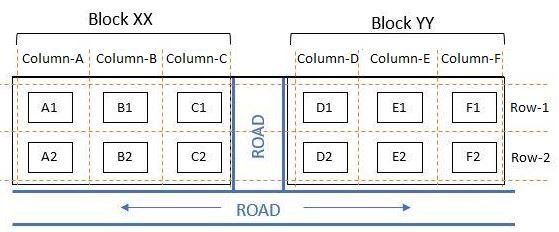
Some of the houses are occupied. The remaining ones are vacant and are the only ones available for sale.
The road adjacency value of a house is the number of its sides adjacent to a road. For example, the road adjacency values of C2, F2, and B1 are 2, 1, and 0, respectively. The neighbour count of a house is the number of sides of that house adjacent to occupied houses in the same block. For example, E1 and C1 can have the maximum possible neighbour counts of 3 and 2, respectively.
The base price of a vacant house is Rs. 10 lakhs if the house does not have a parking space, and Rs. 12 lakhs if it does. The quoted price (in lakhs of Rs.) of a vacant house is calculated as (base price) + 5 × (road adjacency value) + 3 × (neighbour count).
The following information is also known.
1. The maximum quoted price of a house in Block XX is Rs. 24 lakhs. The minimum quoted price of a house in block YY is Rs. 15 lakhs, and one such house is in Column-E.
2. Row-1 has two occupied houses, one in each block.
3. Both houses in Column-E are vacant. Each of Column-D and Column-F has at least one occupied house.
4. There is only one house with parking space in Block YY.
How many houses are vacant in Block XX?
Passage / Data
Answer the following questions based on the information given below:
The schematic diagram below shows 12 rectangular houses in a housing complex. House numbers are mentioned in the rectangles representing the houses. The houses are located in six columns – Column-A through Column-F, and two rows – Row-1 and Row-2. The houses are divided into two blocks - Block XX and Block YY. The diagram also shows two roads, one passing in front of the houses in Row-2 and another between the two blocks.
Some of the houses are occupied. The remaining ones are vacant and are the only ones available for sale.
The road adjacency value of a house is the number of its sides adjacent to a road. For example, the road adjacency values of C2, F2, and B1 are 2, 1, and 0, respectively. The neighbour count of a house is the number of sides of that house adjacent to occupied houses in the same block. For example, E1 and C1 can have the maximum possible neighbour counts of 3 and 2, respectively.
The base price of a vacant house is Rs. 10 lakhs if the house does not have a parking space, and Rs. 12 lakhs if it does. The quoted price (in lakhs of Rs.) of a vacant house is calculated as (base price) + 5 × (road adjacency value) + 3 × (neighbour count).
The following information is also known.
1. The maximum quoted price of a house in Block XX is Rs. 24 lakhs. The minimum quoted price of a house in block YY is Rs. 15 lakhs, and one such house is in Column-E.
2. Row-1 has two occupied houses, one in each block.
3. Both houses in Column-E are vacant. Each of Column-D and Column-F has at least one occupied house.
4. There is only one house with parking space in Block YY.
Which of the following houses is definitely occupied?
[Two options are correct in this question and both were accepted as correct answer by IIM Lucknow]
Passage / Data
Answer the following questions based on the information given below:
The schematic diagram below shows 12 rectangular houses in a housing complex. House numbers are mentioned in the rectangles representing the houses. The houses are located in six columns – Column-A through Column-F, and two rows – Row-1 and Row-2. The houses are divided into two blocks - Block XX and Block YY. The diagram also shows two roads, one passing in front of the houses in Row-2 and another between the two blocks.
Some of the houses are occupied. The remaining ones are vacant and are the only ones available for sale.
The road adjacency value of a house is the number of its sides adjacent to a road. For example, the road adjacency values of C2, F2, and B1 are 2, 1, and 0, respectively. The neighbour count of a house is the number of sides of that house adjacent to occupied houses in the same block. For example, E1 and C1 can have the maximum possible neighbour counts of 3 and 2, respectively.
The base price of a vacant house is Rs. 10 lakhs if the house does not have a parking space, and Rs. 12 lakhs if it does. The quoted price (in lakhs of Rs.) of a vacant house is calculated as (base price) + 5 × (road adjacency value) + 3 × (neighbour count).
The following information is also known.
1. The maximum quoted price of a house in Block XX is Rs. 24 lakhs. The minimum quoted price of a house in block YY is Rs. 15 lakhs, and one such house is in Column-E.
2. Row-1 has two occupied houses, one in each block.
3. Both houses in Column-E are vacant. Each of Column-D and Column-F has at least one occupied house.
4. There is only one house with parking space in Block YY.
Which of the following options best describes the number of vacant houses in Row-2?
Passage / Data
Answer the following questions based on the information given below:
The schematic diagram below shows 12 rectangular houses in a housing complex. House numbers are mentioned in the rectangles representing the houses. The houses are located in six columns – Column-A through Column-F, and two rows – Row-1 and Row-2. The houses are divided into two blocks - Block XX and Block YY. The diagram also shows two roads, one passing in front of the houses in Row-2 and another between the two blocks.
Some of the houses are occupied. The remaining ones are vacant and are the only ones available for sale.
The road adjacency value of a house is the number of its sides adjacent to a road. For example, the road adjacency values of C2, F2, and B1 are 2, 1, and 0, respectively. The neighbour count of a house is the number of sides of that house adjacent to occupied houses in the same block. For example, E1 and C1 can have the maximum possible neighbour counts of 3 and 2, respectively.
The base price of a vacant house is Rs. 10 lakhs if the house does not have a parking space, and Rs. 12 lakhs if it does. The quoted price (in lakhs of Rs.) of a vacant house is calculated as (base price) + 5 × (road adjacency value) + 3 × (neighbour count).
The following information is also known.
1. The maximum quoted price of a house in Block XX is Rs. 24 lakhs. The minimum quoted price of a house in block YY is Rs. 15 lakhs, and one such house is in Column-E.
2. Row-1 has two occupied houses, one in each block.
3. Both houses in Column-E are vacant. Each of Column-D and Column-F has at least one occupied house.
4. There is only one house with parking space in Block YY.
What is the maximum possible quoted price (in lakhs of Rs.) for a vacant house in Column-E?
Passage / Data
Answer the following questions based on the information given below:
The schematic diagram below shows 12 rectangular houses in a housing complex. House numbers are mentioned in the rectangles representing the houses. The houses are located in six columns – Column-A through Column-F, and two rows – Row-1 and Row-2. The houses are divided into two blocks - Block XX and Block YY. The diagram also shows two roads, one passing in front of the houses in Row-2 and another between the two blocks.
Some of the houses are occupied. The remaining ones are vacant and are the only ones available for sale.
The road adjacency value of a house is the number of its sides adjacent to a road. For example, the road adjacency values of C2, F2, and B1 are 2, 1, and 0, respectively. The neighbour count of a house is the number of sides of that house adjacent to occupied houses in the same block. For example, E1 and C1 can have the maximum possible neighbour counts of 3 and 2, respectively.
The base price of a vacant house is Rs. 10 lakhs if the house does not have a parking space, and Rs. 12 lakhs if it does. The quoted price (in lakhs of Rs.) of a vacant house is calculated as (base price) + 5 × (road adjacency value) + 3 × (neighbour count).
The following information is also known.
1. The maximum quoted price of a house in Block XX is Rs. 24 lakhs. The minimum quoted price of a house in block YY is Rs. 15 lakhs, and one such house is in Column-E.
2. Row-1 has two occupied houses, one in each block.
3. Both houses in Column-E are vacant. Each of Column-D and Column-F has at least one occupied house.
4. There is only one house with parking space in Block YY.
Which house in Block YY has parking space?
Passage / Data
Answer the following questions based on the information given below:
Five restaurants, coded R1, R2, R3, R4 and R5 gave integer ratings to five gig workers – Ullas, Vasu, Waman, Xavier and Yusuf, on a scale of 1 to 5.
The means of the ratings given by R1, R2, R3, R4 and R5 were 3.4, 2.2, 3.8, 2.8 and 3.4 respectively.
The summary statistics of these ratings for the five workers is given below.
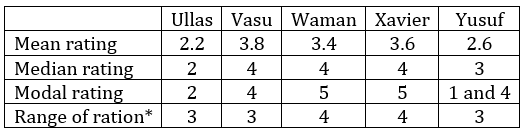
* Range of ratings is defined as the difference between the maximum and minimum ratings awarded to a worker.
The following is partial information about ratings of 1 and 5 awarded by the restaurants to the workers.
(a) R1 awarded a rating of 5 to Waman, as did R2 to Xavier, R3 to Waman and Xavier, and R5 to Vasu.
(b) R1 awarded a rating of 1 to Ullas, as did R2 to Waman and Yusuf, and R3 to Yusuf.
How many individual ratings cannot be determined from the above information?
Passage / Data
Answer the following questions based on the information given below:
Five restaurants, coded R1, R2, R3, R4 and R5 gave integer ratings to five gig workers – Ullas, Vasu, Waman, Xavier and Yusuf, on a scale of 1 to 5.
The means of the ratings given by R1, R2, R3, R4 and R5 were 3.4, 2.2, 3.8, 2.8 and 3.4 respectively.
The summary statistics of these ratings for the five workers is given below.
* Range of ratings is defined as the difference between the maximum and minimum ratings awarded to a worker.
The following is partial information about ratings of 1 and 5 awarded by the restaurants to the workers.
(a) R1 awarded a rating of 5 to Waman, as did R2 to Xavier, R3 to Waman and Xavier, and R5 to Vasu.
(b) R1 awarded a rating of 1 to Ullas, as did R2 to Waman and Yusuf, and R3 to Yusuf.
To how many workers did R2 give a rating of 4?
Passage / Data
Answer the following questions based on the information given below:
Five restaurants, coded R1, R2, R3, R4 and R5 gave integer ratings to five gig workers – Ullas, Vasu, Waman, Xavier and Yusuf, on a scale of 1 to 5.
The means of the ratings given by R1, R2, R3, R4 and R5 were 3.4, 2.2, 3.8, 2.8 and 3.4 respectively.
The summary statistics of these ratings for the five workers is given below.
* Range of ratings is defined as the difference between the maximum and minimum ratings awarded to a worker.
The following is partial information about ratings of 1 and 5 awarded by the restaurants to the workers.
(a) R1 awarded a rating of 5 to Waman, as did R2 to Xavier, R3 to Waman and Xavier, and R5 to Vasu.
(b) R1 awarded a rating of 1 to Ullas, as did R2 to Waman and Yusuf, and R3 to Yusuf.
What rating did R1 give to Xavier?
Passage / Data
Answer the following questions based on the information given below:
Five restaurants, coded R1, R2, R3, R4 and R5 gave integer ratings to five gig workers – Ullas, Vasu, Waman, Xavier and Yusuf, on a scale of 1 to 5.
The means of the ratings given by R1, R2, R3, R4 and R5 were 3.4, 2.2, 3.8, 2.8 and 3.4 respectively.
The summary statistics of these ratings for the five workers is given below.
* Range of ratings is defined as the difference between the maximum and minimum ratings awarded to a worker.
The following is partial information about ratings of 1 and 5 awarded by the restaurants to the workers.
(a) R1 awarded a rating of 5 to Waman, as did R2 to Xavier, R3 to Waman and Xavier, and R5 to Vasu.
(b) R1 awarded a rating of 1 to Ullas, as did R2 to Waman and Yusuf, and R3 to Yusuf.
What is the median of the ratings given by R3 to the five workers?
Passage / Data
Answer the following questions based on the information given below:
Five restaurants, coded R1, R2, R3, R4 and R5 gave integer ratings to five gig workers – Ullas, Vasu, Waman, Xavier and Yusuf, on a scale of 1 to 5.
The means of the ratings given by R1, R2, R3, R4 and R5 were 3.4, 2.2, 3.8, 2.8 and 3.4 respectively.
The summary statistics of these ratings for the five workers is given below.
* Range of ratings is defined as the difference between the maximum and minimum ratings awarded to a worker.
The following is partial information about ratings of 1 and 5 awarded by the restaurants to the workers.
(a) R1 awarded a rating of 5 to Waman, as did R2 to Xavier, R3 to Waman and Xavier, and R5 to Vasu.
(b) R1 awarded a rating of 1 to Ullas, as did R2 to Waman and Yusuf, and R3 to Yusuf.
Which among the following restaurants gave its median rating to exactly one of the workers?
The minor angle between the hour hand and minute hand of a clock was observed at 8:48 am. The minimum deviation (in min) after 8:48 am when the angle increases by 50% is?
Passage / Data
Answer the following questions based on the information given below:
Odsville has five firms – Alfloo, Bzygoo, Czechy, Drjbna and Elavalaki. Each of these firms was founded in some year and also closed down a few years later.
Each firm raised Rs. 1 crore in its first and last year of existence. The amount each firm raised every year increased until it reached a maximum, and then decreased until the firm closed down. No firm raised the same amount of money in two consecutive years. Each annual increase and decrease was either by Rs. 1 crore or by Rs. 2 crores.
The table below provides partial information about the five firms.
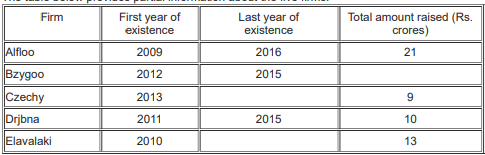
For which firm(s) can the amounts raised by them be concluded with certainty in each year?
Passage / Data
Answer the following questions based on the information given below:
Odsville has five firms – Alfloo, Bzygoo, Czechy, Drjbna and Elavalaki. Each of these firms was founded in some year and also closed down a few years later.
Each firm raised Rs. 1 crore in its first and last year of existence. The amount each firm raised every year increased until it reached a maximum, and then decreased until the firm closed down. No firm raised the same amount of money in two consecutive years. Each annual increase and decrease was either by Rs. 1 crore or by Rs. 2 crores.
The table below provides partial information about the five firms.
What best can be concluded about the total amount of money raised in 2015?
Passage / Data
Answer the following questions based on the information given below:
Odsville has five firms – Alfloo, Bzygoo, Czechy, Drjbna and Elavalaki. Each of these firms was founded in some year and also closed down a few years later.
Each firm raised Rs. 1 crore in its first and last year of existence. The amount each firm raised every year increased until it reached a maximum, and then decreased until the firm closed down. No firm raised the same amount of money in two consecutive years. Each annual increase and decrease was either by Rs. 1 crore or by Rs. 2 crores.
The table below provides partial information about the five firms.
What is the largest possible total amount of money (in Rs. crores) that could have been raised in 2013?
Passage / Data
Answer the following questions based on the information given below:
Odsville has five firms – Alfloo, Bzygoo, Czechy, Drjbna and Elavalaki. Each of these firms was founded in some year and also closed down a few years later.
Each firm raised Rs. 1 crore in its first and last year of existence. The amount each firm raised every year increased until it reached a maximum, and then decreased until the firm closed down. No firm raised the same amount of money in two consecutive years. Each annual increase and decrease was either by Rs. 1 crore or by Rs. 2 crores.
The table below provides partial information about the five firms.
If Elavalaki raised Rs. 3 crores in 2013, then what is the smallest possible total amount of money (in Rs. crores) that could have been raised by all the companies in 2012?
Passage / Data
Answer the following questions based on the information given below:
Odsville has five firms – Alfloo, Bzygoo, Czechy, Drjbna and Elavalaki. Each of these firms was founded in some year and also closed down a few years later.
Each firm raised Rs. 1 crore in its first and last year of existence. The amount each firm raised every year increased until it reached a maximum, and then decreased until the firm closed down. No firm raised the same amount of money in two consecutive years. Each annual increase and decrease was either by Rs. 1 crore or by Rs. 2 crores.
The table below provides partial information about the five firms.
If the total amount of money raised in 2014 is Rs. 12 crores, then which of the following is not possible?
Passage / Data
Answer the following questions based on the information given below:
Anjali, Bipasha, and Chitra visited an entertainment park that has four rides. Each ride lasts one hour and can accommodate one visitor at one point. All rides begin at 9 am and must be completed by 5 pm except for Ride-3, for which the last ride has to be completed by 1 pm. Ride gates open every 30 minutes, e.g. 10 am, 10:30 am, and so on. Whenever a ride gate opens, and there is no visitor inside, the first visitor waiting in the queue buys the ticket just before taking the ride. The ticket prices are Rs. 20, Rs. 50, Rs. 30 and Rs. 40 for Rides 1 to 4, respectively. Each of the three visitors took at least one ride and did not necessarily take all rides. None of them took the same ride more than once. The movement time from one ride to another is negligible, and a visitor leaves the ride immediately after the completion of the ride. No one takes a break inside the park unless mentioned explicitly.
The following information is also known.
- Chitra never waited in the queue and completed her visit by 11 am after spending Rs. 50 to pay for the ticket(s).
- Anjali took Ride-1 at 11 am after waiting for 30 mins for Chitra to complete it. It was the only ride where Anjali waited.
- Bipasha began her first of three rides at 11:30 am. All three visitors incurred the same amount of ticket expense by 12:15 pm.
- The last ride taken by Anjali and Bipasha was the same, where Bipasha waited 30 mins for Anjali to complete her ride. Before standing in the queue for that ride, Bipasha took a 1-hour coffee break after completing her previous ride.
What was the total amount spent on tickets (in Rs.) by Bipasha?
Passage / Data
Answer the following questions based on the information given below:
Anjali, Bipasha, and Chitra visited an entertainment park that has four rides. Each ride lasts one hour and can accommodate one visitor at one point. All rides begin at 9 am and must be completed by 5 pm except for Ride-3, for which the last ride has to be completed by 1 pm. Ride gates open every 30 minutes, e.g. 10 am, 10:30 am, and so on. Whenever a ride gate opens, and there is no visitor inside, the first visitor waiting in the queue buys the ticket just before taking the ride. The ticket prices are Rs. 20, Rs. 50, Rs. 30 and Rs. 40 for Rides 1 to 4, respectively. Each of the three visitors took at least one ride and did not necessarily take all rides. None of them took the same ride more than once. The movement time from one ride to another is negligible, and a visitor leaves the ride immediately after the completion of the ride. No one takes a break inside the park unless mentioned explicitly.
The following information is also known.
- Chitra never waited in the queue and completed her visit by 11 am after spending Rs. 50 to pay for the ticket(s).
- Anjali took Ride-1 at 11 am after waiting for 30 mins for Chitra to complete it. It was the only ride where Anjali waited.
- Bipasha began her first of three rides at 11:30 am. All three visitors incurred the same amount of ticket expense by 12:15 pm.
- The last ride taken by Anjali and Bipasha was the same, where Bipasha waited 30 mins for Anjali to complete her ride. Before standing in the queue for that ride, Bipasha took a 1-hour coffee break after completing her previous ride.
Which were all the rides that Anjali completed by 2:00 pm?
Passage / Data
Answer the following questions based on the information given below:
Anjali, Bipasha, and Chitra visited an entertainment park that has four rides. Each ride lasts one hour and can accommodate one visitor at one point. All rides begin at 9 am and must be completed by 5 pm except for Ride-3, for which the last ride has to be completed by 1 pm. Ride gates open every 30 minutes, e.g. 10 am, 10:30 am, and so on. Whenever a ride gate opens, and there is no visitor inside, the first visitor waiting in the queue buys the ticket just before taking the ride. The ticket prices are Rs. 20, Rs. 50, Rs. 30 and Rs. 40 for Rides 1 to 4, respectively. Each of the three visitors took at least one ride and did not necessarily take all rides. None of them took the same ride more than once. The movement time from one ride to another is negligible, and a visitor leaves the ride immediately after the completion of the ride. No one takes a break inside the park unless mentioned explicitly.
The following information is also known.
- Chitra never waited in the queue and completed her visit by 11 am after spending Rs. 50 to pay for the ticket(s).
- Anjali took Ride-1 at 11 am after waiting for 30 mins for Chitra to complete it. It was the only ride where Anjali waited.
- Bipasha began her first of three rides at 11:30 am. All three visitors incurred the same amount of ticket expense by 12:15 pm.
- The last ride taken by Anjali and Bipasha was the same, where Bipasha waited 30 mins for Anjali to complete her ride. Before standing in the queue for that ride, Bipasha took a 1-hour coffee break after completing her previous ride.
Which ride was taken by all three visitors?
Passage / Data
Answer the following questions based on the information given below:
Anjali, Bipasha, and Chitra visited an entertainment park that has four rides. Each ride lasts one hour and can accommodate one visitor at one point. All rides begin at 9 am and must be completed by 5 pm except for Ride-3, for which the last ride has to be completed by 1 pm. Ride gates open every 30 minutes, e.g. 10 am, 10:30 am, and so on. Whenever a ride gate opens, and there is no visitor inside, the first visitor waiting in the queue buys the ticket just before taking the ride. The ticket prices are Rs. 20, Rs. 50, Rs. 30 and Rs. 40 for Rides 1 to 4, respectively. Each of the three visitors took at least one ride and did not necessarily take all rides. None of them took the same ride more than once. The movement time from one ride to another is negligible, and a visitor leaves the ride immediately after the completion of the ride. No one takes a break inside the park unless mentioned explicitly.
The following information is also known.
- Chitra never waited in the queue and completed her visit by 11 am after spending Rs. 50 to pay for the ticket(s).
- Anjali took Ride-1 at 11 am after waiting for 30 mins for Chitra to complete it. It was the only ride where Anjali waited.
- Bipasha began her first of three rides at 11:30 am. All three visitors incurred the same amount of ticket expense by 12:15 pm.
- The last ride taken by Anjali and Bipasha was the same, where Bipasha waited 30 mins for Anjali to complete her ride. Before standing in the queue for that ride, Bipasha took a 1-hour coffee break after completing her previous ride.
How many rides did Anjali and Chitra take in total?
Passage / Data
Answer the following questions based on the information given below:
Anjali, Bipasha, and Chitra visited an entertainment park that has four rides. Each ride lasts one hour and can accommodate one visitor at one point. All rides begin at 9 am and must be completed by 5 pm except for Ride-3, for which the last ride has to be completed by 1 pm. Ride gates open every 30 minutes, e.g. 10 am, 10:30 am, and so on. Whenever a ride gate opens, and there is no visitor inside, the first visitor waiting in the queue buys the ticket just before taking the ride. The ticket prices are Rs. 20, Rs. 50, Rs. 30 and Rs. 40 for Rides 1 to 4, respectively. Each of the three visitors took at least one ride and did not necessarily take all rides. None of them took the same ride more than once. The movement time from one ride to another is negligible, and a visitor leaves the ride immediately after the completion of the ride. No one takes a break inside the park unless mentioned explicitly.
The following information is also known.
- Chitra never waited in the queue and completed her visit by 11 am after spending Rs. 50 to pay for the ticket(s).
- Anjali took Ride-1 at 11 am after waiting for 30 mins for Chitra to complete it. It was the only ride where Anjali waited.
- Bipasha began her first of three rides at 11:30 am. All three visitors incurred the same amount of ticket expense by 12:15 pm.
- The last ride taken by Anjali and Bipasha was the same, where Bipasha waited 30 mins for Anjali to complete her ride. Before standing in the queue for that ride, Bipasha took a 1-hour coffee break after completing her previous ride.
What was the total amount spent on tickets (in Rs.) by Anjali?
Passage / Data
Answer the following questions based on the information given below:
Three participants – Akhil, Bimal and Chatur participate in a random draw competition for five days. Every day, each participant randomly picks up a ball numbered between 1 and 9. The number on the ball determines his score on that day. The total score of a participant is the sum of his scores attained in the five days. The total score of a day is the sum of participants’ scores on that day. The 2-day average on a day, except on Day 1, is the average of the total scores of that day and of the previous day. For example, if the total scores of Day 1 and Day 2 are 25 and 20, then the 2-day average on Day 2 is calculated as 22.5. Table 1 gives the 2-day averages for

Participants are ranked each day, with the person having the maximum score being awarded the minimum rank (1) on that day. If there is a tie, all participants with the tied score are awarded the best available rank. For example, if on a day Akhil, Bimal, and Chatur score 8, 7 and 7 respectively, then their ranks will be 1, 2 and 2 respectively on that day. These ranks are given in Table 2.
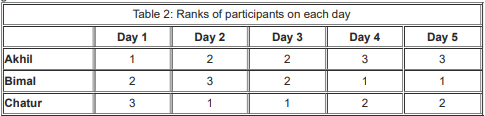
The following information is also known.
- Chatur always scores in multiples of 3. His score on Day 2 is the unique highest score in the competition. His minimum score is observed only on Day 1, and it matches Akhil’s score on Day 4.
- The total score on Day 3 is the same as the total score on Day 4.
- Bimal’s scores are the same on Day 1 and Day 3.
What is Akhil's score on Day 1?
Passage / Data
Answer the following questions based on the information given below:
Three participants – Akhil, Bimal and Chatur participate in a random draw competition for five days. Every day, each participant randomly picks up a ball numbered between 1 and 9. The number on the ball determines his score on that day. The total score of a participant is the sum of his scores attained in the five days. The total score of a day is the sum of participants’ scores on that day. The 2-day average on a day, except on Day 1, is the average of the total scores of that day and of the previous day. For example, if the total scores of Day 1 and Day 2 are 25 and 20, then the 2-day average on Day 2 is calculated as 22.5. Table 1 gives the 2-day averages for
Participants are ranked each day, with the person having the maximum score being awarded the minimum rank (1) on that day. If there is a tie, all participants with the tied score are awarded the best available rank. For example, if on a day Akhil, Bimal, and Chatur score 8, 7 and 7 respectively, then their ranks will be 1, 2 and 2 respectively on that day. These ranks are given in Table 2.
The following information is also known.
- Chatur always scores in multiples of 3. His score on Day 2 is the unique highest score in the competition. His minimum score is observed only on Day 1, and it matches Akhil’s score on Day 4.
- The total score on Day 3 is the same as the total score on Day 4.
- Bimal’s scores are the same on Day 1 and Day 3.
Who attains the maximum total score?
Passage / Data
Answer the following questions based on the information given below:
Three participants – Akhil, Bimal and Chatur participate in a random draw competition for five days. Every day, each participant randomly picks up a ball numbered between 1 and 9. The number on the ball determines his score on that day. The total score of a participant is the sum of his scores attained in the five days. The total score of a day is the sum of participants’ scores on that day. The 2-day average on a day, except on Day 1, is the average of the total scores of that day and of the previous day. For example, if the total scores of Day 1 and Day 2 are 25 and 20, then the 2-day average on Day 2 is calculated as 22.5. Table 1 gives the 2-day averages for
Participants are ranked each day, with the person having the maximum score being awarded the minimum rank (1) on that day. If there is a tie, all participants with the tied score are awarded the best available rank. For example, if on a day Akhil, Bimal, and Chatur score 8, 7 and 7 respectively, then their ranks will be 1, 2 and 2 respectively on that day. These ranks are given in Table 2.
The following information is also known.
- Chatur always scores in multiples of 3. His score on Day 2 is the unique highest score in the competition. His minimum score is observed only on Day 1, and it matches Akhil’s score on Day 4.
- The total score on Day 3 is the same as the total score on Day 4.
- Bimal’s scores are the same on Day 1 and Day 3.
What is the minimum possible total score of Bimal?
Passage / Data
Answer the following questions based on the information given below:
Three participants – Akhil, Bimal and Chatur participate in a random draw competition for five days. Every day, each participant randomly picks up a ball numbered between 1 and 9. The number on the ball determines his score on that day. The total score of a participant is the sum of his scores attained in the five days. The total score of a day is the sum of participants’ scores on that day. The 2-day average on a day, except on Day 1, is the average of the total scores of that day and of the previous day. For example, if the total scores of Day 1 and Day 2 are 25 and 20, then the 2-day average on Day 2 is calculated as 22.5. Table 1 gives the 2-day averages for
Participants are ranked each day, with the person having the maximum score being awarded the minimum rank (1) on that day. If there is a tie, all participants with the tied score are awarded the best available rank. For example, if on a day Akhil, Bimal, and Chatur score 8, 7 and 7 respectively, then their ranks will be 1, 2 and 2 respectively on that day. These ranks are given in Table 2.
The following information is also known.
- Chatur always scores in multiples of 3. His score on Day 2 is the unique highest score in the competition. His minimum score is observed only on Day 1, and it matches Akhil’s score on Day 4.
- The total score on Day 3 is the same as the total score on Day 4.
- Bimal’s scores are the same on Day 1 and Day 3.
If the total score of Bimal is a multiple of 3, what is the score of Akhil on Day 2?
Passage / Data
Answer the following questions based on the information given below:
Three participants – Akhil, Bimal and Chatur participate in a random draw competition for five days. Every day, each participant randomly picks up a ball numbered between 1 and 9. The number on the ball determines his score on that day. The total score of a participant is the sum of his scores attained in the five days. The total score of a day is the sum of participants’ scores on that day. The 2-day average on a day, except on Day 1, is the average of the total scores of that day and of the previous day. For example, if the total scores of Day 1 and Day 2 are 25 and 20, then the 2-day average on Day 2 is calculated as 22.5. Table 1 gives the 2-day averages for
Participants are ranked each day, with the person having the maximum score being awarded the minimum rank (1) on that day. If there is a tie, all participants with the tied score are awarded the best available rank. For example, if on a day Akhil, Bimal, and Chatur score 8, 7 and 7 respectively, then their ranks will be 1, 2 and 2 respectively on that day. These ranks are given in Table 2.
The following information is also known.
- Chatur always scores in multiples of 3. His score on Day 2 is the unique highest score in the competition. His minimum score is observed only on Day 1, and it matches Akhil’s score on Day 4.
- The total score on Day 3 is the same as the total score on Day 4.
- Bimal’s scores are the same on Day 1 and Day 3.
If Akhil attains a total score of 24, then what is the total score of Bimal?
Passage / Data
Answer the following questions based on the information given below:
There are nine boxes arranged in a 3×3 array as shown in Tables 1 and 2. Each box contains three sacks. Each sack has a certain number of coins, between 1 and 9, both inclusive.
The average number of coins per sack in the boxes are all distinct integers. The total number of coins in each row is the same. The total number of coins in each column is also the same.
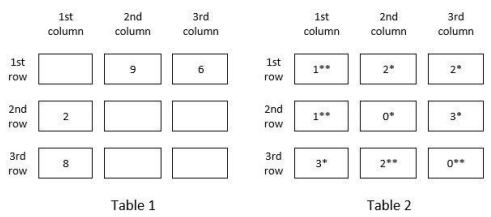
Table 1 gives information regarding the median of the numbers of coins in the three sacks in a box for some of the boxes. In Table 2 each box has a number which represents the number of sacks in that box having more than 5 coins. That number is followed by a * if the sacks in that box satisfy exactly one among the following three conditions, and it is followed by ** if two or more of these conditions are satisfied.
- The minimum among the numbers of coins in the three sacks in the box is 1.
- The median of the numbers of coins in the three sacks is 1.
- The maximum among the numbers of coins in the three sacks in the box is 9.
What is the total number of coins in all the boxes in the 3rd row?
Passage / Data
Answer the following questions based on the information given below:
There are nine boxes arranged in a 3×3 array as shown in Tables 1 and 2. Each box contains three sacks. Each sack has a certain number of coins, between 1 and 9, both inclusive.
The average number of coins per sack in the boxes are all distinct integers. The total number of coins in each row is the same. The total number of coins in each column is also the same.
Table 1 gives information regarding the median of the numbers of coins in the three sacks in a box for some of the boxes. In Table 2 each box has a number which represents the number of sacks in that box having more than 5 coins. That number is followed by a * if the sacks in that box satisfy exactly one among the following three conditions, and it is followed by ** if two or more of these conditions are satisfied.
- The minimum among the numbers of coins in the three sacks in the box is 1.
- The median of the numbers of coins in the three sacks is 1.
- The maximum among the numbers of coins in the three sacks in the box is 9.
How many boxes have at least one sack containing 9 coins?
Passage / Data
Answer the following questions based on the information given below:
There are nine boxes arranged in a 3×3 array as shown in Tables 1 and 2. Each box contains three sacks. Each sack has a certain number of coins, between 1 and 9, both inclusive.
The average number of coins per sack in the boxes are all distinct integers. The total number of coins in each row is the same. The total number of coins in each column is also the same.
Table 1 gives information regarding the median of the numbers of coins in the three sacks in a box for some of the boxes. In Table 2 each box has a number which represents the number of sacks in that box having more than 5 coins. That number is followed by a * if the sacks in that box satisfy exactly one among the following three conditions, and it is followed by ** if two or more of these conditions are satisfied.
- The minimum among the numbers of coins in the three sacks in the box is 1.
- The median of the numbers of coins in the three sacks is 1.
- The maximum among the numbers of coins in the three sacks in the box is 9.
For how many boxes are the average and median of the numbers of coins contained in the three sacks in that box the same?
Passage / Data
Answer the following questions based on the information given below:
There are nine boxes arranged in a 3×3 array as shown in Tables 1 and 2. Each box contains three sacks. Each sack has a certain number of coins, between 1 and 9, both inclusive.
The average number of coins per sack in the boxes are all distinct integers. The total number of coins in each row is the same. The total number of coins in each column is also the same.
Table 1 gives information regarding the median of the numbers of coins in the three sacks in a box for some of the boxes. In Table 2 each box has a number which represents the number of sacks in that box having more than 5 coins. That number is followed by a * if the sacks in that box satisfy exactly one among the following three conditions, and it is followed by ** if two or more of these conditions are satisfied.
- The minimum among the numbers of coins in the three sacks in the box is 1.
- The median of the numbers of coins in the three sacks is 1.
- The maximum among the numbers of coins in the three sacks in the box is 9.
How many sacks have exactly one coin?
Passage / Data
Answer the following questions based on the information given below:
There are nine boxes arranged in a 3×3 array as shown in Tables 1 and 2. Each box contains three sacks. Each sack has a certain number of coins, between 1 and 9, both inclusive.
The average number of coins per sack in the boxes are all distinct integers. The total number of coins in each row is the same. The total number of coins in each column is also the same.
Table 1 gives information regarding the median of the numbers of coins in the three sacks in a box for some of the boxes. In Table 2 each box has a number which represents the number of sacks in that box having more than 5 coins. That number is followed by a * if the sacks in that box satisfy exactly one among the following three conditions, and it is followed by ** if two or more of these conditions are satisfied.
- The minimum among the numbers of coins in the three sacks in the box is 1.
- The median of the numbers of coins in the three sacks is 1.
- The maximum among the numbers of coins in the three sacks in the box is 9.
In how many boxes do all three sacks contain different numbers of coins?
Passage / Data
Answer the following questions based on the information given below:
In a coaching class, some students register online, and some others register offline. No student registers both online and offline; hence the total registration number is the sum of online and offline registrations. The following facts and table pertain to these registration numbers for the five months – January to May of 2023. The table shows the minimum, maximum, median registration numbers of these five months, separately for online, offline and total number of registrations. The following additional facts are known.
1. In every month, both online and offline registration numbers were multiples of 10.
2. In January, the number of offline registrations was twice that of online registrations.
3. In April, the number of online registrations was twice that of offline registrations.
4. The number of online registrations in March was the same as the number of offline registrations in February.
5. The number of online registrations was the largest in May.
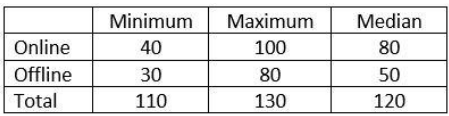
What was the total number of registrations in April?
Passage / Data
Answer the following questions based on the information given below:
In a coaching class, some students register online, and some others register offline. No student registers both online and offline; hence the total registration number is the sum of online and offline registrations. The following facts and table pertain to these registration numbers for the five months – January to May of 2023. The table shows the minimum, maximum, median registration numbers of these five months, separately for online, offline and total number of registrations. The following additional facts are known.
1. In every month, both online and offline registration numbers were multiples of 10.
2. In January, the number of offline registrations was twice that of online registrations.
3. In April, the number of online registrations was twice that of offline registrations.
4. The number of online registrations in March was the same as the number of offline registrations in February.
5. The number of online registrations was the largest in May.
What was the number of online registrations in January?
Passage / Data
Answer the following questions based on the information given below:
In a coaching class, some students register online, and some others register offline. No student registers both online and offline; hence the total registration number is the sum of online and offline registrations. The following facts and table pertain to these registration numbers for the five months – January to May of 2023. The table shows the minimum, maximum, median registration numbers of these five months, separately for online, offline and total number of registrations. The following additional facts are known.
1. In every month, both online and offline registration numbers were multiples of 10.
2. In January, the number of offline registrations was twice that of online registrations.
3. In April, the number of online registrations was twice that of offline registrations.
4. The number of online registrations in March was the same as the number of offline registrations in February.
5. The number of online registrations was the largest in May.
Which of the following statements can be true?
I. The number of offline registrations was the smallest in May.
II. The total number of registrations was the smallest in February.
Passage / Data
Answer the following questions based on the information given below:
In a coaching class, some students register online, and some others register offline. No student registers both online and offline; hence the total registration number is the sum of online and offline registrations. The following facts and table pertain to these registration numbers for the five months – January to May of 2023. The table shows the minimum, maximum, median registration numbers of these five months, separately for online, offline and total number of registrations. The following additional facts are known.
1. In every month, both online and offline registration numbers were multiples of 10.
2. In January, the number of offline registrations was twice that of online registrations.
3. In April, the number of online registrations was twice that of offline registrations.
4. The number of online registrations in March was the same as the number of offline registrations in February.
5. The number of online registrations was the largest in May.
What best can be concluded about the number of offline registrations in February?
Passage / Data
Answer the following questions based on the information given below:
In a coaching class, some students register online, and some others register offline. No student registers both online and offline; hence the total registration number is the sum of online and offline registrations. The following facts and table pertain to these registration numbers for the five months – January to May of 2023. The table shows the minimum, maximum, median registration numbers of these five months, separately for online, offline and total number of registrations. The following additional facts are known.
1. In every month, both online and offline registration numbers were multiples of 10.
2. In January, the number of offline registrations was twice that of online registrations.
3. In April, the number of online registrations was twice that of offline registrations.
4. The number of online registrations in March was the same as the number of offline registrations in February.
5. The number of online registrations was the largest in May.
Which pair of months definitely had the same total number of registrations?
I. January and April
II. February and May
Passage / Data
Answer the following questions based on the information given below:
There are only three female students – Amala, Koli and Rini – and only three male students – Biman, Mathew and Shyamal – in a course. The course has two evaluation components, a project and a test. The aggregate score in the course is a weighted average of the two components, with the weights being positive and adding to 1.
The projects are done in groups of two, with each group consisting of a female and a male student. Both the group members obtain the same score in the project.
The following additional facts are known about the scores in the project and the test.
1. The minimum, maximum and the average of both project and test scores were identical – 40, 80 and 60, respectively.
2. The test scores of the students were all multiples of 10; four of them were distinct and the remaining two were equal to the average test scores.
3. Amala’s score in the project was double that of Koli in the same, but Koli scored 20 more than Amala in the test. Yet Amala had the highest aggregate score.
4. Shyamal scored the second highest in the test. He scored two more than Koli, but two less than Amala in the aggregate.
5. Biman scored the second lowest in the test and the lowest in the aggregate.
6. Mathew scored more than Rini in the project, but less than her in the test.
What was Rini’s score in the project?
Passage / Data
Answer the following questions based on the information given below:
There are only three female students – Amala, Koli and Rini – and only three male students – Biman, Mathew and Shyamal – in a course. The course has two evaluation components, a project and a test. The aggregate score in the course is a weighted average of the two components, with the weights being positive and adding to 1.
The projects are done in groups of two, with each group consisting of a female and a male student. Both the group members obtain the same score in the project.
The following additional facts are known about the scores in the project and the test.
1. The minimum, maximum and the average of both project and test scores were identical – 40, 80 and 60, respectively.
2. The test scores of the students were all multiples of 10; four of them were distinct and the remaining two were equal to the average test scores.
3. Amala’s score in the project was double that of Koli in the same, but Koli scored 20 more than Amala in the test. Yet Amala had the highest aggregate score.
4. Shyamal scored the second highest in the test. He scored two more than Koli, but two less than Amala in the aggregate.
5. Biman scored the second lowest in the test and the lowest in the aggregate.
6. Mathew scored more than Rini in the project, but less than her in the test.
What was the weight of the test component?
Passage / Data
Answer the following questions based on the information given below:
There are only three female students – Amala, Koli and Rini – and only three male students – Biman, Mathew and Shyamal – in a course. The course has two evaluation components, a project and a test. The aggregate score in the course is a weighted average of the two components, with the weights being positive and adding to 1.
The projects are done in groups of two, with each group consisting of a female and a male student. Both the group members obtain the same score in the project.
The following additional facts are known about the scores in the project and the test.
1. The minimum, maximum and the average of both project and test scores were identical – 40, 80 and 60, respectively.
2. The test scores of the students were all multiples of 10; four of them were distinct and the remaining two were equal to the average test scores.
3. Amala’s score in the project was double that of Koli in the same, but Koli scored 20 more than Amala in the test. Yet Amala had the highest aggregate score.
4. Shyamal scored the second highest in the test. He scored two more than Koli, but two less than Amala in the aggregate.
5. Biman scored the second lowest in the test and the lowest in the aggregate.
6. Mathew scored more than Rini in the project, but less than her in the test.
What was the maximum aggregate score obtained by the students?
Passage / Data
Answer the following questions based on the information given below:
There are only three female students – Amala, Koli and Rini – and only three male students – Biman, Mathew and Shyamal – in a course. The course has two evaluation components, a project and a test. The aggregate score in the course is a weighted average of the two components, with the weights being positive and adding to 1.
The projects are done in groups of two, with each group consisting of a female and a male student. Both the group members obtain the same score in the project.
The following additional facts are known about the scores in the project and the test.
1. The minimum, maximum and the average of both project and test scores were identical – 40, 80 and 60, respectively.
2. The test scores of the students were all multiples of 10; four of them were distinct and the remaining two were equal to the average test scores.
3. Amala’s score in the project was double that of Koli in the same, but Koli scored 20 more than Amala in the test. Yet Amala had the highest aggregate score.
4. Shyamal scored the second highest in the test. He scored two more than Koli, but two less than Amala in the aggregate.
5. Biman scored the second lowest in the test and the lowest in the aggregate.
6. Mathew scored more than Rini in the project, but less than her in the test.
What was Mathew’s score in the test?
Passage / Data
Answer the following questions based on the information given below:
There are only three female students – Amala, Koli and Rini – and only three male students – Biman, Mathew and Shyamal – in a course. The course has two evaluation components, a project and a test. The aggregate score in the course is a weighted average of the two components, with the weights being positive and adding to 1.
The projects are done in groups of two, with each group consisting of a female and a male student. Both the group members obtain the same score in the project.
The following additional facts are known about the scores in the project and the test.
1. The minimum, maximum and the average of both project and test scores were identical – 40, 80 and 60, respectively.
2. The test scores of the students were all multiples of 10; four of them were distinct and the remaining two were equal to the average test scores.
3. Amala’s score in the project was double that of Koli in the same, but Koli scored 20 more than Amala in the test. Yet Amala had the highest aggregate score.
4. Shyamal scored the second highest in the test. He scored two more than Koli, but two less than Amala in the aggregate.
5. Biman scored the second lowest in the test and the lowest in the aggregate.
6. Mathew scored more than Rini in the project, but less than her in the test.
Which of the following pairs of students were part of the same project team?
i) Amala and Biman
ii) Koli and Mathew
Passage / Data
Answer the following questions based on the information given below:
An air conditioner (AC) company has four dealers – D1, D2, D3 and D4 in a city. It is evaluating sales performances of these dealers. The company sells two variants of ACs – Window and Split. Both these variants can be either Inverter type or Non-inverter type. It is known that of the total number of ACs sold in the city, 25% were of Window variant, while the rest were of Split variant. Among the Inverter ACs sold, 20% were of Window variant.
The following information is also known:
1. Every dealer sold at least two window ACs.
2. D1 sold 13 inverter ACs, while D3 sold 5 Non-inverter ACs.
3. A total of six Window Non-inverter ACs and 36 Split Inverter ACs were sold in the city.
4. The number of Split ACs sold by D1 was twice the number of Window ACs sold by it.
5. D3 and D4 sold an equal number of Window ACs and this number was one-third of the number of similar ACs sold by D2.
6. D2 and D3 were the only ones who sold Window Non-inverter ACs. The number of these ACs sold by D2 was twice the number of these ACs sold by D3.
7. D3 and D4 sold an equal number of Split Inverter ACs. This number was half the number of similar ACs sold by D2.
How many Split Inverter ACs did D2 sell?
Passage / Data
Answer the following questions based on the information given below:
An air conditioner (AC) company has four dealers – D1, D2, D3 and D4 in a city. It is evaluating sales performances of these dealers. The company sells two variants of ACs – Window and Split. Both these variants can be either Inverter type or Non-inverter type. It is known that of the total number of ACs sold in the city, 25% were of Window variant, while the rest were of Split variant. Among the Inverter ACs sold, 20% were of Window variant.
The following information is also known:
1. Every dealer sold at least two window ACs.
2. D1 sold 13 inverter ACs, while D3 sold 5 Non-inverter ACs.
3. A total of six Window Non-inverter ACs and 36 Split Inverter ACs were sold in the city.
4. The number of Split ACs sold by D1 was twice the number of Window ACs sold by it.
5. D3 and D4 sold an equal number of Window ACs and this number was one-third of the number of similar ACs sold by D2.
6. D2 and D3 were the only ones who sold Window Non-inverter ACs. The number of these ACs sold by D2 was twice the number of these ACs sold by D3.
7. D3 and D4 sold an equal number of Split Inverter ACs. This number was half the number of similar ACs sold by D2.
What percentage of ACs sold were of Non-inverter type?
Passage / Data
Answer the following questions based on the information given below:
An air conditioner (AC) company has four dealers – D1, D2, D3 and D4 in a city. It is evaluating sales performances of these dealers. The company sells two variants of ACs – Window and Split. Both these variants can be either Inverter type or Non-inverter type. It is known that of the total number of ACs sold in the city, 25% were of Window variant, while the rest were of Split variant. Among the Inverter ACs sold, 20% were of Window variant.
The following information is also known:
1. Every dealer sold at least two window ACs.
2. D1 sold 13 inverter ACs, while D3 sold 5 Non-inverter ACs.
3. A total of six Window Non-inverter ACs and 36 Split Inverter ACs were sold in the city.
4. The number of Split ACs sold by D1 was twice the number of Window ACs sold by it.
5. D3 and D4 sold an equal number of Window ACs and this number was one-third of the number of similar ACs sold by D2.
6. D2 and D3 were the only ones who sold Window Non-inverter ACs. The number of these ACs sold by D2 was twice the number of these ACs sold by D3.
7. D3 and D4 sold an equal number of Split Inverter ACs. This number was half the number of similar ACs sold by D2.
What was the total number of ACs sold by D2 and D4?
Passage / Data
Answer the following questions based on the information given below:
An air conditioner (AC) company has four dealers – D1, D2, D3 and D4 in a city. It is evaluating sales performances of these dealers. The company sells two variants of ACs – Window and Split. Both these variants can be either Inverter type or Non-inverter type. It is known that of the total number of ACs sold in the city, 25% were of Window variant, while the rest were of Split variant. Among the Inverter ACs sold, 20% were of Window variant.
The following information is also known:
1. Every dealer sold at least two window ACs.
2. D1 sold 13 inverter ACs, while D3 sold 5 Non-inverter ACs.
3. A total of six Window Non-inverter ACs and 36 Split Inverter ACs were sold in the city.
4. The number of Split ACs sold by D1 was twice the number of Window ACs sold by it.
5. D3 and D4 sold an equal number of Window ACs and this number was one-third of the number of similar ACs sold by D2.
6. D2 and D3 were the only ones who sold Window Non-inverter ACs. The number of these ACs sold by D2 was twice the number of these ACs sold by D3.
7. D3 and D4 sold an equal number of Split Inverter ACs. This number was half the number of similar ACs sold by D2.
Which of the following statements is necessarily false?
Passage / Data
Answer the following questions based on the information given below:
An air conditioner (AC) company has four dealers – D1, D2, D3 and D4 in a city. It is evaluating sales performances of these dealers. The company sells two variants of ACs – Window and Split. Both these variants can be either Inverter type or Non-inverter type. It is known that of the total number of ACs sold in the city, 25% were of Window variant, while the rest were of Split variant. Among the Inverter ACs sold, 20% were of Window variant.
The following information is also known:
1. Every dealer sold at least two window ACs.
2. D1 sold 13 inverter ACs, while D3 sold 5 Non-inverter ACs.
3. A total of six Window Non-inverter ACs and 36 Split Inverter ACs were sold in the city.
4. The number of Split ACs sold by D1 was twice the number of Window ACs sold by it.
5. D3 and D4 sold an equal number of Window ACs and this number was one-third of the number of similar ACs sold by D2.
6. D2 and D3 were the only ones who sold Window Non-inverter ACs. The number of these ACs sold by D2 was twice the number of these ACs sold by D3.
7. D3 and D4 sold an equal number of Split Inverter ACs. This number was half the number of similar ACs sold by D2.
If D3 and D4 sold an equal number of ACs, then what was the number of Non-inverter ACs sold by D2?
Passage / Data
Directions for next 5 queestions.
There are 15 girls and some boys among the graduating students in a class. They are planning a get-together, which can be either a 1-day event, or a 2-day event, or a 3-day event. There are 6 singers in the class, 4 of them are boys. There are 10 dancers in the class, 4 of them are girls. No dancer in the class is a singer.
Some students are not interested in attending the get-together. Those students who are interested in attending a 3-day event are also interested in attending a 2-day event; those who are interested in attending a 2-day event are also interested in attending a 1-day event.
The following facts are also known:
1. All the girls and 80% of the boys are interested in attending a 1-day event. 60% of the boys are interested in attending a 2-day event.
2. Some of the girls are interested in attending a 1-day event, but not a 2-day event; some of the other girls are interested in attending both.
3. 70% of the boys who are interested in attending a 2-day event are neither singers nor dancers. 60% of the girls who are interested in attending a 2-day event are neither singers nor dancers.
4. No girl is interested in attending a 3-day event. All male singers and 2 of the dancers are interested in attending a 3-day event.
5. The number of singers interested in attending a 2-day event is one more than the number of dancers interested in attending a 2-day event.
How many boys are there in the class?
Passage / Data
Directions for next 5 queestions.
There are 15 girls and some boys among the graduating students in a class. They are planning a get-together, which can be either a 1-day event, or a 2-day event, or a 3-day event. There are 6 singers in the class, 4 of them are boys. There are 10 dancers in the class, 4 of them are girls. No dancer in the class is a singer.
Some students are not interested in attending the get-together. Those students who are interested in attending a 3-day event are also interested in attending a 2-day event; those who are interested in attending a 2-day event are also interested in attending a 1-day event.
The following facts are also known:
1. All the girls and 80% of the boys are interested in attending a 1-day event. 60% of the boys are interested in attending a 2-day event.
2. Some of the girls are interested in attending a 1-day event, but not a 2-day event; some of the other girls are interested in attending both.
3. 70% of the boys who are interested in attending a 2-day event are neither singers nor dancers. 60% of the girls who are interested in attending a 2-day event are neither singers nor dancers.
4. No girl is interested in attending a 3-day event. All male singers and 2 of the dancers are interested in attending a 3-day event.
5. The number of singers interested in attending a 2-day event is one more than the number of dancers interested in attending a 2-day event.
Which of the following can be determined from the given information?
I. The number of boys who are interested in attending a 1-day event and are neither dancers nor singers.
II. The number of female dancers who are interested in attending a 1-day event.
Passage / Data
Directions for next 5 queestions.
There are 15 girls and some boys among the graduating students in a class. They are planning a get-together, which can be either a 1-day event, or a 2-day event, or a 3-day event. There are 6 singers in the class, 4 of them are boys. There are 10 dancers in the class, 4 of them are girls. No dancer in the class is a singer.
Some students are not interested in attending the get-together. Those students who are interested in attending a 3-day event are also interested in attending a 2-day event; those who are interested in attending a 2-day event are also interested in attending a 1-day event.
The following facts are also known:
1. All the girls and 80% of the boys are interested in attending a 1-day event. 60% of the boys are interested in attending a 2-day event.
2. Some of the girls are interested in attending a 1-day event, but not a 2-day event; some of the other girls are interested in attending both.
3. 70% of the boys who are interested in attending a 2-day event are neither singers nor dancers. 60% of the girls who are interested in attending a 2-day event are neither singers nor dancers.
4. No girl is interested in attending a 3-day event. All male singers and 2 of the dancers are interested in attending a 3-day event.
5. The number of singers interested in attending a 2-day event is one more than the number of dancers interested in attending a 2-day event.
What fraction of the class are interested in attending a 2-day event?
Passage / Data
Directions for next 5 queestions.
There are 15 girls and some boys among the graduating students in a class. They are planning a get-together, which can be either a 1-day event, or a 2-day event, or a 3-day event. There are 6 singers in the class, 4 of them are boys. There are 10 dancers in the class, 4 of them are girls. No dancer in the class is a singer.
Some students are not interested in attending the get-together. Those students who are interested in attending a 3-day event are also interested in attending a 2-day event; those who are interested in attending a 2-day event are also interested in attending a 1-day event.
The following facts are also known:
1. All the girls and 80% of the boys are interested in attending a 1-day event. 60% of the boys are interested in attending a 2-day event.
2. Some of the girls are interested in attending a 1-day event, but not a 2-day event; some of the other girls are interested in attending both.
3. 70% of the boys who are interested in attending a 2-day event are neither singers nor dancers. 60% of the girls who are interested in attending a 2-day event are neither singers nor dancers.
4. No girl is interested in attending a 3-day event. All male singers and 2 of the dancers are interested in attending a 3-day event.
5. The number of singers interested in attending a 2-day event is one more than the number of dancers interested in attending a 2-day event.
What BEST can be concluded about the number of male dancers who are interested in attending a 1-day event?
Passage / Data
Directions for next 5 queestions.
There are 15 girls and some boys among the graduating students in a class. They are planning a get-together, which can be either a 1-day event, or a 2-day event, or a 3-day event. There are 6 singers in the class, 4 of them are boys. There are 10 dancers in the class, 4 of them are girls. No dancer in the class is a singer.
Some students are not interested in attending the get-together. Those students who are interested in attending a 3-day event are also interested in attending a 2-day event; those who are interested in attending a 2-day event are also interested in attending a 1-day event.
The following facts are also known:
1. All the girls and 80% of the boys are interested in attending a 1-day event. 60% of the boys are interested in attending a 2-day event.
2. Some of the girls are interested in attending a 1-day event, but not a 2-day event; some of the other girls are interested in attending both.
3. 70% of the boys who are interested in attending a 2-day event are neither singers nor dancers. 60% of the girls who are interested in attending a 2-day event are neither singers nor dancers.
4. No girl is interested in attending a 3-day event. All male singers and 2 of the dancers are interested in attending a 3-day event.
5. The number of singers interested in attending a 2-day event is one more than the number of dancers interested in attending a 2-day event.
How many female dancers are interested in attending a 2-day event?
Passage / Data
Answer the next 5 questions based on the information given below:
Adhara, Bithi, Chhaya, Dhanavi, Esther, and Fathima are the interviewers in a process that awards funding for new initiatives. Every interviewer individually interviews each of the candidates individually and awards a token only if she recommends funding. A token has a face value of 2, 3, 5, 7, 11, or 13. Each interviewer awards tokens of a single face value only.
Once all six interviews are over for a candidate, the candidate receives a funding that is Rs.1000 times the product of the face values of all the tokens. For example, if a candidate has tokens with face values 2, 5, and 7, then they get a funding of Rs.1000 × (2 × 5 × 7) = Rs.70,000.
Pragnyaa, Qahira, Rasheeda, Smera, and Tantra were five candidates who received funding. The funds they received, in descending order, were Rs.390,000, Rs.210,000, Rs.165,000, Rs.77,000, and Rs.66,000.
The following additional facts are known:
1. Fathima awarded tokens to everyone except Qahira, while Adhara awarded tokens to no one except Pragnyaa.
2. Rashida received the highest number of tokens that anyone received, but she did not receive one from Esther.
3. Bithi awarded a token to Smera but not to Qahira, while Dhanavi awarded a token to Qahira but not to Smera.
How many tokens did Qahira receive?
Passage / Data
Answer the next 5 questions based on the information given below:
Adhara, Bithi, Chhaya, Dhanavi, Esther, and Fathima are the interviewers in a process that awards funding for new initiatives. Every interviewer individually interviews each of the candidates individually and awards a token only if she recommends funding. A token has a face value of 2, 3, 5, 7, 11, or 13. Each interviewer awards tokens of a single face value only.
Once all six interviews are over for a candidate, the candidate receives a funding that is Rs.1000 times the product of the face values of all the tokens. For example, if a candidate has tokens with face values 2, 5, and 7, then they get a funding of Rs.1000 × (2 × 5 × 7) = Rs.70,000.
Pragnyaa, Qahira, Rasheeda, Smera, and Tantra were five candidates who received funding. The funds they received, in descending order, were Rs.390,000, Rs.210,000, Rs.165,000, Rs.77,000, and Rs.66,000.
The following additional facts are known:
1. Fathima awarded tokens to everyone except Qahira, while Adhara awarded tokens to no one except Pragnyaa.
2. Rashida received the highest number of tokens that anyone received, but she did not receive one from Esther.
3. Bithi awarded a token to Smera but not to Qahira, while Dhanavi awarded a token to Qahira but not to Smera.
Who among the following definitely received a token from Bithi but not from Dhanavi?
Passage / Data
Answer the next 5 questions based on the information given below:
Adhara, Bithi, Chhaya, Dhanavi, Esther, and Fathima are the interviewers in a process that awards funding for new initiatives. Every interviewer individually interviews each of the candidates individually and awards a token only if she recommends funding. A token has a face value of 2, 3, 5, 7, 11, or 13. Each interviewer awards tokens of a single face value only.
Once all six interviews are over for a candidate, the candidate receives a funding that is Rs.1000 times the product of the face values of all the tokens. For example, if a candidate has tokens with face values 2, 5, and 7, then they get a funding of Rs.1000 × (2 × 5 × 7) = Rs.70,000.
Pragnyaa, Qahira, Rasheeda, Smera, and Tantra were five candidates who received funding. The funds they received, in descending order, were Rs.390,000, Rs.210,000, Rs.165,000, Rs.77,000, and Rs.66,000.
The following additional facts are known:
1. Fathima awarded tokens to everyone except Qahira, while Adhara awarded tokens to no one except Pragnyaa.
2. Rashida received the highest number of tokens that anyone received, but she did not receive one from Esther.
3. Bithi awarded a token to Smera but not to Qahira, while Dhanavi awarded a token to Qahira but not to Smera.
How many tokens did Chhaya award?
Passage / Data
Answer the next 5 questions based on the information given below:
Adhara, Bithi, Chhaya, Dhanavi, Esther, and Fathima are the interviewers in a process that awards funding for new initiatives. Every interviewer individually interviews each of the candidates individually and awards a token only if she recommends funding. A token has a face value of 2, 3, 5, 7, 11, or 13. Each interviewer awards tokens of a single face value only.
Once all six interviews are over for a candidate, the candidate receives a funding that is Rs.1000 times the product of the face values of all the tokens. For example, if a candidate has tokens with face values 2, 5, and 7, then they get a funding of Rs.1000 × (2 × 5 × 7) = Rs.70,000.
Pragnyaa, Qahira, Rasheeda, Smera, and Tantra were five candidates who received funding. The funds they received, in descending order, were Rs.390,000, Rs.210,000, Rs.165,000, Rs.77,000, and Rs.66,000.
The following additional facts are known:
1. Fathima awarded tokens to everyone except Qahira, while Adhara awarded tokens to no one except Pragnyaa.
2. Rashida received the highest number of tokens that anyone received, but she did not receive one from Esther.
3. Bithi awarded a token to Smera but not to Qahira, while Dhanavi awarded a token to Qahira but not to Smera.
How many tokens did Smera receive?
Passage / Data
Answer the next 5 questions based on the information given below:
Adhara, Bithi, Chhaya, Dhanavi, Esther, and Fathima are the interviewers in a process that awards funding for new initiatives. Every interviewer individually interviews each of the candidates individually and awards a token only if she recommends funding. A token has a face value of 2, 3, 5, 7, 11, or 13. Each interviewer awards tokens of a single face value only.
Once all six interviews are over for a candidate, the candidate receives a funding that is Rs.1000 times the product of the face values of all the tokens. For example, if a candidate has tokens with face values 2, 5, and 7, then they get a funding of Rs.1000 × (2 × 5 × 7) = Rs.70,000.
Pragnyaa, Qahira, Rasheeda, Smera, and Tantra were five candidates who received funding. The funds they received, in descending order, were Rs.390,000, Rs.210,000, Rs.165,000, Rs.77,000, and Rs.66,000.
The following additional facts are known:
1. Fathima awarded tokens to everyone except Qahira, while Adhara awarded tokens to no one except Pragnyaa.
2. Rashida received the highest number of tokens that anyone received, but she did not receive one from Esther.
3. Bithi awarded a token to Smera but not to Qahira, while Dhanavi awarded a token to Qahira but not to Smera.
Which of the following could be the amount of funding that Tantra received?
(a) Rs. 66,000
(b) Rs. 165,000
Passage / Data
Answer the next 5 questions based on the information given below:
The management of a university hockey team was evaluating performance of four women players - Amla, Bimla, Harita and Sarita for their possible selection in the university team for next year. For this purpose, the management was looking at the number of goals scored by them in the past 8 matches, numbered 1 through 8. The four players together had scored a total of 12 goals in these matches. In the 8 matches, each of them had scored at least one goal. No two players had scored the same total number of goals.
The following facts are known about the goals scored by these four players only. All the questions refer only to the goals scored by these four players.
1. Only one goal was scored in every even numbered match.
2. Harita scored more goals than Bimla.
3. The highest goal scorer scored goals in exactly 3 matches including Match 4 and Match 8.
4. Bimla scored a goal in Match 1 and one each in three other consecutive matches.
5. An equal number of goals were scored in Match 3 and Match 7, which was different from the number of goals scored in either Match 1 or Match 5.
6. The match in which the highest number of goals was scored was unique and it was not Match 5.
Which of the following statement(s) is/are true?
Statement-1: Amla and Sarita never scored goals in the same match.
Statement-2: Harita and Sarita never scored goals in the same match.
Passage / Data
Answer the next 5 questions based on the information given below:
A speciality supermarket sells 320 products. Each of these products was either a cosmetic product or a nutrition product. Each of these products was also either a foreign product or a domestic product. Each of these products had at least one of the two approvals – FDA or EU.
The following facts are also known:
1. There were equal numbers of domestic and foreign products.
2. Half of the domestic products were FDA approved cosmetic products.
3. None of the foreign products had both the approvals, while 60 domestic products had both the approvals.
4. There were 140 nutrition products, half of them were foreign products.
5. There were 200 FDA approved products. 70 of them were foreign products and 120 of them were cosmetic products.
How many foreign products were FDA approved cosmetic products?
Passage / Data
Answer the next 5 questions based on the information given below:
A speciality supermarket sells 320 products. Each of these products was either a cosmetic product or a nutrition product. Each of these products was also either a foreign product or a domestic product. Each of these products had at least one of the two approvals – FDA or EU.
The following facts are also known:
1. There were equal numbers of domestic and foreign products.
2. Half of the domestic products were FDA approved cosmetic products.
3. None of the foreign products had both the approvals, while 60 domestic products had both the approvals.
4. There were 140 nutrition products, half of them were foreign products.
5. There were 200 FDA approved products. 70 of them were foreign products and 120 of them were cosmetic products.
How many cosmetic products did not have FDA approval?
Passage / Data
Answer the next 5 questions based on the information given below:
A speciality supermarket sells 320 products. Each of these products was either a cosmetic product or a nutrition product. Each of these products was also either a foreign product or a domestic product. Each of these products had at least one of the two approvals – FDA or EU.
The following facts are also known:
1. There were equal numbers of domestic and foreign products.
2. Half of the domestic products were FDA approved cosmetic products.
3. None of the foreign products had both the approvals, while 60 domestic products had both the approvals.
4. There were 140 nutrition products, half of them were foreign products.
5. There were 200 FDA approved products. 70 of them were foreign products and 120 of them were cosmetic products.
Which among the following options best represents the number of domestic cosmetic products that had both the approvals?
Passage / Data
Answer the next 5 questions based on the information given below:
A speciality supermarket sells 320 products. Each of these products was either a cosmetic product or a nutrition product. Each of these products was also either a foreign product or a domestic product. Each of these products had at least one of the two approvals – FDA or EU.
The following facts are also known:
1. There were equal numbers of domestic and foreign products.
2. Half of the domestic products were FDA approved cosmetic products.
3. None of the foreign products had both the approvals, while 60 domestic products had both the approvals.
4. There were 140 nutrition products, half of them were foreign products.
5. There were 200 FDA approved products. 70 of them were foreign products and 120 of them were cosmetic products.
If 70 cosmetic products did not have EU approval, then how many nutrition products had both the approvals?
Passage / Data
Answer the next 5 questions based on the information given below:
A speciality supermarket sells 320 products. Each of these products was either a cosmetic product or a nutrition product. Each of these products was also either a foreign product or a domestic product. Each of these products had at least one of the two approvals – FDA or EU.
The following facts are also known:
1. There were equal numbers of domestic and foreign products.
2. Half of the domestic products were FDA approved cosmetic products.
3. None of the foreign products had both the approvals, while 60 domestic products had both the approvals.
4. There were 140 nutrition products, half of them were foreign products.
5. There were 200 FDA approved products. 70 of them were foreign products and 120 of them were cosmetic products.
If 50 nutrition products did not have EU approval, then how many domestic cosmetic products did not have EU approval?
Passage / Data
Answer the next 5 questions based on the information given below:
A few salesmen are employed to sell a product called TRICCEK among households in various housing complexes. On each day, a salesman is assigned to visit one housing complex. Once a salesman enters a housing complex, he can meet any number of households in the time available. However, if a household makes a complaint against the salesman, then he must leave the housing complex immediately and cannot meet any other household on that day. A household may buy any number of TRICCEK items or may not buy any item. The salesman needs to record the total number of TRICCEK items sold as well as the number of households met in each day. The success rate of a salesman for a day is defined as the ratio of the number of items sold to the number of households met on that day. Some details about the performances of three salesmen - Tohri, Hokli and Lahur, on two particular days are given below.
1. Over the two days, all three of them met the same total number of households, and each of them sold a total of 100 items.
2. On both days, Lahur met the same number of households and sold the same number of items.
3. Hokli could not sell any item on the second day because the first household he met on that day complained against him.
4. Tohri met 30 more households on the second day than on the first day.
5. Tohri’s success rate was twice that of Lahur’s on the first day, and it was 75% of Lahur’s on the second day.
What was the total number of households met by Tohri, Hokli and Lahur on the first day?
Passage / Data
Answer the next 5 questions based on the information given below:
A few salesmen are employed to sell a product called TRICCEK among households in various housing complexes. On each day, a salesman is assigned to visit one housing complex. Once a salesman enters a housing complex, he can meet any number of households in the time available. However, if a household makes a complaint against the salesman, then he must leave the housing complex immediately and cannot meet any other household on that day. A household may buy any number of TRICCEK items or may not buy any item. The salesman needs to record the total number of TRICCEK items sold as well as the number of households met in each day. The success rate of a salesman for a day is defined as the ratio of the number of items sold to the number of households met on that day. Some details about the performances of three salesmen - Tohri, Hokli and Lahur, on two particular days are given below.
1. Over the two days, all three of them met the same total number of households, and each of them sold a total of 100 items.
2. On both days, Lahur met the same number of households and sold the same number of items.
3. Hokli could not sell any item on the second day because the first household he met on that day complained against him.
4. Tohri met 30 more households on the second day than on the first day.
5. Tohri’s success rate was twice that of Lahur’s on the first day, and it was 75% of Lahur’s on the second day.
How many TRICCEK items were sold by Tohri on the first day?
Passage / Data
Answer the next 5 questions based on the information given below:
A few salesmen are employed to sell a product called TRICCEK among households in various housing complexes. On each day, a salesman is assigned to visit one housing complex. Once a salesman enters a housing complex, he can meet any number of households in the time available. However, if a household makes a complaint against the salesman, then he must leave the housing complex immediately and cannot meet any other household on that day. A household may buy any number of TRICCEK items or may not buy any item. The salesman needs to record the total number of TRICCEK items sold as well as the number of households met in each day. The success rate of a salesman for a day is defined as the ratio of the number of items sold to the number of households met on that day. Some details about the performances of three salesmen - Tohri, Hokli and Lahur, on two particular days are given below.
1. Over the two days, all three of them met the same total number of households, and each of them sold a total of 100 items.
2. On both days, Lahur met the same number of households and sold the same number of items.
3. Hokli could not sell any item on the second day because the first household he met on that day complained against him.
4. Tohri met 30 more households on the second day than on the first day.
5. Tohri’s success rate was twice that of Lahur’s on the first day, and it was 75% of Lahur’s on the second day.
How many households did Lahur meet on the second day?
Passage / Data
Answer the next 5 questions based on the information given below:
A few salesmen are employed to sell a product called TRICCEK among households in various housing complexes. On each day, a salesman is assigned to visit one housing complex. Once a salesman enters a housing complex, he can meet any number of households in the time available. However, if a household makes a complaint against the salesman, then he must leave the housing complex immediately and cannot meet any other household on that day. A household may buy any number of TRICCEK items or may not buy any item. The salesman needs to record the total number of TRICCEK items sold as well as the number of households met in each day. The success rate of a salesman for a day is defined as the ratio of the number of items sold to the number of households met on that day. Some details about the performances of three salesmen - Tohri, Hokli and Lahur, on two particular days are given below.
1. Over the two days, all three of them met the same total number of households, and each of them sold a total of 100 items.
2. On both days, Lahur met the same number of households and sold the same number of items.
3. Hokli could not sell any item on the second day because the first household he met on that day complained against him.
4. Tohri met 30 more households on the second day than on the first day.
5. Tohri’s success rate was twice that of Lahur’s on the first day, and it was 75% of Lahur’s on the second day.
How many households did Tohri meet on the first day?
Passage / Data
Answer the next 5 questions based on the information given below:
A few salesmen are employed to sell a product called TRICCEK among households in various housing complexes. On each day, a salesman is assigned to visit one housing complex. Once a salesman enters a housing complex, he can meet any number of households in the time available. However, if a household makes a complaint against the salesman, then he must leave the housing complex immediately and cannot meet any other household on that day. A household may buy any number of TRICCEK items or may not buy any item. The salesman needs to record the total number of TRICCEK items sold as well as the number of households met in each day. The success rate of a salesman for a day is defined as the ratio of the number of items sold to the number of households met on that day. Some details about the performances of three salesmen - Tohri, Hokli and Lahur, on two particular days are given below.
1. Over the two days, all three of them met the same total number of households, and each of them sold a total of 100 items.
2. On both days, Lahur met the same number of households and sold the same number of items.
3. Hokli could not sell any item on the second day because the first household he met on that day complained against him.
4. Tohri met 30 more households on the second day than on the first day.
5. Tohri’s success rate was twice that of Lahur’s on the first day, and it was 75% of Lahur’s on the second day.
Which of the following statements is FALSE?
Passage / Data
Answer the next 5 questions based on the information given below:
There are only four neighbourhoods in a city - Levmisto, Tyhrmisto, Pesmisto and Kitmisto. During the onset of a pandemic, the number of new cases of a disease in each of these neighbourhoods was recorded over a period of five days. On each day, the number of new cases recorded in any of the neighbourhoods was either 0, 1, 2 or 3.
The following facts are also known:
1. There was at least one new case in every neighbourhood on Day 1.
2. On each of the five days, there were more new cases in Kitmisto than in Pesmisto.
3. The number of new cases in the city in a day kept increasing during the five-day period. The number of new cases on Day 3 was exactly one more than that on Day 2.
4. The maximum number of new cases in a day in Pesmisto was 2, and this happened only once during the five-day period.
5. Kitmisto is the only place to have 3 new cases on Day 2.
6. The total numbers of new cases in Levmisto, Tyhrmisto, Pesmisto and Kitmisto over the five-day period were 12, 12, 5 and 14 respectively.
What BEST can be concluded about the total number of new cases in the city on Day 2?
Passage / Data
Answer the next 5 questions based on the information given below:
There are only four neighbourhoods in a city - Levmisto, Tyhrmisto, Pesmisto and Kitmisto. During the onset of a pandemic, the number of new cases of a disease in each of these neighbourhoods was recorded over a period of five days. On each day, the number of new cases recorded in any of the neighbourhoods was either 0, 1, 2 or 3.
The following facts are also known:
1. There was at least one new case in every neighbourhood on Day 1.
2. On each of the five days, there were more new cases in Kitmisto than in Pesmisto.
3. The number of new cases in the city in a day kept increasing during the five-day period. The number of new cases on Day 3 was exactly one more than that on Day 2.
4. The maximum number of new cases in a day in Pesmisto was 2, and this happened only once during the five-day period.
5. Kitmisto is the only place to have 3 new cases on Day 2.
6. The total numbers of new cases in Levmisto, Tyhrmisto, Pesmisto and Kitmisto over the five-day period were 12, 12, 5 and 14 respectively.
What BEST can be concluded about the number of new cases in Levmisto on Day 3?
Passage / Data
Answer the next 5 questions based on the information given below:
There are only four neighbourhoods in a city - Levmisto, Tyhrmisto, Pesmisto and Kitmisto. During the onset of a pandemic, the number of new cases of a disease in each of these neighbourhoods was recorded over a period of five days. On each day, the number of new cases recorded in any of the neighbourhoods was either 0, 1, 2 or 3.
The following facts are also known:
1. There was at least one new case in every neighbourhood on Day 1.
2. On each of the five days, there were more new cases in Kitmisto than in Pesmisto.
3. The number of new cases in the city in a day kept increasing during the five-day period. The number of new cases on Day 3 was exactly one more than that on Day 2.
4. The maximum number of new cases in a day in Pesmisto was 2, and this happened only once during the five-day period.
5. Kitmisto is the only place to have 3 new cases on Day 2.
6. The total numbers of new cases in Levmisto, Tyhrmisto, Pesmisto and Kitmisto over the five-day period were 12, 12, 5 and 14 respectively.
On which day(s) did Pesmisto not have any new case?
Passage / Data
Answer the next 5 questions based on the information given below:
There are only four neighbourhoods in a city - Levmisto, Tyhrmisto, Pesmisto and Kitmisto. During the onset of a pandemic, the number of new cases of a disease in each of these neighbourhoods was recorded over a period of five days. On each day, the number of new cases recorded in any of the neighbourhoods was either 0, 1, 2 or 3.
The following facts are also known:
1. There was at least one new case in every neighbourhood on Day 1.
2. On each of the five days, there were more new cases in Kitmisto than in Pesmisto.
3. The number of new cases in the city in a day kept increasing during the five-day period. The number of new cases on Day 3 was exactly one more than that on Day 2.
4. The maximum number of new cases in a day in Pesmisto was 2, and this happened only once during the five-day period.
5. Kitmisto is the only place to have 3 new cases on Day 2.
6. The total numbers of new cases in Levmisto, Tyhrmisto, Pesmisto and Kitmisto over the five-day period were 12, 12, 5 and 14 respectively.
Which of the two statements below is/are necessarily false?
Statement A: There were 2 new cases in Tyhrmisto on Day 3.
Statement B: There were no new cases in Pesmisto on Day 2.
Passage / Data
Answer the next 5 questions based on the information given below:
There are only four neighbourhoods in a city - Levmisto, Tyhrmisto, Pesmisto and Kitmisto. During the onset of a pandemic, the number of new cases of a disease in each of these neighbourhoods was recorded over a period of five days. On each day, the number of new cases recorded in any of the neighbourhoods was either 0, 1, 2 or 3.
The following facts are also known:
1. There was at least one new case in every neighbourhood on Day 1.
2. On each of the five days, there were more new cases in Kitmisto than in Pesmisto.
3. The number of new cases in the city in a day kept increasing during the five-day period. The number of new cases on Day 3 was exactly one more than that on Day 2.
4. The maximum number of new cases in a day in Pesmisto was 2, and this happened only once during the five-day period.
5. Kitmisto is the only place to have 3 new cases on Day 2.
6. The total numbers of new cases in Levmisto, Tyhrmisto, Pesmisto and Kitmisto over the five-day period were 12, 12, 5 and 14 respectively.
On how many days did Levmisto and Tyhrmisto have the same number of new cases?
Passage / Data
Answer the next 5 questions based on the information given below:
All the first-year students in the computer science (CS) department in a university take both the courses (i) AI and (ii) ML. Students from other departments (non-CS students) can also take one of these two courses, but not both. Students who fail in a course get an F grade; others pass and are awarded A or B or C grades depending on their performance. The following are some additional facts about the number of students who took these two courses this year and the grades they obtained.
1. The numbers of non-CS students who took AI and ML were in the ratio 2 : 5.
2. The number of non-CS students who took either AI or ML was equal to the number of CS students.
3. The numbers of non-CS students who failed in the two courses were the same and their total is equal to the number of CS students who got a C grade in ML.
4. In both the courses, 50% of the students who passed got a B grade. But, while the numbers of students who got A and C grades were the same for AI, they were in the ratio 3 : 2 for ML.
5. No CS student failed in AI, while no non-CS student got an A grade in AI.
6. The numbers of CS students who got A, B and C grades respectively in AI were in the ratio 3 : 5 : 2, while in ML the ratio was 4 : 5 : 2.
7. The ratio of the total number of non-CS students failing in one of the two courses to the number of CS students failing in one of the two courses was 3 : 1.
8. 30 students failed in ML.
How many students took AI?
Passage / Data
Answer the next 5 questions based on the information given below:
All the first-year students in the computer science (CS) department in a university take both the courses (i) AI and (ii) ML. Students from other departments (non-CS students) can also take one of these two courses, but not both. Students who fail in a course get an F grade; others pass and are awarded A or B or C grades depending on their performance. The following are some additional facts about the number of students who took these two courses this year and the grades they obtained.
1. The numbers of non-CS students who took AI and ML were in the ratio 2 : 5.
2. The number of non-CS students who took either AI or ML was equal to the number of CS students.
3. The numbers of non-CS students who failed in the two courses were the same and their total is equal to the number of CS students who got a C grade in ML.
4. In both the courses, 50% of the students who passed got a B grade. But, while the numbers of students who got A and C grades were the same for AI, they were in the ratio 3 : 2 for ML.
5. No CS student failed in AI, while no non-CS student got an A grade in AI.
6. The numbers of CS students who got A, B and C grades respectively in AI were in the ratio 3 : 5 : 2, while in ML the ratio was 4 : 5 : 2.
7. The ratio of the total number of non-CS students failing in one of the two courses to the number of CS students failing in one of the two courses was 3 : 1.
8. 30 students failed in ML.
How many CS students failed in ML?
Passage / Data
Answer the next 5 questions based on the information given below:
All the first-year students in the computer science (CS) department in a university take both the courses (i) AI and (ii) ML. Students from other departments (non-CS students) can also take one of these two courses, but not both. Students who fail in a course get an F grade; others pass and are awarded A or B or C grades depending on their performance. The following are some additional facts about the number of students who took these two courses this year and the grades they obtained.
1. The numbers of non-CS students who took AI and ML were in the ratio 2 : 5.
2. The number of non-CS students who took either AI or ML was equal to the number of CS students.
3. The numbers of non-CS students who failed in the two courses were the same and their total is equal to the number of CS students who got a C grade in ML.
4. In both the courses, 50% of the students who passed got a B grade. But, while the numbers of students who got A and C grades were the same for AI, they were in the ratio 3 : 2 for ML.
5. No CS student failed in AI, while no non-CS student got an A grade in AI.
6. The numbers of CS students who got A, B and C grades respectively in AI were in the ratio 3 : 5 : 2, while in ML the ratio was 4 : 5 : 2.
7. The ratio of the total number of non-CS students failing in one of the two courses to the number of CS students failing in one of the two courses was 3 : 1.
8. 30 students failed in ML.
How many non-CS students got A grade in ML?
Passage / Data
Answer the next 5 questions based on the information given below:
All the first-year students in the computer science (CS) department in a university take both the courses (i) AI and (ii) ML. Students from other departments (non-CS students) can also take one of these two courses, but not both. Students who fail in a course get an F grade; others pass and are awarded A or B or C grades depending on their performance. The following are some additional facts about the number of students who took these two courses this year and the grades they obtained.
1. The numbers of non-CS students who took AI and ML were in the ratio 2 : 5.
2. The number of non-CS students who took either AI or ML was equal to the number of CS students.
3. The numbers of non-CS students who failed in the two courses were the same and their total is equal to the number of CS students who got a C grade in ML.
4. In both the courses, 50% of the students who passed got a B grade. But, while the numbers of students who got A and C grades were the same for AI, they were in the ratio 3 : 2 for ML.
5. No CS student failed in AI, while no non-CS student got an A grade in AI.
6. The numbers of CS students who got A, B and C grades respectively in AI were in the ratio 3 : 5 : 2, while in ML the ratio was 4 : 5 : 2.
7. The ratio of the total number of non-CS students failing in one of the two courses to the number of CS students failing in one of the two courses was 3 : 1.
8. 30 students failed in ML.
How many students got A grade in AI?
Passage / Data
Answer the next 5 questions based on the information given below:
All the first-year students in the computer science (CS) department in a university take both the courses (i) AI and (ii) ML. Students from other departments (non-CS students) can also take one of these two courses, but not both. Students who fail in a course get an F grade; others pass and are awarded A or B or C grades depending on their performance. The following are some additional facts about the number of students who took these two courses this year and the grades they obtained.
1. The numbers of non-CS students who took AI and ML were in the ratio 2 : 5.
2. The number of non-CS students who took either AI or ML was equal to the number of CS students.
3. The numbers of non-CS students who failed in the two courses were the same and their total is equal to the number of CS students who got a C grade in ML.
4. In both the courses, 50% of the students who passed got a B grade. But, while the numbers of students who got A and C grades were the same for AI, they were in the ratio 3 : 2 for ML.
5. No CS student failed in AI, while no non-CS student got an A grade in AI.
6. The numbers of CS students who got A, B and C grades respectively in AI were in the ratio 3 : 5 : 2, while in ML the ratio was 4 : 5 : 2.
7. The ratio of the total number of non-CS students failing in one of the two courses to the number of CS students failing in one of the two courses was 3 : 1.
8. 30 students failed in ML.
How many non-CS students got B grade in ML?
Passage / Data
Answer the next 4 questions based on the information given
Ganga, Kaveri, and Narmada are three women who buy four raw materials (Mango, Apple, Banana and Milk) and sell five finished products (Mango smoothie, Apple smoothie, Banana smoothie, Mixed fruit smoothie and Fruit salad). Table-1 gives information about the raw materials required to produce the five finished products. One unit of a finished product requires one unit of each of the raw materials mentioned in the second column of the table.
Table - 1
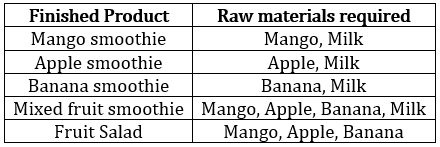
One unit of milk, mango, apple, and banana cost ₹5, ₹3, ₹2, and ₹1 respectively. Each unit of a finished product is sold for a profit equal to two times the number of raw materials used to make that product. For example, apple smoothie is made with two raw materials (apple and milk) and will be sold for a profit of ₹4 per unit. Leftover raw materials are sold during the last business hour of the day for a loss of ₹1 per unit. The amount, in rupees, received from sales (revenue) for each woman in each of the four business hours of the day is given in Table-2.
Table - 2
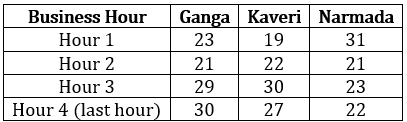
The following additional facts are known.
- No one except possibly Ganga sold any Mango smoothie.
- Each woman sold either zero or one unit of any single finished product in any hour.
- Each woman had exactly one unit each of two different raw materials as leftovers.
- No one had any banana leftover.
What BEST can be concluded about the number of units of fruit salad sold in the first hour?
Passage / Data
Answer the next 4 questions based on the information given
Ganga, Kaveri, and Narmada are three women who buy four raw materials (Mango, Apple, Banana and Milk) and sell five finished products (Mango smoothie, Apple smoothie, Banana smoothie, Mixed fruit smoothie and Fruit salad). Table-1 gives information about the raw materials required to produce the five finished products. One unit of a finished product requires one unit of each of the raw materials mentioned in the second column of the table.
Table - 1
One unit of milk, mango, apple, and banana cost ₹5, ₹3, ₹2, and ₹1 respectively. Each unit of a finished product is sold for a profit equal to two times the number of raw materials used to make that product. For example, apple smoothie is made with two raw materials (apple and milk) and will be sold for a profit of ₹4 per unit. Leftover raw materials are sold during the last business hour of the day for a loss of ₹1 per unit. The amount, in rupees, received from sales (revenue) for each woman in each of the four business hours of the day is given in Table-2.
Table - 2
The following additional facts are known.
- No one except possibly Ganga sold any Mango smoothie.
- Each woman sold either zero or one unit of any single finished product in any hour.
- Each woman had exactly one unit each of two different raw materials as leftovers.
- No one had any banana leftover.
Which of the following is NECESSARILY true?
Passage / Data
Answer the next 4 questions based on the information given
Ganga, Kaveri, and Narmada are three women who buy four raw materials (Mango, Apple, Banana and Milk) and sell five finished products (Mango smoothie, Apple smoothie, Banana smoothie, Mixed fruit smoothie and Fruit salad). Table-1 gives information about the raw materials required to produce the five finished products. One unit of a finished product requires one unit of each of the raw materials mentioned in the second column of the table.
Table - 1
One unit of milk, mango, apple, and banana cost ₹5, ₹3, ₹2, and ₹1 respectively. Each unit of a finished product is sold for a profit equal to two times the number of raw materials used to make that product. For example, apple smoothie is made with two raw materials (apple and milk) and will be sold for a profit of ₹4 per unit. Leftover raw materials are sold during the last business hour of the day for a loss of ₹1 per unit. The amount, in rupees, received from sales (revenue) for each woman in each of the four business hours of the day is given in Table-2.
Table - 2
The following additional facts are known.
- No one except possibly Ganga sold any Mango smoothie.
- Each woman sold either zero or one unit of any single finished product in any hour.
- Each woman had exactly one unit each of two different raw materials as leftovers.
- No one had any banana leftover.
What BEST can be concluded about the total number of units of milk the three women had in the beginning?
Passage / Data
Answer the next 4 questions based on the information given
Ganga, Kaveri, and Narmada are three women who buy four raw materials (Mango, Apple, Banana and Milk) and sell five finished products (Mango smoothie, Apple smoothie, Banana smoothie, Mixed fruit smoothie and Fruit salad). Table-1 gives information about the raw materials required to produce the five finished products. One unit of a finished product requires one unit of each of the raw materials mentioned in the second column of the table.
Table - 1
One unit of milk, mango, apple, and banana cost ₹5, ₹3, ₹2, and ₹1 respectively. Each unit of a finished product is sold for a profit equal to two times the number of raw materials used to make that product. For example, apple smoothie is made with two raw materials (apple and milk) and will be sold for a profit of ₹4 per unit. Leftover raw materials are sold during the last business hour of the day for a loss of ₹1 per unit. The amount, in rupees, received from sales (revenue) for each woman in each of the four business hours of the day is given in Table-2.
Table - 2
The following additional facts are known.
- No one except possibly Ganga sold any Mango smoothie.
- Each woman sold either zero or one unit of any single finished product in any hour.
- Each woman had exactly one unit each of two different raw materials as leftovers.
- No one had any banana leftover.
If it is known that three leftover units of mangoes were sold during the last business hour of the day, how many apple smoothies were sold during the day?
Passage / Data
Answer the next 6 questions based on the information given
A journal plans to publish 18 research papers, written by eight authors (A, B, C, D, E, F, G, and H) in four issues of the journal scheduled in January, April, July and October. Each of the research papers was written by exactly one of the eight authors. Five papers were scheduled in each of the first two issues, while four were scheduled in each of the last two issues. Every author wrote at least one paper and at most three papers. The total number of papers written by A, D, G and H was double the total number of papers written by the other four authors. Four of the authors were from India and two each were from Japan and China. Each author belonged to exactly one of the three areas — Manufacturing, Automation and Logistics. Four of the authors were from the Logistics area and two were from the Automation area. As per the journal policy, none of the authors could have more than one paper in any issue of the journal.
The following facts are also known.
- F, an Indian author from the Logistics area, wrote only one paper. It was scheduled in the October issue.
- A was from the Automation area and did not have a paper scheduled in the October issue.
- None of the Indian authors were from the Manufacturing area and none of the Japanese or Chinese authors were from the Automation area.
- A and H were from different countries, but had their papers scheduled in exactly the same issues.
- C and E, both Chinese authors from different areas, had the same number of papers scheduled. Further, E had papers scheduled in consecutive issues of the journal but C did not.
- B, from the Logistics area, had a paper scheduled in the April issue of the journal.
- B and G belonged to the same country. None of their papers were scheduled in the same issue of the journal.
- D, a Japanese author from the Manufacturing area, did not have a paper scheduled in the July issue.
- C and H belonged to different areas.
What is the correct sequence of number of papers written by B, C, E and G, respectively?
Passage / Data
Answer the next 6 questions based on the information given
A journal plans to publish 18 research papers, written by eight authors (A, B, C, D, E, F, G, and H) in four issues of the journal scheduled in January, April, July and October. Each of the research papers was written by exactly one of the eight authors. Five papers were scheduled in each of the first two issues, while four were scheduled in each of the last two issues. Every author wrote at least one paper and at most three papers. The total number of papers written by A, D, G and H was double the total number of papers written by the other four authors. Four of the authors were from India and two each were from Japan and China. Each author belonged to exactly one of the three areas — Manufacturing, Automation and Logistics. Four of the authors were from the Logistics area and two were from the Automation area. As per the journal policy, none of the authors could have more than one paper in any issue of the journal.
The following facts are also known.
- F, an Indian author from the Logistics area, wrote only one paper. It was scheduled in the October issue.
- A was from the Automation area and did not have a paper scheduled in the October issue.
- None of the Indian authors were from the Manufacturing area and none of the Japanese or Chinese authors were from the Automation area.
- A and H were from different countries, but had their papers scheduled in exactly the same issues.
- C and E, both Chinese authors from different areas, had the same number of papers scheduled. Further, E had papers scheduled in consecutive issues of the journal but C did not.
- B, from the Logistics area, had a paper scheduled in the April issue of the journal.
- B and G belonged to the same country. None of their papers were scheduled in the same issue of the journal.
- D, a Japanese author from the Manufacturing area, did not have a paper scheduled in the July issue.
- C and H belonged to different areas.
How many papers were written by Indian authors?
Passage / Data
Answer the next 6 questions based on the information given
A journal plans to publish 18 research papers, written by eight authors (A, B, C, D, E, F, G, and H) in four issues of the journal scheduled in January, April, July and October. Each of the research papers was written by exactly one of the eight authors. Five papers were scheduled in each of the first two issues, while four were scheduled in each of the last two issues. Every author wrote at least one paper and at most three papers. The total number of papers written by A, D, G and H was double the total number of papers written by the other four authors. Four of the authors were from India and two each were from Japan and China. Each author belonged to exactly one of the three areas — Manufacturing, Automation and Logistics. Four of the authors were from the Logistics area and two were from the Automation area. As per the journal policy, none of the authors could have more than one paper in any issue of the journal.
The following facts are also known.
- F, an Indian author from the Logistics area, wrote only one paper. It was scheduled in the October issue.
- A was from the Automation area and did not have a paper scheduled in the October issue.
- None of the Indian authors were from the Manufacturing area and none of the Japanese or Chinese authors were from the Automation area.
- A and H were from different countries, but had their papers scheduled in exactly the same issues.
- C and E, both Chinese authors from different areas, had the same number of papers scheduled. Further, E had papers scheduled in consecutive issues of the journal but C did not.
- B, from the Logistics area, had a paper scheduled in the April issue of the journal.
- B and G belonged to the same country. None of their papers were scheduled in the same issue of the journal.
- D, a Japanese author from the Manufacturing area, did not have a paper scheduled in the July issue.
- C and H belonged to different areas.
Which of the following statement(s) MUST be true?
Statement A: Every issue had at least one paper by author(s) from each country.
Statement B: Every issue had at most two papers by author(s) from each area.
Passage / Data
Answer the next 6 questions based on the information given
A journal plans to publish 18 research papers, written by eight authors (A, B, C, D, E, F, G, and H) in four issues of the journal scheduled in January, April, July and October. Each of the research papers was written by exactly one of the eight authors. Five papers were scheduled in each of the first two issues, while four were scheduled in each of the last two issues. Every author wrote at least one paper and at most three papers. The total number of papers written by A, D, G and H was double the total number of papers written by the other four authors. Four of the authors were from India and two each were from Japan and China. Each author belonged to exactly one of the three areas — Manufacturing, Automation and Logistics. Four of the authors were from the Logistics area and two were from the Automation area. As per the journal policy, none of the authors could have more than one paper in any issue of the journal.
The following facts are also known.
- F, an Indian author from the Logistics area, wrote only one paper. It was scheduled in the October issue.
- A was from the Automation area and did not have a paper scheduled in the October issue.
- None of the Indian authors were from the Manufacturing area and none of the Japanese or Chinese authors were from the Automation area.
- A and H were from different countries, but had their papers scheduled in exactly the same issues.
- C and E, both Chinese authors from different areas, had the same number of papers scheduled. Further, E had papers scheduled in consecutive issues of the journal but C did not.
- B, from the Logistics area, had a paper scheduled in the April issue of the journal.
- B and G belonged to the same country. None of their papers were scheduled in the same issue of the journal.
- D, a Japanese author from the Manufacturing area, did not have a paper scheduled in the July issue.
- C and H belonged to different areas.
Which of the following statements is FALSE?
Passage / Data
Answer the next 6 questions based on the information given
A journal plans to publish 18 research papers, written by eight authors (A, B, C, D, E, F, G, and H) in four issues of the journal scheduled in January, April, July and October. Each of the research papers was written by exactly one of the eight authors. Five papers were scheduled in each of the first two issues, while four were scheduled in each of the last two issues. Every author wrote at least one paper and at most three papers. The total number of papers written by A, D, G and H was double the total number of papers written by the other four authors. Four of the authors were from India and two each were from Japan and China. Each author belonged to exactly one of the three areas — Manufacturing, Automation and Logistics. Four of the authors were from the Logistics area and two were from the Automation area. As per the journal policy, none of the authors could have more than one paper in any issue of the journal.
The following facts are also known.
- F, an Indian author from the Logistics area, wrote only one paper. It was scheduled in the October issue.
- A was from the Automation area and did not have a paper scheduled in the October issue.
- None of the Indian authors were from the Manufacturing area and none of the Japanese or Chinese authors were from the Automation area.
- A and H were from different countries, but had their papers scheduled in exactly the same issues.
- C and E, both Chinese authors from different areas, had the same number of papers scheduled. Further, E had papers scheduled in consecutive issues of the journal but C did not.
- B, from the Logistics area, had a paper scheduled in the April issue of the journal.
- B and G belonged to the same country. None of their papers were scheduled in the same issue of the journal.
- D, a Japanese author from the Manufacturing area, did not have a paper scheduled in the July issue.
- C and H belonged to different areas.
Which of the following statements is FALSE?
Passage / Data
Answer the next 6 questions based on the information given
A journal plans to publish 18 research papers, written by eight authors (A, B, C, D, E, F, G, and H) in four issues of the journal scheduled in January, April, July and October. Each of the research papers was written by exactly one of the eight authors. Five papers were scheduled in each of the first two issues, while four were scheduled in each of the last two issues. Every author wrote at least one paper and at most three papers. The total number of papers written by A, D, G and H was double the total number of papers written by the other four authors. Four of the authors were from India and two each were from Japan and China. Each author belonged to exactly one of the three areas — Manufacturing, Automation and Logistics. Four of the authors were from the Logistics area and two were from the Automation area. As per the journal policy, none of the authors could have more than one paper in any issue of the journal.
The following facts are also known.
- F, an Indian author from the Logistics area, wrote only one paper. It was scheduled in the October issue.
- A was from the Automation area and did not have a paper scheduled in the October issue.
- None of the Indian authors were from the Manufacturing area and none of the Japanese or Chinese authors were from the Automation area.
- A and H were from different countries, but had their papers scheduled in exactly the same issues.
- C and E, both Chinese authors from different areas, had the same number of papers scheduled. Further, E had papers scheduled in consecutive issues of the journal but C did not.
- B, from the Logistics area, had a paper scheduled in the April issue of the journal.
- B and G belonged to the same country. None of their papers were scheduled in the same issue of the journal.
- D, a Japanese author from the Manufacturing area, did not have a paper scheduled in the July issue.
- C and H belonged to different areas.
Which of the following is the correct sequence of number of papers by authors from Automation, Manufacturing and Logistics areas, respectively?
Passage / Data
Answer the next 6 questions based on the information given
Amudha, Bharatan, Chandran, Dhinesh, Ezhil, Fani and Gowtham are seven people in a town. Any pair of them could either be strangers, acquaintances, or friends. All relationships are mutual. For example, if Amudha is a friend of Bharatan, then Bharatan is also a friend of Amudha. Similarly, if Amudha is a stranger to Bharatan, then Bharatan is also a stranger to Amudha.
Partial information about the number of friends, acquaintances, and strangers of each of these people among them is given in the table below.
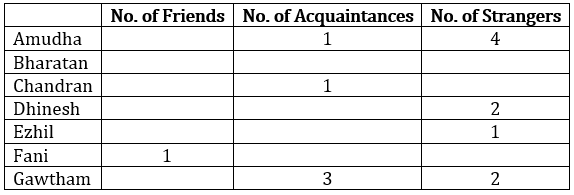
The following additional facts are also known.
- Amudha, Bharatan, and Chandran are mutual strangers.
- Amudha, Dhinesh, and Fani are Ezil's friends.
- Chandran and Gowtham are friends.
- Every friend of Amudha is an acquaintance of Bharatan, and every acquaintance of Bharatan is a friend of Amudha.
- Every friend of Bharatan is an acquaintance of Amudha, and every acquaintance of Amudha is a friend of Bharatan.
Who are Gowtham’s acquaintances?
Passage / Data
Answer the next 6 questions based on the information given
Amudha, Bharatan, Chandran, Dhinesh, Ezhil, Fani and Gowtham are seven people in a town. Any pair of them could either be strangers, acquaintances, or friends. All relationships are mutual. For example, if Amudha is a friend of Bharatan, then Bharatan is also a friend of Amudha. Similarly, if Amudha is a stranger to Bharatan, then Bharatan is also a stranger to Amudha.
Partial information about the number of friends, acquaintances, and strangers of each of these people among them is given in the table below.
The following additional facts are also known.
- Amudha, Bharatan, and Chandran are mutual strangers.
- Amudha, Dhinesh, and Fani are Ezil's friends.
- Chandran and Gowtham are friends.
- Every friend of Amudha is an acquaintance of Bharatan, and every acquaintance of Bharatan is a friend of Amudha.
- Every friend of Bharatan is an acquaintance of Amudha, and every acquaintance of Amudha is a friend of Bharatan.
Which of these pairs share the same type of relationship?
Passage / Data
Answer the next 6 questions based on the information given
Amudha, Bharatan, Chandran, Dhinesh, Ezhil, Fani and Gowtham are seven people in a town. Any pair of them could either be strangers, acquaintances, or friends. All relationships are mutual. For example, if Amudha is a friend of Bharatan, then Bharatan is also a friend of Amudha. Similarly, if Amudha is a stranger to Bharatan, then Bharatan is also a stranger to Amudha.
Partial information about the number of friends, acquaintances, and strangers of each of these people among them is given in the table below.
The following additional facts are also known.
- Amudha, Bharatan, and Chandran are mutual strangers.
- Amudha, Dhinesh, and Fani are Ezil's friends.
- Chandran and Gowtham are friends.
- Every friend of Amudha is an acquaintance of Bharatan, and every acquaintance of Bharatan is a friend of Amudha.
- Every friend of Bharatan is an acquaintance of Amudha, and every acquaintance of Amudha is a friend of Bharatan.
Who is an acquaintance of Amudha?
Passage / Data
Answer the next 6 questions based on the information given
Amudha, Bharatan, Chandran, Dhinesh, Ezhil, Fani and Gowtham are seven people in a town. Any pair of them could either be strangers, acquaintances, or friends. All relationships are mutual. For example, if Amudha is a friend of Bharatan, then Bharatan is also a friend of Amudha. Similarly, if Amudha is a stranger to Bharatan, then Bharatan is also a stranger to Amudha.
Partial information about the number of friends, acquaintances, and strangers of each of these people among them is given in the table below.
The following additional facts are also known.
- Amudha, Bharatan, and Chandran are mutual strangers.
- Amudha, Dhinesh, and Fani are Ezil's friends.
- Chandran and Gowtham are friends.
- Every friend of Amudha is an acquaintance of Bharatan, and every acquaintance of Bharatan is a friend of Amudha.
- Every friend of Bharatan is an acquaintance of Amudha, and every acquaintance of Amudha is a friend of Bharatan.
Who is an acquaintance of Chandran?
Passage / Data
Answer the next 6 questions based on the information given
Amudha, Bharatan, Chandran, Dhinesh, Ezhil, Fani and Gowtham are seven people in a town. Any pair of them could either be strangers, acquaintances, or friends. All relationships are mutual. For example, if Amudha is a friend of Bharatan, then Bharatan is also a friend of Amudha. Similarly, if Amudha is a stranger to Bharatan, then Bharatan is also a stranger to Amudha.
Partial information about the number of friends, acquaintances, and strangers of each of these people among them is given in the table below.
The following additional facts are also known.
- Amudha, Bharatan, and Chandran are mutual strangers.
- Amudha, Dhinesh, and Fani are Ezil's friends.
- Chandran and Gowtham are friends.
- Every friend of Amudha is an acquaintance of Bharatan, and every acquaintance of Bharatan is a friend of Amudha.
- Every friend of Bharatan is an acquaintance of Amudha, and every acquaintance of Amudha is a friend of Bharatan.
How many friends does Ezhil have?
Passage / Data
Answer the next 6 questions based on the information given
Amudha, Bharatan, Chandran, Dhinesh, Ezhil, Fani and Gowtham are seven people in a town. Any pair of them could either be strangers, acquaintances, or friends. All relationships are mutual. For example, if Amudha is a friend of Bharatan, then Bharatan is also a friend of Amudha. Similarly, if Amudha is a stranger to Bharatan, then Bharatan is also a stranger to Amudha.
Partial information about the number of friends, acquaintances, and strangers of each of these people among them is given in the table below.
The following additional facts are also known.
- Amudha, Bharatan, and Chandran are mutual strangers.
- Amudha, Dhinesh, and Fani are Ezil's friends.
- Chandran and Gowtham are friends.
- Every friend of Amudha is an acquaintance of Bharatan, and every acquaintance of Bharatan is a friend of Amudha.
- Every friend of Bharatan is an acquaintance of Amudha, and every acquaintance of Amudha is a friend of Bharatan.
How many people are either a friend or a friend-of-a-friend of Ezhil?
Passage / Data
Answer the next 6 questions based on the information given
Ravi works in an online food-delivery company. After each delivery, customers rate Ravi on each of four parameters – Behaviour, Packaging, Hygiene, and Timeliness, on a scale from 1 to 9. If the total of the four rating points is 25 or more, then Ravi gets a bonus of ₹20 for that delivery. Additionally, a customer may or may not give Ravi a tip. If the customer gives a tip, it
is either ₹30 or ₹50.
One day, Ravi made four deliveries - one to each of Atal, Bihari, Chirag and Deepak, and received a total of ₹120 in bonus and tips. He did not get both a bonus and a tip from the same customer.
The following additional facts are also known.
- In Timeliness, Ravi received a total of 21 points, and three of the customers gave him the same rating points in this parameter. Atal gave higher rating points than Bihari and Chirag in this parameter.
- Ravi received distinct rating points in Packaging from the four customers adding up to 29 points. Similarly, Ravi received distinct rating points in Hygiene from the four customers adding up to 26 points.
- Chirag gave the same rating points for Packaging and Hygiene.
- Among the four customers, Bihari gave the highest rating points in Packaging, and Chirag gave the highest rating points in Hygiene.
- Everyone rated Ravi between 5 and 7 in Behaviour. Unique maximum and minimum ratings in this parameter were given by Atal and Deepak respectively.
- If the customers are ranked based on ratings given by them in individual parameters, then Atal’s rank based on Packaging is the same as that based on Hygiene. This is also true for Deepak.
What was the minimum rating that Ravi received from any customer in any parameter?
Passage / Data
Answer the next 6 questions based on the information given
Ravi works in an online food-delivery company. After each delivery, customers rate Ravi on each of four parameters – Behaviour, Packaging, Hygiene, and Timeliness, on a scale from 1 to 9. If the total of the four rating points is 25 or more, then Ravi gets a bonus of ₹20 for that delivery. Additionally, a customer may or may not give Ravi a tip. If the customer gives a tip, it
is either ₹30 or ₹50.
One day, Ravi made four deliveries - one to each of Atal, Bihari, Chirag and Deepak, and received a total of ₹120 in bonus and tips. He did not get both a bonus and a tip from the same customer.
The following additional facts are also known.
- In Timeliness, Ravi received a total of 21 points, and three of the customers gave him the same rating points in this parameter. Atal gave higher rating points than Bihari and Chirag in this parameter.
- Ravi received distinct rating points in Packaging from the four customers adding up to 29 points. Similarly, Ravi received distinct rating points in Hygiene from the four customers adding up to 26 points.
- Chirag gave the same rating points for Packaging and Hygiene.
- Among the four customers, Bihari gave the highest rating points in Packaging, and Chirag gave the highest rating points in Hygiene.
- Everyone rated Ravi between 5 and 7 in Behaviour. Unique maximum and minimum ratings in this parameter were given by Atal and Deepak respectively.
- If the customers are ranked based on ratings given by them in individual parameters, then Atal’s rank based on Packaging is the same as that based on Hygiene. This is also true for Deepak.
The COMPLETE list of customers who gave the maximum total rating points to Ravi is
Passage / Data
Answer the next 6 questions based on the information given
Ravi works in an online food-delivery company. After each delivery, customers rate Ravi on each of four parameters – Behaviour, Packaging, Hygiene, and Timeliness, on a scale from 1 to 9. If the total of the four rating points is 25 or more, then Ravi gets a bonus of ₹20 for that delivery. Additionally, a customer may or may not give Ravi a tip. If the customer gives a tip, it
is either ₹30 or ₹50.
One day, Ravi made four deliveries - one to each of Atal, Bihari, Chirag and Deepak, and received a total of ₹120 in bonus and tips. He did not get both a bonus and a tip from the same customer.
The following additional facts are also known.
- In Timeliness, Ravi received a total of 21 points, and three of the customers gave him the same rating points in this parameter. Atal gave higher rating points than Bihari and Chirag in this parameter.
- Ravi received distinct rating points in Packaging from the four customers adding up to 29 points. Similarly, Ravi received distinct rating points in Hygiene from the four customers adding up to 26 points.
- Chirag gave the same rating points for Packaging and Hygiene.
- Among the four customers, Bihari gave the highest rating points in Packaging, and Chirag gave the highest rating points in Hygiene.
- Everyone rated Ravi between 5 and 7 in Behaviour. Unique maximum and minimum ratings in this parameter were given by Atal and Deepak respectively.
- If the customers are ranked based on ratings given by them in individual parameters, then Atal’s rank based on Packaging is the same as that based on Hygiene. This is also true for Deepak.
What rating did Atal give on Timeliness?
Passage / Data
Answer the next 6 questions based on the information given
Ravi works in an online food-delivery company. After each delivery, customers rate Ravi on each of four parameters – Behaviour, Packaging, Hygiene, and Timeliness, on a scale from 1 to 9. If the total of the four rating points is 25 or more, then Ravi gets a bonus of ₹20 for that delivery. Additionally, a customer may or may not give Ravi a tip. If the customer gives a tip, it
is either ₹30 or ₹50.
One day, Ravi made four deliveries - one to each of Atal, Bihari, Chirag and Deepak, and received a total of ₹120 in bonus and tips. He did not get both a bonus and a tip from the same customer.
The following additional facts are also known.
- In Timeliness, Ravi received a total of 21 points, and three of the customers gave him the same rating points in this parameter. Atal gave higher rating points than Bihari and Chirag in this parameter.
- Ravi received distinct rating points in Packaging from the four customers adding up to 29 points. Similarly, Ravi received distinct rating points in Hygiene from the four customers adding up to 26 points.
- Chirag gave the same rating points for Packaging and Hygiene.
- Among the four customers, Bihari gave the highest rating points in Packaging, and Chirag gave the highest rating points in Hygiene.
- Everyone rated Ravi between 5 and 7 in Behaviour. Unique maximum and minimum ratings in this parameter were given by Atal and Deepak respectively.
- If the customers are ranked based on ratings given by them in individual parameters, then Atal’s rank based on Packaging is the same as that based on Hygiene. This is also true for Deepak.
What BEST can be concluded about the tip amount given by Deepak?
Passage / Data
Answer the next 6 questions based on the information given
Ravi works in an online food-delivery company. After each delivery, customers rate Ravi on each of four parameters – Behaviour, Packaging, Hygiene, and Timeliness, on a scale from 1 to 9. If the total of the four rating points is 25 or more, then Ravi gets a bonus of ₹20 for that delivery. Additionally, a customer may or may not give Ravi a tip. If the customer gives a tip, it
is either ₹30 or ₹50.
One day, Ravi made four deliveries - one to each of Atal, Bihari, Chirag and Deepak, and received a total of ₹120 in bonus and tips. He did not get both a bonus and a tip from the same customer.
The following additional facts are also known.
- In Timeliness, Ravi received a total of 21 points, and three of the customers gave him the same rating points in this parameter. Atal gave higher rating points than Bihari and Chirag in this parameter.
- Ravi received distinct rating points in Packaging from the four customers adding up to 29 points. Similarly, Ravi received distinct rating points in Hygiene from the four customers adding up to 26 points.
- Chirag gave the same rating points for Packaging and Hygiene.
- Among the four customers, Bihari gave the highest rating points in Packaging, and Chirag gave the highest rating points in Hygiene.
- Everyone rated Ravi between 5 and 7 in Behaviour. Unique maximum and minimum ratings in this parameter were given by Atal and Deepak respectively.
- If the customers are ranked based on ratings given by them in individual parameters, then Atal’s rank based on Packaging is the same as that based on Hygiene. This is also true for Deepak.
In which parameter did Atal give the maximum rating points to Ravi?
Passage / Data
Answer the next 6 questions based on the information given
Ravi works in an online food-delivery company. After each delivery, customers rate Ravi on each of four parameters – Behaviour, Packaging, Hygiene, and Timeliness, on a scale from 1 to 9. If the total of the four rating points is 25 or more, then Ravi gets a bonus of ₹20 for that delivery. Additionally, a customer may or may not give Ravi a tip. If the customer gives a tip, it
is either ₹30 or ₹50.
One day, Ravi made four deliveries - one to each of Atal, Bihari, Chirag and Deepak, and received a total of ₹120 in bonus and tips. He did not get both a bonus and a tip from the same customer.
The following additional facts are also known.
- In Timeliness, Ravi received a total of 21 points, and three of the customers gave him the same rating points in this parameter. Atal gave higher rating points than Bihari and Chirag in this parameter.
- Ravi received distinct rating points in Packaging from the four customers adding up to 29 points. Similarly, Ravi received distinct rating points in Hygiene from the four customers adding up to 26 points.
- Chirag gave the same rating points for Packaging and Hygiene.
- Among the four customers, Bihari gave the highest rating points in Packaging, and Chirag gave the highest rating points in Hygiene.
- Everyone rated Ravi between 5 and 7 in Behaviour. Unique maximum and minimum ratings in this parameter were given by Atal and Deepak respectively.
- If the customers are ranked based on ratings given by them in individual parameters, then Atal’s rank based on Packaging is the same as that based on Hygiene. This is also true for Deepak.
What rating did Deepak give on Packaging?
Passage / Data
Answer the next 6 questions based on the information given
Ten objects o1, o2, …, o10 were distributed among Amar, Barat, Charles, Disha, and Elise. Each item went to exactly one person. Each person got exactly two of the items, and this pair of objects is called her/his bundle.
The following table shows how each person values each object.
The value of any bundle by a person is the sum of that person’s values of the objects in that
bundle. A person X envies another person Y if X values Y’s bundle more than X’s own bundle.
For example, hypothetically suppose Amar’s bundle consists of o1 and o2, and Barat’s bundle consists of o3 and o4. Then Amar values his own bundle at 4 + 9 = 13 and Barat’s bundle at 9 + 3 = 12. Hence Amar does not envy Barat. On the other hand, Barat values his own bundle at 7 + 5 = 12 and Amar’s bundle at 5 + 9 = 14. Hence Barat envies Amar.
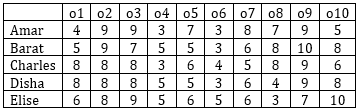
The following facts are known about the actual distribution of the objects among the five
people.
- If someone’s value for an object is 10, then she/he received that object.
- Objects o1, o2, and o3 were given to three different people.
- Objects o1 and o8 were given to different people.
- Three people value their own bundles at 16. No one values her/his own bundle at a number higher than 16.
- Disha values her own bundle at an odd number. All others value their own bundles at an even number.
- Some people who value their own bundles less than 16 envy some other people who value their own bundle at 16. No one else envies others
What BEST can be said about object o8?
Passage / Data
Answer the next 6 questions based on the information given
Ten objects o1, o2, …, o10 were distributed among Amar, Barat, Charles, Disha, and Elise. Each item went to exactly one person. Each person got exactly two of the items, and this pair of objects is called her/his bundle.
The following table shows how each person values each object.
The value of any bundle by a person is the sum of that person’s values of the objects in that
bundle. A person X envies another person Y if X values Y’s bundle more than X’s own bundle.
For example, hypothetically suppose Amar’s bundle consists of o1 and o2, and Barat’s bundle consists of o3 and o4. Then Amar values his own bundle at 4 + 9 = 13 and Barat’s bundle at 9 + 3 = 12. Hence Amar does not envy Barat. On the other hand, Barat values his own bundle at 7 + 5 = 12 and Amar’s bundle at 5 + 9 = 14. Hence Barat envies Amar.
The following facts are known about the actual distribution of the objects among the five
people.
- If someone’s value for an object is 10, then she/he received that object.
- Objects o1, o2, and o3 were given to three different people.
- Objects o1 and o8 were given to different people.
- Three people value their own bundles at 16. No one values her/his own bundle at a number higher than 16.
- Disha values her own bundle at an odd number. All others value their own bundles at an even number.
- Some people who value their own bundles less than 16 envy some other people who value their own bundle at 16. No one else envies others
Who among the following envies someone else?
Passage / Data
Answer the next 6 questions based on the information given
Ten objects o1, o2, …, o10 were distributed among Amar, Barat, Charles, Disha, and Elise. Each item went to exactly one person. Each person got exactly two of the items, and this pair of objects is called her/his bundle.
The following table shows how each person values each object.
The value of any bundle by a person is the sum of that person’s values of the objects in that
bundle. A person X envies another person Y if X values Y’s bundle more than X’s own bundle.
For example, hypothetically suppose Amar’s bundle consists of o1 and o2, and Barat’s bundle consists of o3 and o4. Then Amar values his own bundle at 4 + 9 = 13 and Barat’s bundle at 9 + 3 = 12. Hence Amar does not envy Barat. On the other hand, Barat values his own bundle at 7 + 5 = 12 and Amar’s bundle at 5 + 9 = 14. Hence Barat envies Amar.
The following facts are known about the actual distribution of the objects among the five
people.
- If someone’s value for an object is 10, then she/he received that object.
- Objects o1, o2, and o3 were given to three different people.
- Objects o1 and o8 were given to different people.
- Three people value their own bundles at 16. No one values her/his own bundle at a number higher than 16.
- Disha values her own bundle at an odd number. All others value their own bundles at an even number.
- Some people who value their own bundles less than 16 envy some other people who value their own bundle at 16. No one else envies others
Object o4 was given to
Passage / Data
Answer the next 6 questions based on the information given
Ten objects o1, o2, …, o10 were distributed among Amar, Barat, Charles, Disha, and Elise. Each item went to exactly one person. Each person got exactly two of the items, and this pair of objects is called her/his bundle.
The following table shows how each person values each object.
The value of any bundle by a person is the sum of that person’s values of the objects in that
bundle. A person X envies another person Y if X values Y’s bundle more than X’s own bundle.
For example, hypothetically suppose Amar’s bundle consists of o1 and o2, and Barat’s bundle consists of o3 and o4. Then Amar values his own bundle at 4 + 9 = 13 and Barat’s bundle at 9 + 3 = 12. Hence Amar does not envy Barat. On the other hand, Barat values his own bundle at 7 + 5 = 12 and Amar’s bundle at 5 + 9 = 14. Hence Barat envies Amar.
The following facts are known about the actual distribution of the objects among the five
people.
- If someone’s value for an object is 10, then she/he received that object.
- Objects o1, o2, and o3 were given to three different people.
- Objects o1 and o8 were given to different people.
- Three people value their own bundles at 16. No one values her/his own bundle at a number higher than 16.
- Disha values her own bundle at an odd number. All others value their own bundles at an even number.
- Some people who value their own bundles less than 16 envy some other people who value their own bundle at 16. No one else envies others
What is Amar’s value for his own bundle?
Passage / Data
Answer the next 6 questions based on the information given
Ten objects o1, o2, …, o10 were distributed among Amar, Barat, Charles, Disha, and Elise. Each item went to exactly one person. Each person got exactly two of the items, and this pair of objects is called her/his bundle.
The following table shows how each person values each object.
The value of any bundle by a person is the sum of that person’s values of the objects in that
bundle. A person X envies another person Y if X values Y’s bundle more than X’s own bundle.
For example, hypothetically suppose Amar’s bundle consists of o1 and o2, and Barat’s bundle consists of o3 and o4. Then Amar values his own bundle at 4 + 9 = 13 and Barat’s bundle at 9 + 3 = 12. Hence Amar does not envy Barat. On the other hand, Barat values his own bundle at 7 + 5 = 12 and Amar’s bundle at 5 + 9 = 14. Hence Barat envies Amar.
The following facts are known about the actual distribution of the objects among the five
people.
- If someone’s value for an object is 10, then she/he received that object.
- Objects o1, o2, and o3 were given to three different people.
- Objects o1 and o8 were given to different people.
- Three people value their own bundles at 16. No one values her/his own bundle at a number higher than 16.
- Disha values her own bundle at an odd number. All others value their own bundles at an even number.
- Some people who value their own bundles less than 16 envy some other people who value their own bundle at 16. No one else envies others
Object o5 was given to
Passage / Data
Answer the next 6 questions based on the information given
Ten objects o1, o2, …, o10 were distributed among Amar, Barat, Charles, Disha, and Elise. Each item went to exactly one person. Each person got exactly two of the items, and this pair of objects is called her/his bundle.
The following table shows how each person values each object.
The value of any bundle by a person is the sum of that person’s values of the objects in that
bundle. A person X envies another person Y if X values Y’s bundle more than X’s own bundle.
For example, hypothetically suppose Amar’s bundle consists of o1 and o2, and Barat’s bundle consists of o3 and o4. Then Amar values his own bundle at 4 + 9 = 13 and Barat’s bundle at 9 + 3 = 12. Hence Amar does not envy Barat. On the other hand, Barat values his own bundle at 7 + 5 = 12 and Amar’s bundle at 5 + 9 = 14. Hence Barat envies Amar.
The following facts are known about the actual distribution of the objects among the five
people.
- If someone’s value for an object is 10, then she/he received that object.
- Objects o1, o2, and o3 were given to three different people.
- Objects o1 and o8 were given to different people.
- Three people value their own bundles at 16. No one values her/his own bundle at a number higher than 16.
- Disha values her own bundle at an odd number. All others value their own bundles at an even number.
- Some people who value their own bundles less than 16 envy some other people who value their own bundle at 16. No one else envies others
What BEST can be said about the distribution of object o1?
Passage / Data
Answer the next 4 questions based on the information given
Each of the bottles mentioned in this question contains 50 ml of liquid. The liquid in any bottle can be 100% pure content (P) or can have certain amount of impurity (I). Visually it is not possible to distinguish between P and I. There is a testing device which detects impurity, as long as the percentage of impurity in the content tested is 10% or more.
For example, suppose bottle 1 contains only P, and bottle 2 contains 80% P and 20% I. If content from bottle 1 is tested, it will be found out that it contains only P. If content of bottle 2 is tested, the test will reveal that it contains some amount of I. If 10 ml of content from bottle 1 is mixed with 20 ml content from bottle 2, the test will show that the mixture has impurity, and hence we can conclude that at least one of the two bottles has I. However, if 10 ml of content from bottle 1 is mixed with 5 ml of content from bottle 2. the test will not detect any impurity in the resultant mixture.
5 ml of content from bottle A is mixed with 5 ml of content from bottle B. The resultant mixture, when tested, detects the presence of I. If it is known that bottle A contains only P, what BEST can be concluded about the volume of I in bottle B?
Passage / Data
Answer the next 4 questions based on the information given
Each of the bottles mentioned in this question contains 50 ml of liquid. The liquid in any bottle can be 100% pure content (P) or can have certain amount of impurity (I). Visually it is not possible to distinguish between P and I. There is a testing device which detects impurity, as long as the percentage of impurity in the content tested is 10% or more.
For example, suppose bottle 1 contains only P, and bottle 2 contains 80% P and 20% I. If content from bottle 1 is tested, it will be found out that it contains only P. If content of bottle 2 is tested, the test will reveal that it contains some amount of I. If 10 ml of content from bottle 1 is mixed with 20 ml content from bottle 2, the test will show that the mixture has impurity, and hence we can conclude that at least one of the two bottles has I. However, if 10 ml of content from bottle 1 is mixed with 5 ml of content from bottle 2. the test will not detect any impurity in the resultant mixture.
There are four bottles. Each bottle is known to contain only P or only I. They will be considered to be “collectively ready for despatch” if all of them contain only P. In minimum how many tests, is it possible to ascertain whether these four bottles are “collectively ready for despatch”?
Passage / Data
Answer the next 4 questions based on the information given
Each of the bottles mentioned in this question contains 50 ml of liquid. The liquid in any bottle can be 100% pure content (P) or can have certain amount of impurity (I). Visually it is not possible to distinguish between P and I. There is a testing device which detects impurity, as long as the percentage of impurity in the content tested is 10% or more.
For example, suppose bottle 1 contains only P, and bottle 2 contains 80% P and 20% I. If content from bottle 1 is tested, it will be found out that it contains only P. If content of bottle 2 is tested, the test will reveal that it contains some amount of I. If 10 ml of content from bottle 1 is mixed with 20 ml content from bottle 2, the test will show that the mixture has impurity, and hence we can conclude that at least one of the two bottles has I. However, if 10 ml of content from bottle 1 is mixed with 5 ml of content from bottle 2. the test will not detect any impurity in the resultant mixture.
There are four bottles. It is known that three of these bottles contain only P, while the remaining one contains 80% P and 20% I. What is the minimum number of tests required to definitely identify the bottle containing some amount of I?
Passage / Data
Answer the next 4 questions based on the information given
Each of the bottles mentioned in this question contains 50 ml of liquid. The liquid in any bottle can be 100% pure content (P) or can have certain amount of impurity (I). Visually it is not possible to distinguish between P and I. There is a testing device which detects impurity, as long as the percentage of impurity in the content tested is 10% or more.
For example, suppose bottle 1 contains only P, and bottle 2 contains 80% P and 20% I. If content from bottle 1 is tested, it will be found out that it contains only P. If content of bottle 2 is tested, the test will reveal that it contains some amount of I. If 10 ml of content from bottle 1 is mixed with 20 ml content from bottle 2, the test will show that the mixture has impurity, and hence we can conclude that at least one of the two bottles has I. However, if 10 ml of content from bottle 1 is mixed with 5 ml of content from bottle 2. the test will not detect any impurity in the resultant mixture.
There are four bottles. It is known that either one or two of these bottles contain(s) only P, while the remaining ones contain 85% P and 15% I. What is the minimum number of tests required to ascertain the exact number of bottles containing only P?
Passage / Data
Answer the next 6 questions based on the information given below:
Three reviewers Amal, Bimal, and Komal are tasked with selecting questions from a pool of 13 questions (Q01 to Q13). Questions can be created by external “subject matter experts” (SMEs) or by one of the three reviewers. Each of the reviewers either approves or disapproves a question that is shown to them. Their decisions lead to eventual acceptance or rejection of the question in the manner described below.
If a question is created by an SME, it is reviewed first by Amal, and then by Bimal. If both of them approve the question, then the question is accepted and is not reviewed by Komal. If both disapprove the question, it is rejected and is not reviewed by Komal. If one of them approves the question and the other disapproves it, then the question is reviewed by Komal. Then the question is accepted only if she approves it.
A question created by one of the reviewers is decided upon by the other two. If a question is created by Amal, then it is first reviewed by Bimal. If Bimal approves the question, then it is accepted. Otherwise, it is reviewed by Komal. The question is then accepted only if Komal approves it. A similar process is followed for questions created by Bimal, whose questions are first reviewed by Komal, and then by Amal only if Komal disapproves it. Questions created by Komal are first reviewed by Amal, and then, if required, by Bimal.
The following facts are known about the review process after its completion.
- Q02, Q06, Q09, Q11, and Q12 were rejected and the other questions were accepted.
- Amal reviewed only Q02, Q03, Q04, Q06, Q08, Q10, Q11, and Q13.
- Bimal reviewed only Q02, Q04, Q06 through Q09, Q12, and Q13.
- Komal reviewed only Q01 through Q05, Q07, Q08, Q09, Q11, and Q12.
How many questions were DEFINITELY created by Amal?
Passage / Data
Answer the next 6 questions based on the information given below:
Three reviewers Amal, Bimal, and Komal are tasked with selecting questions from a pool of 13 questions (Q01 to Q13). Questions can be created by external “subject matter experts” (SMEs) or by one of the three reviewers. Each of the reviewers either approves or disapproves a question that is shown to them. Their decisions lead to eventual acceptance or rejection of the question in the manner described below.
If a question is created by an SME, it is reviewed first by Amal, and then by Bimal. If both of them approve the question, then the question is accepted and is not reviewed by Komal. If both disapprove the question, it is rejected and is not reviewed by Komal. If one of them approves the question and the other disapproves it, then the question is reviewed by Komal. Then the question is accepted only if she approves it.
A question created by one of the reviewers is decided upon by the other two. If a question is created by Amal, then it is first reviewed by Bimal. If Bimal approves the question, then it is accepted. Otherwise, it is reviewed by Komal. The question is then accepted only if Komal approves it. A similar process is followed for questions created by Bimal, whose questions are first reviewed by Komal, and then by Amal only if Komal disapproves it. Questions created by Komal are first reviewed by Amal, and then, if required, by Bimal.
The following facts are known about the review process after its completion.
- Q02, Q06, Q09, Q11, and Q12 were rejected and the other questions were accepted.
- Amal reviewed only Q02, Q03, Q04, Q06, Q08, Q10, Q11, and Q13.
- Bimal reviewed only Q02, Q04, Q06 through Q09, Q12, and Q13.
- Komal reviewed only Q01 through Q05, Q07, Q08, Q09, Q11, and Q12.
How many questions were DEFINITELY created by Komal?
Passage / Data
Answer the next 6 questions based on the information given below:
Three reviewers Amal, Bimal, and Komal are tasked with selecting questions from a pool of 13 questions (Q01 to Q13). Questions can be created by external “subject matter experts” (SMEs) or by one of the three reviewers. Each of the reviewers either approves or disapproves a question that is shown to them. Their decisions lead to eventual acceptance or rejection of the question in the manner described below.
If a question is created by an SME, it is reviewed first by Amal, and then by Bimal. If both of them approve the question, then the question is accepted and is not reviewed by Komal. If both disapprove the question, it is rejected and is not reviewed by Komal. If one of them approves the question and the other disapproves it, then the question is reviewed by Komal. Then the question is accepted only if she approves it.
A question created by one of the reviewers is decided upon by the other two. If a question is created by Amal, then it is first reviewed by Bimal. If Bimal approves the question, then it is accepted. Otherwise, it is reviewed by Komal. The question is then accepted only if Komal approves it. A similar process is followed for questions created by Bimal, whose questions are first reviewed by Komal, and then by Amal only if Komal disapproves it. Questions created by Komal are first reviewed by Amal, and then, if required, by Bimal.
The following facts are known about the review process after its completion.
- Q02, Q06, Q09, Q11, and Q12 were rejected and the other questions were accepted.
- Amal reviewed only Q02, Q03, Q04, Q06, Q08, Q10, Q11, and Q13.
- Bimal reviewed only Q02, Q04, Q06 through Q09, Q12, and Q13.
- Komal reviewed only Q01 through Q05, Q07, Q08, Q09, Q11, and Q12.
How many questions were DEFINITELY created by SMEs?
Passage / Data
Answer the next 6 questions based on the information given below:
Three reviewers Amal, Bimal, and Komal are tasked with selecting questions from a pool of 13 questions (Q01 to Q13). Questions can be created by external “subject matter experts” (SMEs) or by one of the three reviewers. Each of the reviewers either approves or disapproves a question that is shown to them. Their decisions lead to eventual acceptance or rejection of the question in the manner described below.
If a question is created by an SME, it is reviewed first by Amal, and then by Bimal. If both of them approve the question, then the question is accepted and is not reviewed by Komal. If both disapprove the question, it is rejected and is not reviewed by Komal. If one of them approves the question and the other disapproves it, then the question is reviewed by Komal. Then the question is accepted only if she approves it.
A question created by one of the reviewers is decided upon by the other two. If a question is created by Amal, then it is first reviewed by Bimal. If Bimal approves the question, then it is accepted. Otherwise, it is reviewed by Komal. The question is then accepted only if Komal approves it. A similar process is followed for questions created by Bimal, whose questions are first reviewed by Komal, and then by Amal only if Komal disapproves it. Questions created by Komal are first reviewed by Amal, and then, if required, by Bimal.
The following facts are known about the review process after its completion.
- Q02, Q06, Q09, Q11, and Q12 were rejected and the other questions were accepted.
- Amal reviewed only Q02, Q03, Q04, Q06, Q08, Q10, Q11, and Q13.
- Bimal reviewed only Q02, Q04, Q06 through Q09, Q12, and Q13.
- Komal reviewed only Q01 through Q05, Q07, Q08, Q09, Q11, and Q12.
How many questions were DEFINITELY disapproved by Bimal?
Passage / Data
Answer the next 6 questions based on the information given below:
Three reviewers Amal, Bimal, and Komal are tasked with selecting questions from a pool of 13 questions (Q01 to Q13). Questions can be created by external “subject matter experts” (SMEs) or by one of the three reviewers. Each of the reviewers either approves or disapproves a question that is shown to them. Their decisions lead to eventual acceptance or rejection of the question in the manner described below.
If a question is created by an SME, it is reviewed first by Amal, and then by Bimal. If both of them approve the question, then the question is accepted and is not reviewed by Komal. If both disapprove the question, it is rejected and is not reviewed by Komal. If one of them approves the question and the other disapproves it, then the question is reviewed by Komal. Then the question is accepted only if she approves it.
A question created by one of the reviewers is decided upon by the other two. If a question is created by Amal, then it is first reviewed by Bimal. If Bimal approves the question, then it is accepted. Otherwise, it is reviewed by Komal. The question is then accepted only if Komal approves it. A similar process is followed for questions created by Bimal, whose questions are first reviewed by Komal, and then by Amal only if Komal disapproves it. Questions created by Komal are first reviewed by Amal, and then, if required, by Bimal.
The following facts are known about the review process after its completion.
- Q02, Q06, Q09, Q11, and Q12 were rejected and the other questions were accepted.
- Amal reviewed only Q02, Q03, Q04, Q06, Q08, Q10, Q11, and Q13.
- Bimal reviewed only Q02, Q04, Q06 through Q09, Q12, and Q13.
- Komal reviewed only Q01 through Q05, Q07, Q08, Q09, Q11, and Q12.
The approval ratio of a reviewer is the ratio of the number of questions (s)he approved to the number of questions (s)he reviewed. Which option best describes Amal’s approval ratio?
Passage / Data
Answer the next 6 questions based on the information given below:
Three reviewers Amal, Bimal, and Komal are tasked with selecting questions from a pool of 13 questions (Q01 to Q13). Questions can be created by external “subject matter experts” (SMEs) or by one of the three reviewers. Each of the reviewers either approves or disapproves a question that is shown to them. Their decisions lead to eventual acceptance or rejection of the question in the manner described below.
If a question is created by an SME, it is reviewed first by Amal, and then by Bimal. If both of them approve the question, then the question is accepted and is not reviewed by Komal. If both disapprove the question, it is rejected and is not reviewed by Komal. If one of them approves the question and the other disapproves it, then the question is reviewed by Komal. Then the question is accepted only if she approves it.
A question created by one of the reviewers is decided upon by the other two. If a question is created by Amal, then it is first reviewed by Bimal. If Bimal approves the question, then it is accepted. Otherwise, it is reviewed by Komal. The question is then accepted only if Komal approves it. A similar process is followed for questions created by Bimal, whose questions are first reviewed by Komal, and then by Amal only if Komal disapproves it. Questions created by Komal are first reviewed by Amal, and then, if required, by Bimal.
The following facts are known about the review process after its completion.
- Q02, Q06, Q09, Q11, and Q12 were rejected and the other questions were accepted.
- Amal reviewed only Q02, Q03, Q04, Q06, Q08, Q10, Q11, and Q13.
- Bimal reviewed only Q02, Q04, Q06 through Q09, Q12, and Q13.
- Komal reviewed only Q01 through Q05, Q07, Q08, Q09, Q11, and Q12.
How many questions created by Amal or Bimal were disapproved by at least one of the other reviewers?
Passage / Data
Answer the next 6 questions based on the information given below:
10 players – P1, P2, … , P10 - competed in an international javelin throw event. The number (after P) of a player reflects his rank at the beginning of the event, with rank 1 going to the topmost player. There were two phases in the event with the first phase consisting of rounds 1, 2, and 3, and the second phase consisting of rounds 4, 5, and 6. A throw is measured in terms of the distance it covers (in meters, up to one decimal point accuracy), only if the throw is a ‘valid’ one. For an invalid throw, the distance is taken as zero. A player’s score at the end of a round is the maximum distance of all his throws up to that round. Players are re-ranked after every round based on their current scores. In case of a tie in scores, the player with a prevailing higher rank retains the higher rank. This ranking determines the order in which the players go for their throws in the next round.
In each of the rounds in the first phase, the players throw in increasing order of their latest rank, i.e. the player ranked 1 at that point throws first, followed by the player ranked 2 at that point and so on. The top six players at the end of the first phase qualify for the second phase. In each of the rounds in the second phase, the players throw in decreasing order of their latest rank i.e. the player ranked 6 at that point throws first, followed by the player ranked 5 at that point and so on. The players ranked 1, 2, and 3 at the end of the sixth round receive gold, silver, and bronze medals respectively.
All the valid throws of the event were of distinct distances (as per stated measurement accuracy). The tables below show distances (in meters) covered by all valid throws in the first and the third round in the event.
Distances covered by all the valid throws in the first round
Distances covered by all the valid throws in the third round
The following facts are also known.
- Among the throws in the second round, only the last two were valid. Both the throws enabled these players to qualify for the second phase, with one of them qualifying with the least score. None of these players won any medal.
- If a player throws first in a round AND he was also the last (among the players in the current round) to throw in the previous round, then the player is said to get a double. Two players got a double.
- In each round of the second phase, exactly one player improved his score. Each of these improvements was by the same amount.
- The gold and bronze medalists improved their scores in the fifth and the sixth rounds respectively. One medal winner improved his score in the fourth round.
- The difference between the final scores of the gold medalist and the silver medalist, as well as the difference between the final scores of the silver medalist and the bronze medalist was 1.0 m.
Which two players got the double?
Passage / Data
Answer the next 6 questions based on the information given below:
10 players – P1, P2, … , P10 - competed in an international javelin throw event. The number (after P) of a player reflects his rank at the beginning of the event, with rank 1 going to the topmost player. There were two phases in the event with the first phase consisting of rounds 1, 2, and 3, and the second phase consisting of rounds 4, 5, and 6. A throw is measured in terms of the distance it covers (in meters, up to one decimal point accuracy), only if the throw is a ‘valid’ one. For an invalid throw, the distance is taken as zero. A player’s score at the end of a round is the maximum distance of all his throws up to that round. Players are re-ranked after every round based on their current scores. In case of a tie in scores, the player with a prevailing higher rank retains the higher rank. This ranking determines the order in which the players go for their throws in the next round.
In each of the rounds in the first phase, the players throw in increasing order of their latest rank, i.e. the player ranked 1 at that point throws first, followed by the player ranked 2 at that point and so on. The top six players at the end of the first phase qualify for the second phase. In each of the rounds in the second phase, the players throw in decreasing order of their latest rank i.e. the player ranked 6 at that point throws first, followed by the player ranked 5 at that point and so on. The players ranked 1, 2, and 3 at the end of the sixth round receive gold, silver, and bronze medals respectively.
All the valid throws of the event were of distinct distances (as per stated measurement accuracy). The tables below show distances (in meters) covered by all valid throws in the first and the third round in the event.
Distances covered by all the valid throws in the first round
Distances covered by all the valid throws in the third round
The following facts are also known.
- Among the throws in the second round, only the last two were valid. Both the throws enabled these players to qualify for the second phase, with one of them qualifying with the least score. None of these players won any medal.
- If a player throws first in a round AND he was also the last (among the players in the current round) to throw in the previous round, then the player is said to get a double. Two players got a double.
- In each round of the second phase, exactly one player improved his score. Each of these improvements was by the same amount.
- The gold and bronze medalists improved their scores in the fifth and the sixth rounds respectively. One medal winner improved his score in the fourth round.
- The difference between the final scores of the gold medalist and the silver medalist, as well as the difference between the final scores of the silver medalist and the bronze medalist was 1.0 m.
Who won the silver medal?
Passage / Data
Answer the next 6 questions based on the information given below:
10 players – P1, P2, … , P10 - competed in an international javelin throw event. The number (after P) of a player reflects his rank at the beginning of the event, with rank 1 going to the topmost player. There were two phases in the event with the first phase consisting of rounds 1, 2, and 3, and the second phase consisting of rounds 4, 5, and 6. A throw is measured in terms of the distance it covers (in meters, up to one decimal point accuracy), only if the throw is a ‘valid’ one. For an invalid throw, the distance is taken as zero. A player’s score at the end of a round is the maximum distance of all his throws up to that round. Players are re-ranked after every round based on their current scores. In case of a tie in scores, the player with a prevailing higher rank retains the higher rank. This ranking determines the order in which the players go for their throws in the next round.
In each of the rounds in the first phase, the players throw in increasing order of their latest rank, i.e. the player ranked 1 at that point throws first, followed by the player ranked 2 at that point and so on. The top six players at the end of the first phase qualify for the second phase. In each of the rounds in the second phase, the players throw in decreasing order of their latest rank i.e. the player ranked 6 at that point throws first, followed by the player ranked 5 at that point and so on. The players ranked 1, 2, and 3 at the end of the sixth round receive gold, silver, and bronze medals respectively.
All the valid throws of the event were of distinct distances (as per stated measurement accuracy). The tables below show distances (in meters) covered by all valid throws in the first and the third round in the event.
Distances covered by all the valid throws in the first round
Distances covered by all the valid throws in the third round
The following facts are also known.
- Among the throws in the second round, only the last two were valid. Both the throws enabled these players to qualify for the second phase, with one of them qualifying with the least score. None of these players won any medal.
- If a player throws first in a round AND he was also the last (among the players in the current round) to throw in the previous round, then the player is said to get a double. Two players got a double.
- In each round of the second phase, exactly one player improved his score. Each of these improvements was by the same amount.
- The gold and bronze medalists improved their scores in the fifth and the sixth rounds respectively. One medal winner improved his score in the fourth round.
- The difference between the final scores of the gold medalist and the silver medalist, as well as the difference between the final scores of the silver medalist and the bronze medalist was 1.0 m.
Who threw the last javelin in the event?
Passage / Data
Answer the next 6 questions based on the information given below:
10 players – P1, P2, … , P10 - competed in an international javelin throw event. The number (after P) of a player reflects his rank at the beginning of the event, with rank 1 going to the topmost player. There were two phases in the event with the first phase consisting of rounds 1, 2, and 3, and the second phase consisting of rounds 4, 5, and 6. A throw is measured in terms of the distance it covers (in meters, up to one decimal point accuracy), only if the throw is a ‘valid’ one. For an invalid throw, the distance is taken as zero. A player’s score at the end of a round is the maximum distance of all his throws up to that round. Players are re-ranked after every round based on their current scores. In case of a tie in scores, the player with a prevailing higher rank retains the higher rank. This ranking determines the order in which the players go for their throws in the next round.
In each of the rounds in the first phase, the players throw in increasing order of their latest rank, i.e. the player ranked 1 at that point throws first, followed by the player ranked 2 at that point and so on. The top six players at the end of the first phase qualify for the second phase. In each of the rounds in the second phase, the players throw in decreasing order of their latest rank i.e. the player ranked 6 at that point throws first, followed by the player ranked 5 at that point and so on. The players ranked 1, 2, and 3 at the end of the sixth round receive gold, silver, and bronze medals respectively.
All the valid throws of the event were of distinct distances (as per stated measurement accuracy). The tables below show distances (in meters) covered by all valid throws in the first and the third round in the event.
Distances covered by all the valid throws in the first round
Distances covered by all the valid throws in the third round
The following facts are also known.
- Among the throws in the second round, only the last two were valid. Both the throws enabled these players to qualify for the second phase, with one of them qualifying with the least score. None of these players won any medal.
- If a player throws first in a round AND he was also the last (among the players in the current round) to throw in the previous round, then the player is said to get a double. Two players got a double.
- In each round of the second phase, exactly one player improved his score. Each of these improvements was by the same amount.
- The gold and bronze medalists improved their scores in the fifth and the sixth rounds respectively. One medal winner improved his score in the fourth round.
- The difference between the final scores of the gold medalist and the silver medalist, as well as the difference between the final scores of the silver medalist and the bronze medalist was 1.0 m.
What was the final score (in m) of the silver-medalist?
Passage / Data
Answer the next 6 questions based on the information given below:
10 players – P1, P2, … , P10 - competed in an international javelin throw event. The number (after P) of a player reflects his rank at the beginning of the event, with rank 1 going to the topmost player. There were two phases in the event with the first phase consisting of rounds 1, 2, and 3, and the second phase consisting of rounds 4, 5, and 6. A throw is measured in terms of the distance it covers (in meters, up to one decimal point accuracy), only if the throw is a ‘valid’ one. For an invalid throw, the distance is taken as zero. A player’s score at the end of a round is the maximum distance of all his throws up to that round. Players are re-ranked after every round based on their current scores. In case of a tie in scores, the player with a prevailing higher rank retains the higher rank. This ranking determines the order in which the players go for their throws in the next round.
In each of the rounds in the first phase, the players throw in increasing order of their latest rank, i.e. the player ranked 1 at that point throws first, followed by the player ranked 2 at that point and so on. The top six players at the end of the first phase qualify for the second phase. In each of the rounds in the second phase, the players throw in decreasing order of their latest rank i.e. the player ranked 6 at that point throws first, followed by the player ranked 5 at that point and so on. The players ranked 1, 2, and 3 at the end of the sixth round receive gold, silver, and bronze medals respectively.
All the valid throws of the event were of distinct distances (as per stated measurement accuracy). The tables below show distances (in meters) covered by all valid throws in the first and the third round in the event.
Distances covered by all the valid throws in the first round
Distances covered by all the valid throws in the third round
The following facts are also known.
- Among the throws in the second round, only the last two were valid. Both the throws enabled these players to qualify for the second phase, with one of them qualifying with the least score. None of these players won any medal.
- If a player throws first in a round AND he was also the last (among the players in the current round) to throw in the previous round, then the player is said to get a double. Two players got a double.
- In each round of the second phase, exactly one player improved his score. Each of these improvements was by the same amount.
- The gold and bronze medalists improved their scores in the fifth and the sixth rounds respectively. One medal winner improved his score in the fourth round.
- The difference between the final scores of the gold medalist and the silver medalist, as well as the difference between the final scores of the silver medalist and the bronze medalist was 1.0 m.
Which of the following can be the final score (in m) of P8?
Passage / Data
Answer the next 6 questions based on the information given below:
10 players – P1, P2, … , P10 - competed in an international javelin throw event. The number (after P) of a player reflects his rank at the beginning of the event, with rank 1 going to the topmost player. There were two phases in the event with the first phase consisting of rounds 1, 2, and 3, and the second phase consisting of rounds 4, 5, and 6. A throw is measured in terms of the distance it covers (in meters, up to one decimal point accuracy), only if the throw is a ‘valid’ one. For an invalid throw, the distance is taken as zero. A player’s score at the end of a round is the maximum distance of all his throws up to that round. Players are re-ranked after every round based on their current scores. In case of a tie in scores, the player with a prevailing higher rank retains the higher rank. This ranking determines the order in which the players go for their throws in the next round.
In each of the rounds in the first phase, the players throw in increasing order of their latest rank, i.e. the player ranked 1 at that point throws first, followed by the player ranked 2 at that point and so on. The top six players at the end of the first phase qualify for the second phase. In each of the rounds in the second phase, the players throw in decreasing order of their latest rank i.e. the player ranked 6 at that point throws first, followed by the player ranked 5 at that point and so on. The players ranked 1, 2, and 3 at the end of the sixth round receive gold, silver, and bronze medals respectively.
All the valid throws of the event were of distinct distances (as per stated measurement accuracy). The tables below show distances (in meters) covered by all valid throws in the first and the third round in the event.
Distances covered by all the valid throws in the first round
Distances covered by all the valid throws in the third round
The following facts are also known.
- Among the throws in the second round, only the last two were valid. Both the throws enabled these players to qualify for the second phase, with one of them qualifying with the least score. None of these players won any medal.
- If a player throws first in a round AND he was also the last (among the players in the current round) to throw in the previous round, then the player is said to get a double. Two players got a double.
- In each round of the second phase, exactly one player improved his score. Each of these improvements was by the same amount.
- The gold and bronze medalists improved their scores in the fifth and the sixth rounds respectively. One medal winner improved his score in the fourth round.
- The difference between the final scores of the gold medalist and the silver medalist, as well as the difference between the final scores of the silver medalist and the bronze medalist was 1.0 m.
By how much did the gold medalist improve his score (in m) in the second phase?
Passage / Data
Answer the next 4 questions based on the information given below.
1000 patients currently suffering from a disease were selected to study the effectiveness of treatment of four types of medicines — A, B, C and D. These patients were first randomly assigned into two groups of equal size, called treatment group and control group. The patients in the control group were not treated with any of these medicines; instead they were given a dummy medicine, called placebo, containing only sugar and starch. The following information is known about the patients in the treatment group.
- A total of 250 patients were treated with type A medicine and a total of 210 patients were treated with type C medicine.
- 25 patients were treated with type A medicine only. 20 patients were treated with type C medicine only. 10 patients were treated with type D medicine only.
- 35 patients were treated with type A and type D medicines only. 20 patients were treated with type A and type B medicines only. 30 patients were treated with type A and type C medicines only. 20 patients were treated with type C and type D medicines only.
- 100 patients were treated with exactly three types of medicines.
- 40 patients were treated with medicines of types A, B and C, but not with medicines of type D. 20 patients were treated with medicines of types A, C and D, but not with medicines of type B.
- 50 patients were given all the four types of medicines. 75 patients were treated with exactly one type of medicine.
How many patients were treated with medicine type B?
Passage / Data
Answer the next 4 questions based on the information given below.
1000 patients currently suffering from a disease were selected to study the effectiveness of treatment of four types of medicines — A, B, C and D. These patients were first randomly assigned into two groups of equal size, called treatment group and control group. The patients in the control group were not treated with any of these medicines; instead they were given a dummy medicine, called placebo, containing only sugar and starch. The following information is known about the patients in the treatment group.
- A total of 250 patients were treated with type A medicine and a total of 210 patients were treated with type C medicine.
- 25 patients were treated with type A medicine only. 20 patients were treated with type C medicine only. 10 patients were treated with type D medicine only.
- 35 patients were treated with type A and type D medicines only. 20 patients were treated with type A and type B medicines only. 30 patients were treated with type A and type C medicines only. 20 patients were treated with type C and type D medicines only.
- 100 patients were treated with exactly three types of medicines.
- 40 patients were treated with medicines of types A, B and C, but not with medicines of type D. 20 patients were treated with medicines of types A, C and D, but not with medicines of type B.
- 50 patients were given all the four types of medicines. 75 patients were treated with exactly one type of medicine.
The number of patients who were treated with medicine types B, C and D, but not type A was:
Passage / Data
Answer the next 4 questions based on the information given below.
1000 patients currently suffering from a disease were selected to study the effectiveness of treatment of four types of medicines — A, B, C and D. These patients were first randomly assigned into two groups of equal size, called treatment group and control group. The patients in the control group were not treated with any of these medicines; instead they were given a dummy medicine, called placebo, containing only sugar and starch. The following information is known about the patients in the treatment group.
- A total of 250 patients were treated with type A medicine and a total of 210 patients were treated with type C medicine.
- 25 patients were treated with type A medicine only. 20 patients were treated with type C medicine only. 10 patients were treated with type D medicine only.
- 35 patients were treated with type A and type D medicines only. 20 patients were treated with type A and type B medicines only. 30 patients were treated with type A and type C medicines only. 20 patients were treated with type C and type D medicines only.
- 100 patients were treated with exactly three types of medicines.
- 40 patients were treated with medicines of types A, B and C, but not with medicines of type D. 20 patients were treated with medicines of types A, C and D, but not with medicines of type B.
- 50 patients were given all the four types of medicines. 75 patients were treated with exactly one type of medicine.
How many patients were treated with medicine types B and D only?
Passage / Data
Answer the next 4 questions based on the information given below.
1000 patients currently suffering from a disease were selected to study the effectiveness of treatment of four types of medicines — A, B, C and D. These patients were first randomly assigned into two groups of equal size, called treatment group and control group. The patients in the control group were not treated with any of these medicines; instead they were given a dummy medicine, called placebo, containing only sugar and starch. The following information is known about the patients in the treatment group.
- A total of 250 patients were treated with type A medicine and a total of 210 patients were treated with type C medicine.
- 25 patients were treated with type A medicine only. 20 patients were treated with type C medicine only. 10 patients were treated with type D medicine only.
- 35 patients were treated with type A and type D medicines only. 20 patients were treated with type A and type B medicines only. 30 patients were treated with type A and type C medicines only. 20 patients were treated with type C and type D medicines only.
- 100 patients were treated with exactly three types of medicines.
- 40 patients were treated with medicines of types A, B and C, but not with medicines of type D. 20 patients were treated with medicines of types A, C and D, but not with medicines of type B.
- 50 patients were given all the four types of medicines. 75 patients were treated with exactly one type of medicine.
The number of patients who were treated with medicine type D was:
Passage / Data
Answer the next 4 questions based on the information given below.
Ten musicians (A, B, C, D, E, F, G, H, I and J) are experts in at least one of the following three percussion instruments: tabla, mridangam, and ghatam. Among them, three are experts in tabla but not in mridangam or ghatam, another three are experts in mridangam but not in tabla or ghatam, and one is an expert in ghatam but not in tabla or mridangam. Further, two are experts in tabla and mridangam but not in ghatam, and one is an expert in tabla and ghatam but not in mridangam.
The following facts are known about these ten musicians.
- Both A and B are experts in mridangam, but only one of them is also an expert in tabla.
- D is an expert in both tabla and ghatam.
- Both F and G are experts in tabla, but only one of them is also an expert in mridangam.
- Neither I nor J is an expert in tabla.
- Neither H nor I is an expert in mridangam, but only one of them is an expert in ghatam.
Who among the following is DEFINITELY an expert in tabla but not in either mridangam or ghatam?
Passage / Data
Answer the next 4 questions based on the information given below.
Ten musicians (A, B, C, D, E, F, G, H, I and J) are experts in at least one of the following three percussion instruments: tabla, mridangam, and ghatam. Among them, three are experts in tabla but not in mridangam or ghatam, another three are experts in mridangam but not in tabla or ghatam, and one is an expert in ghatam but not in tabla or mridangam. Further, two are experts in tabla and mridangam but not in ghatam, and one is an expert in tabla and ghatam but not in mridangam.
The following facts are known about these ten musicians.
- Both A and B are experts in mridangam, but only one of them is also an expert in tabla.
- D is an expert in both tabla and ghatam.
- Both F and G are experts in tabla, but only one of them is also an expert in mridangam.
- Neither I nor J is an expert in tabla.
- Neither H nor I is an expert in mridangam, but only one of them is an expert in ghatam.
Who among the following is DEFINITELY an expert in mridangam but not in either tabla or ghatam?
Passage / Data
Answer the next 4 questions based on the information given below.
Ten musicians (A, B, C, D, E, F, G, H, I and J) are experts in at least one of the following three percussion instruments: tabla, mridangam, and ghatam. Among them, three are experts in tabla but not in mridangam or ghatam, another three are experts in mridangam but not in tabla or ghatam, and one is an expert in ghatam but not in tabla or mridangam. Further, two are experts in tabla and mridangam but not in ghatam, and one is an expert in tabla and ghatam but not in mridangam.
The following facts are known about these ten musicians.
- Both A and B are experts in mridangam, but only one of them is also an expert in tabla.
- D is an expert in both tabla and ghatam.
- Both F and G are experts in tabla, but only one of them is also an expert in mridangam.
- Neither I nor J is an expert in tabla.
- Neither H nor I is an expert in mridangam, but only one of them is an expert in ghatam.
Which of the following pairs CANNOT have any musician who is an expert in both tabla and mridangam but not in ghatam?
Passage / Data
Answer the next 4 questions based on the information given below.
Ten musicians (A, B, C, D, E, F, G, H, I and J) are experts in at least one of the following three percussion instruments: tabla, mridangam, and ghatam. Among them, three are experts in tabla but not in mridangam or ghatam, another three are experts in mridangam but not in tabla or ghatam, and one is an expert in ghatam but not in tabla or mridangam. Further, two are experts in tabla and mridangam but not in ghatam, and one is an expert in tabla and ghatam but not in mridangam.
The following facts are known about these ten musicians.
- Both A and B are experts in mridangam, but only one of them is also an expert in tabla.
- D is an expert in both tabla and ghatam.
- Both F and G are experts in tabla, but only one of them is also an expert in mridangam.
- Neither I nor J is an expert in tabla.
- Neither H nor I is an expert in mridangam, but only one of them is an expert in ghatam.
If C is an expert in mridangam and F is not, then which are the three musicians who are experts in tabla but not in either mridangam or ghatam?
Passage / Data
Answer the next 6 questions based on the information given below.
In a certain board examination, students were to appear for examination in five subjects: English, Hindi, Mathematics, Science and Social Science. Due to a certain emergency situation, a few of the examinations could not be conducted for some students. Hence, some students missed one examination and some others missed two examinations. Nobody missed more than two examinations.
The board adopted the following policy for awarding marks to students. If a student appeared in all five examinations, then the marks awarded in each of the examinations were on the basis of the scores obtained by them in those examinations.
- If a student missed only one examination, then the marks awarded in that examination was the average of the best three among the four scores in the examinations they appeared for.
- If a student missed two examinations, then the marks awarded in each of these examinations was the average of the best two among the three scores in the examinations they appeared for.
- The marks obtained by six students in the examination are given in the table below. Each of them missed either one or two examinations.
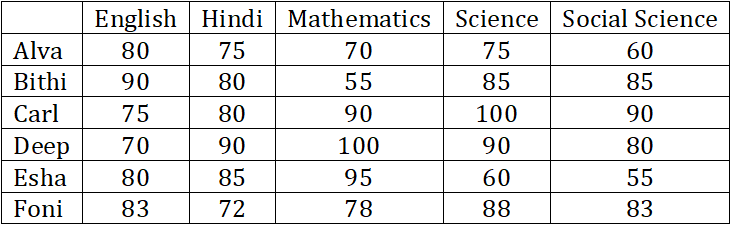
The following facts are also known.
- Four of these students appeared in each of the English, Hindi, Science, and Social Science examinations.
- The student who missed the Mathematics examination did not miss any other examination.
- One of the students who missed the Hindi examination did not miss any other examination. The other student who missed the Hindi examination also missed the Science examination.
Who among the following did not appear for the Mathematics examination?
Passage / Data
Answer the next 6 questions based on the information given below.
In a certain board examination, students were to appear for examination in five subjects: English, Hindi, Mathematics, Science and Social Science. Due to a certain emergency situation, a few of the examinations could not be conducted for some students. Hence, some students missed one examination and some others missed two examinations. Nobody missed more than two examinations.
The board adopted the following policy for awarding marks to students. If a student appeared in all five examinations, then the marks awarded in each of the examinations were on the basis of the scores obtained by them in those examinations.
- If a student missed only one examination, then the marks awarded in that examination was the average of the best three among the four scores in the examinations they appeared for.
- If a student missed two examinations, then the marks awarded in each of these examinations was the average of the best two among the three scores in the examinations they appeared for.
- The marks obtained by six students in the examination are given in the table below. Each of them missed either one or two examinations.
The following facts are also known.
- Four of these students appeared in each of the English, Hindi, Science, and Social Science examinations.
- The student who missed the Mathematics examination did not miss any other examination.
- One of the students who missed the Hindi examination did not miss any other examination. The other student who missed the Hindi examination also missed the Science examination.
Which students did not appear for the English examination?
Passage / Data
Answer the next 6 questions based on the information given below.
In a certain board examination, students were to appear for examination in five subjects: English, Hindi, Mathematics, Science and Social Science. Due to a certain emergency situation, a few of the examinations could not be conducted for some students. Hence, some students missed one examination and some others missed two examinations. Nobody missed more than two examinations.
The board adopted the following policy for awarding marks to students. If a student appeared in all five examinations, then the marks awarded in each of the examinations were on the basis of the scores obtained by them in those examinations.
- If a student missed only one examination, then the marks awarded in that examination was the average of the best three among the four scores in the examinations they appeared for.
- If a student missed two examinations, then the marks awarded in each of these examinations was the average of the best two among the three scores in the examinations they appeared for.
- The marks obtained by six students in the examination are given in the table below. Each of them missed either one or two examinations.
The following facts are also known.
- Four of these students appeared in each of the English, Hindi, Science, and Social Science examinations.
- The student who missed the Mathematics examination did not miss any other examination.
- One of the students who missed the Hindi examination did not miss any other examination. The other student who missed the Hindi examination also missed the Science examination.
What BEST can be concluded about the students who did not appear for the Hindi examination?
Passage / Data
Answer the next 6 questions based on the information given below.
In a certain board examination, students were to appear for examination in five subjects: English, Hindi, Mathematics, Science and Social Science. Due to a certain emergency situation, a few of the examinations could not be conducted for some students. Hence, some students missed one examination and some others missed two examinations. Nobody missed more than two examinations.
The board adopted the following policy for awarding marks to students. If a student appeared in all five examinations, then the marks awarded in each of the examinations were on the basis of the scores obtained by them in those examinations.
- If a student missed only one examination, then the marks awarded in that examination was the average of the best three among the four scores in the examinations they appeared for.
- If a student missed two examinations, then the marks awarded in each of these examinations was the average of the best two among the three scores in the examinations they appeared for.
- The marks obtained by six students in the examination are given in the table below. Each of them missed either one or two examinations.
The following facts are also known.
- Four of these students appeared in each of the English, Hindi, Science, and Social Science examinations.
- The student who missed the Mathematics examination did not miss any other examination.
- One of the students who missed the Hindi examination did not miss any other examination. The other student who missed the Hindi examination also missed the Science examination.
What BEST can be concluded about the students who missed the Science examination?
Passage / Data
Answer the next 6 questions based on the information given below.
In a certain board examination, students were to appear for examination in five subjects: English, Hindi, Mathematics, Science and Social Science. Due to a certain emergency situation, a few of the examinations could not be conducted for some students. Hence, some students missed one examination and some others missed two examinations. Nobody missed more than two examinations.
The board adopted the following policy for awarding marks to students. If a student appeared in all five examinations, then the marks awarded in each of the examinations were on the basis of the scores obtained by them in those examinations.
- If a student missed only one examination, then the marks awarded in that examination was the average of the best three among the four scores in the examinations they appeared for.
- If a student missed two examinations, then the marks awarded in each of these examinations was the average of the best two among the three scores in the examinations they appeared for.
- The marks obtained by six students in the examination are given in the table below. Each of them missed either one or two examinations.
The following facts are also known.
- Four of these students appeared in each of the English, Hindi, Science, and Social Science examinations.
- The student who missed the Mathematics examination did not miss any other examination.
- One of the students who missed the Hindi examination did not miss any other examination. The other student who missed the Hindi examination also missed the Science examination.
How many out of these six students missed exactly one examination?
Passage / Data
Answer the next 6 questions based on the information given below.
In a certain board examination, students were to appear for examination in five subjects: English, Hindi, Mathematics, Science and Social Science. Due to a certain emergency situation, a few of the examinations could not be conducted for some students. Hence, some students missed one examination and some others missed two examinations. Nobody missed more than two examinations.
The board adopted the following policy for awarding marks to students. If a student appeared in all five examinations, then the marks awarded in each of the examinations were on the basis of the scores obtained by them in those examinations.
- If a student missed only one examination, then the marks awarded in that examination was the average of the best three among the four scores in the examinations they appeared for.
- If a student missed two examinations, then the marks awarded in each of these examinations was the average of the best two among the three scores in the examinations they appeared for.
- The marks obtained by six students in the examination are given in the table below. Each of them missed either one or two examinations.
The following facts are also known.
- Four of these students appeared in each of the English, Hindi, Science, and Social Science examinations.
- The student who missed the Mathematics examination did not miss any other examination.
- One of the students who missed the Hindi examination did not miss any other examination. The other student who missed the Hindi examination also missed the Science examination.
For how many students can we be definite about which examinations they missed?
Passage / Data
Answer the following questions based on the information given below.
Four institutes, A, B, C, and D, had contracts with four vendors W, X, Y, and Z during the ten calendar years from 2010 to 2019. The contracts were either multi-year contracts running for several consecutive years or single-year contracts. No institute had more than one contract with the same vendor. However, in a calendar year, an institute may have had contracts with multiple vendors, and a vendor may have had contracts with multiple institutes. It is known that over the decade, the institutes each got into two contracts with two of these vendors, and each vendor got into two contracts with two of these institutes.
The following facts are also known about these contracts.
- Vendor Z had at least one contract in every year.
- Vendor X had one or more contracts in every year up to 2015, but no contract in any year after that.
- Vendor Y had contracts in 2010 and 2019. Vendor W had contracts only in 2012.
- There were five contracts in 2012.
- There were exactly four multi-year contracts. Institute B had a 7-year contract, D had a 4-year contract, and A and C had one 3-year contract each. The other four contracts were single-year contracts.
- Institute C had one or more contracts in 2012 but did not have any contract in 2011.
- Institutes B and D each had exactly one contract in 2012. Institute D did not have any contract in 2010.
In which of the following years were there two or more contracts?
Passage / Data
Answer the following questions based on the information given below.
Four institutes, A, B, C, and D, had contracts with four vendors W, X, Y, and Z during the ten calendar years from 2010 to 2019. The contracts were either multi-year contracts running for several consecutive years or single-year contracts. No institute had more than one contract with the same vendor. However, in a calendar year, an institute may have had contracts with multiple vendors, and a vendor may have had contracts with multiple institutes. It is known that over the decade, the institutes each got into two contracts with two of these vendors, and each vendor got into two contracts with two of these institutes.
The following facts are also known about these contracts.
- Vendor Z had at least one contract in every year.
- Vendor X had one or more contracts in every year up to 2015, but no contract in any year after that.
- Vendor Y had contracts in 2010 and 2019. Vendor W had contracts only in 2012.
- There were five contracts in 2012.
- There were exactly four multi-year contracts. Institute B had a 7-year contract, D had a 4-year contract, and A and C had one 3-year contract each. The other four contracts were single-year contracts.
- Institute C had one or more contracts in 2012 but did not have any contract in 2011.
- Institutes B and D each had exactly one contract in 2012. Institute D did not have any contract in 2010.
Which of the following is true?
Passage / Data
Answer the following questions based on the information given below.
Four institutes, A, B, C, and D, had contracts with four vendors W, X, Y, and Z during the ten calendar years from 2010 to 2019. The contracts were either multi-year contracts running for several consecutive years or single-year contracts. No institute had more than one contract with the same vendor. However, in a calendar year, an institute may have had contracts with multiple vendors, and a vendor may have had contracts with multiple institutes. It is known that over the decade, the institutes each got into two contracts with two of these vendors, and each vendor got into two contracts with two of these institutes.
The following facts are also known about these contracts.
- Vendor Z had at least one contract in every year.
- Vendor X had one or more contracts in every year up to 2015, but no contract in any year after that.
- Vendor Y had contracts in 2010 and 2019. Vendor W had contracts only in 2012.
- There were five contracts in 2012.
- There were exactly four multi-year contracts. Institute B had a 7-year contract, D had a 4-year contract, and A and C had one 3-year contract each. The other four contracts were single-year contracts.
- Institute C had one or more contracts in 2012 but did not have any contract in 2011.
- Institutes B and D each had exactly one contract in 2012. Institute D did not have any contract in 2010.
In how many years during this period was there only one contract?
Passage / Data
Answer the following questions based on the information given below.
Four institutes, A, B, C, and D, had contracts with four vendors W, X, Y, and Z during the ten calendar years from 2010 to 2019. The contracts were either multi-year contracts running for several consecutive years or single-year contracts. No institute had more than one contract with the same vendor. However, in a calendar year, an institute may have had contracts with multiple vendors, and a vendor may have had contracts with multiple institutes. It is known that over the decade, the institutes each got into two contracts with two of these vendors, and each vendor got into two contracts with two of these institutes.
The following facts are also known about these contracts.
- Vendor Z had at least one contract in every year.
- Vendor X had one or more contracts in every year up to 2015, but no contract in any year after that.
- Vendor Y had contracts in 2010 and 2019. Vendor W had contracts only in 2012.
- There were five contracts in 2012.
- There were exactly four multi-year contracts. Institute B had a 7-year contract, D had a 4-year contract, and A and C had one 3-year contract each. The other four contracts were single-year contracts.
- Institute C had one or more contracts in 2012 but did not have any contract in 2011.
- Institutes B and D each had exactly one contract in 2012. Institute D did not have any contract in 2010.
What BEST can be concluded about the number of contracts in 2010?
Passage / Data
Answer the following questions based on the information given below.
Four institutes, A, B, C, and D, had contracts with four vendors W, X, Y, and Z during the ten calendar years from 2010 to 2019. The contracts were either multi-year contracts running for several consecutive years or single-year contracts. No institute had more than one contract with the same vendor. However, in a calendar year, an institute may have had contracts with multiple vendors, and a vendor may have had contracts with multiple institutes. It is known that over the decade, the institutes each got into two contracts with two of these vendors, and each vendor got into two contracts with two of these institutes.
The following facts are also known about these contracts.
- Vendor Z had at least one contract in every year.
- Vendor X had one or more contracts in every year up to 2015, but no contract in any year after that.
- Vendor Y had contracts in 2010 and 2019. Vendor W had contracts only in 2012.
- There were five contracts in 2012.
- There were exactly four multi-year contracts. Institute B had a 7-year contract, D had a 4-year contract, and A and C had one 3-year contract each. The other four contracts were single-year contracts.
- Institute C had one or more contracts in 2012 but did not have any contract in 2011.
- Institutes B and D each had exactly one contract in 2012. Institute D did not have any contract in 2010.
Which institutes had multiple contracts during the same year?
Passage / Data
Answer the following questions based on the information given below.
Four institutes, A, B, C, and D, had contracts with four vendors W, X, Y, and Z during the ten calendar years from 2010 to 2019. The contracts were either multi-year contracts running for several consecutive years or single-year contracts. No institute had more than one contract with the same vendor. However, in a calendar year, an institute may have had contracts with multiple vendors, and a vendor may have had contracts with multiple institutes. It is known that over the decade, the institutes each got into two contracts with two of these vendors, and each vendor got into two contracts with two of these institutes.
The following facts are also known about these contracts.
- Vendor Z had at least one contract in every year.
- Vendor X had one or more contracts in every year up to 2015, but no contract in any year after that.
- Vendor Y had contracts in 2010 and 2019. Vendor W had contracts only in 2012.
- There were five contracts in 2012.
- There were exactly four multi-year contracts. Institute B had a 7-year contract, D had a 4-year contract, and A and C had one 3-year contract each. The other four contracts were single-year contracts.
- Institute C had one or more contracts in 2012 but did not have any contract in 2011.
- Institutes B and D each had exactly one contract in 2012. Institute D did not have any contract in 2010.
Which institutes and vendors had more than one contracts in any year?
Passage / Data
Answer the next 4 questions based on the information given below.
Twenty-five coloured beads are to be arranged in a grid comprising of five rows and five columns. Each cell in the grid must contain exactly one bead. Each bead is coloured either Red, Blue or Green.
While arranging the beads along any of the five rows or along any of the five columns, the rules given below are to be followed:
- Two adjacent beads along the same row or column are always of different colors.
- There is at least one Green bead between any two Blue beads along the same row or column.
- There is at least one Blue and at least one Green bead between any two Red beads along the same row or column.
Every unique, complete arrangement of twenty-five beads is called a configuration.
The total number of possible configurations using beads of only two colors is:
Passage / Data
Answer the next 4 questions based on the information given below.
Twenty-five coloured beads are to be arranged in a grid comprising of five rows and five columns. Each cell in the grid must contain exactly one bead. Each bead is coloured either Red, Blue or Green.
While arranging the beads along any of the five rows or along any of the five columns, the rules given below are to be followed:
- Two adjacent beads along the same row or column are always of different colors.
- There is at least one Green bead between any two Blue beads along the same row or column.
- There is at least one Blue and at least one Green bead between any two Red beads along the same row or column.
Every unique, complete arrangement of twenty-five beads is called a configuration.
What is the maximum possible number of Red beads that can appear in any configuration?
Passage / Data
Answer the next 4 questions based on the information given below.
Twenty-five coloured beads are to be arranged in a grid comprising of five rows and five columns. Each cell in the grid must contain exactly one bead. Each bead is coloured either Red, Blue or Green.
While arranging the beads along any of the five rows or along any of the five columns, the rules given below are to be followed:
- Two adjacent beads along the same row or column are always of different colors.
- There is at least one Green bead between any two Blue beads along the same row or column.
- There is at least one Blue and at least one Green bead between any two Red beads along the same row or column.
Every unique, complete arrangement of twenty-five beads is called a configuration.
What is the minimum number of Blue beads in any configuration?
Passage / Data
Answer the next 4 questions based on the information given below.
Twenty-five coloured beads are to be arranged in a grid comprising of five rows and five columns. Each cell in the grid must contain exactly one bead. Each bead is coloured either Red, Blue or Green.
While arranging the beads along any of the five rows or along any of the five columns, the rules given below are to be followed:
- Two adjacent beads along the same row or column are always of different colors.
- There is at least one Green bead between any two Blue beads along the same row or column.
- There is at least one Blue and at least one Green bead between any two Red beads along the same row or column.
Every unique, complete arrangement of twenty-five beads is called a configuration.
Two Red beads have been placed in ‘second row, third column’ and ‘third row, second column’. How many more Red beads can be placed so as to maximize the number of Red beads used in the configuration?
Passage / Data
Answer the next 4 questions based on the information given below.
A shopping mall has a large basement parking lot with parking slots painted in it along a single row. These slots are quite narrow; a compact car can fit in a single slot but an SUV requires two slots. When a car arrives, the parking attendant guides the car to the first available slot from the beginning of the row into which the car can fit.
For our purpose, cars are numbered according to the order in which they arrive at the lot. For example, the first car to arrive is given a number 1, the second a number 2, and so on. This numbering does not indicate whether a car is a compact or an SUV. The configuration of a parking lot is a sequence of the car numbers in each slot. Each single vacant slot is represented by letter V.
For instance, suppose cars numbered 1 through 5 arrive and park, where cars 1, 3 and 5 are compact cars and 2 and 4 are SUVs. At this point, the parking lot would be described by the sequence 1, 2, 3, 4, 5. If cars 2 and 5 now vacate their slots, the parking lot would now be described as 1, V, V, 3, 4. If a compact car (numbered 6) arrives subsequently followed by an SUV (numbered 7), the parking lot would be described by the sequence 1, 6, V, 3, 4, 7.
Answer the following questions INDEPENDENTLY of each other.
Initially cars numbered 1, 2, 3, and 4 arrive among which 1 and 4 are SUVs while 2 and 3 are compact cars. Car 1 then leaves, followed by the arrivals of car 5 (a compact car) and car 6 (an SUV). Car 4 then leaves. Then car 7 (an SUV) and car 8 (a compact car) arrive. At this moment, which among the following numbered car is parked next to car 3?
Passage / Data
Answer the next 4 questions based on the information given below.
A shopping mall has a large basement parking lot with parking slots painted in it along a single row. These slots are quite narrow; a compact car can fit in a single slot but an SUV requires two slots. When a car arrives, the parking attendant guides the car to the first available slot from the beginning of the row into which the car can fit.
For our purpose, cars are numbered according to the order in which they arrive at the lot. For example, the first car to arrive is given a number 1, the second a number 2, and so on. This numbering does not indicate whether a car is a compact or an SUV. The configuration of a parking lot is a sequence of the car numbers in each slot. Each single vacant slot is represented by letter V.
For instance, suppose cars numbered 1 through 5 arrive and park, where cars 1, 3 and 5 are compact cars and 2 and 4 are SUVs. At this point, the parking lot would be described by the sequence 1, 2, 3, 4, 5. If cars 2 and 5 now vacate their slots, the parking lot would now be described as 1, V, V, 3, 4. If a compact car (numbered 6) arrives subsequently followed by an SUV (numbered 7), the parking lot would be described by the sequence 1, 6, V, 3, 4, 7.
Answer the following questions INDEPENDENTLY of each other.
Suppose eight cars have arrived, of which two have left. Also suppose that car 4 is a compact and car 7 is an SUV. Which of the following is a POSSIBLE current configuration of the parking lot?
Passage / Data
Answer the next 4 questions based on the information given below.
A shopping mall has a large basement parking lot with parking slots painted in it along a single row. These slots are quite narrow; a compact car can fit in a single slot but an SUV requires two slots. When a car arrives, the parking attendant guides the car to the first available slot from the beginning of the row into which the car can fit.
For our purpose, cars are numbered according to the order in which they arrive at the lot. For example, the first car to arrive is given a number 1, the second a number 2, and so on. This numbering does not indicate whether a car is a compact or an SUV. The configuration of a parking lot is a sequence of the car numbers in each slot. Each single vacant slot is represented by letter V.
For instance, suppose cars numbered 1 through 5 arrive and park, where cars 1, 3 and 5 are compact cars and 2 and 4 are SUVs. At this point, the parking lot would be described by the sequence 1, 2, 3, 4, 5. If cars 2 and 5 now vacate their slots, the parking lot would now be described as 1, V, V, 3, 4. If a compact car (numbered 6) arrives subsequently followed by an SUV (numbered 7), the parking lot would be described by the sequence 1, 6, V, 3, 4, 7.
Answer the following questions INDEPENDENTLY of each other.
Suppose the sequence at some point of time is 4, 5, 6, V, 3. Which of the following is NOT necessarily true?
Passage / Data
Answer the next 4 questions based on the information given below.
A shopping mall has a large basement parking lot with parking slots painted in it along a single row. These slots are quite narrow; a compact car can fit in a single slot but an SUV requires two slots. When a car arrives, the parking attendant guides the car to the first available slot from the beginning of the row into which the car can fit.
For our purpose, cars are numbered according to the order in which they arrive at the lot. For example, the first car to arrive is given a number 1, the second a number 2, and so on. This numbering does not indicate whether a car is a compact or an SUV. The configuration of a parking lot is a sequence of the car numbers in each slot. Each single vacant slot is represented by letter V.
For instance, suppose cars numbered 1 through 5 arrive and park, where cars 1, 3 and 5 are compact cars and 2 and 4 are SUVs. At this point, the parking lot would be described by the sequence 1, 2, 3, 4, 5. If cars 2 and 5 now vacate their slots, the parking lot would now be described as 1, V, V, 3, 4. If a compact car (numbered 6) arrives subsequently followed by an SUV (numbered 7), the parking lot would be described by the sequence 1, 6, V, 3, 4, 7.
Answer the following questions INDEPENDENTLY of each other.
Suppose that car 4 is not the first car to leave and that the sequence at a time between the arrival of the car 7 and car 8 is V, 7, 3, 6, 5. Then which of the following statements MUST be false?
Passage / Data
Answer the next 4 questions based on the information given below.
The Humanities department of a college is planning to organize eight seminars, one for each of the eight doctoral students - A, B, C, D, E, F, G and H. Four of them are from Economics, three from Sociology and one from Anthropology department. Each student is guided by one among P, Q, R, S and T. Two students are guided by each of P, R and T, while one student is guided by each of Q and S. Each student is guided by a guide belonging to their department.
Each seminar is to be scheduled in one of four consecutive 30-minute slots starting at 9:00 am, 9:30 am, 10:00 am and 10:30 am on the same day. More than one seminars can be scheduled in a slot, provided the guide is free. Only three rooms are available and hence at the most three seminars can be scheduled in a slot. Students who are guided by the same guide must be scheduled in consecutive slots.
The following additional facts are also known.
- Seminars by students from Economics are scheduled in each of the four slots.
- A’s is the only seminar that is scheduled at 10:00 am. A is guided by R.
- F is an Anthropology student whose seminar is scheduled at 10:30 am.
- The seminar of a Sociology student is scheduled at 9:00 am.
- B and G are both Sociology students, whose seminars are scheduled in the same slot. The seminar of an Economics student, who is guided by T, is also scheduled in the same slot.
- P, who is guiding both B and C, has students scheduled in the first two slots.
- A and G are scheduled in two consecutive slots.
Which one of the following statements is true?
Passage / Data
Answer the next 4 questions based on the information given below.
The Humanities department of a college is planning to organize eight seminars, one for each of the eight doctoral students - A, B, C, D, E, F, G and H. Four of them are from Economics, three from Sociology and one from Anthropology department. Each student is guided by one among P, Q, R, S and T. Two students are guided by each of P, R and T, while one student is guided by each of Q and S. Each student is guided by a guide belonging to their department.
Each seminar is to be scheduled in one of four consecutive 30-minute slots starting at 9:00 am, 9:30 am, 10:00 am and 10:30 am on the same day. More than one seminars can be scheduled in a slot, provided the guide is free. Only three rooms are available and hence at the most three seminars can be scheduled in a slot. Students who are guided by the same guide must be scheduled in consecutive slots.
The following additional facts are also known.
- Seminars by students from Economics are scheduled in each of the four slots.
- A’s is the only seminar that is scheduled at 10:00 am. A is guided by R.
- F is an Anthropology student whose seminar is scheduled at 10:30 am.
- The seminar of a Sociology student is scheduled at 9:00 am.
- B and G are both Sociology students, whose seminars are scheduled in the same slot. The seminar of an Economics student, who is guided by T, is also scheduled in the same slot.
- P, who is guiding both B and C, has students scheduled in the first two slots.
- A and G are scheduled in two consecutive slots.
Who all are NOT guiding any Economics students?
Passage / Data
Answer the next 4 questions based on the information given below.
The Humanities department of a college is planning to organize eight seminars, one for each of the eight doctoral students - A, B, C, D, E, F, G and H. Four of them are from Economics, three from Sociology and one from Anthropology department. Each student is guided by one among P, Q, R, S and T. Two students are guided by each of P, R and T, while one student is guided by each of Q and S. Each student is guided by a guide belonging to their department.
Each seminar is to be scheduled in one of four consecutive 30-minute slots starting at 9:00 am, 9:30 am, 10:00 am and 10:30 am on the same day. More than one seminars can be scheduled in a slot, provided the guide is free. Only three rooms are available and hence at the most three seminars can be scheduled in a slot. Students who are guided by the same guide must be scheduled in consecutive slots.
The following additional facts are also known.
- Seminars by students from Economics are scheduled in each of the four slots.
- A’s is the only seminar that is scheduled at 10:00 am. A is guided by R.
- F is an Anthropology student whose seminar is scheduled at 10:30 am.
- The seminar of a Sociology student is scheduled at 9:00 am.
- B and G are both Sociology students, whose seminars are scheduled in the same slot. The seminar of an Economics student, who is guided by T, is also scheduled in the same slot.
- P, who is guiding both B and C, has students scheduled in the first two slots.
- A and G are scheduled in two consecutive slots.
Which of the following statements is necessarily true?
Passage / Data
Answer the next 4 questions based on the information given below.
The Humanities department of a college is planning to organize eight seminars, one for each of the eight doctoral students - A, B, C, D, E, F, G and H. Four of them are from Economics, three from Sociology and one from Anthropology department. Each student is guided by one among P, Q, R, S and T. Two students are guided by each of P, R and T, while one student is guided by each of Q and S. Each student is guided by a guide belonging to their department.
Each seminar is to be scheduled in one of four consecutive 30-minute slots starting at 9:00 am, 9:30 am, 10:00 am and 10:30 am on the same day. More than one seminars can be scheduled in a slot, provided the guide is free. Only three rooms are available and hence at the most three seminars can be scheduled in a slot. Students who are guided by the same guide must be scheduled in consecutive slots.
The following additional facts are also known.
- Seminars by students from Economics are scheduled in each of the four slots.
- A’s is the only seminar that is scheduled at 10:00 am. A is guided by R.
- F is an Anthropology student whose seminar is scheduled at 10:30 am.
- The seminar of a Sociology student is scheduled at 9:00 am.
- B and G are both Sociology students, whose seminars are scheduled in the same slot. The seminar of an Economics student, who is guided by T, is also scheduled in the same slot.
- P, who is guiding both B and C, has students scheduled in the first two slots.
- A and G are scheduled in two consecutive slots.
If D is scheduled in a slot later than Q's, then which of the following two statement(s) is(are) true?
(i) E and H are guided by T.
(ii) G is guided by Q.
Passage / Data
Answer the next 4 questions based on the information given below.
The Humanities department of a college is planning to organize eight seminars, one for each of the eight doctoral students - A, B, C, D, E, F, G and H. Four of them are from Economics, three from Sociology and one from Anthropology department. Each student is guided by one among P, Q, R, S and T. Two students are guided by each of P, R and T, while one student is guided by each of Q and S. Each student is guided by a guide belonging to their department.
Each seminar is to be scheduled in one of four consecutive 30-minute slots starting at 9:00 am, 9:30 am, 10:00 am and 10:30 am on the same day. More than one seminars can be scheduled in a slot, provided the guide is free. Only three rooms are available and hence at the most three seminars can be scheduled in a slot. Students who are guided by the same guide must be scheduled in consecutive slots.
The following additional facts are also known.
- Seminars by students from Economics are scheduled in each of the four slots.
- A’s is the only seminar that is scheduled at 10:00 am. A is guided by R.
- F is an Anthropology student whose seminar is scheduled at 10:30 am.
- The seminar of a Sociology student is scheduled at 9:00 am.
- B and G are both Sociology students, whose seminars are scheduled in the same slot. The seminar of an Economics student, who is guided by T, is also scheduled in the same slot.
- P, who is guiding both B and C, has students scheduled in the first two slots.
- A and G are scheduled in two consecutive slots.
If E and Q are both scheduled in the same slot, then which of the following statements BEST describes the relationship between D, H, and T?
Passage / Data
Answer the next 4 questions based on the information given below.
The Humanities department of a college is planning to organize eight seminars, one for each of the eight doctoral students - A, B, C, D, E, F, G and H. Four of them are from Economics, three from Sociology and one from Anthropology department. Each student is guided by one among P, Q, R, S and T. Two students are guided by each of P, R and T, while one student is guided by each of Q and S. Each student is guided by a guide belonging to their department.
Each seminar is to be scheduled in one of four consecutive 30-minute slots starting at 9:00 am, 9:30 am, 10:00 am and 10:30 am on the same day. More than one seminars can be scheduled in a slot, provided the guide is free. Only three rooms are available and hence at the most three seminars can be scheduled in a slot. Students who are guided by the same guide must be scheduled in consecutive slots.
The following additional facts are also known.
- Seminars by students from Economics are scheduled in each of the four slots.
- A’s is the only seminar that is scheduled at 10:00 am. A is guided by R.
- F is an Anthropology student whose seminar is scheduled at 10:30 am.
- The seminar of a Sociology student is scheduled at 9:00 am.
- B and G are both Sociology students, whose seminars are scheduled in the same slot. The seminar of an Economics student, who is guided by T, is also scheduled in the same slot.
- P, who is guiding both B and C, has students scheduled in the first two slots.
- A and G are scheduled in two consecutive slots.
If D is scheduled in the slot immediately before Q’s, then which of the following is NOT necessarily true?
Passage / Data
Answer the next 4 questions based on the information given below.
Sixteen patients in a hospital must undergo a blood test for a disease. It is known that exactly one of them has the disease. The hospital has only eight testing kits and has decided to pool blood samples of patients into eight vials for the tests. The patients are numbered 1 through 16, and the vials are labelled A, B, C, D, E, F, G, and H. The following table shows the vials into which each patient’s blood sample is distributed.
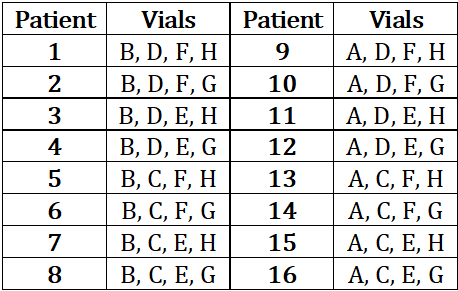
If a patient has the disease, then each vial containing his/her blood sample will test positive. If a vial tests positive, one of the patients whose blood samples were mixed in the vial has the disease. If a vial tests negative, then none of the patients whose blood samples were mixed in the vial has the disease.
Suppose vial C tests positive and vials A, E and H test negative. Which patient has the disease?
Passage / Data
Answer the next 4 questions based on the information given below.
Sixteen patients in a hospital must undergo a blood test for a disease. It is known that exactly one of them has the disease. The hospital has only eight testing kits and has decided to pool blood samples of patients into eight vials for the tests. The patients are numbered 1 through 16, and the vials are labelled A, B, C, D, E, F, G, and H. The following table shows the vials into which each patient’s blood sample is distributed.
If a patient has the disease, then each vial containing his/her blood sample will test positive. If a vial tests positive, one of the patients whose blood samples were mixed in the vial has the disease. If a vial tests negative, then none of the patients whose blood samples were mixed in the vial has the disease.
Suppose vial A tests positive and vials D and G test negative. Which of the following vials should we test next to identify the patient with the disease?
Passage / Data
Answer the next 4 questions based on the information given below.
Sixteen patients in a hospital must undergo a blood test for a disease. It is known that exactly one of them has the disease. The hospital has only eight testing kits and has decided to pool blood samples of patients into eight vials for the tests. The patients are numbered 1 through 16, and the vials are labelled A, B, C, D, E, F, G, and H. The following table shows the vials into which each patient’s blood sample is distributed.
If a patient has the disease, then each vial containing his/her blood sample will test positive. If a vial tests positive, one of the patients whose blood samples were mixed in the vial has the disease. If a vial tests negative, then none of the patients whose blood samples were mixed in the vial has the disease.
Which of the following combinations of test results is NOT possible?
Passage / Data
Answer the next 4 questions based on the information given below.
Sixteen patients in a hospital must undergo a blood test for a disease. It is known that exactly one of them has the disease. The hospital has only eight testing kits and has decided to pool blood samples of patients into eight vials for the tests. The patients are numbered 1 through 16, and the vials are labelled A, B, C, D, E, F, G, and H. The following table shows the vials into which each patient’s blood sample is distributed.
If a patient has the disease, then each vial containing his/her blood sample will test positive. If a vial tests positive, one of the patients whose blood samples were mixed in the vial has the disease. If a vial tests negative, then none of the patients whose blood samples were mixed in the vial has the disease.
Suppose one of the lab assistants accidentally mixed two patients' blood samples before they were distributed to the vials. Which of the following correctly represents the set of all possible numbers of positive test results out of the eight vials?
Passage / Data
Answer the next 4 questions based on the information given.
A survey of 600 schools in India was conducted to gather information about their online teaching learning processes (OTLP). The following four facilities were studied.
F1: Own software for OTLP
F2: Trained teachers for OTLP
F3: Training materials for OTLP
F4: All students having Laptops
The following observations were summarized from the survey.
- 80 schools did not have any of the four facilities – F1, F2, F3, F4.
- 40 schools had all four facilities.
- The number of schools with only F1, only F2, only F3, and only F4 was 25, 30, 26 and 20 respectively.
- The number of schools with exactly three of the facilities was the same irrespective of which three were considered.
- 313 schools had F2.
- 26 schools had only F2 and F3 (but neither F1 nor F4).
- Among the schools having F4, 24 had only F3, and 45 had only F2.
- 162 schools had both F1 and F2.
- The number of schools having F1 was the same as the number of schools having F4.
What was the total number of schools having exactly three of the four facilities?
Passage / Data
Answer the next 4 questions based on the information given.
A survey of 600 schools in India was conducted to gather information about their online teaching learning processes (OTLP). The following four facilities were studied.
F1: Own software for OTLP
F2: Trained teachers for OTLP
F3: Training materials for OTLP
F4: All students having Laptops
The following observations were summarized from the survey.
- 80 schools did not have any of the four facilities – F1, F2, F3, F4.
- 40 schools had all four facilities.
- The number of schools with only F1, only F2, only F3, and only F4 was 25, 30, 26 and 20 respectively.
- The number of schools with exactly three of the facilities was the same irrespective of which three were considered.
- 313 schools had F2.
- 26 schools had only F2 and F3 (but neither F1 nor F4).
- Among the schools having F4, 24 had only F3, and 45 had only F2.
- 162 schools had both F1 and F2.
- The number of schools having F1 was the same as the number of schools having F4.
What was the number of schools having facilities F2 and F4?
Passage / Data
Answer the next 4 questions based on the information given.
A survey of 600 schools in India was conducted to gather information about their online teaching learning processes (OTLP). The following four facilities were studied.
F1: Own software for OTLP
F2: Trained teachers for OTLP
F3: Training materials for OTLP
F4: All students having Laptops
The following observations were summarized from the survey.
- 80 schools did not have any of the four facilities – F1, F2, F3, F4.
- 40 schools had all four facilities.
- The number of schools with only F1, only F2, only F3, and only F4 was 25, 30, 26 and 20 respectively.
- The number of schools with exactly three of the facilities was the same irrespective of which three were considered.
- 313 schools had F2.
- 26 schools had only F2 and F3 (but neither F1 nor F4).
- Among the schools having F4, 24 had only F3, and 45 had only F2.
- 162 schools had both F1 and F2.
- The number of schools having F1 was the same as the number of schools having F4.
What was the number of schools having only facilities F1 and F3?
Passage / Data
Answer the next 4 questions based on the information given.
A survey of 600 schools in India was conducted to gather information about their online teaching learning processes (OTLP). The following four facilities were studied.
F1: Own software for OTLP
F2: Trained teachers for OTLP
F3: Training materials for OTLP
F4: All students having Laptops
The following observations were summarized from the survey.
- 80 schools did not have any of the four facilities – F1, F2, F3, F4.
- 40 schools had all four facilities.
- The number of schools with only F1, only F2, only F3, and only F4 was 25, 30, 26 and 20 respectively.
- The number of schools with exactly three of the facilities was the same irrespective of which three were considered.
- 313 schools had F2.
- 26 schools had only F2 and F3 (but neither F1 nor F4).
- Among the schools having F4, 24 had only F3, and 45 had only F2.
- 162 schools had both F1 and F2.
- The number of schools having F1 was the same as the number of schools having F4.
What was the number of schools having only facilities F1 andF4?
Passage / Data
Answer the next 4 questions based on the information given.
XYZ organization got into the business of delivering groceries to home at the beginning of the last month. They have a two-day delivery promise. However, their deliveries are unreliable. An order booked on a particular day may be delivered the next day or the day after. If the order is not delivered at the end of two days, then the order is declared as lost at the end of the second day. XYZ then does not deliver the order, but informs the customer, marks the order as lost, returns the payment and pays a penalty for non-delivery.
The following table provides details about the operations of XYZ for a week of the last month. The first column gives the date, the second gives the cumulative number of orders that were booked up to and including that day. The third column represents the number of orders delivered on that day. The last column gives the cumulative number of orders that were lost up to and including that day.
It is known that the numbers of orders that were booked on the 11th, 12th, and 13th of the last month that took two days to deliver were 4, 6, and 8 respectively.
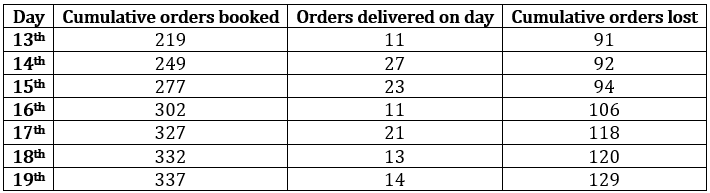
Among the following days, the largest fraction of orders booked on which day was lost?
Passage / Data
Answer the next 4 questions based on the information given.
XYZ organization got into the business of delivering groceries to home at the beginning of the last month. They have a two-day delivery promise. However, their deliveries are unreliable. An order booked on a particular day may be delivered the next day or the day after. If the order is not delivered at the end of two days, then the order is declared as lost at the end of the second day. XYZ then does not deliver the order, but informs the customer, marks the order as lost, returns the payment and pays a penalty for non-delivery.
The following table provides details about the operations of XYZ for a week of the last month. The first column gives the date, the second gives the cumulative number of orders that were booked up to and including that day. The third column represents the number of orders delivered on that day. The last column gives the cumulative number of orders that were lost up to and including that day.
It is known that the numbers of orders that were booked on the 11th, 12th, and 13th of the last month that took two days to deliver were 4, 6, and 8 respectively.
On which of the following days was the number of orders booked the highest?
Passage / Data
Answer the next 4 questions based on the information given.
XYZ organization got into the business of delivering groceries to home at the beginning of the last month. They have a two-day delivery promise. However, their deliveries are unreliable. An order booked on a particular day may be delivered the next day or the day after. If the order is not delivered at the end of two days, then the order is declared as lost at the end of the second day. XYZ then does not deliver the order, but informs the customer, marks the order as lost, returns the payment and pays a penalty for non-delivery.
The following table provides details about the operations of XYZ for a week of the last month. The first column gives the date, the second gives the cumulative number of orders that were booked up to and including that day. The third column represents the number of orders delivered on that day. The last column gives the cumulative number of orders that were lost up to and including that day.
It is known that the numbers of orders that were booked on the 11th, 12th, and 13th of the last month that took two days to deliver were 4, 6, and 8 respectively.
The delivery ratio for a given day is defined as the ratio of the number of orders booked on that day which are delivered on the next day to the number of orders booked on that day which are delivered on the second day after booking. On which of the following days, was the delivery ratio the highest?
Passage / Data
Answer the next 4 questions based on the information given.
XYZ organization got into the business of delivering groceries to home at the beginning of the last month. They have a two-day delivery promise. However, their deliveries are unreliable. An order booked on a particular day may be delivered the next day or the day after. If the order is not delivered at the end of two days, then the order is declared as lost at the end of the second day. XYZ then does not deliver the order, but informs the customer, marks the order as lost, returns the payment and pays a penalty for non-delivery.
The following table provides details about the operations of XYZ for a week of the last month. The first column gives the date, the second gives the cumulative number of orders that were booked up to and including that day. The third column represents the number of orders delivered on that day. The last column gives the cumulative number of orders that were lost up to and including that day.
It is known that the numbers of orders that were booked on the 11th, 12th, and 13th of the last month that took two days to deliver were 4, 6, and 8 respectively.
The average time taken to deliver orders booked on a particular day is computed as follows. Let the number of orders delivered the next day be x and the number of orders delivered the day after be y. Then the average time to deliver order is (x+2y)/(x+y). On which of the following days was the average time taken to deliver orders booked the least?
Passage / Data
Answer the next 4 questions based on the information given.
The Hi-Lo game is a four-player game played in six rounds. In every round, each player chooses to bid Hi or Lo. The bids are made simultaneously. If all four bid Hi, then all four lose1 point each. If three players bid Hi and one bids Lo, then the players bidding Hi gain 1 point each and the player bidding Lo loses 3 points. If two players bid Hi and two bid Lo, then the players bidding Hi gain 2 points each and the players bidding Lo lose 2 points each. If one player bids Hi and three bid Lo, then the player bidding Hi gains 3 points and the players bidding Lo lose 1 point each. If all four bid Lo, then all four gain 1 point each.
Four players Arun, Bankim, Charu, and Dipak played the Hi-Lo game. The following facts are known about their game:
- At the end of three rounds, Arun had scored 6 points, Dipak had scored 2 points, Bankim and Charu had scored -2 points each.
- At the end of six rounds, Arun had scored 7 points, Bankim and Dipak had scored -1 point each, and Charu had scored -5 points.
- Dipak’s score in the third round was less than his score in the first round but was more than his score in the second round.
- In exactly two out of the six rounds, Arun was the only player who bid Hi.
What were the bids by Arun, Bankim, Charu and Dipak, respectively in the first round?
Passage / Data
Answer the next 4 questions based on the information given.
The Hi-Lo game is a four-player game played in six rounds. In every round, each player chooses to bid Hi or Lo. The bids are made simultaneously. If all four bid Hi, then all four lose1 point each. If three players bid Hi and one bids Lo, then the players bidding Hi gain 1 point each and the player bidding Lo loses 3 points. If two players bid Hi and two bid Lo, then the players bidding Hi gain 2 points each and the players bidding Lo lose 2 points each. If one player bids Hi and three bid Lo, then the player bidding Hi gains 3 points and the players bidding Lo lose 1 point each. If all four bid Lo, then all four gain 1 point each.
Four players Arun, Bankim, Charu, and Dipak played the Hi-Lo game. The following facts are known about their game:
- At the end of three rounds, Arun had scored 6 points, Dipak had scored 2 points, Bankim and Charu had scored -2 points each.
- At the end of six rounds, Arun had scored 7 points, Bankim and Dipak had scored -1 point each, and Charu had scored -5 points.
- Dipak’s score in the third round was less than his score in the first round but was more than his score in the second round.
- In exactly two out of the six rounds, Arun was the only player who bid Hi.
In how many rounds did Arun bid Hi?
Passage / Data
Answer the next 4 questions based on the information given.
The Hi-Lo game is a four-player game played in six rounds. In every round, each player chooses to bid Hi or Lo. The bids are made simultaneously. If all four bid Hi, then all four lose1 point each. If three players bid Hi and one bids Lo, then the players bidding Hi gain 1 point each and the player bidding Lo loses 3 points. If two players bid Hi and two bid Lo, then the players bidding Hi gain 2 points each and the players bidding Lo lose 2 points each. If one player bids Hi and three bid Lo, then the player bidding Hi gains 3 points and the players bidding Lo lose 1 point each. If all four bid Lo, then all four gain 1 point each.
Four players Arun, Bankim, Charu, and Dipak played the Hi-Lo game. The following facts are known about their game:
- At the end of three rounds, Arun had scored 6 points, Dipak had scored 2 points, Bankim and Charu had scored -2 points each.
- At the end of six rounds, Arun had scored 7 points, Bankim and Dipak had scored -1 point each, and Charu had scored -5 points.
- Dipak’s score in the third round was less than his score in the first round but was more than his score in the second round.
- In exactly two out of the six rounds, Arun was the only player who bid Hi.
In how many rounds did Bankim bid Lo?
Passage / Data
Answer the next 4 questions based on the information given.
The Hi-Lo game is a four-player game played in six rounds. In every round, each player chooses to bid Hi or Lo. The bids are made simultaneously. If all four bid Hi, then all four lose1 point each. If three players bid Hi and one bids Lo, then the players bidding Hi gain 1 point each and the player bidding Lo loses 3 points. If two players bid Hi and two bid Lo, then the players bidding Hi gain 2 points each and the players bidding Lo lose 2 points each. If one player bids Hi and three bid Lo, then the player bidding Hi gains 3 points and the players bidding Lo lose 1 point each. If all four bid Lo, then all four gain 1 point each.
Four players Arun, Bankim, Charu, and Dipak played the Hi-Lo game. The following facts are known about their game:
- At the end of three rounds, Arun had scored 6 points, Dipak had scored 2 points, Bankim and Charu had scored -2 points each.
- At the end of six rounds, Arun had scored 7 points, Bankim and Dipak had scored -1 point each, and Charu had scored -5 points.
- Dipak’s score in the third round was less than his score in the first round but was more than his score in the second round.
- In exactly two out of the six rounds, Arun was the only player who bid Hi.
In how many rounds did all four players make identical bids?
Passage / Data
Answer the next 4 questions based on the information given.
The Hi-Lo game is a four-player game played in six rounds. In every round, each player chooses to bid Hi or Lo. The bids are made simultaneously. If all four bid Hi, then all four lose1 point each. If three players bid Hi and one bids Lo, then the players bidding Hi gain 1 point each and the player bidding Lo loses 3 points. If two players bid Hi and two bid Lo, then the players bidding Hi gain 2 points each and the players bidding Lo lose 2 points each. If one player bids Hi and three bid Lo, then the player bidding Hi gains 3 points and the players bidding Lo lose 1 point each. If all four bid Lo, then all four gain 1 point each.
Four players Arun, Bankim, Charu, and Dipak played the Hi-Lo game. The following facts are known about their game:
- At the end of three rounds, Arun had scored 6 points, Dipak had scored 2 points, Bankim and Charu had scored -2 points each.
- At the end of six rounds, Arun had scored 7 points, Bankim and Dipak had scored -1 point each, and Charu had scored -5 points.
- Dipak’s score in the third round was less than his score in the first round but was more than his score in the second round.
- In exactly two out of the six rounds, Arun was the only player who bid Hi.
In how many rounds did Dipak gain exactly 1 point?
Passage / Data
Answer the next 4 questions based on the information given.
The Hi-Lo game is a four-player game played in six rounds. In every round, each player chooses to bid Hi or Lo. The bids are made simultaneously. If all four bid Hi, then all four lose1 point each. If three players bid Hi and one bids Lo, then the players bidding Hi gain 1 point each and the player bidding Lo loses 3 points. If two players bid Hi and two bid Lo, then the players bidding Hi gain 2 points each and the players bidding Lo lose 2 points each. If one player bids Hi and three bid Lo, then the player bidding Hi gains 3 points and the players bidding Lo lose 1 point each. If all four bid Lo, then all four gain 1 point each.
Four players Arun, Bankim, Charu, and Dipak played the Hi-Lo game. The following facts are known about their game:
- At the end of three rounds, Arun had scored 6 points, Dipak had scored 2 points, Bankim and Charu had scored -2 points each.
- At the end of six rounds, Arun had scored 7 points, Bankim and Dipak had scored -1 point each, and Charu had scored -5 points.
- Dipak’s score in the third round was less than his score in the first round but was more than his score in the second round.
- In exactly two out of the six rounds, Arun was the only player who bid Hi.
In which of the following rounds, was Arun DEFINITELY the only player to bid Hi?
Passage / Data
Answer the next 4 questions based on the information given.
A farmer had a rectangular land containing 205 trees. He distributed that land among his four daughters – Abha, Bina, Chitra and Dipti by dividing the land into twelve plots along three rows (X,Y,Z) and four Columns (1,2,3,4) as shown in the figure below:
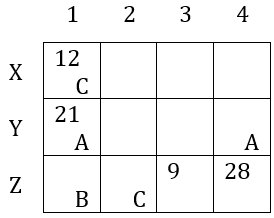
The plots in rows X, Y, Z contained mango, teak and pine trees respectively. Each plot had trees in non-zero multiples of 3 or 4 and none of the plots had the same number of trees. Each daughter got an even number of plots. In the figure, the number mentioned in top left corner of a plot is the number of trees in that plot, while the letter in the bottom right corner is the first letter of the name of the daughter who got that plot (For example, Abha got the plot in row Y and column 1 containing 21 trees). Some information in the figure got erased, but the following is known:
- Abha got 20 trees more than Chitra but 6 trees less than Dipti.
- The largest number of trees in a plot was 32, but it was not with Abha.
- The number of teak trees in Column 3 was double of that in Column 2 but was half of that in Column 4.
- Both Abha and Bina got a higher number of plots than Dipti.
- Only Bina, Chitra and Dipti got corner plots.
- Dipti got two adjoining plots in the same row.
- Bina was the only one who got a plot in each row and each column.
- Chitra and Dipti did not get plots which were adjacent to each other (either in row / column /diagonal).
- The number of mango trees was double the number of teak trees.
How many mango trees were there in total?
Passage / Data
Answer the next 4 questions based on the information given.
A farmer had a rectangular land containing 205 trees. He distributed that land among his four daughters – Abha, Bina, Chitra and Dipti by dividing the land into twelve plots along three rows (X,Y,Z) and four Columns (1,2,3,4) as shown in the figure below:
The plots in rows X, Y, Z contained mango, teak and pine trees respectively. Each plot had trees in non-zero multiples of 3 or 4 and none of the plots had the same number of trees. Each daughter got an even number of plots. In the figure, the number mentioned in top left corner of a plot is the number of trees in that plot, while the letter in the bottom right corner is the first letter of the name of the daughter who got that plot (For example, Abha got the plot in row Y and column 1 containing 21 trees). Some information in the figure got erased, but the following is known:
- Abha got 20 trees more than Chitra but 6 trees less than Dipti.
- The largest number of trees in a plot was 32, but it was not with Abha.
- The number of teak trees in Column 3 was double of that in Column 2 but was half of that in Column 4.
- Both Abha and Bina got a higher number of plots than Dipti.
- Only Bina, Chitra and Dipti got corner plots.
- Dipti got two adjoining plots in the same row.
- Bina was the only one who got a plot in each row and each column.
- Chitra and Dipti did not get plots which were adjacent to each other (either in row / column /diagonal).
- The number of mango trees was double the number of teak trees.
Which of the following is the correct sequence of trees received by Abha, Bina, Chitra and Dipti in that order?
Passage / Data
Answer the next 4 questions based on the information given.
A farmer had a rectangular land containing 205 trees. He distributed that land among his four daughters – Abha, Bina, Chitra and Dipti by dividing the land into twelve plots along three rows (X,Y,Z) and four Columns (1,2,3,4) as shown in the figure below:
The plots in rows X, Y, Z contained mango, teak and pine trees respectively. Each plot had trees in non-zero multiples of 3 or 4 and none of the plots had the same number of trees. Each daughter got an even number of plots. In the figure, the number mentioned in top left corner of a plot is the number of trees in that plot, while the letter in the bottom right corner is the first letter of the name of the daughter who got that plot (For example, Abha got the plot in row Y and column 1 containing 21 trees). Some information in the figure got erased, but the following is known:
- Abha got 20 trees more than Chitra but 6 trees less than Dipti.
- The largest number of trees in a plot was 32, but it was not with Abha.
- The number of teak trees in Column 3 was double of that in Column 2 but was half of that in Column 4.
- Both Abha and Bina got a higher number of plots than Dipti.
- Only Bina, Chitra and Dipti got corner plots.
- Dipti got two adjoining plots in the same row.
- Bina was the only one who got a plot in each row and each column.
- Chitra and Dipti did not get plots which were adjacent to each other (either in row / column /diagonal).
- The number of mango trees was double the number of teak trees.
How many pine trees did Chitra receive?
Passage / Data
Answer the next 4 questions based on the information given.
A farmer had a rectangular land containing 205 trees. He distributed that land among his four daughters – Abha, Bina, Chitra and Dipti by dividing the land into twelve plots along three rows (X,Y,Z) and four Columns (1,2,3,4) as shown in the figure below:
The plots in rows X, Y, Z contained mango, teak and pine trees respectively. Each plot had trees in non-zero multiples of 3 or 4 and none of the plots had the same number of trees. Each daughter got an even number of plots. In the figure, the number mentioned in top left corner of a plot is the number of trees in that plot, while the letter in the bottom right corner is the first letter of the name of the daughter who got that plot (For example, Abha got the plot in row Y and column 1 containing 21 trees). Some information in the figure got erased, but the following is known:
- Abha got 20 trees more than Chitra but 6 trees less than Dipti.
- The largest number of trees in a plot was 32, but it was not with Abha.
- The number of teak trees in Column 3 was double of that in Column 2 but was half of that in Column 4.
- Both Abha and Bina got a higher number of plots than Dipti.
- Only Bina, Chitra and Dipti got corner plots.
- Dipti got two adjoining plots in the same row.
- Bina was the only one who got a plot in each row and each column.
- Chitra and Dipti did not get plots which were adjacent to each other (either in row / column /diagonal).
- The number of mango trees was double the number of teak trees.
Who got the plot with the smallest number of trees and how many trees did that plot have?
Passage / Data
Answer the next 4 questions based on the information given.
A farmer had a rectangular land containing 205 trees. He distributed that land among his four daughters – Abha, Bina, Chitra and Dipti by dividing the land into twelve plots along three rows (X,Y,Z) and four Columns (1,2,3,4) as shown in the figure below:
The plots in rows X, Y, Z contained mango, teak and pine trees respectively. Each plot had trees in non-zero multiples of 3 or 4 and none of the plots had the same number of trees. Each daughter got an even number of plots. In the figure, the number mentioned in top left corner of a plot is the number of trees in that plot, while the letter in the bottom right corner is the first letter of the name of the daughter who got that plot (For example, Abha got the plot in row Y and column 1 containing 21 trees). Some information in the figure got erased, but the following is known:
- Abha got 20 trees more than Chitra but 6 trees less than Dipti.
- The largest number of trees in a plot was 32, but it was not with Abha.
- The number of teak trees in Column 3 was double of that in Column 2 but was half of that in Column 4.
- Both Abha and Bina got a higher number of plots than Dipti.
- Only Bina, Chitra and Dipti got corner plots.
- Dipti got two adjoining plots in the same row.
- Bina was the only one who got a plot in each row and each column.
- Chitra and Dipti did not get plots which were adjacent to each other (either in row / column /diagonal).
- The number of mango trees was double the number of teak trees.
Which of the following statements is NOT true?
Passage / Data
Answer the next 4 questions based on the information given.
A farmer had a rectangular land containing 205 trees. He distributed that land among his four daughters – Abha, Bina, Chitra and Dipti by dividing the land into twelve plots along three rows (X,Y,Z) and four Columns (1,2,3,4) as shown in the figure below:
The plots in rows X, Y, Z contained mango, teak and pine trees respectively. Each plot had trees in non-zero multiples of 3 or 4 and none of the plots had the same number of trees. Each daughter got an even number of plots. In the figure, the number mentioned in top left corner of a plot is the number of trees in that plot, while the letter in the bottom right corner is the first letter of the name of the daughter who got that plot (For example, Abha got the plot in row Y and column 1 containing 21 trees). Some information in the figure got erased, but the following is known:
- Abha got 20 trees more than Chitra but 6 trees less than Dipti.
- The largest number of trees in a plot was 32, but it was not with Abha.
- The number of teak trees in Column 3 was double of that in Column 2 but was half of that in Column 4.
- Both Abha and Bina got a higher number of plots than Dipti.
- Only Bina, Chitra and Dipti got corner plots.
- Dipti got two adjoining plots in the same row.
- Bina was the only one who got a plot in each row and each column.
- Chitra and Dipti did not get plots which were adjacent to each other (either in row / column /diagonal).
- The number of mango trees was double the number of teak trees.
Which column had the highest number of trees?
Passage / Data
Answer the following question based on the information given below.
A supermarket has to place 12 items (coded A to L) in shelves numbered 1 to 16. Five of these items are types of biscuits, three are types of candies and the rest are types of savouries. Only one item can be kept in a shelf. Items are to be placed such that all items of same type are clustered together with no empty shelf between items of the same type and at least one empty shelf between two different types of items. At most two empty shelves can have consecutive numbers.
The following additional facts are known.
- A and B are to be placed in consecutively numbered shelves in increasing order.
- I and J are to be placed in consecutively numbered shelves both higher numbered than the shelves in which A and B are kept.
- D, E and F are savouries and are to be placed in consecutively numbered shelves in increasing order after all the biscuits and candies.
- K is to be placed in shelf number 16.
- L and J are items of the same type, while H is an item of a different type.
- C is a candy and is to be placed in a shelf preceded by two empty shelves.
- L is to be placed in a shelf preceded by exactly one empty shelf.
In how many different ways can the items be arranged on the shelves?
Passage / Data
Answer the following question based on the information given below.
A supermarket has to place 12 items (coded A to L) in shelves numbered 1 to 16. Five of these items are types of biscuits, three are types of candies and the rest are types of savouries. Only one item can be kept in a shelf. Items are to be placed such that all items of same type are clustered together with no empty shelf between items of the same type and at least one empty shelf between two different types of items. At most two empty shelves can have consecutive numbers.
The following additional facts are known.
- A and B are to be placed in consecutively numbered shelves in increasing order.
- I and J are to be placed in consecutively numbered shelves both higher numbered than the shelves in which A and B are kept.
- D, E and F are savouries and are to be placed in consecutively numbered shelves in increasing order after all the biscuits and candies.
- K is to be placed in shelf number 16.
- L and J are items of the same type, while H is an item of a different type.
- C is a candy and is to be placed in a shelf preceded by two empty shelves.
- L is to be placed in a shelf preceded by exactly one empty shelf.
Which of the following items is not a type of biscuit?
Passage / Data
Answer the following question based on the information given below.
A supermarket has to place 12 items (coded A to L) in shelves numbered 1 to 16. Five of these items are types of biscuits, three are types of candies and the rest are types of savouries. Only one item can be kept in a shelf. Items are to be placed such that all items of same type are clustered together with no empty shelf between items of the same type and at least one empty shelf between two different types of items. At most two empty shelves can have consecutive numbers.
The following additional facts are known.
- A and B are to be placed in consecutively numbered shelves in increasing order.
- I and J are to be placed in consecutively numbered shelves both higher numbered than the shelves in which A and B are kept.
- D, E and F are savouries and are to be placed in consecutively numbered shelves in increasing order after all the biscuits and candies.
- K is to be placed in shelf number 16.
- L and J are items of the same type, while H is an item of a different type.
- C is a candy and is to be placed in a shelf preceded by two empty shelves.
- L is to be placed in a shelf preceded by exactly one empty shelf.
Which of the following can represent the numbers of the empty shelves in a possible arrangement?
Passage / Data
Answer the following question based on the information given below.
A supermarket has to place 12 items (coded A to L) in shelves numbered 1 to 16. Five of these items are types of biscuits, three are types of candies and the rest are types of savouries. Only one item can be kept in a shelf. Items are to be placed such that all items of same type are clustered together with no empty shelf between items of the same type and at least one empty shelf between two different types of items. At most two empty shelves can have consecutive numbers.
The following additional facts are known.
- A and B are to be placed in consecutively numbered shelves in increasing order.
- I and J are to be placed in consecutively numbered shelves both higher numbered than the shelves in which A and B are kept.
- D, E and F are savouries and are to be placed in consecutively numbered shelves in increasing order after all the biscuits and candies.
- K is to be placed in shelf number 16.
- L and J are items of the same type, while H is an item of a different type.
- C is a candy and is to be placed in a shelf preceded by two empty shelves.
- L is to be placed in a shelf preceded by exactly one empty shelf.
Which of the following statements is necessarily true?
Passage / Data
Answer the following question based on the information given below.
A new game show on TV has 100 boxes numbered 1, 2, . . . , 100 in a row, each containing a mystery prize. The prizes are items of different types, a, b, c, . . . , in decreasing order of value. The most expensive item is of type a, a diamond ring, and there is exactly one of these. You are told that the number of items at least doubles as you move to the next type. For example, there would be at least twice as many items of type b as of type a, at least twice as many items of type c as of type b and so on. There is no particular order in which the prizes are placed in the boxes.
What is the minimum possible number of different types of prizes?
Passage / Data
Answer the following question based on the information given below.
A new game show on TV has 100 boxes numbered 1, 2, . . . , 100 in a row, each containing a mystery prize. The prizes are items of different types, a, b, c, . . . , in decreasing order of value. The most expensive item is of type a, a diamond ring, and there is exactly one of these. You are told that the number of items at least doubles as you move to the next type. For example, there would be at least twice as many items of type b as of type a, at least twice as many items of type c as of type b and so on. There is no particular order in which the prizes are placed in the boxes.
What is the maximum possible number of different types of prizes?
Passage / Data
Answer the following question based on the information given below.
A new game show on TV has 100 boxes numbered 1, 2, . . . , 100 in a row, each containing a mystery prize. The prizes are items of different types, a, b, c, . . . , in decreasing order of value. The most expensive item is of type a, a diamond ring, and there is exactly one of these. You are told that the number of items at least doubles as you move to the next type. For example, there would be at least twice as many items of type b as of type a, at least twice as many items of type c as of type b and so on. There is no particular order in which the prizes are placed in the boxes.
Which of the following is not possible?
Passage / Data
Answer the following question based on the information given below.
A new game show on TV has 100 boxes numbered 1, 2, . . . , 100 in a row, each containing a mystery prize. The prizes are items of different types, a, b, c, . . . , in decreasing order of value. The most expensive item is of type a, a diamond ring, and there is exactly one of these. You are told that the number of items at least doubles as you move to the next type. For example, there would be at least twice as many items of type b as of type a, at least twice as many items of type c as of type b and so on. There is no particular order in which the prizes are placed in the boxes.
You ask for the type of item in box 45. Instead of being given a direct answer, you are told that there are 31 items of the same type as box 45 in boxes 1 to 44 and 43 items of the same type as box 45 in boxes 46 to 100.
What is the maximum possible number of different types of items?
Passage / Data
Answer the following question based on the information given below.
The following table represents addition of two six-digit numbers given in the first and the second rows, while the sum is given in the third row. In the representation, each of the digits 0, 1, 2, 3, 4, 5, 6, 7, 8, 9 has been coded with one letter among A, B, C, D, E, F, G, H, J, K, with distinct letters representing distinct digits.
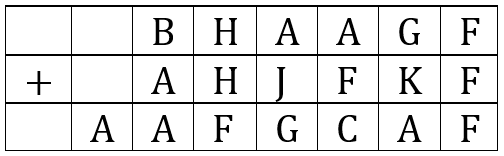
Which digit does the letter A represent?
Passage / Data
Answer the following question based on the information given below.
The following table represents addition of two six-digit numbers given in the first and the second rows, while the sum is given in the third row. In the representation, each of the digits 0, 1, 2, 3, 4, 5, 6, 7, 8, 9 has been coded with one letter among A, B, C, D, E, F, G, H, J, K, with distinct letters representing distinct digits.
Which digit does the letter B represent?
Passage / Data
Answer the following question based on the information given below.
The following table represents addition of two six-digit numbers given in the first and the second rows, while the sum is given in the third row. In the representation, each of the digits 0, 1, 2, 3, 4, 5, 6, 7, 8, 9 has been coded with one letter among A, B, C, D, E, F, G, H, J, K, with distinct letters representing distinct digits.
Which among the digits 3, 4, 6 and 7 cannot be represented by the letter D?
Passage / Data
Answer the following question based on the information given below.
The following table represents addition of two six-digit numbers given in the first and the second rows, while the sum is given in the third row. In the representation, each of the digits 0, 1, 2, 3, 4, 5, 6, 7, 8, 9 has been coded with one letter among A, B, C, D, E, F, G, H, J, K, with distinct letters representing distinct digits.
Which among the digits 4, 6, 7 and 8 cannot be represented by the letter G?
Passage / Data
Answer the following question based on the information given below.
Princess, Queen, Rani and Samragni were the four finalists in a dance competition. Ashman, Badal, Gagan and Dyu were the four music composers who individually assigned items to the dancers. Each dancer had to individually perform in two dance items assigned by the different composers. The first items performed by the four dancers were all assigned by different music composers. No dancer performed her second item before the performance of the first item by any other dancers. The dancers performed their second items in the same sequence of their performance of their first items.
The following additional facts are known.i) No composer who assigned item to Princess, assigned any item to Queen.
ii) No composer who assigned item to Rani, assigned any item to Samragni.
iii) The first performance was by Princess; this item was assigned by Badal.
iv) The last performance was by Rani; this item was assigned by Gagan.
v) The items assigned by Ashman were performed consecutively. The number of performances between items assigned by each of the remaining composers was the same.
Which of the following is true?
Passage / Data
Answer the following question based on the information given below.
Princess, Queen, Rani and Samragni were the four finalists in a dance competition. Ashman, Badal, Gagan and Dyu were the four music composers who individually assigned items to the dancers. Each dancer had to individually perform in two dance items assigned by the different composers. The first items performed by the four dancers were all assigned by different music composers. No dancer performed her second item before the performance of the first item by any other dancers. The dancers performed their second items in the same sequence of their performance of their first items.
The following additional facts are known.i) No composer who assigned item to Princess, assigned any item to Queen.
ii) No composer who assigned item to Rani, assigned any item to Samragni.
iii) The first performance was by Princess; this item was assigned by Badal.
iv) The last performance was by Rani; this item was assigned by Gagan.
v) The items assigned by Ashman were performed consecutively. The number of performances between items assigned by each of the remaining composers was the same.
Which of the following is FALSE?
Passage / Data
Answer the following question based on the information given below.
Princess, Queen, Rani and Samragni were the four finalists in a dance competition. Ashman, Badal, Gagan and Dyu were the four music composers who individually assigned items to the dancers. Each dancer had to individually perform in two dance items assigned by the different composers. The first items performed by the four dancers were all assigned by different music composers. No dancer performed her second item before the performance of the first item by any other dancers. The dancers performed their second items in the same sequence of their performance of their first items.
The following additional facts are known.i) No composer who assigned item to Princess, assigned any item to Queen.
ii) No composer who assigned item to Rani, assigned any item to Samragni.
iii) The first performance was by Princess; this item was assigned by Badal.
iv) The last performance was by Rani; this item was assigned by Gagan.
v) The items assigned by Ashman were performed consecutively. The number of performances between items assigned by each of the remaining composers was the same.
The sixth performance was composed by
Passage / Data
Answer the following question based on the information given below.
Princess, Queen, Rani and Samragni were the four finalists in a dance competition. Ashman, Badal, Gagan and Dyu were the four music composers who individually assigned items to the dancers. Each dancer had to individually perform in two dance items assigned by the different composers. The first items performed by the four dancers were all assigned by different music composers. No dancer performed her second item before the performance of the first item by any other dancers. The dancers performed their second items in the same sequence of their performance of their first items.
The following additional facts are known.i) No composer who assigned item to Princess, assigned any item to Queen.
ii) No composer who assigned item to Rani, assigned any item to Samragni.
iii) The first performance was by Princess; this item was assigned by Badal.
iv) The last performance was by Rani; this item was assigned by Gagan.
v) The items assigned by Ashman were performed consecutively. The number of performances between items assigned by each of the remaining composers was the same.
Which pair of performances were composed by the same composer?
Passage / Data
Answer the following questions based on the information given below.
The first year students in a business school are split into six sections. In 2019 the Business Statistics course was taught in these six sections by Annie, Beti, Chetan, Dave, Esha, and Fakir. All six sections had a common midterm (MT) and a common endterm (ET) worth 100 marks each. ET contained more questions than MT. Questions for MT and ET were prepared collectively by the six faculty members. Considering MT and ET together, each faculty member prepared the same number of questions.
Each of MT and ET had at least four questions that were worth 5 marks, at least three questions that were worth 10 marks, and at least two questions that were worth 15 marks. In both MT and ET, all the 5-mark questions preceded the 10-mark questions, and all the 15- mark questions followed the 10-mark questions.
The following additional facts are known.
- Annie prepared the fifth question for both MT and ET. For MT, this question carried 5 marks.
- Annie prepared one question for MT. Every other faculty member prepared more than one questions for MT.
- All questions prepared by a faculty member appeared consecutively in MT as well as ET
- Chetan prepared the third question in both MT and ET; and Esha prepared the eighth question in both.
- Fakir prepared the first question of MT and the last one in ET. Dave prepared the last question of MT and the first one in ET.
The second question in ET was prepared by:
Passage / Data
Answer the following questions based on the information given below.
The first year students in a business school are split into six sections. In 2019 the Business Statistics course was taught in these six sections by Annie, Beti, Chetan, Dave, Esha, and Fakir. All six sections had a common midterm (MT) and a common endterm (ET) worth 100 marks each. ET contained more questions than MT. Questions for MT and ET were prepared collectively by the six faculty members. Considering MT and ET together, each faculty member prepared the same number of questions.
Each of MT and ET had at least four questions that were worth 5 marks, at least three questions that were worth 10 marks, and at least two questions that were worth 15 marks. In both MT and ET, all the 5-mark questions preceded the 10-mark questions, and all the 15- mark questions followed the 10-mark questions.
The following additional facts are known.
- Annie prepared the fifth question for both MT and ET. For MT, this question carried 5 marks.
- Annie prepared one question for MT. Every other faculty member prepared more than one questions for MT.
- All questions prepared by a faculty member appeared consecutively in MT as well as ET
- Chetan prepared the third question in both MT and ET; and Esha prepared the eighth question in both.
- Fakir prepared the first question of MT and the last one in ET. Dave prepared the last question of MT and the first one in ET.
How many 5‐mark questions were there in MT and ET combined?
Passage / Data
Answer the following questions based on the information given below.
The first year students in a business school are split into six sections. In 2019 the Business Statistics course was taught in these six sections by Annie, Beti, Chetan, Dave, Esha, and Fakir. All six sections had a common midterm (MT) and a common endterm (ET) worth 100 marks each. ET contained more questions than MT. Questions for MT and ET were prepared collectively by the six faculty members. Considering MT and ET together, each faculty member prepared the same number of questions.
Each of MT and ET had at least four questions that were worth 5 marks, at least three questions that were worth 10 marks, and at least two questions that were worth 15 marks. In both MT and ET, all the 5-mark questions preceded the 10-mark questions, and all the 15- mark questions followed the 10-mark questions.
The following additional facts are known.
- Annie prepared the fifth question for both MT and ET. For MT, this question carried 5 marks.
- Annie prepared one question for MT. Every other faculty member prepared more than one questions for MT.
- All questions prepared by a faculty member appeared consecutively in MT as well as ET
- Chetan prepared the third question in both MT and ET; and Esha prepared the eighth question in both.
- Fakir prepared the first question of MT and the last one in ET. Dave prepared the last question of MT and the first one in ET.
Who prepared 15-mark questions for MT and ET?
Passage / Data
Answer the following questions based on the information given below.
The first year students in a business school are split into six sections. In 2019 the Business Statistics course was taught in these six sections by Annie, Beti, Chetan, Dave, Esha, and Fakir. All six sections had a common midterm (MT) and a common endterm (ET) worth 100 marks each. ET contained more questions than MT. Questions for MT and ET were prepared collectively by the six faculty members. Considering MT and ET together, each faculty member prepared the same number of questions.
Each of MT and ET had at least four questions that were worth 5 marks, at least three questions that were worth 10 marks, and at least two questions that were worth 15 marks. In both MT and ET, all the 5-mark questions preceded the 10-mark questions, and all the 15- mark questions followed the 10-mark questions.
The following additional facts are known.
- Annie prepared the fifth question for both MT and ET. For MT, this question carried 5 marks.
- Annie prepared one question for MT. Every other faculty member prepared more than one questions for MT.
- All questions prepared by a faculty member appeared consecutively in MT as well as ET
- Chetan prepared the third question in both MT and ET; and Esha prepared the eighth question in both.
- Fakir prepared the first question of MT and the last one in ET. Dave prepared the last question of MT and the first one in ET.
Which of the following questions did Beti prepare in ET?
Passage / Data
Answer the following questions based on the information given below.

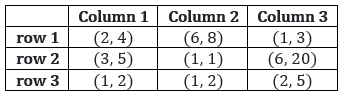
Three pouches (each represented by a filled circle) are kept in each of the nine slots in a 3 × 3 grid, as shown in the figure. Every pouch has a certain number of one-rupee coins. The minimum and maximum amounts of money (in rupees) among the three pouches in each of the nine slots are given in the table. For example, we know that among the three pouches kept in the second column of the first row, the minimum amount in a pouch is Rs. 6 and the maximum amount is Rs. 8.
There are nine pouches in any of the three columns, as well as in any of the three rows. It is known that the average amount of money (in rupees) kept in the nine pouches in any column or in any row is an integer. It is also known that the total amount of money kept in the three pouches in the first column of the third row is Rs. 4.
What is the total amount of money (in rupees) in the three pouches kept in the first column of the second row?
Passage / Data
Answer the following questions based on the information given below.
Three pouches (each represented by a filled circle) are kept in each of the nine slots in a 3 × 3 grid, as shown in the figure. Every pouch has a certain number of one-rupee coins. The minimum and maximum amounts of money (in rupees) among the three pouches in each of the nine slots are given in the table. For example, we know that among the three pouches kept in the second column of the first row, the minimum amount in a pouch is Rs. 6 and the maximum amount is Rs. 8.
There are nine pouches in any of the three columns, as well as in any of the three rows. It is known that the average amount of money (in rupees) kept in the nine pouches in any column or in any row is an integer. It is also known that the total amount of money kept in the three pouches in the first column of the third row is Rs. 4.
How many pouches contain exactly one coin?
Passage / Data
Answer the following questions based on the information given below.
Three pouches (each represented by a filled circle) are kept in each of the nine slots in a 3 × 3 grid, as shown in the figure. Every pouch has a certain number of one-rupee coins. The minimum and maximum amounts of money (in rupees) among the three pouches in each of the nine slots are given in the table. For example, we know that among the three pouches kept in the second column of the first row, the minimum amount in a pouch is Rs. 6 and the maximum amount is Rs. 8.
There are nine pouches in any of the three columns, as well as in any of the three rows. It is known that the average amount of money (in rupees) kept in the nine pouches in any column or in any row is an integer. It is also known that the total amount of money kept in the three pouches in the first column of the third row is Rs. 4.
What is the number of slots for which the average amount (in rupees) of its three pouches is an integer?
Passage / Data
Answer the following questions based on the information given below.
Three pouches (each represented by a filled circle) are kept in each of the nine slots in a 3 × 3 grid, as shown in the figure. Every pouch has a certain number of one-rupee coins. The minimum and maximum amounts of money (in rupees) among the three pouches in each of the nine slots are given in the table. For example, we know that among the three pouches kept in the second column of the first row, the minimum amount in a pouch is Rs. 6 and the maximum amount is Rs. 8.
There are nine pouches in any of the three columns, as well as in any of the three rows. It is known that the average amount of money (in rupees) kept in the nine pouches in any column or in any row is an integer. It is also known that the total amount of money kept in the three pouches in the first column of the third row is Rs. 4.
The number of slots for which the total amount in its three pouches strictly exceeds Rs. 10 is
Passage / Data
Answer the following questions based on the information given below.
In the table below the check marks indicate all languages spoken by five people: Paula, Quentin, Robert, Sally and Terence. For example, Paula speaks only Chinese and English.
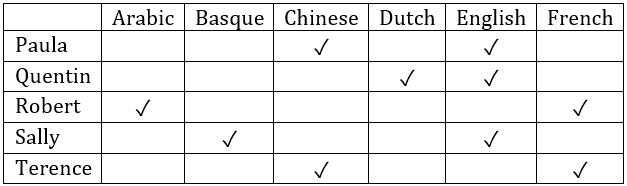
These five people form three teams, Team 1, Team 2 and Team 3. Each team has either 2 or 3 members. A team is said to speak a particular language if at least one of its members speak that language.
The following facts are known.
(1) Each team speaks exactly four languages and has the same number of members.
(2) English and Chinese are spoken by all three teams, Basque and French by exactly two teams and the other languages by exactly one team.
(3) None of the teams include both Quentin and Robert.
(4) Paula and Sally are together in exactly two teams.
(5) Robert is in Team 1 and Quentin is in Team 3.
Who among the following four is not a member of Team 2?
Passage / Data
Answer the following questions based on the information given below.
In the table below the check marks indicate all languages spoken by five people: Paula, Quentin, Robert, Sally and Terence. For example, Paula speaks only Chinese and English.
These five people form three teams, Team 1, Team 2 and Team 3. Each team has either 2 or 3 members. A team is said to speak a particular language if at least one of its members speak that language.
The following facts are known.
(1) Each team speaks exactly four languages and has the same number of members.
(2) English and Chinese are spoken by all three teams, Basque and French by exactly two teams and the other languages by exactly one team.
(3) None of the teams include both Quentin and Robert.
(4) Paula and Sally are together in exactly two teams.
(5) Robert is in Team 1 and Quentin is in Team 3.
Who among the following four people is a part of exactly two teams?
Passage / Data
Answer the following questions based on the information given below.
In the table below the check marks indicate all languages spoken by five people: Paula, Quentin, Robert, Sally and Terence. For example, Paula speaks only Chinese and English.
These five people form three teams, Team 1, Team 2 and Team 3. Each team has either 2 or 3 members. A team is said to speak a particular language if at least one of its members speak that language.
The following facts are known.
(1) Each team speaks exactly four languages and has the same number of members.
(2) English and Chinese are spoken by all three teams, Basque and French by exactly two teams and the other languages by exactly one team.
(3) None of the teams include both Quentin and Robert.
(4) Paula and Sally are together in exactly two teams.
(5) Robert is in Team 1 and Quentin is in Team 3.
Who among the five people is a member of all teams?
Passage / Data
Answer the following questions based on the information given below.
In the table below the check marks indicate all languages spoken by five people: Paula, Quentin, Robert, Sally and Terence. For example, Paula speaks only Chinese and English.
These five people form three teams, Team 1, Team 2 and Team 3. Each team has either 2 or 3 members. A team is said to speak a particular language if at least one of its members speak that language.
The following facts are known.
(1) Each team speaks exactly four languages and has the same number of members.
(2) English and Chinese are spoken by all three teams, Basque and French by exactly two teams and the other languages by exactly one team.
(3) None of the teams include both Quentin and Robert.
(4) Paula and Sally are together in exactly two teams.
(5) Robert is in Team 1 and Quentin is in Team 3.
Apart from Chinese and English, which languages are spoken by Team 1?
Passage / Data
Answer the following questions based on the information given below.
Three doctors, Dr. Ben, Dr. Kane and Dr. Wayne visit a particular clinic Monday to Saturday to see patients. Dr. Ben sees each patient for 10 minutes and charges Rs. 100/-. Dr. Kane sees each patient for 15 minutes and charges Rs. 200/-, while Dr. Wayne sees each patient for 25 minutes and charges Rs. 300/-.
The clinic has three rooms numbered 1, 2 and 3 which are assigned to the three doctors as per the following table.
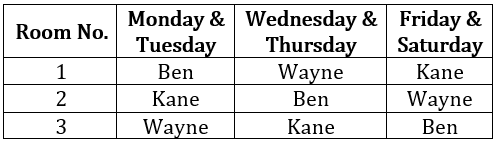
The clinic is open from 9 a.m. to 11.30 a.m. every Monday to Saturday.
On arrival each patient is handed a numbered token indicating their position in the queue, starting with token number 1 every day. As soon as any doctor becomes free, the next patient in the queue enters that emptied room for consultation. If at any time, more than one room is free then the waiting patient enters the room with the smallest number. For example, if the next two patients in the queue have token numbers 7 and 8 and if rooms numbered 1 and 3 are free, then patient with token number 7 enters room number 1 and patient with token number 8 enters room number 3.
What is the maximum number of patients that the clinic can cater to on any single day?
Passage / Data
Answer the following questions based on the information given below.
Three doctors, Dr. Ben, Dr. Kane and Dr. Wayne visit a particular clinic Monday to Saturday to see patients. Dr. Ben sees each patient for 10 minutes and charges Rs. 100/-. Dr. Kane sees each patient for 15 minutes and charges Rs. 200/-, while Dr. Wayne sees each patient for 25 minutes and charges Rs. 300/-.
The clinic has three rooms numbered 1, 2 and 3 which are assigned to the three doctors as per the following table.
The clinic is open from 9 a.m. to 11.30 a.m. every Monday to Saturday.
On arrival each patient is handed a numbered token indicating their position in the queue, starting with token number 1 every day. As soon as any doctor becomes free, the next patient in the queue enters that emptied room for consultation. If at any time, more than one room is free then the waiting patient enters the room with the smallest number. For example, if the next two patients in the queue have token numbers 7 and 8 and if rooms numbered 1 and 3 are free, then patient with token number 7 enters room number 1 and patient with token number 8 enters room number 3.
The queue is never empty on one particular Saturday. Which of the three doctors would earn the maximum amount in consultation charges on that day?
Passage / Data
Answer the following questions based on the information given below.
Three doctors, Dr. Ben, Dr. Kane and Dr. Wayne visit a particular clinic Monday to Saturday to see patients. Dr. Ben sees each patient for 10 minutes and charges Rs. 100/-. Dr. Kane sees each patient for 15 minutes and charges Rs. 200/-, while Dr. Wayne sees each patient for 25 minutes and charges Rs. 300/-.
The clinic has three rooms numbered 1, 2 and 3 which are assigned to the three doctors as per the following table.
The clinic is open from 9 a.m. to 11.30 a.m. every Monday to Saturday.
On arrival each patient is handed a numbered token indicating their position in the queue, starting with token number 1 every day. As soon as any doctor becomes free, the next patient in the queue enters that emptied room for consultation. If at any time, more than one room is free then the waiting patient enters the room with the smallest number. For example, if the next two patients in the queue have token numbers 7 and 8 and if rooms numbered 1 and 3 are free, then patient with token number 7 enters room number 1 and patient with token number 8 enters room number 3.
Mr. Singh visited the clinic on Monday, Wednesday, and Friday of a particular week, arriving at 8:50 a.m. on each of the three days. His token number was 13 on all three days. On which day was he at the clinic for the maximum duration?
Passage / Data
Answer the following questions based on the information given below.
Three doctors, Dr. Ben, Dr. Kane and Dr. Wayne visit a particular clinic Monday to Saturday to see patients. Dr. Ben sees each patient for 10 minutes and charges Rs. 100/-. Dr. Kane sees each patient for 15 minutes and charges Rs. 200/-, while Dr. Wayne sees each patient for 25 minutes and charges Rs. 300/-.
The clinic has three rooms numbered 1, 2 and 3 which are assigned to the three doctors as per the following table.
The clinic is open from 9 a.m. to 11.30 a.m. every Monday to Saturday.
On arrival each patient is handed a numbered token indicating their position in the queue, starting with token number 1 every day. As soon as any doctor becomes free, the next patient in the queue enters that emptied room for consultation. If at any time, more than one room is free then the waiting patient enters the room with the smallest number. For example, if the next two patients in the queue have token numbers 7 and 8 and if rooms numbered 1 and 3 are free, then patient with token number 7 enters room number 1 and patient with token number 8 enters room number 3.
On a slow Thursday, only two patients are waiting at 9 a.m. After that two patients keep arriving at exact 15 minute intervals starting at 9:15 a.m. -- i.e. at 9:15 a.m., 9:30 a.m., 9:45 a.m. etc. Then the total duration in minutes when all three doctors are simultaneously free is
Passage / Data
Answer the following question based on the information given below.
1600 satellites were sent up by a country for several purposes. The purposes are classified as broadcasting (B), communication (C), surveillance (S), and others (O). A satellite can serve multiple purposes; however a satellite serving either B, or C, or S does not serve O.
The following facts are known about the satellites:
- The numbers of satellites serving B, C, and S (though may be not exclusively) are in the ratio 2 : 1 : 1.
- The number of satellites serving all three of B, C, and S is 100.
- The number of satellites exclusively serving C is the same as the number of satellites exclusively serving S. This number is 30% of the number of satellites exclusively serving B.
- The number of satellites serving O is the same as the number of satellites serving both Cand S but not B.
What best can be said about the number of satellites serving C?
Passage / Data
Answer the following question based on the information given below.
1600 satellites were sent up by a country for several purposes. The purposes are classified as broadcasting (B), communication (C), surveillance (S), and others (O). A satellite can serve multiple purposes; however a satellite serving either B, or C, or S does not serve O.
The following facts are known about the satellites:
- The numbers of satellites serving B, C, and S (though may be not exclusively) are in the ratio 2 : 1 : 1.
- The number of satellites serving all three of B, C, and S is 100.
- The number of satellites exclusively serving C is the same as the number of satellites exclusively serving S. This number is 30% of the number of satellites exclusively serving B.
- The number of satellites serving O is the same as the number of satellites serving both Cand S but not B.
What is the minimum possible number of satellites serving B exclusively?
Passage / Data
Answer the following question based on the information given below.
1600 satellites were sent up by a country for several purposes. The purposes are classified as broadcasting (B), communication (C), surveillance (S), and others (O). A satellite can serve multiple purposes; however a satellite serving either B, or C, or S does not serve O.
The following facts are known about the satellites:
- The numbers of satellites serving B, C, and S (though may be not exclusively) are in the ratio 2 : 1 : 1.
- The number of satellites serving all three of B, C, and S is 100.
- The number of satellites exclusively serving C is the same as the number of satellites exclusively serving S. This number is 30% of the number of satellites exclusively serving B.
- The number of satellites serving O is the same as the number of satellites serving both Cand S but not B.
If at least 100 of the 1600 satellites were serving O, what can be said about the number of satellites serving S?
Passage / Data
Answer the following question based on the information given below.
1600 satellites were sent up by a country for several purposes. The purposes are classified as broadcasting (B), communication (C), surveillance (S), and others (O). A satellite can serve multiple purposes; however a satellite serving either B, or C, or S does not serve O.
The following facts are known about the satellites:
- The numbers of satellites serving B, C, and S (though may be not exclusively) are in the ratio 2 : 1 : 1.
- The number of satellites serving all three of B, C, and S is 100.
- The number of satellites exclusively serving C is the same as the number of satellites exclusively serving S. This number is 30% of the number of satellites exclusively serving B.
- The number of satellites serving O is the same as the number of satellites serving both Cand S but not B.
If the number of satellites serving at least two among B, C, and S is 1200, which of the following MUST be FALSE?
Passage / Data
Answer the following question based on the information given below.
Twenty four people are part of three committees which are to look at research, teaching, and administration respectively. No two committees have any member in common. No two committees are of the same size. Each committee has three types of people: bureaucrats, educationalists, and politicians, with at least one from each of the three types in each committee. The following facts are also known about the committees:
- The numbers of bureaucrats in the research and teaching committees are equal, while the number of bureaucrats in the research committee is 75% of the number of bureaucrats in the administration committee.
- The number of educationalists in the teaching committee is less than the number of educationalists in the research committee. The number of educationalists in the research committee is the average of the numbers of educationalists in the other two committees.
- 60% of the politicians are in the administration committee, and 20% are in the teachingcommittee.
Based on the given information, which of the following statements MUST be FALSE?
Passage / Data
Answer the following question based on the information given below.
Twenty four people are part of three committees which are to look at research, teaching, and administration respectively. No two committees have any member in common. No two committees are of the same size. Each committee has three types of people: bureaucrats, educationalists, and politicians, with at least one from each of the three types in each committee. The following facts are also known about the committees:
- The numbers of bureaucrats in the research and teaching committees are equal, while the number of bureaucrats in the research committee is 75% of the number of bureaucrats in the administration committee.
- The number of educationalists in the teaching committee is less than the number of educationalists in the research committee. The number of educationalists in the research committee is the average of the numbers of educationalists in the other two committees.
- 60% of the politicians are in the administration committee, and 20% are in the teachingcommittee.
What is the number of bureaucrats in the administration committee?
Passage / Data
Answer the following question based on the information given below.
Twenty four people are part of three committees which are to look at research, teaching, and administration respectively. No two committees have any member in common. No two committees are of the same size. Each committee has three types of people: bureaucrats, educationalists, and politicians, with at least one from each of the three types in each committee. The following facts are also known about the committees:
- The numbers of bureaucrats in the research and teaching committees are equal, while the number of bureaucrats in the research committee is 75% of the number of bureaucrats in the administration committee.
- The number of educationalists in the teaching committee is less than the number of educationalists in the research committee. The number of educationalists in the research committee is the average of the numbers of educationalists in the other two committees.
- 60% of the politicians are in the administration committee, and 20% are in the teachingcommittee.
What is the number of educationalists in the research committee?
Passage / Data
Answer the following question based on the information given below.
Twenty four people are part of three committees which are to look at research, teaching, and administration respectively. No two committees have any member in common. No two committees are of the same size. Each committee has three types of people: bureaucrats, educationalists, and politicians, with at least one from each of the three types in each committee. The following facts are also known about the committees:
- The numbers of bureaucrats in the research and teaching committees are equal, while the number of bureaucrats in the research committee is 75% of the number of bureaucrats in the administration committee.
- The number of educationalists in the teaching committee is less than the number of educationalists in the research committee. The number of educationalists in the research committee is the average of the numbers of educationalists in the other two committees.
- 60% of the politicians are in the administration committee, and 20% are in the teachingcommittee.
Which of the following CANNOT be determined uniquely based on the given information?
Passage / Data
Answer the following question based on the information given below.
A company administers a written test comprising of three sections of 20 marks each – Data Interpretation (DI), Written English (WE) and General Awareness (GA), for recruitment. A composite score for a candidate (out of 80) is calculated by doubling her marks in DI and adding it to the sum of her marks in the other two sections. Candidates who score less than 70% marks in two or more sections are disqualified. From among the rest, the four with the highest composite scores are recruited. If four or less candidates qualify, all who qualify are recruited.
Ten candidates appeared for the written test. Their marks in the test are given in the table below. Some marks in the table are missing, but the following facts are known:
- No two candidates had the same composite score.
- Ajay was the unique highest scorer in WE.
- Among the four recruited, Geeta had the lowest composite score.
- Indu was recruited.
- Danish, Harini, and Indu had scored the same marks the in GA.
- Indu and Jatin both scored 100% in exactly one section and Jatin’s composite score was 10 more than Indu’s.
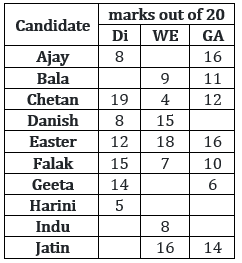
Which of the following statements MUST be true?
- Jatin's composite score was more than that of Danish.
- Indu scored less than Chetna in DI.
- Jatin scored more than Indu in GA.
Passage / Data
Answer the following question based on the information given below.
A company administers a written test comprising of three sections of 20 marks each – Data Interpretation (DI), Written English (WE) and General Awareness (GA), for recruitment. A composite score for a candidate (out of 80) is calculated by doubling her marks in DI and adding it to the sum of her marks in the other two sections. Candidates who score less than 70% marks in two or more sections are disqualified. From among the rest, the four with the highest composite scores are recruited. If four or less candidates qualify, all who qualify are recruited.
Ten candidates appeared for the written test. Their marks in the test are given in the table below. Some marks in the table are missing, but the following facts are known:
- No two candidates had the same composite score.
- Ajay was the unique highest scorer in WE.
- Among the four recruited, Geeta had the lowest composite score.
- Indu was recruited.
- Danish, Harini, and Indu had scored the same marks the in GA.
- Indu and Jatin both scored 100% in exactly one section and Jatin’s composite score was 10 more than Indu’s.
Which of the following statements MUST be FALSE?
Passage / Data
Answer the following question based on the information given below.
A company administers a written test comprising of three sections of 20 marks each – Data Interpretation (DI), Written English (WE) and General Awareness (GA), for recruitment. A composite score for a candidate (out of 80) is calculated by doubling her marks in DI and adding it to the sum of her marks in the other two sections. Candidates who score less than 70% marks in two or more sections are disqualified. From among the rest, the four with the highest composite scores are recruited. If four or less candidates qualify, all who qualify are recruited.
Ten candidates appeared for the written test. Their marks in the test are given in the table below. Some marks in the table are missing, but the following facts are known:
- No two candidates had the same composite score.
- Ajay was the unique highest scorer in WE.
- Among the four recruited, Geeta had the lowest composite score.
- Indu was recruited.
- Danish, Harini, and Indu had scored the same marks the in GA.
- Indu and Jatin both scored 100% in exactly one section and Jatin’s composite score was 10 more than Indu’s.
If all the candidates except Ajay and Danish had different marks in DI, and Bala's composite score was less than Chetna's composite score, then what is the maximum marks that Bala could have scored in DI?
Passage / Data
Answer the following question based on the information given below.
A company administers a written test comprising of three sections of 20 marks each – Data Interpretation (DI), Written English (WE) and General Awareness (GA), for recruitment. A composite score for a candidate (out of 80) is calculated by doubling her marks in DI and adding it to the sum of her marks in the other two sections. Candidates who score less than 70% marks in two or more sections are disqualified. From among the rest, the four with the highest composite scores are recruited. If four or less candidates qualify, all who qualify are recruited.
Ten candidates appeared for the written test. Their marks in the test are given in the table below. Some marks in the table are missing, but the following facts are known:
- No two candidates had the same composite score.
- Ajay was the unique highest scorer in WE.
- Among the four recruited, Geeta had the lowest composite score.
- Indu was recruited.
- Danish, Harini, and Indu had scored the same marks the in GA.
- Indu and Jatin both scored 100% in exactly one section and Jatin’s composite score was 10 more than Indu’s.
If all the candidates scored different marks in WE then what is the maximum marks that Harini could have scored in WE?
Passage / Data
Answer the following question based on the information given below.
You are given an n × n square matrix to be filled with numerals so that no two adjacent cells have the same numeral. Two cells are called adjacent if they touch each other horizontally, vertically or diagonally. So a cell in one of the four corners has three cells adjacent to it, and a cell in the first or last row or column which is not in the corner has five cells adjacent to it. Any other cell has eight cells adjacent to it.
What is the minimum number of different numerals needed to fill a 3×3 square matrix?
Passage / Data
Answer the following question based on the information given below.
You are given an n × n square matrix to be filled with numerals so that no two adjacent cells have the same numeral. Two cells are called adjacent if they touch each other horizontally, vertically or diagonally. So a cell in one of the four corners has three cells adjacent to it, and a cell in the first or last row or column which is not in the corner has five cells adjacent to it. Any other cell has eight cells adjacent to it.
What is the minimum number of different numerals needed to fill a 5 × 5 square matrix?
Passage / Data
Answer the following question based on the information given below.
You are given an n × n square matrix to be filled with numerals so that no two adjacent cells have the same numeral. Two cells are called adjacent if they touch each other horizontally, vertically or diagonally. So a cell in one of the four corners has three cells adjacent to it, and a cell in the first or last row or column which is not in the corner has five cells adjacent to it. Any other cell has eight cells adjacent to it.
Suppose you are allowed to make one mistake, that is, one pair of adjacent cells can have the same numeral. What is the minimum number of different numerals required to fill a 5×5 matrix?
Passage / Data
Answer the following question based on the information given below.
You are given an n × n square matrix to be filled with numerals so that no two adjacent cells have the same numeral. Two cells are called adjacent if they touch each other horizontally, vertically or diagonally. So a cell in one of the four corners has three cells adjacent to it, and a cell in the first or last row or column which is not in the corner has five cells adjacent to it. Any other cell has eight cells adjacent to it.
Suppose that all the cells adjacent to any particular cell must have different numerals. What is the minimum number of different numerals needed to fill a 5×5 square matrix?
Passage / Data
Answer the following question based on the information given below.
An ATM dispenses exactly Rs. 5000 per withdrawal using 100, 200 and 500 rupee notes. The ATM requires every customer to give her preference for one of the three denominations of notes. It then dispenses notes such that the number of notes of the customer’s preferred denomination exceeds the total number of notes of other denominations dispensed to her.
In how many different ways can the ATM serve a customer who gives 500 rupee notes as her preference?
Passage / Data
Answer the following question based on the information given below.
An ATM dispenses exactly Rs. 5000 per withdrawal using 100, 200 and 500 rupee notes. The ATM requires every customer to give her preference for one of the three denominations of notes. It then dispenses notes such that the number of notes of the customer’s preferred denomination exceeds the total number of notes of other denominations dispensed to her.
If the ATM could serve only 10 customers with a stock of fifty 500 rupee notes and a sufficient number of notes of other denominations, what is the maximum number of customers among these 10 who could have given 500 rupee notes as their preferences?
Passage / Data
Answer the following question based on the information given below.
An ATM dispenses exactly Rs. 5000 per withdrawal using 100, 200 and 500 rupee notes. The ATM requires every customer to give her preference for one of the three denominations of notes. It then dispenses notes such that the number of notes of the customer’s preferred denomination exceeds the total number of notes of other denominations dispensed to her.
What is the maximum number of customers that the ATM can serve with a stock of fifty 500 rupee notes and a sufficient number of notes of other denominations, if all the customers are to be served with at most 20 notes per withdrawal?
Passage / Data
Answer the following question based on the information given below.
An ATM dispenses exactly Rs. 5000 per withdrawal using 100, 200 and 500 rupee notes. The ATM requires every customer to give her preference for one of the three denominations of notes. It then dispenses notes such that the number of notes of the customer’s preferred denomination exceeds the total number of notes of other denominations dispensed to her.
What is the number of 500 rupee notes required to serve 50 customers with 500 rupee notes as their preferences and another 50 customers with 100 rupee notes as their preferences, if the total number of notes to be dispensed is the smallest possible?
Passage / Data
Answer the following question based on the information given below.
Adriana, Bandita, Chitra, and Daisy are four female students, and Amit, Barun, Chetan, and Deb are four male students. Each of them studies in one of three institutes - X, Y, and Z. Each student majors in one subject among Marketing, Operations, and Finance, and minors in a different one among these three subjects. The following facts are known about the eight students:
- Three students are from X, three are from Y, and the remaining two students, both female, are from Z.
- Both the male students from Y minor in Finance, while the female student from Y majors in Operations.
- Only one male student majors in Operations, while three female students minor in Marketing.
- One female and two male students major in Finance.
- Adriana and Deb are from the same institute. Daisy and Amit are from the same institute.
- Barun is from Y and majors in Operations. Chetan is from X and majors in Finance.
- Daisy minors in Operations.
Who are the students from the institute Z?
Passage / Data
Answer the following question based on the information given below.
Adriana, Bandita, Chitra, and Daisy are four female students, and Amit, Barun, Chetan, and Deb are four male students. Each of them studies in one of three institutes - X, Y, and Z. Each student majors in one subject among Marketing, Operations, and Finance, and minors in a different one among these three subjects. The following facts are known about the eight students:
- Three students are from X, three are from Y, and the remaining two students, both female, are from Z.
- Both the male students from Y minor in Finance, while the female student from Y majors in Operations.
- Only one male student majors in Operations, while three female students minor in Marketing.
- One female and two male students major in Finance.
- Adriana and Deb are from the same institute. Daisy and Amit are from the same institute.
- Barun is from Y and majors in Operations. Chetan is from X and majors in Finance.
- Daisy minors in Operations.
Which subject does Deb minor in?
Passage / Data
Answer the following question based on the information given below.
Adriana, Bandita, Chitra, and Daisy are four female students, and Amit, Barun, Chetan, and Deb are four male students. Each of them studies in one of three institutes - X, Y, and Z. Each student majors in one subject among Marketing, Operations, and Finance, and minors in a different one among these three subjects. The following facts are known about the eight students:
- Three students are from X, three are from Y, and the remaining two students, both female, are from Z.
- Both the male students from Y minor in Finance, while the female student from Y majors in Operations.
- Only one male student majors in Operations, while three female students minor in Marketing.
- One female and two male students major in Finance.
- Adriana and Deb are from the same institute. Daisy and Amit are from the same institute.
- Barun is from Y and majors in Operations. Chetan is from X and majors in Finance.
- Daisy minors in Operations.
Which subject does Amit major in?
Passage / Data
Answer the following question based on the information given below.
Adriana, Bandita, Chitra, and Daisy are four female students, and Amit, Barun, Chetan, and Deb are four male students. Each of them studies in one of three institutes - X, Y, and Z. Each student majors in one subject among Marketing, Operations, and Finance, and minors in a different one among these three subjects. The following facts are known about the eight students:
- Three students are from X, three are from Y, and the remaining two students, both female, are from Z.
- Both the male students from Y minor in Finance, while the female student from Y majors in Operations.
- Only one male student majors in Operations, while three female students minor in Marketing.
- One female and two male students major in Finance.
- Adriana and Deb are from the same institute. Daisy and Amit are from the same institute.
- Barun is from Y and majors in Operations. Chetan is from X and majors in Finance.
- Daisy minors in Operations.
If Chitra majors in Finance, which subject does Bandita major in?
Passage / Data
Answer the following question based on the information given below.
Fuel contamination levels at each of 20 petrol pumps P1, P2, …, P20 were recorded as either high, medium, or low.
- Contamination levels at three pumps among P1 – P5 were recorded as high.
- P6 was the only pump among P1 – P10 where the contamination level was recorded as low.
- P7 and P8 were the only two consecutively numbered pumps where the same levels of contamination were recorded.
- High contamination levels were not recorded at any of the pumps P16 – P20.
- The number of pumps where high contamination levels were recorded was twice the number of pumps where low contamination levels were recorded.
Which of the following MUST be true?
Passage / Data
Answer the following question based on the information given below.
Fuel contamination levels at each of 20 petrol pumps P1, P2, …, P20 were recorded as either high, medium, or low.
- Contamination levels at three pumps among P1 – P5 were recorded as high.
- P6 was the only pump among P1 – P10 where the contamination level was recorded as low.
- P7 and P8 were the only two consecutively numbered pumps where the same levels of contamination were recorded.
- High contamination levels were not recorded at any of the pumps P16 – P20.
- The number of pumps where high contamination levels were recorded was twice the number of pumps where low contamination levels were recorded.
What best can be said about the number of pumps at which the contamination levels were recorded as medium?
Passage / Data
Answer the following question based on the information given below.
Fuel contamination levels at each of 20 petrol pumps P1, P2, …, P20 were recorded as either high, medium, or low.
- Contamination levels at three pumps among P1 – P5 were recorded as high.
- P6 was the only pump among P1 – P10 where the contamination level was recorded as low.
- P7 and P8 were the only two consecutively numbered pumps where the same levels of contamination were recorded.
- High contamination levels were not recorded at any of the pumps P16 – P20.
- The number of pumps where high contamination levels were recorded was twice the number of pumps where low contamination levels were recorded.
If the contamination level at P11 was recorded as low, then which of the following MUST be true?
Passage / Data
Answer the following question based on the information given below.
Fuel contamination levels at each of 20 petrol pumps P1, P2, …, P20 were recorded as either high, medium, or low.
- Contamination levels at three pumps among P1 – P5 were recorded as high.
- P6 was the only pump among P1 – P10 where the contamination level was recorded as low.
- P7 and P8 were the only two consecutively numbered pumps where the same levels of contamination were recorded.
- High contamination levels were not recorded at any of the pumps P16 – P20.
- The number of pumps where high contamination levels were recorded was twice the number of pumps where low contamination levels were recorded.
If contamination level at P15 was recorded as medium, then which of the following MUST be FALSE?
Passage / Data
Answer the following question based on the information given below.
Fun Sports (FS) provides training in three sports – Gilli-danda (G), Kho-Kho (K), and Ludo (L). Currently it has an enrollment of 39 students each of whom is enrolled in at least one of the three sports. The following details are known:
- The number of students enrolled only in L is double the number of students enrolled in all the three sports.
- There are a total of 17 students enrolled in G.
- The number of students enrolled only in G is one less than the number of students enrolled only in L.
- The number of students enrolled only in K is equal to the number of students who are enrolled in both K and L.
- The maximum student enrollment is in L.
- Ten students enrolled in G are also enrolled in at least one more sport.
What is the minimum number of students enrolled in both G and L but not in K?
Passage / Data
Answer the following question based on the information given below.
Fun Sports (FS) provides training in three sports – Gilli-danda (G), Kho-Kho (K), and Ludo (L). Currently it has an enrollment of 39 students each of whom is enrolled in at least one of the three sports. The following details are known:
- The number of students enrolled only in L is double the number of students enrolled in all the three sports.
- There are a total of 17 students enrolled in G.
- The number of students enrolled only in G is one less than the number of students enrolled only in L.
- The number of students enrolled only in K is equal to the number of students who are enrolled in both K and L.
- The maximum student enrollment is in L.
- Ten students enrolled in G are also enrolled in at least one more sport.
If the numbers of students enrolled in K and L are in the ratio 19:22, then what is the number of students enrolled in L?
Passage / Data
Answer the following question based on the information given below.
Fun Sports (FS) provides training in three sports – Gilli-danda (G), Kho-Kho (K), and Ludo (L). Currently it has an enrollment of 39 students each of whom is enrolled in at least one of the three sports. The following details are known:
- The number of students enrolled only in L is double the number of students enrolled in all the three sports.
- There are a total of 17 students enrolled in G.
- The number of students enrolled only in G is one less than the number of students enrolled only in L.
- The number of students enrolled only in K is equal to the number of students who are enrolled in both K and L.
- The maximum student enrollment is in L.
- Ten students enrolled in G are also enrolled in at least one more sport.
Due to academic pressure, students who were enrolled in all three sports were asked to withdraw from one of the three sports. After the withdrawal, the number of students enrolled in G was six less than the number of students enrolled in L, while the number of students enrolled in K went down by one. After the withdrawal, how many students were enrolled in both G and K?
Passage / Data
Answer the following question based on the information given below.
Fun Sports (FS) provides training in three sports – Gilli-danda (G), Kho-Kho (K), and Ludo (L). Currently it has an enrollment of 39 students each of whom is enrolled in at least one of the three sports. The following details are known:
- The number of students enrolled only in L is double the number of students enrolled in all the three sports.
- There are a total of 17 students enrolled in G.
- The number of students enrolled only in G is one less than the number of students enrolled only in L.
- The number of students enrolled only in K is equal to the number of students who are enrolled in both K and L.
- The maximum student enrollment is in L.
- Ten students enrolled in G are also enrolled in at least one more sport.
Due to academic pressure, students who were enrolled in all three sports were asked to withdraw from one of the three sports. After the withdrawal, the number of students enrolled in G was six less than the number of students enrolled in L, while the number of students enrolled in K went down by one. After the withdrawal, how many students were enrolled in both G and L?
Passage / Data
Answer the following question based on the information given below.
According to a coding scheme the sentence Peacock is designated as the national bird of India is coded as
5688999 35 1135556678 56 458 13666689 1334 79 13366
This coding scheme has the following rules:
- The scheme is case-insensitive (does not distinguish between upper case and lower case letters).
- Each letter has a unique code which is a single digit from among 1,2,3, …, 9.
- The digit 9 codes two letters, and every other digit codes three letters.
- The code for a word is constructed by arranging the digits corresponding to its letters in a non-decreasing sequence.
What best can be concluded about the code for the letter L?
Passage / Data
Answer the following question based on the information given below.
According to a coding scheme the sentence Peacock is designated as the national bird of India is coded as
5688999 35 1135556678 56 458 13666689 1334 79 13366
This coding scheme has the following rules:
- The scheme is case-insensitive (does not distinguish between upper case and lower case letters).
- Each letter has a unique code which is a single digit from among 1,2,3, …, 9.
- The digit 9 codes two letters, and every other digit codes three letters.
- The code for a word is constructed by arranging the digits corresponding to its letters in a non-decreasing sequence.
What best can be concluded about the code for the letter B?
Passage / Data
Answer the following question based on the information given below.
According to a coding scheme the sentence Peacock is designated as the national bird of India is coded as
5688999 35 1135556678 56 458 13666689 1334 79 13366
This coding scheme has the following rules:
- The scheme is case-insensitive (does not distinguish between upper case and lower case letters).
- Each letter has a unique code which is a single digit from among 1,2,3, …, 9.
- The digit 9 codes two letters, and every other digit codes three letters.
- The code for a word is constructed by arranging the digits corresponding to its letters in a non-decreasing sequence.
For how many digits can the complete list of letters associated with that digit be identified?
Passage / Data
Answer the following question based on the information given below.
According to a coding scheme the sentence Peacock is designated as the national bird of India is coded as
5688999 35 1135556678 56 458 13666689 1334 79 13366
This coding scheme has the following rules:
- The scheme is case-insensitive (does not distinguish between upper case and lower case letters).
- Each letter has a unique code which is a single digit from among 1,2,3, …, 9.
- The digit 9 codes two letters, and every other digit codes three letters.
- The code for a word is constructed by arranging the digits corresponding to its letters in a non-decreasing sequence.
Which set of letters CANNOT be coded with the same digit?
Passage / Data
Answer the following question based on the information given below.
The base exchange rate of a currency X with respect to a currency Y is the number of units of currency Y which is equivalent in value to one unit of currency X. Currency exchange outlets buy currency at buying exchange rates that are lower than base exchange rates, and sell currency at selling exchange rates that are higher than base exchange rates.
A currency exchange outlet uses the local currency L to buy and sell three international currencies A, B, and C, but does not exchange one international currency directly withanother. The base exchange rates of A, B and C with respect to L are in the ratio 100:120:1. The buying exchange rates of each of A, B, and C with respect to L are 5% below the corresponding base exchange rates, and their selling exchange rates are 10% above their corresponding base exchange rates.
The following facts are known about the outlet on a particular day:
- The amount of L used by the outlet to buy C equals the amount of L it received by selling C.
- The amounts of L used by the outlet to buy A and B are in the ratio 5 : 3.
- The amounts of L the outlet received from the sales of A and B are in the ratio 5 : 9.
- The outlet received 88000 units of L by selling A during the day.
- The outlet started the day with some amount of L, 2500 units of A, 4800 units of B, and 48000 units of C.
- The outlet ended the day with some amount of L, 3300 units of A, 4800 units of B, and 51000 units of C.
How many units of currency A did the outlet buy on that day?
Passage / Data
Answer the following question based on the information given below.
The base exchange rate of a currency X with respect to a currency Y is the number of units of currency Y which is equivalent in value to one unit of currency X. Currency exchange outlets buy currency at buying exchange rates that are lower than base exchange rates, and sell currency at selling exchange rates that are higher than base exchange rates.
A currency exchange outlet uses the local currency L to buy and sell three international currencies A, B, and C, but does not exchange one international currency directly withanother. The base exchange rates of A, B and C with respect to L are in the ratio 100:120:1. The buying exchange rates of each of A, B, and C with respect to L are 5% below the corresponding base exchange rates, and their selling exchange rates are 10% above their corresponding base exchange rates.
The following facts are known about the outlet on a particular day:
- The amount of L used by the outlet to buy C equals the amount of L it received by selling C.
- The amounts of L used by the outlet to buy A and B are in the ratio 5 : 3.
- The amounts of L the outlet received from the sales of A and B are in the ratio 5 : 9.
- The outlet received 88000 units of L by selling A during the day.
- The outlet started the day with some amount of L, 2500 units of A, 4800 units of B, and 48000 units of C.
- The outlet ended the day with some amount of L, 3300 units of A, 4800 units of B, and 51000 units of C.
How many units of currency C did the outlet sell on that day?
Passage / Data
Answer the following question based on the information given below.
The base exchange rate of a currency X with respect to a currency Y is the number of units of currency Y which is equivalent in value to one unit of currency X. Currency exchange outlets buy currency at buying exchange rates that are lower than base exchange rates, and sell currency at selling exchange rates that are higher than base exchange rates.
A currency exchange outlet uses the local currency L to buy and sell three international currencies A, B, and C, but does not exchange one international currency directly withanother. The base exchange rates of A, B and C with respect to L are in the ratio 100:120:1. The buying exchange rates of each of A, B, and C with respect to L are 5% below the corresponding base exchange rates, and their selling exchange rates are 10% above their corresponding base exchange rates.
The following facts are known about the outlet on a particular day:
- The amount of L used by the outlet to buy C equals the amount of L it received by selling C.
- The amounts of L used by the outlet to buy A and B are in the ratio 5 : 3.
- The amounts of L the outlet received from the sales of A and B are in the ratio 5 : 9.
- The outlet received 88000 units of L by selling A during the day.
- The outlet started the day with some amount of L, 2500 units of A, 4800 units of B, and 48000 units of C.
- The outlet ended the day with some amount of L, 3300 units of A, 4800 units of B, and 51000 units of C.
What was the base exchange rate of currency B with respect to currency L on that day?
Passage / Data
Answer the following question based on the information given below.
The base exchange rate of a currency X with respect to a currency Y is the number of units of currency Y which is equivalent in value to one unit of currency X. Currency exchange outlets buy currency at buying exchange rates that are lower than base exchange rates, and sell currency at selling exchange rates that are higher than base exchange rates.
A currency exchange outlet uses the local currency L to buy and sell three international currencies A, B, and C, but does not exchange one international currency directly withanother. The base exchange rates of A, B and C with respect to L are in the ratio 100:120:1. The buying exchange rates of each of A, B, and C with respect to L are 5% below the corresponding base exchange rates, and their selling exchange rates are 10% above their corresponding base exchange rates.
The following facts are known about the outlet on a particular day:
- The amount of L used by the outlet to buy C equals the amount of L it received by selling C.
- The amounts of L used by the outlet to buy A and B are in the ratio 5 : 3.
- The amounts of L the outlet received from the sales of A and B are in the ratio 5 : 9.
- The outlet received 88000 units of L by selling A during the day.
- The outlet started the day with some amount of L, 2500 units of A, 4800 units of B, and 48000 units of C.
- The outlet ended the day with some amount of L, 3300 units of A, 4800 units of B, and 51000 units of C.
What was the buying exchange rate of currency C with respect to currency L on that day?
Passage / Data
Answer the following question based on the information given below.
Seven candidates, Akil, Balaram, Chitra, Divya, Erina, Fatima, and Ganeshan, were invited to interview for a position. Candidates were required to reach the venue before 8 am. Immediately upon arrival, they were sent to one of three interview rooms: 101, 102, and 103. The following venue log shows the arrival times for these candidates. Some of the names have not been recorded in the log and have been marked as ‘?’.

Additionally here are some statements from the candidates: Balaram: I was the third person to enter Room 101. Chitra: I was the last person to enter the room I was allotted to. Erina: I was the only person in the room I was allotted to. Fatima: Three people including Akil were already in the ro om that I was allotted to when entered it. Ganeshan : I was one among the two candidates allotted to Room 102.
What best can be said about the room to which Divya was allotted?
Passage / Data
Answer the following question based on the information given below.
Seven candidates, Akil, Balaram, Chitra, Divya, Erina, Fatima, and Ganeshan, were invited to interview for a position. Candidates were required to reach the venue before 8 am. Immediately upon arrival, they were sent to one of three interview rooms: 101, 102, and 103. The following venue log shows the arrival times for these candidates. Some of the names have not been recorded in the log and have been marked as ‘?’.
Additionally here are some statements from the candidates: Balaram: I was the third person to enter Room 101. Chitra: I was the last person to enter the room I was allotted to. Erina: I was the only person in the room I was allotted to. Fatima: Three people including Akil were already in the ro om that I was allotted to when entered it. Ganeshan : I was one among the two candidates allotted to Room 102.
Who else was in Room 102 when Ganeshan entered?
Passage / Data
Answer the following question based on the information given below.
Seven candidates, Akil, Balaram, Chitra, Divya, Erina, Fatima, and Ganeshan, were invited to interview for a position. Candidates were required to reach the venue before 8 am. Immediately upon arrival, they were sent to one of three interview rooms: 101, 102, and 103. The following venue log shows the arrival times for these candidates. Some of the names have not been recorded in the log and have been marked as ‘?’.
Additionally here are some statements from the candidates: Balaram: I was the third person to enter Room 101. Chitra: I was the last person to enter the room I was allotted to. Erina: I was the only person in the room I was allotted to. Fatima: Three people including Akil were already in the ro om that I was allotted to when entered it. Ganeshan : I was one among the two candidates allotted to Room 102.
When did Erina reach the venue?
Passage / Data
Answer the following question based on the information given below.
Seven candidates, Akil, Balaram, Chitra, Divya, Erina, Fatima, and Ganeshan, were invited to interview for a position. Candidates were required to reach the venue before 8 am. Immediately upon arrival, they were sent to one of three interview rooms: 101, 102, and 103. The following venue log shows the arrival times for these candidates. Some of the names have not been recorded in the log and have been marked as ‘?’.
Additionally here are some statements from the candidates: Balaram: I was the third person to enter Room 101. Chitra: I was the last person to enter the room I was allotted to. Erina: I was the only person in the room I was allotted to. Fatima: Three people including Akil were already in the ro om that I was allotted to when entered it. Ganeshan : I was one among the two candidates allotted to Room 102.
If Ganeshan entered the venue before Divya, when did Balaram enter the venue?
Passage / Data
Answer the following question based on the information given below.
Each visitor to an amusement park needs to buy a ticket. Tickets can be Platinum, Gold, or Economy. Visitors are classified as Old, Middle-aged, or Young. The following facts are known about visitors and ticket sales on particular day:
- 140 tickets were sold.
- The number of Middle-aged visitors was twice the number of Old visitors, while the number of Young visitors was twice the number of Middle-aged visitors.
- Young visitors bought 38 of the 55 Economy tickets that were sold, and they bought half the total number of Platinum tickets that were sold.
- The number of Gold tickets bought by Old visitors was equal to the number of Economy tickets bought by Old visitors.
If the number of Old visitors buying Platinum tickets was equal to the number of Middle-aged visitors buying Platinum tickets, then which among the following could be the total number of Platinum tickets sold?
Passage / Data
Answer the following question based on the information given below.
Each visitor to an amusement park needs to buy a ticket. Tickets can be Platinum, Gold, or Economy. Visitors are classified as Old, Middle-aged, or Young. The following facts are known about visitors and ticket sales on particular day:
- 140 tickets were sold.
- The number of Middle-aged visitors was twice the number of Old visitors, while the number of Young visitors was twice the number of Middle-aged visitors.
- Young visitors bought 38 of the 55 Economy tickets that were sold, and they bought half the total number of Platinum tickets that were sold.
- The number of Gold tickets bought by Old visitors was equal to the number of Economy tickets bought by Old visitors.
If the number of Old visitors buying Platinum tickets was equal to the number of Middleaged visitors buying Economy tickets, then the number of Old visitors buying Gold tickets was
Passage / Data
Answer the following question based on the information given below.
Each visitor to an amusement park needs to buy a ticket. Tickets can be Platinum, Gold, or Economy. Visitors are classified as Old, Middle-aged, or Young. The following facts are known about visitors and ticket sales on particular day:
- 140 tickets were sold.
- The number of Middle-aged visitors was twice the number of Old visitors, while the number of Young visitors was twice the number of Middle-aged visitors.
- Young visitors bought 38 of the 55 Economy tickets that were sold, and they bought half the total number of Platinum tickets that were sold.
- The number of Gold tickets bought by Old visitors was equal to the number of Economy tickets bought by Old visitors.
If the number of Old visitors buying Gold tickets was strictly greater than the number of Young visitors buying Gold tickets, then the number of Middle-aged visitors buying Gold tickets was
Passage / Data
Answer the following question based on the information given below.
Each visitor to an amusement park needs to buy a ticket. Tickets can be Platinum, Gold, or Economy. Visitors are classified as Old, Middle-aged, or Young. The following facts are known about visitors and ticket sales on particular day:
- 140 tickets were sold.
- The number of Middle-aged visitors was twice the number of Old visitors, while the number of Young visitors was twice the number of Middle-aged visitors.
- Young visitors bought 38 of the 55 Economy tickets that were sold, and they bought half the total number of Platinum tickets that were sold.
- The number of Gold tickets bought by Old visitors was equal to the number of Economy tickets bought by Old visitors.
Which of the following statements MUST be FALSE?
Passage / Data
Answer the following question based on the information given below.
Healthy Bites is a fast food joint serving three items: burgers, fries and ice cream. It has two employees Anish and Bani who prepare the items ordered by the clients. Preparation time is 10 minutes for a burger and 2 minutes for an order of ice cream. An employee can prepare only one of these items at a time. The fries are prepared in an automatic fryer which can prepare up to 3 portions of fries at a time, and takes 5 minutes irrespective of the number of portions. The fryer does not need an employee to constantly attend to it, and we can ignore the time taken by an employee to start and stop the fryer; thus an employee can be engaged in preparing other items while the frying is on. However fries cannot be prepared in anticipation of future orders.
Healthy Bites wishes to serve the order as early as possible. The individual items in any order are served as and when ready; however, the order is considered to be completely served only when all the items of that order are served.
The table below gives the orders of three clients and the times at which they placed their orders:

Assume that only one client’s order can be processed at any given point of time. So, Anish or Bani cannot start preparing a new order while a pervious order is being prepared. At what time is the order placed by Client 1 completely served?
Passage / Data
Answer the following question based on the information given below.
Healthy Bites is a fast food joint serving three items: burgers, fries and ice cream. It has two employees Anish and Bani who prepare the items ordered by the clients. Preparation time is 10 minutes for a burger and 2 minutes for an order of ice cream. An employee can prepare only one of these items at a time. The fries are prepared in an automatic fryer which can prepare up to 3 portions of fries at a time, and takes 5 minutes irrespective of the number of portions. The fryer does not need an employee to constantly attend to it, and we can ignore the time taken by an employee to start and stop the fryer; thus an employee can be engaged in preparing other items while the frying is on. However fries cannot be prepared in anticipation of future orders.
Healthy Bites wishes to serve the order as early as possible. The individual items in any order are served as and when ready; however, the order is considered to be completely served only when all the items of that order are served.
The table below gives the orders of three clients and the times at which they placed their orders:
Assume that only one client’s order can be processed at any given point of time. So, Anish or Bani cannot start preparing a new order while a pervious order is being prepared. At what time is the order placed by Client 3 completely served?
Passage / Data
Answer the following question based on the information given below.
Healthy Bites is a fast food joint serving three items: burgers, fries and ice cream. It has two employees Anish and Bani who prepare the items ordered by the clients. Preparation time is 10 minutes for a burger and 2 minutes for an order of ice cream. An employee can prepare only one of these items at a time. The fries are prepared in an automatic fryer which can prepare up to 3 portions of fries at a time, and takes 5 minutes irrespective of the number of portions. The fryer does not need an employee to constantly attend to it, and we can ignore the time taken by an employee to start and stop the fryer; thus an employee can be engaged in preparing other items while the frying is on. However fries cannot be prepared in anticipation of future orders.
Healthy Bites wishes to serve the order as early as possible. The individual items in any order are served as and when ready; however, the order is considered to be completely served only when all the items of that order are served.
The table below gives the orders of three clients and the times at which they placed their orders:
Suppose the employees are allowed to process multiple order at a time, but the preference would be to finish orders of clients who placed their orders earlier. At what time is the order placed by Client 2 completely served?
Passage / Data
Answer the following question based on the information given below.
Healthy Bites is a fast food joint serving three items: burgers, fries and ice cream. It has two employees Anish and Bani who prepare the items ordered by the clients. Preparation time is 10 minutes for a burger and 2 minutes for an order of ice cream. An employee can prepare only one of these items at a time. The fries are prepared in an automatic fryer which can prepare up to 3 portions of fries at a time, and takes 5 minutes irrespective of the number of portions. The fryer does not need an employee to constantly attend to it, and we can ignore the time taken by an employee to start and stop the fryer; thus an employee can be engaged in preparing other items while the frying is on. However fries cannot be prepared in anticipation of future orders.
Healthy Bites wishes to serve the order as early as possible. The individual items in any order are served as and when ready; however, the order is considered to be completely served only when all the items of that order are served.
The table below gives the orders of three clients and the times at which they placed their orders:
Suppose the employees are allowed to process multiple order at a time, but the preference would be to finish orders of clients who placed their orders earlier. Also assume that the fourth client came in only at 10:35. Between 10:00 and 10:30, for how many minutes is exactly one of the employees idle?
Passage / Data
Answer the following question based on the information given below.
Applicants for the doctoral programmes of Ambi Institute of Engineering (AIE) and Bambi Institute of Enginneering (BIE) have to appear for a Common Entrance Test (CET). The test has three sections: Physics (P), Chemistry (C), and Maths (M). Among those appearing for CET, those at or above the 80th percentile in at least two sections, and at or above the 90th percentile overall, are selected for Advanced Entrance Test (AET) conducted by AIE. AET is used by AIE for final selection.
For the 200 candidates who are at or above the 90th percentile overall based on CET, the following are known about their performance in CET:
- No one is below the 80th percentile in all 3 sections.
- 150 are at or above the 80th percentile in exactly two sections.
- The number of candidates at or above the 80th percentile only in P is the same as the number of candidates at or above the 80th percentile only in C. The same is the number of candidates at or above the 80th percentile only in M.
- Number of candidates below 80th percentile in P : Number of candidates below 80th percentile in C : Number of candidates below 80th percentile in M = 4 : 2 : 1.
BIE uses a different process for selection. If any candidates is appearing in the AET by AIE, BIE consider their AET score for final selection provided the candidates is at or above the 80th percentile in P. Any other candidate at or above the 80th percentile in P in CET, but who is not eligible for AET, is required to appear in a separate test to be conducted by BIE for being considered for final selection. Altogether, there are 400 candidates this year who are at or above the 80th percentile in P.
What best can be concluded about the number of candidates sitting for the separate test for BIE who were at or above the 90th percentile overall in CET?
Passage / Data
Answer the following question based on the information given below.
Applicants for the doctoral programmes of Ambi Institute of Engineering (AIE) and Bambi Institute of Enginneering (BIE) have to appear for a Common Entrance Test (CET). The test has three sections: Physics (P), Chemistry (C), and Maths (M). Among those appearing for CET, those at or above the 80th percentile in at least two sections, and at or above the 90th percentile overall, are selected for Advanced Entrance Test (AET) conducted by AIE. AET is used by AIE for final selection.
For the 200 candidates who are at or above the 90th percentile overall based on CET, the following are known about their performance in CET:
- No one is below the 80th percentile in all 3 sections.
- 150 are at or above the 80th percentile in exactly two sections.
- The number of candidates at or above the 80th percentile only in P is the same as the number of candidates at or above the 80th percentile only in C. The same is the number of candidates at or above the 80th percentile only in M.
- Number of candidates below 80th percentile in P : Number of candidates below 80th percentile in C : Number of candidates below 80th percentile in M = 4 : 2 : 1.
BIE uses a different process for selection. If any candidates is appearing in the AET by AIE, BIE consider their AET score for final selection provided the candidates is at or above the 80th percentile in P. Any other candidate at or above the 80th percentile in P in CET, but who is not eligible for AET, is required to appear in a separate test to be conducted by BIE for being considered for final selection. Altogether, there are 400 candidates this year who are at or above the 80th percentile in P.
If the number of candidates who are at or above the 90th percentile overall and also at or above the 80th percentile in all three sections in CET is actually a multiple of 5, what is the number of candidates who are at or above the 90th percentile overall and at or above the 80th percentile in both P and M in CET?
Passage / Data
Answer the following question based on the information given below.
Applicants for the doctoral programmes of Ambi Institute of Engineering (AIE) and Bambi Institute of Enginneering (BIE) have to appear for a Common Entrance Test (CET). The test has three sections: Physics (P), Chemistry (C), and Maths (M). Among those appearing for CET, those at or above the 80th percentile in at least two sections, and at or above the 90th percentile overall, are selected for Advanced Entrance Test (AET) conducted by AIE. AET is used by AIE for final selection.
For the 200 candidates who are at or above the 90th percentile overall based on CET, the following are known about their performance in CET:
- No one is below the 80th percentile in all 3 sections.
- 150 are at or above the 80th percentile in exactly two sections.
- The number of candidates at or above the 80th percentile only in P is the same as the number of candidates at or above the 80th percentile only in C. The same is the number of candidates at or above the 80th percentile only in M.
- Number of candidates below 80th percentile in P : Number of candidates below 80th percentile in C : Number of candidates below 80th percentile in M = 4 : 2 : 1.
BIE uses a different process for selection. If any candidates is appearing in the AET by AIE, BIE consider their AET score for final selection provided the candidates is at or above the 80th percentile in P. Any other candidate at or above the 80th percentile in P in CET, but who is not eligible for AET, is required to appear in a separate test to be conducted by BIE for being considered for final selection. Altogether, there are 400 candidates this year who are at or above the 80th percentile in P.
If the number of candidates who are at or above the 90th percentile overall and also at or above the 80th percentile in all three sections in CET is actually a multiple of 5, then how many candidates were shortlisted for the AET for AIE?
Passage / Data
Answer the following question based on the information given below.
Applicants for the doctoral programmes of Ambi Institute of Engineering (AIE) and Bambi Institute of Enginneering (BIE) have to appear for a Common Entrance Test (CET). The test has three sections: Physics (P), Chemistry (C), and Maths (M). Among those appearing for CET, those at or above the 80th percentile in at least two sections, and at or above the 90th percentile overall, are selected for Advanced Entrance Test (AET) conducted by AIE. AET is used by AIE for final selection.
For the 200 candidates who are at or above the 90th percentile overall based on CET, the following are known about their performance in CET:
- No one is below the 80th percentile in all 3 sections.
- 150 are at or above the 80th percentile in exactly two sections.
- The number of candidates at or above the 80th percentile only in P is the same as the number of candidates at or above the 80th percentile only in C. The same is the number of candidates at or above the 80th percentile only in M.
- Number of candidates below 80th percentile in P : Number of candidates below 80th percentile in C : Number of candidates below 80th percentile in M = 4 : 2 : 1.
BIE uses a different process for selection. If any candidates is appearing in the AET by AIE, BIE consider their AET score for final selection provided the candidates is at or above the 80th percentile in P. Any other candidate at or above the 80th percentile in P in CET, but who is not eligible for AET, is required to appear in a separate test to be conducted by BIE for being considered for final selection. Altogether, there are 400 candidates this year who are at or above the 80th percentile in P.
If the number of candidates who are at or above the 90th percentile overall and also are at or above the 80th percentile in P in CET, is more than 100, how many candidates had to sit for the separate test for BIE?
Passage / Data
Answer the following question based on the information given below.
There are 21 employees working in a division, out of whom 10 are special-skilled employees (SE) and the remaining are regular-skilled employees (RE). During the next five months, the division has to complete five projects every month. Out of the 25 projects, 5 projects are “challenging”’ while the remaining ones are “standard”. Each of the challenging projects has to be completed in different months. Every month, five teams – T1, T2, T3, T4 and T5, work on one project each. T1, T2, T3, T4 and T5 are allotted the challenging project in the first, second, third, fourth and fifth month, respectively. The team assigned the challenging project has one more employee than the rest.
In the first month, T1 has one more SE than T2, T2 has one more SE than T3, T3 has one more SE than T4, and T4 has one more SE than T5. Between two successive months, the composition of the teams changes as follows:
a. The team allotted the challenging project, gets two SE from the team which was allotted the challenging project in the previous month. In exchange, one RE is shifted from the former team to the latter team.
b. After the above exchange, if T1 has any SE and T5 has any RE, then one SE is shifted from T1 to T5, and one RE is shifted fromT5 to T1. Also, if T2 has any SE and T4 has any RE, then one SE is shifted from T2 to T4, and one RE is shifted from T4 to T2.
Each standard project has a total of 100 credit points, while each challenging project has 200 credit points. The credit points are equally shared between the employees included in that team.
The number of times in which the composition of team T2 and the number of times in which composition of team T4 remained unchanged in two successive months are:
Passage / Data
Answer the following question based on the information given below.
There are 21 employees working in a division, out of whom 10 are special-skilled employees (SE) and the remaining are regular-skilled employees (RE). During the next five months, the division has to complete five projects every month. Out of the 25 projects, 5 projects are “challenging”’ while the remaining ones are “standard”. Each of the challenging projects has to be completed in different months. Every month, five teams – T1, T2, T3, T4 and T5, work on one project each. T1, T2, T3, T4 and T5 are allotted the challenging project in the first, second, third, fourth and fifth month, respectively. The team assigned the challenging project has one more employee than the rest.
In the first month, T1 has one more SE than T2, T2 has one more SE than T3, T3 has one more SE than T4, and T4 has one more SE than T5. Between two successive months, the composition of the teams changes as follows:
a. The team allotted the challenging project, gets two SE from the team which was allotted the challenging project in the previous month. In exchange, one RE is shifted from the former team to the latter team.
b. After the above exchange, if T1 has any SE and T5 has any RE, then one SE is shifted from T1 to T5, and one RE is shifted fromT5 to T1. Also, if T2 has any SE and T4 has any RE, then one SE is shifted from T2 to T4, and one RE is shifted from T4 to T2.
Each standard project has a total of 100 credit points, while each challenging project has 200 credit points. The credit points are equally shared between the employees included in that team.
The number of SE in T1 and T5 for the projects in the third month are, respectively:
Passage / Data
Answer the following question based on the information given below.
There are 21 employees working in a division, out of whom 10 are special-skilled employees (SE) and the remaining are regular-skilled employees (RE). During the next five months, the division has to complete five projects every month. Out of the 25 projects, 5 projects are “challenging”’ while the remaining ones are “standard”. Each of the challenging projects has to be completed in different months. Every month, five teams – T1, T2, T3, T4 and T5, work on one project each. T1, T2, T3, T4 and T5 are allotted the challenging project in the first, second, third, fourth and fifth month, respectively. The team assigned the challenging project has one more employee than the rest.
In the first month, T1 has one more SE than T2, T2 has one more SE than T3, T3 has one more SE than T4, and T4 has one more SE than T5. Between two successive months, the composition of the teams changes as follows:
a. The team allotted the challenging project, gets two SE from the team which was allotted the challenging project in the previous month. In exchange, one RE is shifted from the former team to the latter team.
b. After the above exchange, if T1 has any SE and T5 has any RE, then one SE is shifted from T1 to T5, and one RE is shifted fromT5 to T1. Also, if T2 has any SE and T4 has any RE, then one SE is shifted from T2 to T4, and one RE is shifted from T4 to T2.
Each standard project has a total of 100 credit points, while each challenging project has 200 credit points. The credit points are equally shared between the employees included in that team.
Which of the following CANNOT be the total credit points earned by any employee from the projects?
Passage / Data
Answer the following question based on the information given below.
There are 21 employees working in a division, out of whom 10 are special-skilled employees (SE) and the remaining are regular-skilled employees (RE). During the next five months, the division has to complete five projects every month. Out of the 25 projects, 5 projects are “challenging”’ while the remaining ones are “standard”. Each of the challenging projects has to be completed in different months. Every month, five teams – T1, T2, T3, T4 and T5, work on one project each. T1, T2, T3, T4 and T5 are allotted the challenging project in the first, second, third, fourth and fifth month, respectively. The team assigned the challenging project has one more employee than the rest.
In the first month, T1 has one more SE than T2, T2 has one more SE than T3, T3 has one more SE than T4, and T4 has one more SE than T5. Between two successive months, the composition of the teams changes as follows:
a. The team allotted the challenging project, gets two SE from the team which was allotted the challenging project in the previous month. In exchange, one RE is shifted from the former team to the latter team.
b. After the above exchange, if T1 has any SE and T5 has any RE, then one SE is shifted from T1 to T5, and one RE is shifted fromT5 to T1. Also, if T2 has any SE and T4 has any RE, then one SE is shifted from T2 to T4, and one RE is shifted from T4 to T2.
Each standard project has a total of 100 credit points, while each challenging project has 200 credit points. The credit points are equally shared between the employees included in that team.
One of the employees named Aneek scored 185 points. Which of the following CANNOT be true?
Passage / Data
Answer the following question based on the information given below.
In a square layout of size 5m × 5m, 25 equal-sized square platforms of different heights are built.
The heights (in metres) of individual platforms are as shown below:
6 1 2 4 3
9 5 3 2 8
7 8 4 6 5
3 9 5 1 2
1 7 6 3 9
Individuals (all of same height) are seated on these platforms. We say an individual A can reach an individual B if all the three following conditions are met:
(i) A and B are in the same row or column
(ii) A is at a lower height than B
(iii) If there is / are any individual(s) between A and B, such individual(s) must be at a height lower than that of A.
Thus in the table given above, consider the individual seated at height 8 on 3rd row and 2nd column. He can be reached by four individuals. He can be reached by the individual on his left at height 7, by the two individuals on his right at heights of 4 and 6 and by the individual above at height 5.
Rows in the layout are numbered from top to bottom and columns are numbered from left to right.
How many individuals in this layout can be reached by just one individual?
Passage / Data
Answer the following question based on the information given below.
In a square layout of size 5m × 5m, 25 equal-sized square platforms of different heights are built.
The heights (in metres) of individual platforms are as shown below:
6 1 2 4 3
9 5 3 2 8
7 8 4 6 5
3 9 5 1 2
1 7 6 3 9
Individuals (all of same height) are seated on these platforms. We say an individual A can reach an individual B if all the three following conditions are met:
(i) A and B are in the same row or column
(ii) A is at a lower height than B
(iii) If there is / are any individual(s) between A and B, such individual(s) must be at a height lower than that of A.
Thus in the table given above, consider the individual seated at height 8 on 3rd row and 2nd column. He can be reached by four individuals. He can be reached by the individual on his left at height 7, by the two individuals on his right at heights of 4 and 6 and by the individual above at height 5.
Rows in the layout are numbered from top to bottom and columns are numbered from left to right.
Which of the following is true for any individual at a platform of height 1 m in this layout?
Passage / Data
Answer the following question based on the information given below.
In a square layout of size 5m × 5m, 25 equal-sized square platforms of different heights are built.
The heights (in metres) of individual platforms are as shown below:
6 1 2 4 3
9 5 3 2 8
7 8 4 6 5
3 9 5 1 2
1 7 6 3 9
Individuals (all of same height) are seated on these platforms. We say an individual A can reach an individual B if all the three following conditions are met:
(i) A and B are in the same row or column
(ii) A is at a lower height than B
(iii) If there is / are any individual(s) between A and B, such individual(s) must be at a height lower than that of A.
Thus in the table given above, consider the individual seated at height 8 on 3rd row and 2nd column. He can be reached by four individuals. He can be reached by the individual on his left at height 7, by the two individuals on his right at heights of 4 and 6 and by the individual above at height 5.
Rows in the layout are numbered from top to bottom and columns are numbered from left to right.
We can find two individuals who cannot be reached anyone in
Passage / Data
Answer the following question based on the information given below.
In a square layout of size 5m × 5m, 25 equal-sized square platforms of different heights are built.
The heights (in metres) of individual platforms are as shown below:
6 1 2 4 3
9 5 3 2 8
7 8 4 6 5
3 9 5 1 2
1 7 6 3 9
Individuals (all of same height) are seated on these platforms. We say an individual A can reach an individual B if all the three following conditions are met:
(i) A and B are in the same row or column
(ii) A is at a lower height than B
(iii) If there is / are any individual(s) between A and B, such individual(s) must be at a height lower than that of A.
Thus in the table given above, consider the individual seated at height 8 on 3rd row and 2nd column. He can be reached by four individuals. He can be reached by the individual on his left at height 7, by the two individuals on his right at heights of 4 and 6 and by the individual above at height 5.
Rows in the layout are numbered from top to bottom and columns are numbered from left to right.
Which of the following statements is true about this layout?
Passage / Data
Directions for next 4 questions.
Funky Pizzaria was required to supply pizzas to three different parties. The total number of pizzas it had to deliver was 800, 70% of which were to be delivered to party 3 and the rest equally divided between Party 1 and Party 2.
Pizzas could be of Thin Crust (T) or Deep Dish (D) variety and come in either Normal Cheese (NC) or Extra Cheese (EC) versions. Hence, there are four types of pizzas: T-NC, T-EC, D-NC and D-EC. Partial information about proportions of T and NC pizzas ordered by the three parties is given below:
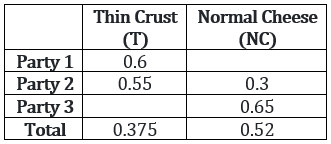
How many Thin Crust pizzas were to be delivered to Party 3?
Passage / Data
Directions for next 4 questions.
Funky Pizzaria was required to supply pizzas to three different parties. The total number of pizzas it had to deliver was 800, 70% of which were to be delivered to party 3 and the rest equally divided between Party 1 and Party 2.
Pizzas could be of Thin Crust (T) or Deep Dish (D) variety and come in either Normal Cheese (NC) or Extra Cheese (EC) versions. Hence, there are four types of pizzas: T-NC, T-EC, D-NC and D-EC. Partial information about proportions of T and NC pizzas ordered by the three parties is given below:
How many Normal Cheese pizzas were required to be delivered to Party 1?
Passage / Data
Directions for next 4 questions.
Funky Pizzaria was required to supply pizzas to three different parties. The total number of pizzas it had to deliver was 800, 70% of which were to be delivered to party 3 and the rest equally divided between Party 1 and Party 2.
Pizzas could be of Thin Crust (T) or Deep Dish (D) variety and come in either Normal Cheese (NC) or Extra Cheese (EC) versions. Hence, there are four types of pizzas: T-NC, T-EC, D-NC and D-EC. Partial information about proportions of T and NC pizzas ordered by the three parties is given below:
For Party 2, if 50% of the Normal Cheese pizzas were of Thin Crust variety, what was the difference between the numbers of T-EC and D-EC pizzas to be delivered to party 2?
Passage / Data
Directions for next 4 questions.
Funky Pizzaria was required to supply pizzas to three different parties. The total number of pizzas it had to deliver was 800, 70% of which were to be delivered to party 3 and the rest equally divided between Party 1 and Party 2.
Pizzas could be of Thin Crust (T) or Deep Dish (D) variety and come in either Normal Cheese (NC) or Extra Cheese (EC) versions. Hence, there are four types of pizzas: T-NC, T-EC, D-NC and D-EC. Partial information about proportions of T and NC pizzas ordered by the three parties is given below:
Suppose that a T-NC pizza cost as much as a D-NC pizza, but 3/5th of the price of a D-EC pizza. A D-EC pizza costs Rs. 50 more than a T-EC pizza, and the latter costs Rs. 500.
If 25% of the Normal Cheese pizzas delivered to Party 1 were of Deep Dish variety, what was the total bill for Party 1?
Passage / Data
Answer the following question based on the information given below.
There were seven elective courses - E1 to E7 – running in a specific term in a college. Each of the 300 students enrolled had chosen just one elective from among these seven. However, before the start of the term, E7 was withdrawn as the instructor concerned had left the college. The students who had opted for E7 were allowed to join any of the remaining electives. Also, the students who had chosen other electives were given one chance to change their choice. The table below captures the movement of the students from one elective to another during this process. Movement from one elective to the same elective simply means no movement. Some numbers in the table got accidentally erased; however, it is known that these were either 0 or 1.
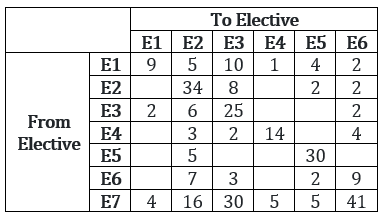
Further, the following are known:
- Before the change process there were 6 more students in E1 than in E4, but after the reshuffle, the number of students in E4 was 3 more than that in E1.
- The number of students in E2 increased by 30 after the change process.
- Before the change process, E4 and 2 more students than E6, while E2 had 10 more students than E3.
How many elective courses among E1 to E6 had a decrease in their enrollments after the change process?
Passage / Data
Answer the following question based on the information given below.
There were seven elective courses - E1 to E7 – running in a specific term in a college. Each of the 300 students enrolled had chosen just one elective from among these seven. However, before the start of the term, E7 was withdrawn as the instructor concerned had left the college. The students who had opted for E7 were allowed to join any of the remaining electives. Also, the students who had chosen other electives were given one chance to change their choice. The table below captures the movement of the students from one elective to another during this process. Movement from one elective to the same elective simply means no movement. Some numbers in the table got accidentally erased; however, it is known that these were either 0 or 1.
Further, the following are known:
- Before the change process there were 6 more students in E1 than in E4, but after the reshuffle, the number of students in E4 was 3 more than that in E1.
- The number of students in E2 increased by 30 after the change process.
- Before the change process, E4 and 2 more students than E6, while E2 had 10 more students than E3.
After the change process, which of the following is the correct sequence of number of students in the six electives E1 to E6?
Passage / Data
Answer the following question based on the information given below.
There were seven elective courses - E1 to E7 – running in a specific term in a college. Each of the 300 students enrolled had chosen just one elective from among these seven. However, before the start of the term, E7 was withdrawn as the instructor concerned had left the college. The students who had opted for E7 were allowed to join any of the remaining electives. Also, the students who had chosen other electives were given one chance to change their choice. The table below captures the movement of the students from one elective to another during this process. Movement from one elective to the same elective simply means no movement. Some numbers in the table got accidentally erased; however, it is known that these were either 0 or 1.
Further, the following are known:
- Before the change process there were 6 more students in E1 than in E4, but after the reshuffle, the number of students in E4 was 3 more than that in E1.
- The number of students in E2 increased by 30 after the change process.
- Before the change process, E4 and 2 more students than E6, while E2 had 10 more students than E3.
After the change process, which course among E1 to E6 had the largest change in its enrollment as a percentage of its original enrollment?
Passage / Data
Answer the following question based on the information given below.
There were seven elective courses - E1 to E7 – running in a specific term in a college. Each of the 300 students enrolled had chosen just one elective from among these seven. However, before the start of the term, E7 was withdrawn as the instructor concerned had left the college. The students who had opted for E7 were allowed to join any of the remaining electives. Also, the students who had chosen other electives were given one chance to change their choice. The table below captures the movement of the students from one elective to another during this process. Movement from one elective to the same elective simply means no movement. Some numbers in the table got accidentally erased; however, it is known that these were either 0 or 1.
Further, the following are known:
- Before the change process there were 6 more students in E1 than in E4, but after the reshuffle, the number of students in E4 was 3 more than that in E1.
- The number of students in E2 increased by 30 after the change process.
- Before the change process, E4 and 2 more students than E6, while E2 had 10 more students than E3.
Later, the college imposed a condition that if after the change of electives, the enrollment in any elective (other than E7) dropped to less than 20 students, all the students who had left that course will be required to re-enroll for that elective.
Which of the following is a correct sequence of electives in decreasing order of their final enrollments?
Passage / Data
Answer the following question based on the information given below.
An old woman had the following assets:
(a) Rs. 70 lakh in bank deposits
(b) 1 house worth Rs. 50 lakh
(c). 3 flats, each worth Rs. 30 lakh
(d) Certain number of gold coins, each worth Rs. 1 lakh
She wanted to distribute her assets among her three children; Neeta, Seeta and Geeta.
The house, any of the flats or any of the coins were not to be split. That is, the house went entirely to one child; a flat went to one child and similarly, a gold coin went to one child.
Among the three, Neeta received the least amount in bank deposits, while Geeta received the highest. The value of the assets was distributed equally among the children, as were the gold coins.How much did Seeta receive in bank deposits (in lakhs of rupees)?
Passage / Data
Answer the following question based on the information given below.
An old woman had the following assets:
(a) Rs. 70 lakh in bank deposits
(b) 1 house worth Rs. 50 lakh
(c). 3 flats, each worth Rs. 30 lakh
(d) Certain number of gold coins, each worth Rs. 1 lakh
She wanted to distribute her assets among her three children; Neeta, Seeta and Geeta.
The house, any of the flats or any of the coins were not to be split. That is, the house went entirely to one child; a flat went to one child and similarly, a gold coin went to one child.
Among the three, Neeta received the least amount in bank deposits, while Geeta received the highest. The value of the assets was distributed equally among the children, as were the gold coins. How many flats did Neeta receive?
Passage / Data
Answer the following question based on the information given below.
An old woman had the following assets:
(a) Rs. 70 lakh in bank deposits
(b) 1 house worth Rs. 50 lakh
(c). 3 flats, each worth Rs. 30 lakh
(d) Certain number of gold coins, each worth Rs. 1 lakh
She wanted to distribute her assets among her three children; Neeta, Seeta and Geeta.
The house, any of the flats or any of the coins were not to be split. That is, the house went entirely to one child; a flat went to one child and similarly, a gold coin went to one child.
The value of the assets distributed among Neeta, Seeta and Geeta was in the ratio of 1 : 2 : 3, while the gold coins were distributed among them in the ratio of 2 : 3 : 4. One child got all three flats and she did not get the house. One child, other than Geeta, got Rs. 30 lakh in bank deposits.
How many gold coins did the old woman have?
Passage / Data
Answer the following question based on the information given below.
An old woman had the following assets:
(a) Rs. 70 lakh in bank deposits
(b) 1 house worth Rs. 50 lakh
(c). 3 flats, each worth Rs. 30 lakh
(d) Certain number of gold coins, each worth Rs. 1 lakh
She wanted to distribute her assets among her three children; Neeta, Seeta and Geeta.
The house, any of the flats or any of the coins were not to be split. That is, the house went entirely to one child; a flat went to one child and similarly, a gold coin went to one child.
The value of the assets distributed among Neeta, Seeta and Geeta was in the ratio of 1 : 2 : 3, while the gold coins were distributed among them in the ratio of 2 : 3 : 4. One child got all three flats and she did not get the house. One child, other than Geeta, got Rs. 30 lakh in bank deposits.
How much did Geeta get in bank deposits (in lakhs of rupees)?
Passage / Data
Answer the following question based on the information given below.
At a management school, the oldest 10 dorms, numbered 1 to 10, need to be repaired urgently. The following diagram represents the estimated repair costs (in Rs. Crores) for the 10 dorms. For any dorm, the estimated repair cost (in Rs. Crores) in an integer. Repairs with estimated cost Rs. 1 or 2 Crores are considered light repairs, repairs with estimated cost Rs. 3 or 4 are considered moderate repairs and repairs with estimated cost Rs. 5 of 6 Crores are considered extensive repairs.
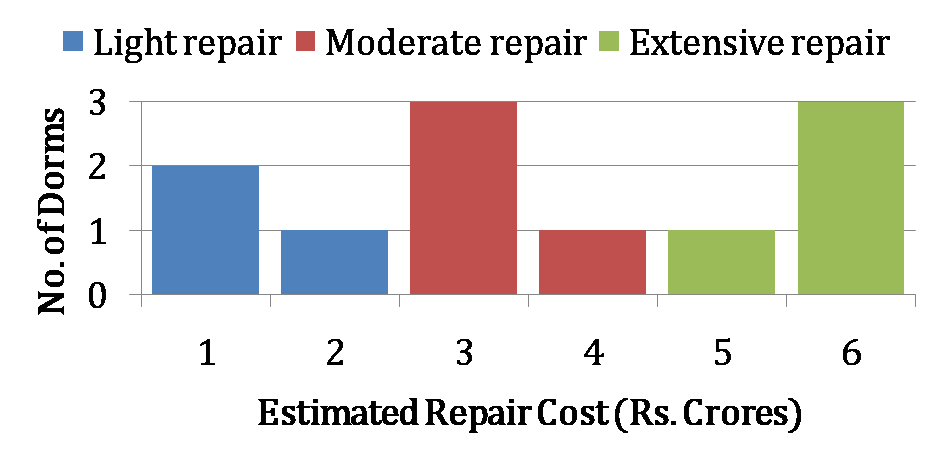
Further, the following are known:
- Odd – numbered dorms do not need light repair; even-numbered dorms do not need moderate repair and dorms, whose numbers are divisible by 3, do not need extensive repair.
- Dorms 4 to 9 all need different repair costs, with Dorm 7 needing the maximum and Dorm 8 needing the minimum.
Which of the following is NOT necessarily true?
Passage / Data
Answer the following question based on the information given below.
At a management school, the oldest 10 dorms, numbered 1 to 10, need to be repaired urgently. The following diagram represents the estimated repair costs (in Rs. Crores) for the 10 dorms. For any dorm, the estimated repair cost (in Rs. Crores) in an integer. Repairs with estimated cost Rs. 1 or 2 Crores are considered light repairs, repairs with estimated cost Rs. 3 or 4 are considered moderate repairs and repairs with estimated cost Rs. 5 of 6 Crores are considered extensive repairs.
Further, the following are known:
- Odd – numbered dorms do not need light repair; even-numbered dorms do not need moderate repair and dorms, whose numbers are divisible by 3, do not need extensive repair.
- Dorms 4 to 9 all need different repair costs, with Dorm 7 needing the maximum and Dorm 8 needing the minimum.
What is the total cost of repairing the odd-numbered dorms (in Rs. Crores)?
Passage / Data
Answer the following question based on the information given below.
At a management school, the oldest 10 dorms, numbered 1 to 10, need to be repaired urgently. The following diagram represents the estimated repair costs (in Rs. Crores) for the 10 dorms. For any dorm, the estimated repair cost (in Rs. Crores) in an integer. Repairs with estimated cost Rs. 1 or 2 Crores are considered light repairs, repairs with estimated cost Rs. 3 or 4 are considered moderate repairs and repairs with estimated cost Rs. 5 of 6 Crores are considered extensive repairs.
Further, the following are known:
- Odd – numbered dorms do not need light repair; even-numbered dorms do not need moderate repair and dorms, whose numbers are divisible by 3, do not need extensive repair.
- Dorms 4 to 9 all need different repair costs, with Dorm 7 needing the maximum and Dorm 8 needing the minimum.
Suppose further that:
- 4 of the 10 dorms needing repair are women’s dorms and need a total of Rs. 20 Crores for repair.
- Only one of Dorms 1 to 5 is a women’s dorm.
What is the cost for repairing Dorm 9 (in Rs. Crores)?
Passage / Data
Answer the following question based on the information given below.
At a management school, the oldest 10 dorms, numbered 1 to 10, need to be repaired urgently. The following diagram represents the estimated repair costs (in Rs. Crores) for the 10 dorms. For any dorm, the estimated repair cost (in Rs. Crores) in an integer. Repairs with estimated cost Rs. 1 or 2 Crores are considered light repairs, repairs with estimated cost Rs. 3 or 4 are considered moderate repairs and repairs with estimated cost Rs. 5 of 6 Crores are considered extensive repairs.
Further, the following are known:
- Odd – numbered dorms do not need light repair; even-numbered dorms do not need moderate repair and dorms, whose numbers are divisible by 3, do not need extensive repair.
- Dorms 4 to 9 all need different repair costs, with Dorm 7 needing the maximum and Dorm 8 needing the minimum.
Suppose further that:
- 4 of the 10 dorms needing repair are women’s dorms and need a total of Rs. 20 Crores for repair.
- Only one of Dorms 1 to 5 is a women’s dorm.
Which of the following is a women’s dorm?
Passage / Data
Answer the following question based on the information given below.
A tea taster was assigned to rate teas from six different locations – Munnar, Wayanand, Ooty, Darjeeling, Assam and Himachal. These teas were placed in six cups, numbered 1 to 6, not necessarily in the same order. The tea taster was asked to rate these teas on the strength of their flavour on a scale of 1 to 10. He gave a unique integer rating to each tea. Some other information is given below:
- Cup 6 contained tea from Himachal.
- Tea from Ooty got the highest rating, but it was not in Cup 3.
- The rating of tea in Cup 3 was double the rating of the tea in Cup 5.
- Only two cups got ratings in even numbers.
- Cup 2 got the minimum rating and this rating was an even number.
- Tea in Cup 3 got a higher rating than that in Cup 1.
- The rating of tea from Wayanad was more than the rating of tea from Munnar, but less than that from Assam.
What was the second highest rating given?
Passage / Data
Answer the following question based on the information given below.
A tea taster was assigned to rate teas from six different locations – Munnar, Wayanand, Ooty, Darjeeling, Assam and Himachal. These teas were placed in six cups, numbered 1 to 6, not necessarily in the same order. The tea taster was asked to rate these teas on the strength of their flavour on a scale of 1 to 10. He gave a unique integer rating to each tea. Some other information is given below:
- Cup 6 contained tea from Himachal.
- Tea from Ooty got the highest rating, but it was not in Cup 3.
- The rating of tea in Cup 3 was double the rating of the tea in Cup 5.
- Only two cups got ratings in even numbers.
- Cup 2 got the minimum rating and this rating was an even number.
- Tea in Cup 3 got a higher rating than that in Cup 1.
- The rating of tea from Wayanad was more than the rating of tea from Munnar, but less than that from Assam.
What was the number of the cup that contained tea from Ooty?
Passage / Data
Answer the following question based on the information given below.
A tea taster was assigned to rate teas from six different locations – Munnar, Wayanand, Ooty, Darjeeling, Assam and Himachal. These teas were placed in six cups, numbered 1 to 6, not necessarily in the same order. The tea taster was asked to rate these teas on the strength of their flavour on a scale of 1 to 10. He gave a unique integer rating to each tea. Some other information is given below:
- Cup 6 contained tea from Himachal.
- Tea from Ooty got the highest rating, but it was not in Cup 3.
- The rating of tea in Cup 3 was double the rating of the tea in Cup 5.
- Only two cups got ratings in even numbers.
- Cup 2 got the minimum rating and this rating was an even number.
- Tea in Cup 3 got a higher rating than that in Cup 1.
- The rating of tea from Wayanad was more than the rating of tea from Munnar, but less than that from Assam.
If the tea from Munnar did not get the minimum rating, what was the rating of the tea from Wayanad?
Passage / Data
Answer the following question based on the information given below.
A tea taster was assigned to rate teas from six different locations – Munnar, Wayanand, Ooty, Darjeeling, Assam and Himachal. These teas were placed in six cups, numbered 1 to 6, not necessarily in the same order. The tea taster was asked to rate these teas on the strength of their flavour on a scale of 1 to 10. He gave a unique integer rating to each tea. Some other information is given below:
- Cup 6 contained tea from Himachal.
- Tea from Ooty got the highest rating, but it was not in Cup 3.
- The rating of tea in Cup 3 was double the rating of the tea in Cup 5.
- Only two cups got ratings in even numbers.
- Cup 2 got the minimum rating and this rating was an even number.
- Tea in Cup 3 got a higher rating than that in Cup 1.
- The rating of tea from Wayanad was more than the rating of tea from Munnar, but less than that from Assam.
If cups containing teas from Wayanad and Ooty had consecutive numbers, which of the following statements may be true?
Passage / Data
Answer the following question based on the information given below.
In an 8 × 8 chessboard a queen placed anywhere can attack another piece if the piece is present in the same row, or in the same column or in any diagonal position in any possible 4 directions, provided there is no other piece in between in the path from the queen to that piece.
The columns are labelled a to h (left to right) and the rows are numbered 1 to 8 (bottom to top). The position of a piece given by the combination of column and row labels. For example, position c5 means that the piece is cth column and 5th row.
If the queen is at c5, and the other pieces at positions c2, g1, g3, g5 and a3, how many are under attack by the queen? There are no other pieces on the board.
Passage / Data
Answer the following question based on the information given below.
In an 8 × 8 chessboard a queen placed anywhere can attack another piece if the piece is present in the same row, or in the same column or in any diagonal position in any possible 4 directions, provided there is no other piece in between in the path from the queen to that piece.
The columns are labelled a to h (left to right) and the rows are numbered 1 to 8 (bottom to top). The position of a piece given by the combination of column and row labels. For example, position c5 means that the piece is cth column and 5th row.
If the other pieces are only at positions a1, a3, b4, d7, h7 and h8, then which of the following positions of the queen results in the maximum number of pieces being under attack?
Passage / Data
Answer the following question based on the information given below.
In an 8 × 8 chessboard a queen placed anywhere can attack another piece if the piece is present in the same row, or in the same column or in any diagonal position in any possible 4 directions, provided there is no other piece in between in the path from the queen to that piece.
The columns are labelled a to h (left to right) and the rows are numbered 1 to 8 (bottom to top). The position of a piece given by the combination of column and row labels. For example, position c5 means that the piece is cth column and 5th row.
If the other pieces are only at positions a1, a3, b4, d7, h7 and h8, then from how many positions the queen cannot attack any of the pieces?
Passage / Data
Answer the following question based on the information given below.
In an 8 × 8 chessboard a queen placed anywhere can attack another piece if the piece is present in the same row, or in the same column or in any diagonal position in any possible 4 directions, provided there is no other piece in between in the path from the queen to that piece.
The columns are labelled a to h (left to right) and the rows are numbered 1 to 8 (bottom to top). The position of a piece given by the combination of column and row labels. For example, position c5 means that the piece is cth column and 5th row.
Suppose the queen is the only piece on the board and it is at position d5.
In how many positions can another piece be placed on the board such that it is safe from attack from the queen?
Passage / Data
Answer the following question based on the information given below.
Eight friends: Ajit, Byomkesh, Gargi, Jayanta, Kikira, Manik, Prodosh and Tapesh are goin to Delhi from Kolkatta by a flight operated by Cheap Air. In the flight, sitting is arranged in 30 rows, numbered 1 to 30, each consisting of 6 seats, marked by letters A to F from left to right, respectively. Seats A to C are to the left of the aisle (the passage running from the front of the aircraft to the back), and seats D to F are to the right of the aisle. Seats A and F are by the windows and referred to as Window seats, C and D are by the aisle and are referred to as Aisle seats while B and E are referred to as Middle seats. Seats marked by consecutive letters are called consecutive seats (or seats next to each other).A seat number is a combination of the row number, followed by the letter indicating the position in the row, e.g, 1A is the left window seat in the first row, while 12E is the right middle seat in the 12th row.
Cheap Air charges Rs. 1000 extra for any seats in Rows 1, 12 and 13 as those have extra legroom. For Rows 2-10, it charges Rs. 300 extra for Window seats and Rs. 500 extra for Aisle seats. For Rows 11 and 14 to 20, it charges Rs. 200 extra for Window seats and Rs. 400 extra for Aisle seats. All other seats are available at no extra charge.
The following are known:
- The eight friends were seated in six different rows.
- They occupied 3 Window seats, 4 Aisle seats and 1 Middle seat.
- Seven of them had to pay extra amounts, totaling to Rs. 4600, for their choices of seat. One of them did not pay any additional amount of his/her choice of seat.
- Jayanta, Ajit and Byomkesh were sitting in seats marked by the same letter, in consecutive rows in increasing order of row numbers; but all of them paid different amounts for their choices of seat. One of these amounts may be zero.
- Gargi was sitting next to Kikira, and Manik was sitting next to Jayanta.
- Prodosh and Tapesh were sitting in seats marked by the same letter, in consecutive rows in increasing order of row numbers; but they paid different amounts for their choices of seat. One of these amounts may be zero.
In which row was Manik sitting?
Passage / Data
Answer the following question based on the information given below.
Eight friends: Ajit, Byomkesh, Gargi, Jayanta, Kikira, Manik, Prodosh and Tapesh are goin to Delhi from Kolkatta by a flight operated by Cheap Air. In the flight, sitting is arranged in 30 rows, numbered 1 to 30, each consisting of 6 seats, marked by letters A to F from left to right, respectively. Seats A to C are to the left of the aisle (the passage running from the front of the aircraft to the back), and seats D to F are to the right of the aisle. Seats A and F are by the windows and referred to as Window seats, C and D are by the aisle and are referred to as Aisle seats while B and E are referred to as Middle seats. Seats marked by consecutive letters are called consecutive seats (or seats next to each other).A seat number is a combination of the row number, followed by the letter indicating the position in the row, e.g, 1A is the left window seat in the first row, while 12E is the right middle seat in the 12th row.
Cheap Air charges Rs. 1000 extra for any seats in Rows 1, 12 and 13 as those have extra legroom. For Rows 2-10, it charges Rs. 300 extra for Window seats and Rs. 500 extra for Aisle seats. For Rows 11 and 14 to 20, it charges Rs. 200 extra for Window seats and Rs. 400 extra for Aisle seats. All other seats are available at no extra charge.
The following are known:
- The eight friends were seated in six different rows.
- They occupied 3 Window seats, 4 Aisle seats and 1 Middle seat.
- Seven of them had to pay extra amounts, totaling to Rs. 4600, for their choices of seat. One of them did not pay any additional amount of his/her choice of seat.
- Jayanta, Ajit and Byomkesh were sitting in seats marked by the same letter, in consecutive rows in increasing order of row numbers; but all of them paid different amounts for their choices of seat. One of these amounts may be zero.
- Gargi was sitting next to Kikira, and Manik was sitting next to Jayanta.
- Prodosh and Tapesh were sitting in seats marked by the same letter, in consecutive rows in increasing order of row numbers; but they paid different amounts for their choices of seat. One of these amounts may be zero.
How much extra did Jayanta pay for his choice of seat?
Passage / Data
Answer the following question based on the information given below.
Eight friends: Ajit, Byomkesh, Gargi, Jayanta, Kikira, Manik, Prodosh and Tapesh are goin to Delhi from Kolkatta by a flight operated by Cheap Air. In the flight, sitting is arranged in 30 rows, numbered 1 to 30, each consisting of 6 seats, marked by letters A to F from left to right, respectively. Seats A to C are to the left of the aisle (the passage running from the front of the aircraft to the back), and seats D to F are to the right of the aisle. Seats A and F are by the windows and referred to as Window seats, C and D are by the aisle and are referred to as Aisle seats while B and E are referred to as Middle seats. Seats marked by consecutive letters are called consecutive seats (or seats next to each other).A seat number is a combination of the row number, followed by the letter indicating the position in the row, e.g, 1A is the left window seat in the first row, while 12E is the right middle seat in the 12th row.
Cheap Air charges Rs. 1000 extra for any seats in Rows 1, 12 and 13 as those have extra legroom. For Rows 2-10, it charges Rs. 300 extra for Window seats and Rs. 500 extra for Aisle seats. For Rows 11 and 14 to 20, it charges Rs. 200 extra for Window seats and Rs. 400 extra for Aisle seats. All other seats are available at no extra charge.
The following are known:
- The eight friends were seated in six different rows.
- They occupied 3 Window seats, 4 Aisle seats and 1 Middle seat.
- Seven of them had to pay extra amounts, totaling to Rs. 4600, for their choices of seat. One of them did not pay any additional amount of his/her choice of seat.
- Jayanta, Ajit and Byomkesh were sitting in seats marked by the same letter, in consecutive rows in increasing order of row numbers; but all of them paid different amounts for their choices of seat. One of these amounts may be zero.
- Gargi was sitting next to Kikira, and Manik was sitting next to Jayanta.
- Prodosh and Tapesh were sitting in seats marked by the same letter, in consecutive rows in increasing order of row numbers; but they paid different amounts for their choices of seat. One of these amounts may be zero.
How much extra did Gargi pay for her choice of seat?
Passage / Data
Answer the following question based on the information given below.
Eight friends: Ajit, Byomkesh, Gargi, Jayanta, Kikira, Manik, Prodosh and Tapesh are goin to Delhi from Kolkatta by a flight operated by Cheap Air. In the flight, sitting is arranged in 30 rows, numbered 1 to 30, each consisting of 6 seats, marked by letters A to F from left to right, respectively. Seats A to C are to the left of the aisle (the passage running from the front of the aircraft to the back), and seats D to F are to the right of the aisle. Seats A and F are by the windows and referred to as Window seats, C and D are by the aisle and are referred to as Aisle seats while B and E are referred to as Middle seats. Seats marked by consecutive letters are called consecutive seats (or seats next to each other).A seat number is a combination of the row number, followed by the letter indicating the position in the row, e.g, 1A is the left window seat in the first row, while 12E is the right middle seat in the 12th row.
Cheap Air charges Rs. 1000 extra for any seats in Rows 1, 12 and 13 as those have extra legroom. For Rows 2-10, it charges Rs. 300 extra for Window seats and Rs. 500 extra for Aisle seats. For Rows 11 and 14 to 20, it charges Rs. 200 extra for Window seats and Rs. 400 extra for Aisle seats. All other seats are available at no extra charge.
The following are known:
- The eight friends were seated in six different rows.
- They occupied 3 Window seats, 4 Aisle seats and 1 Middle seat.
- Seven of them had to pay extra amounts, totaling to Rs. 4600, for their choices of seat. One of them did not pay any additional amount of his/her choice of seat.
- Jayanta, Ajit and Byomkesh were sitting in seats marked by the same letter, in consecutive rows in increasing order of row numbers; but all of them paid different amounts for their choices of seat. One of these amounts may be zero.
- Gargi was sitting next to Kikira, and Manik was sitting next to Jayanta.
- Prodosh and Tapesh were sitting in seats marked by the same letter, in consecutive rows in increasing order of row numbers; but they paid different amounts for their choices of seat. One of these amounts may be zero.
Who among the following did not pay any extra amount for his/her choice of seat?
Passage / Data
Answer the following question based on the information given below.
A high security research lab requires the researches to set a pass key sequence based on the scan of the five fingers of their left hands. When an employee first joins the lab, her fingers are scanned in an order of her choice, and then when she wants to re-enter the facility, she has to scan the five fingers in the same sequence.
The lab authorities are considering some relaxations of the scan order requirements of the scan order requirements, since it is observed that some employees often get locked-out because they forget the sequence.
The lab has decided to allow a variation in the sequence of scans of five fingers so that at most two scans (out of five) are out of place. For example, if the original sequence is Thumb (T), index finger (I), middle finger (M), ring finger (R) and little finger (L) then TLMRI is also allowed, but TMRLI is not.
How many different sequences of scans are allowed for any given person’s original scan?
Passage / Data
Answer the following question based on the information given below.
A high security research lab requires the researches to set a pass key sequence based on the scan of the five fingers of their left hands. When an employee first joins the lab, her fingers are scanned in an order of her choice, and then when she wants to re-enter the facility, she has to scan the five fingers in the same sequence.
The lab authorities are considering some relaxations of the scan order requirements of the scan order requirements, since it is observed that some employees often get locked-out because they forget the sequence.
The lab has decided to allow variations of the original sequence so that input of the scanned sequence of five fingers is allowed to vary from the original sequence by one place for any of the fingers. Thus, for example, if TIMRL is the original sequence, then ITRML is also allowed, but LIMRT is not.
How many different sequences are allowed for any given person’s original scan?
Passage / Data
Answer the following question based on the information given below.
A high security research lab requires the researches to set a pass key sequence based on the scan of the five fingers of their left hands. When an employee first joins the lab, her fingers are scanned in an order of her choice, and then when she wants to re-enter the facility, she has to scan the five fingers in the same sequence.
The lab authorities are considering some relaxations of the scan order requirements of the scan order requirements, since it is observed that some employees often get locked-out because they forget the sequence.
The lab has now decided to require six scans in the pass key sequence, where exactly one finger is scanned twice, and the other fingers are scanned exactly once, which can be done in any order. For example, a possible sequence is TIMTRL.
Suppose the lab allows a variation of the original sequence (of six inputs) where at most two scans (out of six) are out of place, as long as the finger originally scanned twice is scanned twice and other fingers are scanned once.
How many different sequences if scans are allowed for any given person’s original scan?
Passage / Data
Answer the following question based on the information given below.
A high security research lab requires the researches to set a pass key sequence based on the scan of the five fingers of their left hands. When an employee first joins the lab, her fingers are scanned in an order of her choice, and then when she wants to re-enter the facility, she has to scan the five fingers in the same sequence.
The lab authorities are considering some relaxations of the scan order requirements of the scan order requirements, since it is observed that some employees often get locked-out because they forget the sequence.
The lab has now decided to require six scans in the pass key sequence, where exactly one finger is scanned twice, and the other fingers are scanned exactly once, which can be done in any order. For example, a possible sequence is TIMTRL.
Suppose the lab allows a variation of the original sequence (of six inputs) so that input in the form of scanned sequence of six fingers is allowed to vary from the original sequence by one place for any of the fingers, as long as the finger originally scanned twice is scanned twice and other fingers are scanned once.
How many different sequences of scans are allowed if the original scan sequence is LRLTIM?
Passage / Data
Answer the following question based on the information given below.
For admission to various affiliated colleges, a university conducts a written test with four different sections, each with a maximum of 50 marks. The following table gives the aggregate as well as the sectional cut-off marks fixed by six different colleges affiliated to the university. A student will get admission only if he/she gets marks greater than or equal to the cut-off marks in each of the sections and his/her aggregate marks are at least equal to the aggregate cut-off marks as specified by the college.
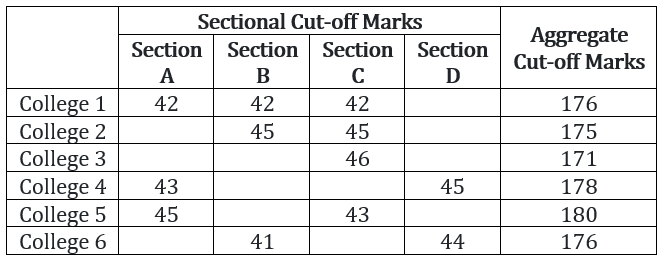
Aditya did not get a call from even a single college. What could be the maximum aggregate marks obtained by him?
Passage / Data
Answer the following question based on the information given below.
For admission to various affiliated colleges, a university conducts a written test with four different sections, each with a maximum of 50 marks. The following table gives the aggregate as well as the sectional cut-off marks fixed by six different colleges affiliated to the university. A student will get admission only if he/she gets marks greater than or equal to the cut-off marks in each of the sections and his/her aggregate marks are at least equal to the aggregate cut-off marks as specified by the college.
Bhama got calls from all colleges. What could be the minimum aggregate marks obtained by her?
Passage / Data
Answer the following question based on the information given below.
For admission to various affiliated colleges, a university conducts a written test with four different sections, each with a maximum of 50 marks. The following table gives the aggregate as well as the sectional cut-off marks fixed by six different colleges affiliated to the university. A student will get admission only if he/she gets marks greater than or equal to the cut-off marks in each of the sections and his/her aggregate marks are at least equal to the aggregate cut-off marks as specified by the college.
Charlie got calls from two colleges. What could be the minimum marks obtained by him in a section?
Passage / Data
Answer the following question based on the information given below.
There are 100 employees in an organization across five departments. The following table gives the departement-wise distribution of average age, average basic pay and allowances. The gross pay of an employee is the sum of his/her basic pay and allowances.
There are limited numbers of employees considered for transfer/promotion across departments. Whenever a person is transferred/promoted from a department of lower average age to a department of higher average age, he/she will get an additional allowance of 10% of basic pay over and above his/her current allowance. There will not be any change in pay structure if a person is transferred/promoted from a department with higher average age to a department with lower average age.
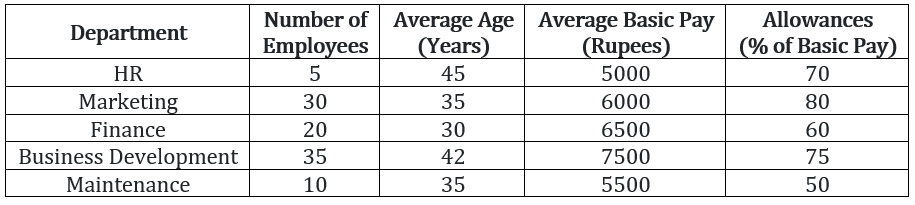
There was a mutual transfer of an employee between Marketing and Finance departments and transfer of one employee from Marketing to HR. As a result, the average age of Finance department increased by one year and that of Marketing department remained the same. What is the new average age of HR department?
Passage / Data
Answer the following question based on the information given below.
There are 100 employees in an organization across five departments. The following table gives the departement-wise distribution of average age, average basic pay and allowances. The gross pay of an employee is the sum of his/her basic pay and allowances.
There are limited numbers of employees considered for transfer/promotion across departments. Whenever a person is transferred/promoted from a department of lower average age to a department of higher average age, he/she will get an additional allowance of 10% of basic pay over and above his/her current allowance. There will not be any change in pay structure if a person is transferred/promoted from a department with higher average age to a department with lower average age.
What is the approximate percentage change in the average gross pay of the HR department due to transfer of a 40-yr old person with basic pay of Rs. 8000 from the Marketing department?
Passage / Data
Answer the following question based on the information given below.
There are 100 employees in an organization across five departments. The following table gives the departement-wise distribution of average age, average basic pay and allowances. The gross pay of an employee is the sum of his/her basic pay and allowances.
There are limited numbers of employees considered for transfer/promotion across departments. Whenever a person is transferred/promoted from a department of lower average age to a department of higher average age, he/she will get an additional allowance of 10% of basic pay over and above his/her current allowance. There will not be any change in pay structure if a person is transferred/promoted from a department with higher average age to a department with lower average age.
If two employees (each with a basic pay of Rs. 6000) are transferred from Maintenance department to HR department and one person (with a basic pay of Rs. 8000) was transferred from Marketing department to HR department, what will be the percentage change in average basic pay of HR department?
Passage / Data
Answer the following question based on the information given below.
Abdul, Bikram and Chetan are three professional traders who trade in shares of a company XYZ Ltd. Abdul follows the strategy of buying at the opening of the day at 10 am and selling the whole lot at the close of the day at 3 pm. Bikram follows the strategy of buying at hourly intervals: 10 am , 11 am, 12 noon, 1 pm and 2 pm, and selling the whole lot at the close of the day. Further, he buys an equal number of shares in each purchase. Chetan follows a similar pattern as Bikram but his strategy is somewhat different. Chetan’s total investment amount is divided equally among his purchases. The profit or loss made by each investor is the difference between the sale value at the close of the day less the investment in purchase. The “return” for each investor is defined as the ratio of the profit or loss to the investment amount expressed as a percentage.
On a “boom” day the price of XYZ Ltd. keeps rising throughout the day and peaks at the close of the day. Which trader got the minimum return on that day?
Passage / Data
Answer the following question based on the information given below.
Abdul, Bikram and Chetan are three professional traders who trade in shares of a company XYZ Ltd. Abdul follows the strategy of buying at the opening of the day at 10 am and selling the whole lot at the close of the day at 3 pm. Bikram follows the strategy of buying at hourly intervals: 10 am , 11 am, 12 noon, 1 pm and 2 pm, and selling the whole lot at the close of the day. Further, he buys an equal number of shares in each purchase. Chetan follows a similar pattern as Bikram but his strategy is somewhat different. Chetan’s total investment amount is divided equally among his purchases. The profit or loss made by each investor is the difference between the sale value at the close of the day less the investment in purchase. The “return” for each investor is defined as the ratio of the profit or loss to the investment amount expressed as a percentage.
On a day of fluctuating market prices, the share price of XYZ Ltd. ends with a gain, i.e., it is higher at the close of the day compared to the opening value. Which trader got the maximum return on that day?
Passage / Data
Answer the following question based on the information given below.
Abdul, Bikram and Chetan are three professional traders who trade in shares of a company XYZ Ltd. Abdul follows the strategy of buying at the opening of the day at 10 am and selling the whole lot at the close of the day at 3 pm. Bikram follows the strategy of buying at hourly intervals: 10 am , 11 am, 12 noon, 1 pm and 2 pm, and selling the whole lot at the close of the day. Further, he buys an equal number of shares in each purchase. Chetan follows a similar pattern as Bikram but his strategy is somewhat different. Chetan’s total investment amount is divided equally among his purchases. The profit or loss made by each investor is the difference between the sale value at the close of the day less the investment in purchase. The “return” for each investor is defined as the ratio of the profit or loss to the investment amount expressed as a percentage.
Which one of the following statements is always true?
Passage / Data
Answer the following question based on the information given below.
Abdul, Bikram and Chetan are three professional traders who trade in shares of a company XYZ Ltd. Abdul follows the strategy of buying at the opening of the day at 10 am and selling the whole lot at the close of the day at 3 pm. Bikram follows the strategy of buying at hourly intervals: 10 am , 11 am, 12 noon, 1 pm and 2 pm, and selling the whole lot at the close of the day. Further, he buys an equal number of shares in each purchase. Chetan follows a similar pattern as Bikram but his strategy is somewhat different. Chetan’s total investment amount is divided equally among his purchases. The profit or loss made by each investor is the difference between the sale value at the close of the day less the investment in purchase. The “return” for each investor is defined as the ratio of the profit or loss to the investment amount expressed as a percentage.
One day, two other traders, Dane and Emily joined Abdul, Bikram and Chetan for trading in the shares of XYZ Ltd. Dane followed a strategy of buying equal numbers of shares at 10 am, 11 am and 12 noon, and selling the same numbers at 1 pm, 2 pm and 3 pm. Emily, on the other hand, followed the strategy of buying shares using all her money at 10 am and selling all of them at 12 noon and again buying the shares for all the money at 1 pm and again selling all of them at the close of the day at 3 pm. At the close of the day the following was observed:
i. Abdul lost money in the transactions.
ii. Both Dane and Emily made profits.
iii. There was an increase in share price during the closing hour compared to the price at 2 pm.
iv. Share price at 12 noon was lower than the opening price.
Which of the following is necessarily false?
Passage / Data
Answer the following question based on the information given below.
Abdul, Bikram and Chetan are three professional traders who trade in shares of a company XYZ Ltd. Abdul follows the strategy of buying at the opening of the day at 10 am and selling the whole lot at the close of the day at 3 pm. Bikram follows the strategy of buying at hourly intervals: 10 am , 11 am, 12 noon, 1 pm and 2 pm, and selling the whole lot at the close of the day. Further, he buys an equal number of shares in each purchase. Chetan follows a similar pattern as Bikram but his strategy is somewhat different. Chetan’s total investment amount is divided equally among his purchases. The profit or loss made by each investor is the difference between the sale value at the close of the day less the investment in purchase. The “return” for each investor is defined as the ratio of the profit or loss to the investment amount expressed as a percentage.
Share price was at its highest at
Note: Use data from the previous question.
Passage / Data
Answer the following question based on the information given below.
i. There are three houses on each side of the road.
ii. These six houses are labeled as P, Q, R, S, T and U.
iii. The houses are of different colours, namely, Red, Blue, Green, Orange, Yellow and White.
iv. The houses are of different heights.
v. T, the tallest house, is exactly opposite to the Red coloured house.
vi. The shortest house is exactly opposite to the Green coloured house.
vii. U, the Orange coloured house, is located between P and S.
viii. R, the Yellow coloured house, is exactly opposite to P.
ix. Q, the Green coloured house, is exactly opposite to U.
x. P, the White coloured house, is taller than R, but shorter than S and Q.
What is the colour of the tallest house?
Passage / Data
Answer the following question based on the information given below.
i. There are three houses on each side of the road.
ii. These six houses are labeled as P, Q, R, S, T and U.
iii. The houses are of different colours, namely, Red, Blue, Green, Orange, Yellow and White.
iv. The houses are of different heights.
v. T, the tallest house, is exactly opposite to the Red coloured house.
vi. The shortest house is exactly opposite to the Green coloured house.
vii. U, the Orange coloured house, is located between P and S.
viii. R, the Yellow coloured house, is exactly opposite to P.
ix. Q, the Green coloured house, is exactly opposite to U.
x. P, the White coloured house, is taller than R, but shorter than S and Q.
What is the colour of the house diagonally opposite to the Yellow coloured house?
Passage / Data
Answer the following question based on the information given below.
i. There are three houses on each side of the road.
ii. These six houses are labeled as P, Q, R, S, T and U.
iii. The houses are of different colours, namely, Red, Blue, Green, Orange, Yellow and White.
iv. The houses are of different heights.
v. T, the tallest house, is exactly opposite to the Red coloured house.
vi. The shortest house is exactly opposite to the Green coloured house.
vii. U, the Orange coloured house, is located between P and S.
viii. R, the Yellow coloured house, is exactly opposite to P.
ix. Q, the Green coloured house, is exactly opposite to U.
x. P, the White coloured house, is taller than R, but shorter than S and Q.
Which is the second tallest house?
Passage / Data
Answer the following question based on the information given below.
Mathematicians are assigned a number called Erdös number, (named after the famous mathematician, Paul Erdös). Only Paul Erdös himself has an Erdös number of zero. Any mathematician who has written a research paper with Erdös has an Erdös number of 1. For other mathematicians, the calculation of his/her Erdös number is illustrated below:
Suppose that a mathematician X has co-authored papers with several other mathematicians. From among them, mathematician Y has the smallest Erdös number. Let the Erdös number of Y be y. Then X has an Erdös number of y + 1. Hence any mathematician with no co-authorship chain connected to Erdös has an Erdös number of infinity.
- In a seven day long mini-conference organized in memory of Paul Erdös, a close group of eight mathematicians, call them A, B, C, D, E, F, G and H, discussed some research problems. At the beginning of the conference, A was the only participant who had an infinite Erdös number. Nobody had an Erdös number less than that of F.
- On the third day of the conference F co-authored a paper jointly with A and C. This reduced the average Erdös number of the group of eight mathematicians to 3. The Erdös numbers of B, D, E, G and H remained unchanged with the writing of this paper. Further, no other co-authorship among any three members would have reduced the average Erdös number of the group of eight to as low as 3.
- At the end of the third day, five members of this group had identical Erdös numbers while the other three had Erdös numbers distinct from each other.
- On the fifth day, E co-authored a paper with F which reduced the group‘s average Erdös number by 0.5. The Erdös numbers of the remaining six were unchanged with the writing of this paper.
- No other paper was written during the conference.
The person having the largest Erdös number at the end of the conference must have had Erdös number (at that time):
Passage / Data
Answer the following question based on the information given below.
Mathematicians are assigned a number called Erdös number, (named after the famous mathematician, Paul Erdös). Only Paul Erdös himself has an Erdös number of zero. Any mathematician who has written a research paper with Erdös has an Erdös number of 1. For other mathematicians, the calculation of his/her Erdös number is illustrated below:
Suppose that a mathematician X has co-authored papers with several other mathematicians. From among them, mathematician Y has the smallest Erdös number. Let the Erdös number of Y be y. Then X has an Erdös number of y + 1. Hence any mathematician with no co-authorship chain connected to Erdös has an Erdös number of infinity.
- In a seven day long mini-conference organized in memory of Paul Erdös, a close group of eight mathematicians, call them A, B, C, D, E, F, G and H, discussed some research problems. At the beginning of the conference, A was the only participant who had an infinite Erdös number. Nobody had an Erdös number less than that of F.
- On the third day of the conference F co-authored a paper jointly with A and C. This reduced the average Erdös number of the group of eight mathematicians to 3. The Erdös numbers of B, D, E, G and H remained unchanged with the writing of this paper. Further, no other co-authorship among any three members would have reduced the average Erdös number of the group of eight to as low as 3.
- At the end of the third day, five members of this group had identical Erdös numbers while the other three had Erdös numbers distinct from each other.
- On the fifth day, E co-authored a paper with F which reduced the group‘s average Erdös number by 0.5. The Erdös numbers of the remaining six were unchanged with the writing of this paper.
- No other paper was written during the conference.
How many participants in the conference did not change their Erdös number during the conference?
Passage / Data
Answer the following question based on the information given below.
Mathematicians are assigned a number called Erdös number, (named after the famous mathematician, Paul Erdös). Only Paul Erdös himself has an Erdös number of zero. Any mathematician who has written a research paper with Erdös has an Erdös number of 1. For other mathematicians, the calculation of his/her Erdös number is illustrated below:
Suppose that a mathematician X has co-authored papers with several other mathematicians. From among them, mathematician Y has the smallest Erdös number. Let the Erdös number of Y be y. Then X has an Erdös number of y + 1. Hence any mathematician with no co-authorship chain connected to Erdös has an Erdös number of infinity.
- In a seven day long mini-conference organized in memory of Paul Erdös, a close group of eight mathematicians, call them A, B, C, D, E, F, G and H, discussed some research problems. At the beginning of the conference, A was the only participant who had an infinite Erdös number. Nobody had an Erdös number less than that of F.
- On the third day of the conference F co-authored a paper jointly with A and C. This reduced the average Erdös number of the group of eight mathematicians to 3. The Erdös numbers of B, D, E, G and H remained unchanged with the writing of this paper. Further, no other co-authorship among any three members would have reduced the average Erdös number of the group of eight to as low as 3.
- At the end of the third day, five members of this group had identical Erdös numbers while the other three had Erdös numbers distinct from each other.
- On the fifth day, E co-authored a paper with F which reduced the group‘s average Erdös number by 0.5. The Erdös numbers of the remaining six were unchanged with the writing of this paper.
- No other paper was written during the conference.
The Erdös number of C at the end of the conference was:
Passage / Data
Answer the following question based on the information given below.
Mathematicians are assigned a number called Erdös number, (named after the famous mathematician, Paul Erdös). Only Paul Erdös himself has an Erdös number of zero. Any mathematician who has written a research paper with Erdös has an Erdös number of 1. For other mathematicians, the calculation of his/her Erdös number is illustrated below:
Suppose that a mathematician X has co-authored papers with several other mathematicians. From among them, mathematician Y has the smallest Erdös number. Let the Erdös number of Y be y. Then X has an Erdös number of y + 1. Hence any mathematician with no co-authorship chain connected to Erdös has an Erdös number of infinity.
- In a seven day long mini-conference organized in memory of Paul Erdös, a close group of eight mathematicians, call them A, B, C, D, E, F, G and H, discussed some research problems. At the beginning of the conference, A was the only participant who had an infinite Erdös number. Nobody had an Erdös number less than that of F.
- On the third day of the conference F co-authored a paper jointly with A and C. This reduced the average Erdös number of the group of eight mathematicians to 3. The Erdös numbers of B, D, E, G and H remained unchanged with the writing of this paper. Further, no other co-authorship among any three members would have reduced the average Erdös number of the group of eight to as low as 3.
- At the end of the third day, five members of this group had identical Erdös numbers while the other three had Erdös numbers distinct from each other.
- On the fifth day, E co-authored a paper with F which reduced the group‘s average Erdös number by 0.5. The Erdös numbers of the remaining six were unchanged with the writing of this paper.
- No other paper was written during the conference.
The Erdös number of E at the beginning of the conference was:
Passage / Data
Answer the following question based on the information given below.
Mathematicians are assigned a number called Erdös number, (named after the famous mathematician, Paul Erdös). Only Paul Erdös himself has an Erdös number of zero. Any mathematician who has written a research paper with Erdös has an Erdös number of 1. For other mathematicians, the calculation of his/her Erdös number is illustrated below:
Suppose that a mathematician X has co-authored papers with several other mathematicians. From among them, mathematician Y has the smallest Erdös number. Let the Erdös number of Y be y. Then X has an Erdös number of y + 1. Hence any mathematician with no co-authorship chain connected to Erdös has an Erdös number of infinity.
- In a seven day long mini-conference organized in memory of Paul Erdös, a close group of eight mathematicians, call them A, B, C, D, E, F, G and H, discussed some research problems. At the beginning of the conference, A was the only participant who had an infinite Erdös number. Nobody had an Erdös number less than that of F.
- On the third day of the conference F co-authored a paper jointly with A and C. This reduced the average Erdös number of the group of eight mathematicians to 3. The Erdös numbers of B, D, E, G and H remained unchanged with the writing of this paper. Further, no other co-authorship among any three members would have reduced the average Erdös number of the group of eight to as low as 3.
- At the end of the third day, five members of this group had identical Erdös numbers while the other three had Erdös numbers distinct from each other.
- On the fifth day, E co-authored a paper with F which reduced the group‘s average Erdös number by 0.5. The Erdös numbers of the remaining six were unchanged with the writing of this paper.
- No other paper was written during the conference.
How many participants had the same Erdös number at the beginning of the conference?
Passage / Data
Answer the following question based on the information given below.
Two traders, Chetan and Michael, were involved in the buying and selling of MCS shares over five trading days. At the beginning of the first day, the MCS share was priced at Rs. 100, while at the end of the fifth day it was priced at Rs. 110. At the end of each day, the MCS share price either went up by Rs. 10, or else, it came down by Rs. 10. Both Chetan and Michael took buying and selling decisions at the end of each trading day.
The beginning price of MCS share on a given day was the same as the ending price of the previous day.
Chetan and Michael started with the same number of shares and amount of cash, and had enough of both. Below are some additional facts about how Chetan and Michael traded over the five trading days.
- Each day if the price went up, Chetan sold 10 shares of MCS at the closing price. On the other hand, each day if the price went down, he bought 10 shares at the closing price.
- If on any day, the closing price was above Rs. 110, then Michael sold 10 shares of MCS, while if it was below Rs. 90, he bought 10 shares, all at the closing price.
If Chetan sold 10 shares of MCS on three consecutive days, while Michael sold 10 shares only once during the five days, what was the price of MCS at the end of day 3?
Passage / Data
Answer the following question based on the information given below.
Two traders, Chetan and Michael, were involved in the buying and selling of MCS shares over five trading days. At the beginning of the first day, the MCS share was priced at Rs. 100, while at the end of the fifth day it was priced at Rs. 110. At the end of each day, the MCS share price either went up by Rs. 10, or else, it came down by Rs. 10. Both Chetan and Michael took buying and selling decisions at the end of each trading day.
The beginning price of MCS share on a given day was the same as the ending price of the previous day.
Chetan and Michael started with the same number of shares and amount of cash, and had enough of both. Below are some additional facts about how Chetan and Michael traded over the five trading days.
- Each day if the price went up, Chetan sold 10 shares of MCS at the closing price. On the other hand, each day if the price went down, he bought 10 shares at the closing price.
- If on any day, the closing price was above Rs. 110, then Michael sold 10 shares of MCS, while if it was below Rs. 90, he bought 10 shares, all at the closing price.
If Michael ended up with Rs. 100 less cash than Chetan at the end of day 5, what was the difference in the number of shares possessed by Michael and Chetan (at the end of day 5)?
Passage / Data
Answer the following question based on the information given below.
Two traders, Chetan and Michael, were involved in the buying and selling of MCS shares over five trading days. At the beginning of the first day, the MCS share was priced at Rs. 100, while at the end of the fifth day it was priced at Rs. 110. At the end of each day, the MCS share price either went up by Rs. 10, or else, it came down by Rs. 10. Both Chetan and Michael took buying and selling decisions at the end of each trading day.
The beginning price of MCS share on a given day was the same as the ending price of the previous day.
Chetan and Michael started with the same number of shares and amount of cash, and had enough of both. Below are some additional facts about how Chetan and Michael traded over the five trading days.
- Each day if the price went up, Chetan sold 10 shares of MCS at the closing price. On the other hand, each day if the price went down, he bought 10 shares at the closing price.
- If on any day, the closing price was above Rs. 110, then Michael sold 10 shares of MCS, while if it was below Rs. 90, he bought 10 shares, all at the closing price.
If Chetan ended up with Rs. 1300 more cash than Michael at the end of day 5, what was the price of MCS share at the end of day 4?
Passage / Data
Answer the following question based on the information given below.
Two traders, Chetan and Michael, were involved in the buying and selling of MCS shares over five trading days. At the beginning of the first day, the MCS share was priced at Rs. 100, while at the end of the fifth day it was priced at Rs. 110. At the end of each day, the MCS share price either went up by Rs. 10, or else, it came down by Rs. 10. Both Chetan and Michael took buying and selling decisions at the end of each trading day.
The beginning price of MCS share on a given day was the same as the ending price of the previous day.
Chetan and Michael started with the same number of shares and amount of cash, and had enough of both. Below are some additional facts about how Chetan and Michael traded over the five trading days.
- Each day if the price went up, Chetan sold 10 shares of MCS at the closing price. On the other hand, each day if the price went down, he bought 10 shares at the closing price.
- If on any day, the closing price was above Rs. 110, then Michael sold 10 shares of MCS, while if it was below Rs. 90, he bought 10 shares, all at the closing price.
What could have been the maximum possible increase in combined cash balance of Chetan and Michael at the end of the fifth day?
Passage / Data
Answer the following question based on the information given below.
Two traders, Chetan and Michael, were involved in the buying and selling of MCS shares over five trading days. At the beginning of the first day, the MCS share was priced at Rs. 100, while at the end of the fifth day it was priced at Rs. 110. At the end of each day, the MCS share price either went up by Rs. 10, or else, it came down by Rs. 10. Both Chetan and Michael took buying and selling decisions at the end of each trading day.
The beginning price of MCS share on a given day was the same as the ending price of the previous day.
Chetan and Michael started with the same number of shares and amount of cash, and had enough of both. Below are some additional facts about how Chetan and Michael traded over the five trading days.
- Each day if the price went up, Chetan sold 10 shares of MCS at the closing price. On the other hand, each day if the price went down, he bought 10 shares at the closing price.
- If on any day, the closing price was above Rs. 110, then Michael sold 10 shares of MCS, while if it was below Rs. 90, he bought 10 shares, all at the closing price.
If Michael ended up with 20 more shares than Chetan at the end of day 5, what was the price of the share at the end of day 3?
Passage / Data
Answer the following question based on the information given below.
K, L, M, N, P, Q, R, S, U and W are the only ten members in a department. There is a proposal to form a team from within the members of the department, subject to the following conditions:
- A team must include exactly one among P, R, and S.
- A team must include either M or Q, but not both.
- If a team includes K, then it must also include L, and vice versa.
- If a team includes one among S, U, and W, then it must also include the other two.
- L and N cannot be members of the same team.
- L and U cannot be members of the same team.
- The size of a team is defined as the number of members in the team.
What could be the size of a team that includes K?
Passage / Data
Answer the following question based on the information given below.
K, L, M, N, P, Q, R, S, U and W are the only ten members in a department. There is a proposal to form a team from within the members of the department, subject to the following conditions:
- A team must include exactly one among P, R, and S.
- A team must include either M or Q, but not both.
- If a team includes K, then it must also include L, and vice versa.
- If a team includes one among S, U, and W, then it must also include the other two.
- L and N cannot be members of the same team.
- L and U cannot be members of the same team.
- The size of a team is defined as the number of members in the team.
In how many ways a team can be constituted so that the team includes N?
Passage / Data
Answer the following question based on the information given below.
K, L, M, N, P, Q, R, S, U and W are the only ten members in a department. There is a proposal to form a team from within the members of the department, subject to the following conditions:
- A team must include exactly one among P, R, and S.
- A team must include either M or Q, but not both.
- If a team includes K, then it must also include L, and vice versa.
- If a team includes one among S, U, and W, then it must also include the other two.
- L and N cannot be members of the same team.
- L and U cannot be members of the same team.
- The size of a team is defined as the number of members in the team.
What would be the size of the largest possible team?
Passage / Data
Answer the following question based on the information given below.
K, L, M, N, P, Q, R, S, U and W are the only ten members in a department. There is a proposal to form a team from within the members of the department, subject to the following conditions:
- A team must include exactly one among P, R, and S.
- A team must include either M or Q, but not both.
- If a team includes K, then it must also include L, and vice versa.
- If a team includes one among S, U, and W, then it must also include the other two.
- L and N cannot be members of the same team.
- L and U cannot be members of the same team.
- The size of a team is defined as the number of members in the team.
Who can be a member of a team of size 5?
Passage / Data
Answer the following question based on the information given below.
K, L, M, N, P, Q, R, S, U and W are the only ten members in a department. There is a proposal to form a team from within the members of the department, subject to the following conditions:
- A team must include exactly one among P, R, and S.
- A team must include either M or Q, but not both.
- If a team includes K, then it must also include L, and vice versa.
- If a team includes one among S, U, and W, then it must also include the other two.
- L and N cannot be members of the same team.
- L and U cannot be members of the same team.
- The size of a team is defined as the number of members in the team.
Who cannot be a member of a team of size 3?
Passage / Data
Answer the following question based on the information given below.
The table below reports the gender, designation and age-group of the employees in an organization. It also provides information on their commitment to projects coming up in the months of January (Jan), February (Feb), March (Mar) and April (Apr), as well as their interest in attending workshops on: Business Opportunities (BO), Communication Skills (CS), and E-Governance (EG).
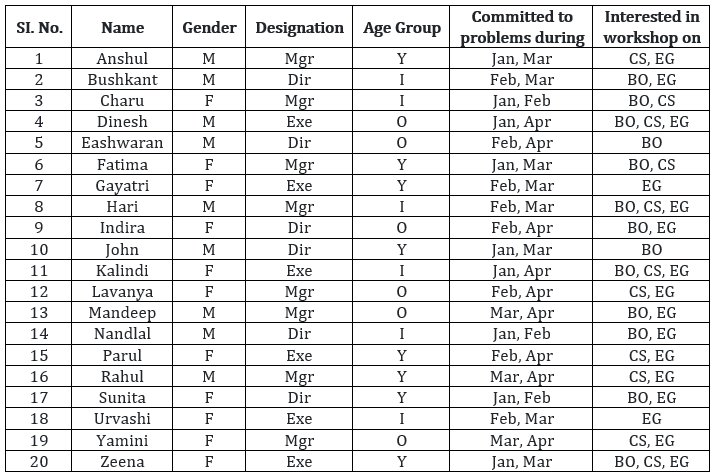
M = Male, F = Female; Exe = Executive, Mgr = Manager, Dir = Director; Y = Young, I = In-between, O = Old
For each workshop, exactly four employees are to be sent, of which at least two should be Females and at least one should be Young. No employee can be sent to a workshop in which he or she is not interested in. An employee cannot attend the workshop on
- Communication Skills, if he or she is committed to internal projects in the month of January;
- Business Opportunities, if he or she is committed to internal projects in the month of February;
- E-governance, if he or she is committed to internal projects in the month of March.
Assuming that Parul and Hari are attending the workshop on Communication Skills (CS), then which of the following employees can possibly attend the CS workshop?
Passage / Data
Answer the following question based on the information given below.
The table below reports the gender, designation and age-group of the employees in an organization. It also provides information on their commitment to projects coming up in the months of January (Jan), February (Feb), March (Mar) and April (Apr), as well as their interest in attending workshops on: Business Opportunities (BO), Communication Skills (CS), and E-Governance (EG).
M = Male, F = Female; Exe = Executive, Mgr = Manager, Dir = Director; Y = Young, I = In-between, O = Old
For each workshop, exactly four employees are to be sent, of which at least two should be Females and at least one should be Young. No employee can be sent to a workshop in which he or she is not interested in. An employee cannot attend the workshop on
- Communication Skills, if he or she is committed to internal projects in the month of January;
- Business Opportunities, if he or she is committed to internal projects in the month of February;
- E-governance, if he or she is committed to internal projects in the month of March.
How many Executives (Exe) cannot attend more than one workshop?
Passage / Data
Answer the following question based on the information given below.
The table below reports the gender, designation and age-group of the employees in an organization. It also provides information on their commitment to projects coming up in the months of January (Jan), February (Feb), March (Mar) and April (Apr), as well as their interest in attending workshops on: Business Opportunities (BO), Communication Skills (CS), and E-Governance (EG).
M = Male, F = Female; Exe = Executive, Mgr = Manager, Dir = Director; Y = Young, I = In-between, O = Old
For each workshop, exactly four employees are to be sent, of which at least two should be Females and at least one should be Young. No employee can be sent to a workshop in which he or she is not interested in. An employee cannot attend the workshop on
- Communication Skills, if he or she is committed to internal projects in the month of January;
- Business Opportunities, if he or she is committed to internal projects in the month of February;
- E-governance, if he or she is committed to internal projects in the month of March.
Which set of employees cannot attend any of the workshops?
Passage / Data
Answer the following question based on the information given below.
Venkat, a stockbroker, invested a part of his money in the stock of four companies - A, B, C and D. Each of these companies belonged to different industries, viz., Cement, Information Technology (IT), Auto, and Steel, in no particular order. At the time of investment, the price of each stock was Rs.100. Venkat purchased only one stock of each of these companies. He was expecting returns of 20%, 10%, 30%, and 40% from the stock of companies A, B, C and D, respectively. Returns are defined as the change in the value of the stock after one year, expressed as a percentage of the initial value. During the year, two of these companies announced extraordinarily good results. One of these two companies belonged to the Cement or the IT industry, while the other one belonged to either the Steel or the Auto industry. As a result, the returns on the stocks of these two companies were higher than the initially expected returns. For the company belonging to the Cement or the IT industry with extraordinarily good results, the returns were twice that of the initially expected returns. For the company belonging to the Steel or the Auto industry, the returns on announcement of extraordinarily good results were only one and a half times that of the initially expected returns. For the remaining two companies, which did not announce extraordinarily good results, the returns realized during the year were the same as initially expected.
What is the minimum average return Venkat would have earned during the year?
Passage / Data
Answer the following question based on the information given below.
Venkat, a stockbroker, invested a part of his money in the stock of four companies - A, B, C and D. Each of these companies belonged to different industries, viz., Cement, Information Technology (IT), Auto, and Steel, in no particular order. At the time of investment, the price of each stock was Rs.100. Venkat purchased only one stock of each of these companies. He was expecting returns of 20%, 10%, 30%, and 40% from the stock of companies A, B, C and D, respectively. Returns are defined as the change in the value of the stock after one year, expressed as a percentage of the initial value. During the year, two of these companies announced extraordinarily good results. One of these two companies belonged to the Cement or the IT industry, while the other one belonged to either the Steel or the Auto industry. As a result, the returns on the stocks of these two companies were higher than the initially expected returns. For the company belonging to the Cement or the IT industry with extraordinarily good results, the returns were twice that of the initially expected returns. For the company belonging to the Steel or the Auto industry, the returns on announcement of extraordinarily good results were only one and a half times that of the initially expected returns. For the remaining two companies, which did not announce extraordinarily good results, the returns realized during the year were the same as initially expected.
If Venkat earned a 35% return on average during the year, then which of these statements would necessarily be true?
I . Company A belonged either to Auto or to Steel Industry.
II. Company B did not announce extraordinarily good results.
III. Company A announced extraordinarily good results.IV. Company D did not announce extraordinarily good results.
Passage / Data
Answer the following question based on the information given below.
Venkat, a stockbroker, invested a part of his money in the stock of four companies - A, B, C and D. Each of these companies belonged to different industries, viz., Cement, Information Technology (IT), Auto, and Steel, in no particular order. At the time of investment, the price of each stock was Rs.100. Venkat purchased only one stock of each of these companies. He was expecting returns of 20%, 10%, 30%, and 40% from the stock of companies A, B, C and D, respectively. Returns are defined as the change in the value of the stock after one year, expressed as a percentage of the initial value. During the year, two of these companies announced extraordinarily good results. One of these two companies belonged to the Cement or the IT industry, while the other one belonged to either the Steel or the Auto industry. As a result, the returns on the stocks of these two companies were higher than the initially expected returns. For the company belonging to the Cement or the IT industry with extraordinarily good results, the returns were twice that of the initially expected returns. For the company belonging to the Steel or the Auto industry, the returns on announcement of extraordinarily good results were only one and a half times that of the initially expected returns. For the remaining two companies, which did not announce extraordinarily good results, the returns realized during the year were the same as initially expected.
If Venkat earned a 38.75% return on average during the year, then which of these statement(s) would necessarily be true?
I . Company C belonged either to Auto or to Steel Industry.
II. Company D belonged either to Auto or to Steel Industry.
III. Company A announced extraordinarily good results.IV. Company B did not announce extraordinarily good results.
Passage / Data
Answer the following question based on the information given below.
Venkat, a stockbroker, invested a part of his money in the stock of four companies - A, B, C and D. Each of these companies belonged to different industries, viz., Cement, Information Technology (IT), Auto, and Steel, in no particular order. At the time of investment, the price of each stock was Rs.100. Venkat purchased only one stock of each of these companies. He was expecting returns of 20%, 10%, 30%, and 40% from the stock of companies A, B, C and D, respectively. Returns are defined as the change in the value of the stock after one year, expressed as a percentage of the initial value. During the year, two of these companies announced extraordinarily good results. One of these two companies belonged to the Cement or the IT industry, while the other one belonged to either the Steel or the Auto industry. As a result, the returns on the stocks of these two companies were higher than the initially expected returns. For the company belonging to the Cement or the IT industry with extraordinarily good results, the returns were twice that of the initially expected returns. For the company belonging to the Steel or the Auto industry, the returns on announcement of extraordinarily good results were only one and a half times that of the initially expected returns. For the remaining two companies, which did not announce extraordinarily good results, the returns realized during the year were the same as initially expected.
If Company C belonged to the Cement or the IT industry and did announce extraordinarily good results, then which of these statement(s) would necessarily be true?
I . Venkat earned not more than 36.25% return on average.
II. Venkat earned not less than 33.75% return on average.
III. If Venkat earned 33.75% return on average, Company A announced extraordinarily good results.IV. If Venkat earned 33.75% return on average, Company B belonged either to Auto or to Steel Industry.
Passage / Data
Answer the following question based on the information given below.
The year is 2089. Beijing, London, New York, and Paris are in contention to host the 2096 Olympics. The eventual winner is determined through several rounds of voting by members of the IOC with each member representing a different city. All the four cities in contention are also represented in IOC.
- In any round of voting, the city receiving the lowest number of votes in that round gets eliminated. The survivor after the last round of voting gets to host the event.
- A member is allowed to cast votes for at most two different cities in all rounds of voting combined. (Hence, a member becomes ineligible to cast a vote in a given round if both the cities (s)he voted for in earlier rounds are out of contention in that round of voting).
- A member is also ineligible to cast a vote in a round if the city (s)he represents is in contention in that round of voting.
- As long as the member is eligible, (s)he must vote and vote for only one candidate city in any round of voting.
The following incomplete table shows the information on cities that received the maximum and minimum votes in different rounds, the number of votes cast in their favour, and the total votes that were cast in those rounds.
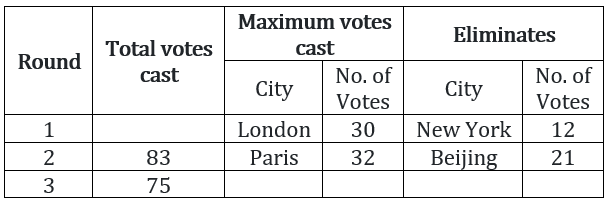
It is also known that:
- All those who voted for London and Paris in round 1, continued to vote for the same cities in subsequent rounds as long as these cities were in contention. 75% of those who voted for Beijing in round 1, voted for Beijing in round 2 as well.
- Those who voted for New York in round 1, voted either for Beijing or Paris in round 2.
- The difference in votes cast for the two contending cities in the last round was 1.
- 50% of those who voted for Beijing in round 1, voted for Paris in round 3.
What percentage of members from among those who voted for New York in round 1, voted for Beijing in round 2?
Passage / Data
Answer the following question based on the information given below.
The year is 2089. Beijing, London, New York, and Paris are in contention to host the 2096 Olympics. The eventual winner is determined through several rounds of voting by members of the IOC with each member representing a different city. All the four cities in contention are also represented in IOC.
- In any round of voting, the city receiving the lowest number of votes in that round gets eliminated. The survivor after the last round of voting gets to host the event.
- A member is allowed to cast votes for at most two different cities in all rounds of voting combined. (Hence, a member becomes ineligible to cast a vote in a given round if both the cities (s)he voted for in earlier rounds are out of contention in that round of voting).
- A member is also ineligible to cast a vote in a round if the city (s)he represents is in contention in that round of voting.
- As long as the member is eligible, (s)he must vote and vote for only one candidate city in any round of voting.
The following incomplete table shows the information on cities that received the maximum and minimum votes in different rounds, the number of votes cast in their favour, and the total votes that were cast in those rounds.
It is also known that:
- All those who voted for London and Paris in round 1, continued to vote for the same cities in subsequent rounds as long as these cities were in contention. 75% of those who voted for Beijing in round 1, voted for Beijing in round 2 as well.
- Those who voted for New York in round 1, voted either for Beijing or Paris in round 2.
- The difference in votes cast for the two contending cities in the last round was 1.
- 50% of those who voted for Beijing in round 1, voted for Paris in round 3.
What is the number of votes cast for Paris in round 1?
Passage / Data
Answer the following question based on the information given below.
The year is 2089. Beijing, London, New York, and Paris are in contention to host the 2096 Olympics. The eventual winner is determined through several rounds of voting by members of the IOC with each member representing a different city. All the four cities in contention are also represented in IOC.
- In any round of voting, the city receiving the lowest number of votes in that round gets eliminated. The survivor after the last round of voting gets to host the event.
- A member is allowed to cast votes for at most two different cities in all rounds of voting combined. (Hence, a member becomes ineligible to cast a vote in a given round if both the cities (s)he voted for in earlier rounds are out of contention in that round of voting).
- A member is also ineligible to cast a vote in a round if the city (s)he represents is in contention in that round of voting.
- As long as the member is eligible, (s)he must vote and vote for only one candidate city in any round of voting.
The following incomplete table shows the information on cities that received the maximum and minimum votes in different rounds, the number of votes cast in their favour, and the total votes that were cast in those rounds.
It is also known that:
- All those who voted for London and Paris in round 1, continued to vote for the same cities in subsequent rounds as long as these cities were in contention. 75% of those who voted for Beijing in round 1, voted for Beijing in round 2 as well.
- Those who voted for New York in round 1, voted either for Beijing or Paris in round 2.
- The difference in votes cast for the two contending cities in the last round was 1.
- 50% of those who voted for Beijing in round 1, voted for Paris in round 3.
What percentage of members from among those who voted for Beijing in round 2 and were eligible to vote in round 3, voted for London?
Passage / Data
Answer the following question based on the information given below.
The year is 2089. Beijing, London, New York, and Paris are in contention to host the 2096 Olympics. The eventual winner is determined through several rounds of voting by members of the IOC with each member representing a different city. All the four cities in contention are also represented in IOC.
- In any round of voting, the city receiving the lowest number of votes in that round gets eliminated. The survivor after the last round of voting gets to host the event.
- A member is allowed to cast votes for at most two different cities in all rounds of voting combined. (Hence, a member becomes ineligible to cast a vote in a given round if both the cities (s)he voted for in earlier rounds are out of contention in that round of voting).
- A member is also ineligible to cast a vote in a round if the city (s)he represents is in contention in that round of voting.
- As long as the member is eligible, (s)he must vote and vote for only one candidate city in any round of voting.
The following incomplete table shows the information on cities that received the maximum and minimum votes in different rounds, the number of votes cast in their favour, and the total votes that were cast in those rounds.
It is also known that:
- All those who voted for London and Paris in round 1, continued to vote for the same cities in subsequent rounds as long as these cities were in contention. 75% of those who voted for Beijing in round 1, voted for Beijing in round 2 as well.
- Those who voted for New York in round 1, voted either for Beijing or Paris in round 2.
- The difference in votes cast for the two contending cities in the last round was 1.
- 50% of those who voted for Beijing in round 1, voted for Paris in round 3.
Which of the following statements must be true?
a. IOC member from New York must have voted for Paris in round 2.
b. IOC member from Beijing voted for London in round 3.
Passage / Data
Answer the following question based on the information given below.
Help Distress (HD) is an NGO involved in providing assistance to people suffering from natural disasters. Currently, it has 37 volunteers. They are involved in three projects: Tsunami Relief (TR) in Tamil Nadu, FloodRelief (FR) in Maharashtra, and Earthquake Relief (ER) in Gujarat. Each volunteer working with Help Distress has to be involved in at least one relief work project.
- A Maximum number of volunteers are involved in the FR project. Among them, the number of volunteers involved in FR project alone is equal to the volunteers having additional involvement in the ER project.
- The number of volunteers involved in the ER project alone is double the number of volunteers involved in all the three projects.
- 17 volunteers are involved in the TR project.
- The number of volunteers involved in the TR project alone is one less than the number of volunteers involved in ER Project alone.
- Ten volunteers involved in the TR project are also involved in at least one more project.
Based on the information given above, the minimum number of volunteers involved in both FR and TR projects, but not in the ER project is:
Passage / Data
Answer the following question based on the information given below.
Help Distress (HD) is an NGO involved in providing assistance to people suffering from natural disasters. Currently, it has 37 volunteers. They are involved in three projects: Tsunami Relief (TR) in Tamil Nadu, FloodRelief (FR) in Maharashtra, and Earthquake Relief (ER) in Gujarat. Each volunteer working with Help Distress has to be involved in at least one relief work project.
- A Maximum number of volunteers are involved in the FR project. Among them, the number of volunteers involved in FR project alone is equal to the volunteers having additional involvement in the ER project.
- The number of volunteers involved in the ER project alone is double the number of volunteers involved in all the three projects.
- 17 volunteers are involved in the TR project.
- The number of volunteers involved in the TR project alone is one less than the number of volunteers involved in ER Project alone.
- Ten volunteers involved in the TR project are also involved in at least one more project.
Which of the following additional information would enable to find the exact number of volunteers involved in various projects?
Passage / Data
Answer the following question based on the information given below.
Help Distress (HD) is an NGO involved in providing assistance to people suffering from natural disasters. Currently, it has 37 volunteers. They are involved in three projects: Tsunami Relief (TR) in Tamil Nadu, FloodRelief (FR) in Maharashtra, and Earthquake Relief (ER) in Gujarat. Each volunteer working with Help Distress has to be involved in at least one relief work project.
- A Maximum number of volunteers are involved in the FR project. Among them, the number of volunteers involved in FR project alone is equal to the volunteers having additional involvement in the ER project.
- The number of volunteers involved in the ER project alone is double the number of volunteers involved in all the three projects.
- 17 volunteers are involved in the TR project.
- The number of volunteers involved in the TR project alone is one less than the number of volunteers involved in ER Project alone.
- Ten volunteers involved in the TR project are also involved in at least one more project.
After some time, the volunteers who were involved in all the three projects were asked to withdraw from one project. As a result, one of the volunteers opted out of the TR project, and one opted out of the ER project, while the remaining ones involved in all the three projects opted out of the FR project. Which of the following statements, then, necessarily follows?
Passage / Data
Answer the following question based on the information given below.
Help Distress (HD) is an NGO involved in providing assistance to people suffering from natural disasters. Currently, it has 37 volunteers. They are involved in three projects: Tsunami Relief (TR) in Tamil Nadu, FloodRelief (FR) in Maharashtra, and Earthquake Relief (ER) in Gujarat. Each volunteer working with Help Distress has to be involved in at least one relief work project.
- A Maximum number of volunteers are involved in the FR project. Among them, the number of volunteers involved in FR project alone is equal to the volunteers having additional involvement in the ER project.
- The number of volunteers involved in the ER project alone is double the number of volunteers involved in all the three projects.
- 17 volunteers are involved in the TR project.
- The number of volunteers involved in the TR project alone is one less than the number of volunteers involved in ER Project alone.
- Ten volunteers involved in the TR project are also involved in at least one more project.
After the withdrawal of volunteers, as indicated in Question 89, some new volunteers joined the NGO. Each one of them was allotted only one project in a manner such that, the number of volunteers working in one project alone for each of the three projects became identical. At that point, it was also found that the number of volunteers involved in FR and ER projects was the same as the number of volunteers involved in TR and ER projects. Which of the projects now has the highest number of volunteers?
Passage / Data
Answer the following question based on the information given below.
A study was conducted to ascertain the relative importance that employees in five different countries assigned to five different traits in their Chief Executive Officers. The traits were compassion (C), decisiveness (D), negotiation skills (N), public visibility (P), and vision (V). The level of dissimilarity between two countries is the maximum difference in the ranks allotted by the two countries to any of the five traits. The following table indicates the rank order of the five traits for each country.
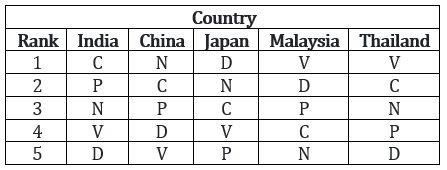
Three of the following four pairs of countries have identical levels of dissimilarity. Which pair is the odd one out?
Passage / Data
Answer the following question based on the information given below.
A study was conducted to ascertain the relative importance that employees in five different countries assigned to five different traits in their Chief Executive Officers. The traits were compassion (C), decisiveness (D), negotiation skills (N), public visibility (P), and vision (V). The level of dissimilarity between two countries is the maximum difference in the ranks allotted by the two countries to any of the five traits. The following table indicates the rank order of the five traits for each country.
Which amongst the following countries is most dissimilar to India?
Passage / Data
Answer the following question based on the information given below.
A study was conducted to ascertain the relative importance that employees in five different countries assigned to five different traits in their Chief Executive Officers. The traits were compassion (C), decisiveness (D), negotiation skills (N), public visibility (P), and vision (V). The level of dissimilarity between two countries is the maximum difference in the ranks allotted by the two countries to any of the five traits. The following table indicates the rank order of the five traits for each country.
Which of the following countries is least dissimilar to India?
Passage / Data
Answer the following question based on the information given below.
A study was conducted to ascertain the relative importance that employees in five different countries assigned to five different traits in their Chief Executive Officers. The traits were compassion (C), decisiveness (D), negotiation skills (N), public visibility (P), and vision (V). The level of dissimilarity between two countries is the maximum difference in the ranks allotted by the two countries to any of the five traits. The following table indicates the rank order of the five traits for each country.
Which of the following pairs of countries are most dissimilar?
Passage / Data
Answer the following question based on the information given below.
Coach John sat with the score cards of Indian players from the 3 games in a one-day cricket tournament where the same set of players played for India and all the major batsmen got out. John summarized the batting performance through three diagrams, one for each game. In each diagram, the three outer triangles communicate the number of runs scored by the three top scorers from India, where K, R, S, V, and Y represent Kaif, Rahul, Saurav, Virender, and Yuvraj respectively. The middle triangle in each diagram denotes the percentage of total score that was scored by the top three Indian scorers in that game. No two players score the same number of runs in the same game. John also calculated two batting indices for each player based on his scores in the tournament; the R-index of a batsman is the difference between his highest and lowest scores in the 3 games while the M-index is the middle number, if his scores are arranged in a non-increasing order
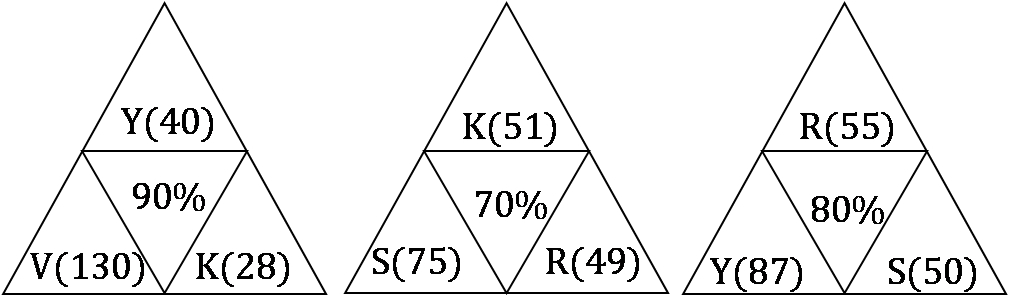
Which of the players had the best M-index from the tournament?
Passage / Data
Answer the following question based on the information given below.
Coach John sat with the score cards of Indian players from the 3 games in a one-day cricket tournament where the same set of players played for India and all the major batsmen got out. John summarized the batting performance through three diagrams, one for each game. In each diagram, the three outer triangles communicate the number of runs scored by the three top scorers from India, where K, R, S, V, and Y represent Kaif, Rahul, Saurav, Virender, and Yuvraj respectively. The middle triangle in each diagram denotes the percentage of total score that was scored by the top three Indian scorers in that game. No two players score the same number of runs in the same game. John also calculated two batting indices for each player based on his scores in the tournament; the R-index of a batsman is the difference between his highest and lowest scores in the 3 games while the M-index is the middle number, if his scores are arranged in a non-increasing order
Among the players mentioned, who can have the lowest R-index from the tournament?
Passage / Data
Answer the following question based on the information given below.
Coach John sat with the score cards of Indian players from the 3 games in a one-day cricket tournament where the same set of players played for India and all the major batsmen got out. John summarized the batting performance through three diagrams, one for each game. In each diagram, the three outer triangles communicate the number of runs scored by the three top scorers from India, where K, R, S, V, and Y represent Kaif, Rahul, Saurav, Virender, and Yuvraj respectively. The middle triangle in each diagram denotes the percentage of total score that was scored by the top three Indian scorers in that game. No two players score the same number of runs in the same game. John also calculated two batting indices for each player based on his scores in the tournament; the R-index of a batsman is the difference between his highest and lowest scores in the 3 games while the M-index is the middle number, if his scores are arranged in a non-increasing order
For how many Indian players is it possible to calculate the exact M-index?
Passage / Data
Answer the following question based on the information given below.
Coach John sat with the score cards of Indian players from the 3 games in a one-day cricket tournament where the same set of players played for India and all the major batsmen got out. John summarized the batting performance through three diagrams, one for each game. In each diagram, the three outer triangles communicate the number of runs scored by the three top scorers from India, where K, R, S, V, and Y represent Kaif, Rahul, Saurav, Virender, and Yuvraj respectively. The middle triangle in each diagram denotes the percentage of total score that was scored by the top three Indian scorers in that game. No two players score the same number of runs in the same game. John also calculated two batting indices for each player based on his scores in the tournament; the R-index of a batsman is the difference between his highest and lowest scores in the 3 games while the M-index is the middle number, if his scores are arranged in a non-increasing order
How many players among those listed definitely scored less than Yuvraj in the tournament?
Passage / Data
Answer the following question based on the information given below.
A, B, C, D, E, and F are a group of friends. There are two housewives, one professor, one engineer, one accountant and one lawyer in the group. There are only two married couples in the group. The lawyer is married to D, who is a housewife. No woman in the group is either an engineer or an accountant. C, the accountant, is married to F, who is a professor. A is married to a housewife. E is not a housewife.
Which of the following is one of the married couples?
Passage / Data
Answer the following question based on the information given below.
A, B, C, D, E, and F are a group of friends. There are two housewives, one professor, one engineer, one accountant and one lawyer in the group. There are only two married couples in the group. The lawyer is married to D, who is a housewife. No woman in the group is either an engineer or an accountant. C, the accountant, is married to F, who is a professor. A is married to a housewife. E is not a housewife.
What is E's profession?
Passage / Data
Answer the following question based on the information given below.
A, B, C, D, E, and F are a group of friends. There are two housewives, one professor, one engineer, one accountant and one lawyer in the group. There are only two married couples in the group. The lawyer is married to D, who is a housewife. No woman in the group is either an engineer or an accountant. C, the accountant, is married to F, who is a professor. A is married to a housewife. E is not a housewife.
How many members of the group are males?
Passage / Data
Answer the following question based on the information given below.
The Head of a newly formed government desires to appoint five of the six elected members A, B, C, D, E and F to portfolios of Home, Power, Defence, Telecom and Finance. F does not want any portfolio if D gets one of the five. C wants either Home or Finance or no portfolio. B says that if D gets either Power or Telecom then she must get the other one. E insists on a portfolio if A gets one.
Which is a valid assignment?
Passage / Data
Answer the following question based on the information given below.
The Head of a newly formed government desires to appoint five of the six elected members A, B, C, D, E and F to portfolios of Home, Power, Defence, Telecom and Finance. F does not want any portfolio if D gets one of the five. C wants either Home or Finance or no portfolio. B says that if D gets either Power or Telecom then she must get the other one. E insists on a portfolio if A gets one.
If A gets Home and C gets Finance, then which is NOT a valid assignment for Defence and Telecom?
Passage / Data
Answer the following question based on the information given below.
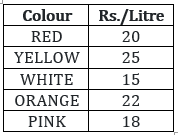
Rang Barsey Paint Company (RBPC) is in the business of manufacturing paints. RBPC buys RED, YELLOW, WHITE, ORANGE, and PINK paints. ORANGE paint can be also produced by mixing RED and YELLOW paints in equal proportions. Similarly, PINK paint can also be produced by mixing equal amounts of RED and WHITE paints. Among other paints, RBPC sells CREAM paint, (formed by mixing WHITE and YELLOW in the ratio 70 : 30) AVOCADO paint (formed by mixing equal amounts of ORANGE and PINK paint) and WASHEDORANGE paint (formed by mixing equal amounts of ORANGE and WHITE paint). The following table provides the price at which RBPC buys paints.
The cheapest way to manufacture AVOCADO paint would cost:
Passage / Data
Answer the following question based on the information given below.
Rang Barsey Paint Company (RBPC) is in the business of manufacturing paints. RBPC buys RED, YELLOW, WHITE, ORANGE, and PINK paints. ORANGE paint can be also produced by mixing RED and YELLOW paints in equal proportions. Similarly, PINK paint can also be produced by mixing equal amounts of RED and WHITE paints. Among other paints, RBPC sells CREAM paint, (formed by mixing WHITE and YELLOW in the ratio 70 : 30) AVOCADO paint (formed by mixing equal amounts of ORANGE and PINK paint) and WASHEDORANGE paint (formed by mixing equal amounts of ORANGE and WHITE paint). The following table provides the price at which RBPC buys paints.
WASHEDORANGE can be manufactured by mixing
Passage / Data
Answer the following question based on the information given below.
Rang Barsey Paint Company (RBPC) is in the business of manufacturing paints. RBPC buys RED, YELLOW, WHITE, ORANGE, and PINK paints. ORANGE paint can be also produced by mixing RED and YELLOW paints in equal proportions. Similarly, PINK paint can also be produced by mixing equal amounts of RED and WHITE paints. Among other paints, RBPC sells CREAM paint, (formed by mixing WHITE and YELLOW in the ratio 70 : 30) AVOCADO paint (formed by mixing equal amounts of ORANGE and PINK paint) and WASHEDORANGE paint (formed by mixing equal amounts of ORANGE and WHITE paint). The following table provides the price at which RBPC buys paints.
Assume that AVOCADO, CREAM, and WASHEDORANGE each sells for the same price. Which of the three is the most profitable to manufacture?
Passage / Data
Answer the following question based on the information given below.
Seven varsity basketball players (A, B, C, D, E, F, and G) are to be honoured at a special luncheon. The players will be seated on the dais in a row. A and G have to leave the luncheon early and so must be seated at the extreme right. B will receive the most valuable player's trophy and so must be in the centre to facilitate presentation. C and D are bitter rivals and therefore must be seated as far apart as possible.
Which of the following cannot be seated at either end?
Passage / Data
Answer the following question based on the information given below.
Seven varsity basketball players (A, B, C, D, E, F, and G) are to be honoured at a special luncheon. The players will be seated on the dais in a row. A and G have to leave the luncheon early and so must be seated at the extreme right. B will receive the most valuable player's trophy and so must be in the centre to facilitate presentation. C and D are bitter rivals and therefore must be seated as far apart as possible.
Which of the following pairs cannot be seated together?
Passage / Data
Answer the following question based on the information given below.
Seven varsity basketball players (A, B, C, D, E, F, and G) are to be honoured at a special luncheon. The players will be seated on the dais in a row. A and G have to leave the luncheon early and so must be seated at the extreme right. B will receive the most valuable player's trophy and so must be in the centre to facilitate presentation. C and D are bitter rivals and therefore must be seated as far apart as possible.
Which of the following pairs cannot occupy the seats on either side of B?
Passage / Data
Answer the following question based on the information given below.
Seven varsity basketball players (A, B, C, D, E, F, and G) are to be honoured at a special luncheon. The players will be seated on the dais in a row. A and G have to leave the luncheon early and so must be seated at the extreme right. B will receive the most valuable player's trophy and so must be in the centre to facilitate presentation. C and D are bitter rivals and therefore must be seated as far apart as possible.
In each question there are two statements: A and B.
Choose 1 if the question can be answered by one of the statements alone but not by the other.
Choose 2 if the question can be answered by using either statement alone.
Choose 3 if the question can be answered by using both the statements together but cannot be answered using either statement alone.
Choose 4 if the question cannot be answered even by using both the statements A and B.
F and M are father and mother of S, respectively. S has four uncles and three aunts. F has two siblings. The siblings of F and M are unmarried. How many brothers does M have?
A. F has two brothers.
B. M has five siblings.
Passage / Data
Answer the following question based on the information given below.
Some children were taking free throws at the basketball court in school during lunch break. Below are some facts about how many baskets these children shot.
i. Ganesh shot 8 baskets less than Ashish.
ii. Dhanraj and Ramesh together shot 37 baskets.
iii. Jugraj shot 8 baskets more than Dhanraj.
iv. Ashish shot 5 baskets more than Dhanraj.
v. Ashish and Ganesh together shot 40 baskets.
Which of the following statements is true?
Passage / Data
Answer the following question based on the information given below.
Some children were taking free throws at the basketball court in school during lunch break. Below are some facts about how many baskets these children shot.
i. Ganesh shot 8 baskets less than Ashish.
ii. Dhanraj and Ramesh together shot 37 baskets.
iii. Jugraj shot 8 baskets more than Dhanraj.
iv. Ashish shot 5 baskets more than Dhanraj.
v. Ashish and Ganesh together shot 40 baskets.
Which of the following statements is true?
Passage / Data
Answer the following question based on the information given below.
Five friends meet every morning at Sree Sagar restaurant for an idli-vada breakfast. Each consumes a different number of idlis and vadas. The number of idlis consumed are 1, 4, 5, 6, and 8, while the number of vadas consumed are 0, 1, 2, 4, and 6. Below are some more facts about who eats what and how much?
i. The number of vadas eaten by Ignesh is three times the number of vadas consumed by the person who eats four idlis.
ii. Three persons, including the one who eats four vadas, eat without chutney.
iii. Sandeep does not take any chutney.
iv. The one who eats one idli a day does not eat any vadas or chutney. Further, he is not Mukesh.
v. Daljit eats idli with chutney and also eats vada.
vi. Mukesh, who does not take chutney, eats half as many vadas as the person who eats twice as many idlis as he does.
vii. Bimal eats two more idlis than Ignesh, but Ignesh eats two more vadas than Bimal.
Which one of the following statements is true?
Passage / Data
Answer the following question based on the information given below.
Five friends meet every morning at Sree Sagar restaurant for an idli-vada breakfast. Each consumes a different number of idlis and vadas. The number of idlis consumed are 1, 4, 5, 6, and 8, while the number of vadas consumed are 0, 1, 2, 4, and 6. Below are some more facts about who eats what and how much?
i. The number of vadas eaten by Ignesh is three times the number of vadas consumed by the person who eats four idlis.
ii. Three persons, including the one who eats four vadas, eat without chutney.
iii. Sandeep does not take any chutney.
iv. The one who eats one idli a day does not eat any vadas or chutney. Further, he is not Mukesh.
v. Daljit eats idli with chutney and also eats vada.
vi. Mukesh, who does not take chutney, eats half as many vadas as the person who eats twice as many idlis as he does.
vii. Bimal eats two more idlis than Ignesh, but Ignesh eats two more vadas than Bimal.
Which of the following statements is true?
Passage / Data
Answer the following question based on the information given below.
Five friends meet every morning at Sree Sagar restaurant for an idli-vada breakfast. Each consumes a different number of idlis and vadas. The number of idlis consumed are 1, 4, 5, 6, and 8, while the number of vadas consumed are 0, 1, 2, 4, and 6. Below are some more facts about who eats what and how much?
i. The number of vadas eaten by Ignesh is three times the number of vadas consumed by the person who eats four idlis.
ii. Three persons, including the one who eats four vadas, eat without chutney.
iii. Sandeep does not take any chutney.
iv. The one who eats one idli a day does not eat any vadas or chutney. Further, he is not Mukesh.
v. Daljit eats idli with chutney and also eats vada.
vi. Mukesh, who does not take chutney, eats half as many vadas as the person who eats twice as many idlis as he does.
vii. Bimal eats two more idlis than Ignesh, but Ignesh eats two more vadas than Bimal.
Which of the following statements is true?
Passage / Data
Choose 1, if the question can be answered by using statement A alone but not by using B alone.
Choose 2, if the question can be answered by using statement B alone but not by using A alone.
Choose 3, if the question can be answered by using either statement alone.
Choose 4, if the question can be answered by using both the statements together but not by either statement.
In a cricket match, the ‘man of the match’ award is given to the player scoring the highest number of runs. In case of a tie, the player (out of those locked in the tie) who has taken the higher number of catches is chosen. Even thereafter if there is a tie, the player (out of those locked in the tie) who has dropped fewer catches is selected. Aakash, Biplab and Chirag who were contenders for the award dropped at least one catch each. Biplab dropped 2 catches more than Aakash did, scored 50, and took 2 catches. Chirag got two chances to catch and dropped both. Who was the ‘man of the match’?
A. Chirag made 15 runs less than both Aakash and Biplab.
B. The catches dropped by Biplab are 1 more than the catches taken by Aakash.
Passage / Data
Choose 1, if the question can be answered by using statement A alone but not by using B alone.
Choose 2, if the question can be answered by using statement B alone but not by using A alone.
Choose 3, if the question can be answered by using either statement alone.
Choose 4, if the question can be answered by using both the statements together but not by either statement.
Four friends, A, B, C and D got the top four ranks in a competitive examination, but A did not get the first, B did not get the second, C did not get the third, and D did not get the fourth rank. Who secured which rank?
A. Neither A nor D were among the first 2.
B. Neither B nor C was third or fourth.
Passage / Data
Choose 1, if the question can be answered by using statement A alone but not by using B alone.
Choose 2, if the question can be answered by using statement B alone but not by using A alone.
Choose 3, if the question can be answered by using either statement alone.
Choose 4, if the question can be answered by using both the statements together but not by either statement.
The members of a local club contributed equally to pay Rs.600 towards a donation. How much did each one pay?
A. If there had been five fewer members, each one would have paid an additional Rs.10.
B. There were at least 20 members in the club, and each one paid no more than Rs.30.
Passage / Data
Choose 1, if the question can be answered by using statement A alone but not by using B alone.
Choose 2, if the question can be answered by using statement B alone but not by using A alone.
Choose 3, if the question can be answered by using either statement alone.
Choose 4, if the question can be answered by using both the statements together but not by either statement.
A family has only one kid. The father says “after ‘n’ years, my age will be 4 times the age of my kid.” The mother says “after ‘n’ years, my age will be 3 times that of my kid.” What will be the combined ages of the parents after ‘n’ years?
A. The age difference between the parents is 10 years.
B. After ‘n’ years, the kid is going to be twice as old as she is now.
Passage / Data
Choose 1, if the question can be answered by using statement A alone but not by using B alone.
Choose 2, if the question can be answered by using statement B alone but not by using A alone.
Choose 3, if the question can be answered by using either statement alone.
Choose 4, if the question can be answered by using both the statements together but not by either statement.
70 percent of the employees in a multinational corporation have VCD players, 75 percent have microwave ovens, 80 percent have ACs and 85 percent have washing machines. At least what percentage of employees has all four gadgets?
Passage / Data
Answer the following question based on the information given below.
Four families decided to attend the marriage ceremony of one of their colleagues. One family has no kids, while the others have at least one kid each. Each family with kids has at least one kid attending the marriage. Given below is some information about the families, and who reached when to attend the marriage.
The family with 2 kids came just before the family with no kids.
Shanthi who does not have any kids reached just before Sridevi’s family.
Sunil and his wife reached last with their only kid.
Anil is not the husband of Joya.
Anil and Raj are fathers.
Sridevi’s and Anita’s daughters go to the same school.
Joya came before Shanthi and met Anita when she reached the venue.
Raman stays the farthest from the venue.
Raj said his son could not come because of his exams.
Which woman arrived third?
Passage / Data
Answer the following question based on the information given below.
Four families decided to attend the marriage ceremony of one of their colleagues. One family has no kids, while the others have at least one kid each. Each family with kids has at least one kid attending the marriage. Given below is some information about the families, and who reached when to attend the marriage.
The family with 2 kids came just before the family with no kids.
Shanthi who does not have any kids reached just before Sridevi’s family.
Sunil and his wife reached last with their only kid.
Anil is not the husband of Joya.
Anil and Raj are fathers.
Sridevi’s and Anita’s daughters go to the same school.
Joya came before Shanthi and met Anita when she reached the venue.
Raman stays the farthest from the venue.
Raj said his son could not come because of his exams.
Name the correct pair of husband and wife.
Passage / Data
Answer the following question based on the information given below.
Four families decided to attend the marriage ceremony of one of their colleagues. One family has no kids, while the others have at least one kid each. Each family with kids has at least one kid attending the marriage. Given below is some information about the families, and who reached when to attend the marriage.
The family with 2 kids came just before the family with no kids.
Shanthi who does not have any kids reached just before Sridevi’s family.
Sunil and his wife reached last with their only kid.
Anil is not the husband of Joya.
Anil and Raj are fathers.
Sridevi’s and Anita’s daughters go to the same school.
Joya came before Shanthi and met Anita when she reached the venue.
Raman stays the farthest from the venue.
Raj said his son could not come because of his exams.
Of the following pairs, whose daughters go to the same school?
Passage / Data
Answer the following question based on the information given below.
Four families decided to attend the marriage ceremony of one of their colleagues. One family has no kids, while the others have at least one kid each. Each family with kids has at least one kid attending the marriage. Given below is some information about the families, and who reached when to attend the marriage.
The family with 2 kids came just before the family with no kids.
Shanthi who does not have any kids reached just before Sridevi’s family.
Sunil and his wife reached last with their only kid.
Anil is not the husband of Joya.
Anil and Raj are fathers.
Sridevi’s and Anita’s daughters go to the same school.
Joya came before Shanthi and met Anita when she reached the venue.
Raman stays the farthest from the venue.
Raj said his son could not come because of his exams.
Whose family is known to have more than one kid for certain?
Passage / Data
Answer the following question based on the information given below.
Recently, the answers of a test held nationwide were leaked to a group of unscrupulous people. The investigative agency has arrested the mastermind and nine other people A, B, C, D, E, F, G, H and I in this matter. Interrogating them, the following facts have been obtained regarding their operation. Initially the mastermind obtains the correct answer-key. All the others create their answer-key from one or two people who already possess the same. These people are called his/her “sources”. If the person has two sources, then he/she compares the answer-keys obtained from both sources. If the key to a question from both sources is identical, it is copied, otherwise it is left blank. If the person has only one source, he/she copies the source’s answers into his/her copy. Finally, each person compulsorily replaces one of the answers (not a blank one) with a wrong answer in his/her answer key.
The paper contained 200 questions; so the investigative agency has ruled out the possibility of two or more of them introducing wrong answers to the same question. The investigative agency has a copy of the correct answer key and has tabulated the following data. These data represent question numbers.
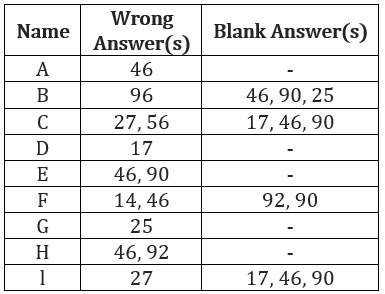
Which one among the following must have two sources?
Passage / Data
Answer the following question based on the information given below.
Recently, the answers of a test held nationwide were leaked to a group of unscrupulous people. The investigative agency has arrested the mastermind and nine other people A, B, C, D, E, F, G, H and I in this matter. Interrogating them, the following facts have been obtained regarding their operation. Initially the mastermind obtains the correct answer-key. All the others create their answer-key from one or two people who already possess the same. These people are called his/her “sources”. If the person has two sources, then he/she compares the answer-keys obtained from both sources. If the key to a question from both sources is identical, it is copied, otherwise it is left blank. If the person has only one source, he/she copies the source’s answers into his/her copy. Finally, each person compulsorily replaces one of the answers (not a blank one) with a wrong answer in his/her answer key.
The paper contained 200 questions; so the investigative agency has ruled out the possibility of two or more of them introducing wrong answers to the same question. The investigative agency has a copy of the correct answer key and has tabulated the following data. These data represent question numbers.
How many people (excluding the mastermind) needed to make answer keys before C could make his answer key?
Passage / Data
Answer the following question based on the information given below.
Recently, the answers of a test held nationwide were leaked to a group of unscrupulous people. The investigative agency has arrested the mastermind and nine other people A, B, C, D, E, F, G, H and I in this matter. Interrogating them, the following facts have been obtained regarding their operation. Initially the mastermind obtains the correct answer-key. All the others create their answer-key from one or two people who already possess the same. These people are called his/her “sources”. If the person has two sources, then he/she compares the answer-keys obtained from both sources. If the key to a question from both sources is identical, it is copied, otherwise it is left blank. If the person has only one source, he/she copies the source’s answers into his/her copy. Finally, each person compulsorily replaces one of the answers (not a blank one) with a wrong answer in his/her answer key.
The paper contained 200 questions; so the investigative agency has ruled out the possibility of two or more of them introducing wrong answers to the same question. The investigative agency has a copy of the correct answer key and has tabulated the following data. These data represent question numbers.
Both G and H were sources to:
Passage / Data
Answer the following question based on the information given below.
Recently, the answers of a test held nationwide were leaked to a group of unscrupulous people. The investigative agency has arrested the mastermind and nine other people A, B, C, D, E, F, G, H and I in this matter. Interrogating them, the following facts have been obtained regarding their operation. Initially the mastermind obtains the correct answer-key. All the others create their answer-key from one or two people who already possess the same. These people are called his/her “sources”. If the person has two sources, then he/she compares the answer-keys obtained from both sources. If the key to a question from both sources is identical, it is copied, otherwise it is left blank. If the person has only one source, he/she copies the source’s answers into his/her copy. Finally, each person compulsorily replaces one of the answers (not a blank one) with a wrong answer in his/her answer key.
The paper contained 200 questions; so the investigative agency has ruled out the possibility of two or more of them introducing wrong answers to the same question. The investigative agency has a copy of the correct answer key and has tabulated the following data. These data represent question numbers.
Which of the following statements is true?
Passage / Data
Answer the following question based on the information given below.
Recently, the answers of a test held nationwide were leaked to a group of unscrupulous people. The investigative agency has arrested the mastermind and nine other people A, B, C, D, E, F, G, H and I in this matter. Interrogating them, the following facts have been obtained regarding their operation. Initially the mastermind obtains the correct answer-key. All the others create their answer-key from one or two people who already possess the same. These people are called his/her “sources”. If the person has two sources, then he/she compares the answer-keys obtained from both sources. If the key to a question from both sources is identical, it is copied, otherwise it is left blank. If the person has only one source, he/she copies the source’s answers into his/her copy. Finally, each person compulsorily replaces one of the answers (not a blank one) with a wrong answer in his/her answer key.
The paper contained 200 questions; so the investigative agency has ruled out the possibility of two or more of them introducing wrong answers to the same question. The investigative agency has a copy of the correct answer key and has tabulated the following data. These data represent question numbers.
Which of the following two groups of people has identical sources?
(I) A, D and G
(II) E and H
Passage / Data
Answer the following question based on the information given below.
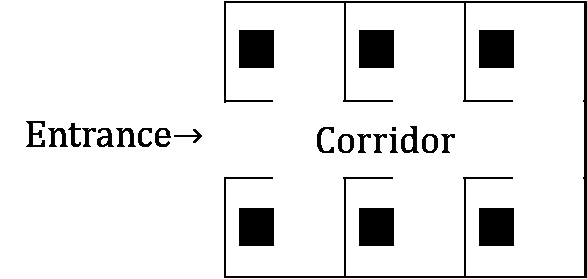
The plan above shows an office block for six officers, A, B, C, D, E and F. Both B and C occupy offices to the right of corridor (as one enters the office block) and A occupies an office to the left of the corridor. E and F occupy offices on opposite sides of the corridor but their offices do not face each other. The offices of C and D face each other. E does not have a corner office. F’s office is further down the corridor than A’s, but on the same side.
If E sits in his office and faces the corridor, whose office is to his left?
Passage / Data
Answer the following question based on the information given below.
The plan above shows an office block for six officers, A, B, C, D, E and F. Both B and C occupy offices to the right of corridor (as one enters the office block) and A occupies an office to the left of the corridor. E and F occupy offices on opposite sides of the corridor but their offices do not face each other. The offices of C and D face each other. E does not have a corner office. F’s office is further down the corridor than A’s, but on the same side.
Whose office faces A’s office?
Passage / Data
Answer the following question based on the information given below.
The plan above shows an office block for six officers, A, B, C, D, E and F. Both B and C occupy offices to the right of corridor (as one enters the office block) and A occupies an office to the left of the corridor. E and F occupy offices on opposite sides of the corridor but their offices do not face each other. The offices of C and D face each other. E does not have a corner office. F’s office is further down the corridor than A’s, but on the same side.
Who is/are F’s neighbour(s)?
Passage / Data
Answer the following question based on the information given below.
The plan above shows an office block for six officers, A, B, C, D, E and F. Both B and C occupy offices to the right of corridor (as one enters the office block) and A occupies an office to the left of the corridor. E and F occupy offices on opposite sides of the corridor but their offices do not face each other. The offices of C and D face each other. E does not have a corner office. F’s office is further down the corridor than A’s, but on the same side.
D was heard telling someone to go further down the corridor to the last office on the right. To whose room was he trying to direct that person?
Passage / Data
Answer the following question based on the information given below.
Seven faculty members at a management institute frequent a lounge for strong coffee and stimulating conversation. On being asked about their visit to the lounge last Friday we got the following responses.
JC : I came in first, and the next two persons to enter were SS and SM. When I left the lounge, JP and VR were present in the lounge. DG left with me.
JP : When I entered the lounge with VR, JC was sitting there. There was someone else, but I cannot remember who it was.
SM : I went to the lounge for a short while, and met JC, SS and DG in the lounge on that day.
SS : I left immediately after SM left.
DG : I met JC, SS, SM, JP and VR during my first visit to the lounge. I went back to my office with JC. When I went to the lounge the second time, JP and VR were there.
PK : I had some urgent work, so I did not sit in the lounge that day, but just collected my coffee and left. JP and DG were the only people in the lounge while I was there.
VR : No comments.
Based on the responses, which of the two JP or DG, entered the lounge first?
Passage / Data
Answer the following question based on the information given below.
Seven faculty members at a management institute frequent a lounge for strong coffee and stimulating conversation. On being asked about their visit to the lounge last Friday we got the following responses.
JC : I came in first, and the next two persons to enter were SS and SM. When I left the lounge, JP and VR were present in the lounge. DG left with me.
JP : When I entered the lounge with VR, JC was sitting there. There was someone else, but I cannot remember who it was.
SM : I went to the lounge for a short while, and met JC, SS and DG in the lounge on that day.
SS : I left immediately after SM left.
DG : I met JC, SS, SM, JP and VR during my first visit to the lounge. I went back to my office with JC. When I went to the lounge the second time, JP and VR were there.
PK : I had some urgent work, so I did not sit in the lounge that day, but just collected my coffee and left. JP and DG were the only people in the lounge while I was there.
VR : No comments.
Who was sitting with JC when JP entered the lounge?
Passage / Data
Answer the following question based on the information given below.
Seven faculty members at a management institute frequent a lounge for strong coffee and stimulating conversation. On being asked about their visit to the lounge last Friday we got the following responses.
JC : I came in first, and the next two persons to enter were SS and SM. When I left the lounge, JP and VR were present in the lounge. DG left with me.
JP : When I entered the lounge with VR, JC was sitting there. There was someone else, but I cannot remember who it was.
SM : I went to the lounge for a short while, and met JC, SS and DG in the lounge on that day.
SS : I left immediately after SM left.
DG : I met JC, SS, SM, JP and VR during my first visit to the lounge. I went back to my office with JC. When I went to the lounge the second time, JP and VR were there.
PK : I had some urgent work, so I did not sit in the lounge that day, but just collected my coffee and left. JP and DG were the only people in the lounge while I was there.
VR : No comments.
How many of the seven members did VR meet on Friday in the lounge?
Passage / Data
Answer the following question based on the information given below.
Seven faculty members at a management institute frequent a lounge for strong coffee and stimulating conversation. On being asked about their visit to the lounge last Friday we got the following responses.
JC : I came in first, and the next two persons to enter were SS and SM. When I left the lounge, JP and VR were present in the lounge. DG left with me.
JP : When I entered the lounge with VR, JC was sitting there. There was someone else, but I cannot remember who it was.
SM : I went to the lounge for a short while, and met JC, SS and DG in the lounge on that day.
SS : I left immediately after SM left.
DG : I met JC, SS, SM, JP and VR during my first visit to the lounge. I went back to my office with JC. When I went to the lounge the second time, JP and VR were there.
PK : I had some urgent work, so I did not sit in the lounge that day, but just collected my coffee and left. JP and DG were the only people in the lounge while I was there.
VR : No comments.
Who were the last two faculty members to leave the lounge?
Passage / Data
Answer the following question based on the information given below.
In a Decathlon, the events are 100m, 400m, 100m hurdles, 1500m, High jump, Pole vault, Long jump, Discus, Shot put and Javelin. The performance in the first four of these events is consolidated into Score 1, the next three into Score 2, and the last three into Score 3. Each such consolidation is obtained by giving appropriate positive weights to individual events. The final score is simply the total of these three scores. The athletes with the highest, second highest and the third highest final scores receive the gold, silver and bronze medals, respectively. The table given below gives the scores and performance of nineteen top athletes in this event.
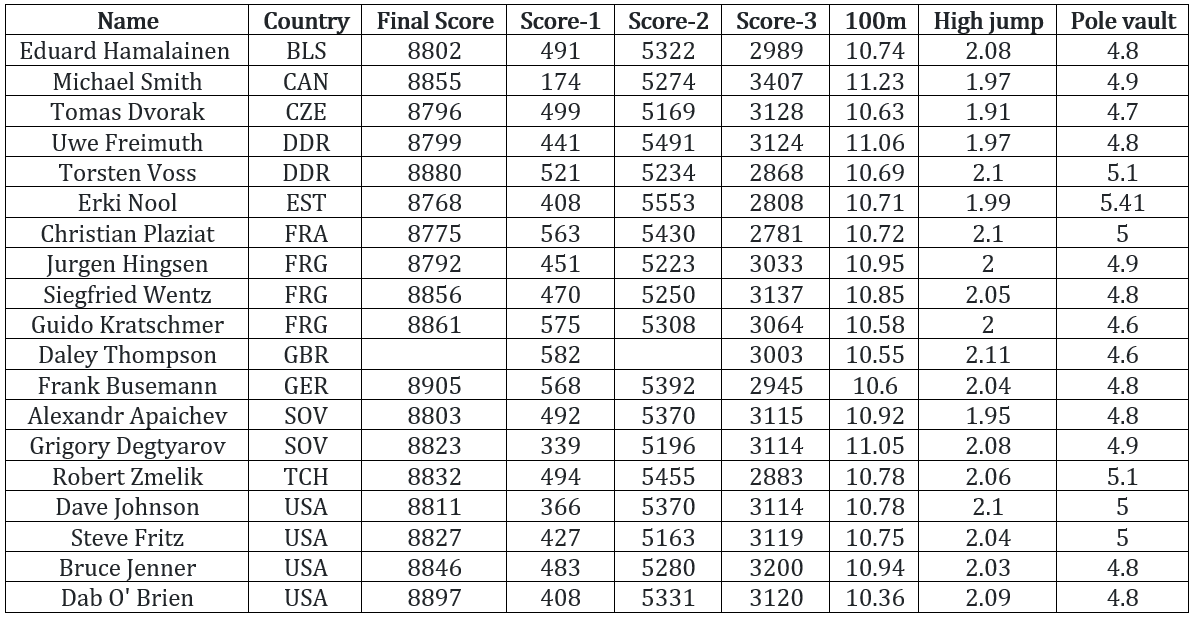
The athletes from FRG and USA decided to run a 4 × 100 m relay race for their respective countries with the country having three athletes borrowing the athlete from CZE. Assume that all the athletes ran their stretch of the relay race at the same speed as in Decathlon event. How much more time did the FRG relay team take as compared to the USA team?
Passage / Data
Answer the following question based on the information given below.
In a Decathlon, the events are 100m, 400m, 100m hurdles, 1500m, High jump, Pole vault, Long jump, Discus, Shot put and Javelin. The performance in the first four of these events is consolidated into Score 1, the next three into Score 2, and the last three into Score 3. Each such consolidation is obtained by giving appropriate positive weights to individual events. The final score is simply the total of these three scores. The athletes with the highest, second highest and the third highest final scores receive the gold, silver and bronze medals, respectively. The table given below gives the scores and performance of nineteen top athletes in this event.
What is the least that Daley Thompson must get in Score 2 that ensures him a bronze medal?
Passage / Data
Answer the following question based on the information given below.
In a Decathlon, the events are 100m, 400m, 100m hurdles, 1500m, High jump, Pole vault, Long jump, Discus, Shot put and Javelin. The performance in the first four of these events is consolidated into Score 1, the next three into Score 2, and the last three into Score 3. Each such consolidation is obtained by giving appropriate positive weights to individual events. The final score is simply the total of these three scores. The athletes with the highest, second highest and the third highest final scores receive the gold, silver and bronze medals, respectively. The table given below gives the scores and performance of nineteen top athletes in this event.
At least how many competitors (excluding Daley Thompson) must Michael Smith have out-jumped in the long jump event?
Passage / Data
Answer the following question based on the information given below.
The table below gives information about four different crops, their different quality categories and the regions where they are cultivated. Based on the information given in the table, answer the questions given below:
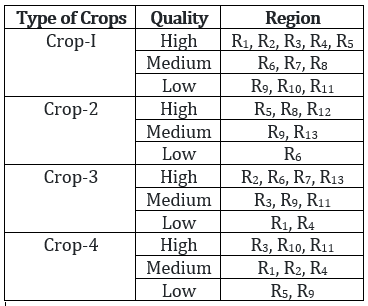
How many regions produce medium quality of Crop-1 or Crop-2 and also produce low quality of Crop-3 or Crop-4?
Passage / Data
Answer the following question based on the information given below.
The table below gives information about four different crops, their different quality categories and the regions where they are cultivated. Based on the information given in the table, answer the questions given below:
Which of the following statements is true?
Passage / Data
Answer the following question based on the information given below.
The table below gives information about four different crops, their different quality categories and the regions where they are cultivated. Based on the information given in the table, answer the questions given below:
How many low quality Crop-1 producing regions are either high quality Crop-4 producing regions or medium quality Crop-3 producing regions?
Passage / Data
Answer the following question based on the information given below.
There are 6 refineries, 7 depots, 9 districts. The refineries are BB, BC, BD, BE, BF, BG. The depots are AA, AB, AC, AD, AE, AF and AG and the districts are AAA, AAB, AAC, AAD, AAE, AAF, AAG, AAH, AAI.
Table A shows the cost of transporting one unit from refinery to depot.
Table B shows the cost of transporting one unit from depot to districts.
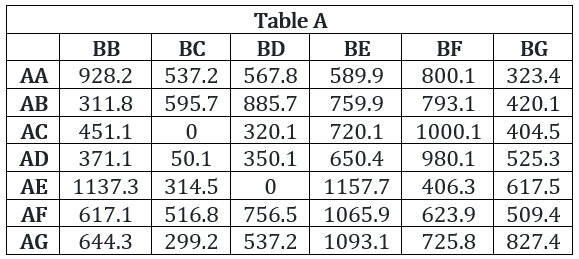
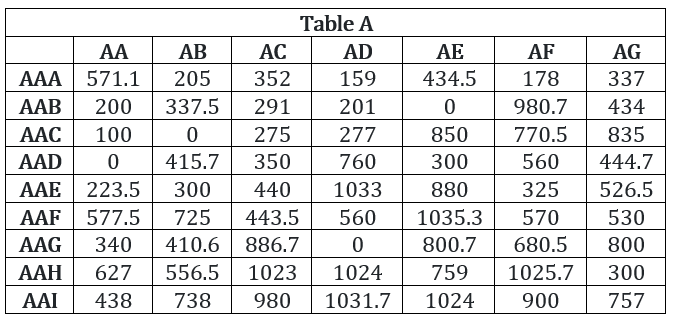
The minimum cost of sending one unit from any refinery to any district is:
Passage / Data
Answer the following question based on the information given below.
There are 6 refineries, 7 depots, 9 districts. The refineries are BB, BC, BD, BE, BF, BG. The depots are AA, AB, AC, AD, AE, AF and AG and the districts are AAA, AAB, AAC, AAD, AAE, AAF, AAG, AAH, AAI.
Table A shows the cost of transporting one unit from refinery to depot.
Table B shows the cost of transporting one unit from depot to districts.
How many possible ways are there for sending one unit from any refinery to any district?
Passage / Data
Answer the following question based on the information given below.
There are 6 refineries, 7 depots, 9 districts. The refineries are BB, BC, BD, BE, BF, BG. The depots are AA, AB, AC, AD, AE, AF and AG and the districts are AAA, AAB, AAC, AAD, AAE, AAF, AAG, AAH, AAI.
Table A shows the cost of transporting one unit from refinery to depot.
Table B shows the cost of transporting one unit from depot to districts.
The largest cost of sending one unit from any refinery to district is:
Passage / Data
Answer the following question based on the information given below.
There are 6 refineries, 7 depots, 9 districts. The refineries are BB, BC, BD, BE, BF, BG. The depots are AA, AB, AC, AD, AE, AF and AG and the districts are AAA, AAB, AAC, AAD, AAE, AAF, AAG, AAH, AAI.
Table A shows the cost of transporting one unit from refinery to depot.
Table B shows the cost of transporting one unit from depot to districts.
The minimum cost of transportation of one unit from refinery BD to any district is:
Passage / Data
Answer the following question based on the information given below.
There are 6 refineries, 7 depots, 9 districts. The refineries are BB, BC, BD, BE, BF, BG. The depots are AA, AB, AC, AD, AE, AF and AG and the districts are AAA, AAB, AAC, AAD, AAE, AAF, AAG, AAH, AAI.
Table A shows the cost of transporting one unit from refinery to depot.
Table B shows the cost of transporting one unit from depot to districts.
The minimum cost of transportation from any refinery to AAG district is:
Passage / Data
Answer the following question based on the information given below.
There are 6 refineries, 7 depots, 9 districts. The refineries are BB, BC, BD, BE, BF, BG. The depots are AA, AB, AC, AD, AE, AF and AG and the districts are AAA, AAB, AAC, AAD, AAE, AAF, AAG, AAH, AAI.
Table A shows the cost of transporting one unit from refinery to depot.
Table B shows the cost of transporting one unit from depot to districts.
The minimum cost of transportation from refinery BE to district AAA is:
Passage / Data
Answer the following question based on the information given below.
In a country, the following signals are applicable:
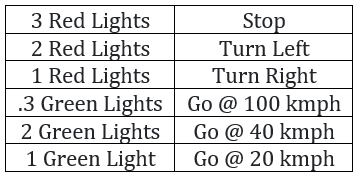
A man headed towards north and follows the given signals as:
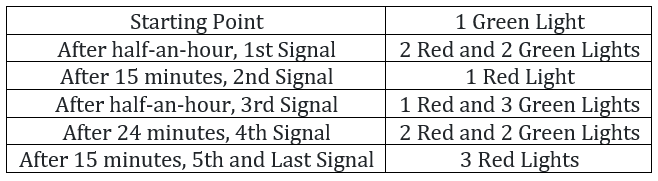
What is the total distance covered by the man till the last signal?
Passage / Data
Answer the following question based on the information given below.
In a country, the following signals are applicable:
A man headed towards north and follows the given signals as:
What is his net displacement with respect to the starting point?
Passage / Data
Answer the following question based on the information given below.
In a country, the following signals are applicable:
A man headed towards north and follows the given signals as:
If the first signal after the starting point, is 1 Red and 2 Green lights, then what is the total distance covered by the man till the last signal?
Passage / Data
Answer the following question based on the information given below.
In a country, the following signals are applicable:
A man headed towards north and follows the given signals as:
Instead of heading North, if the man was heading South, then by the end of the journey, he was
Passage / Data
Answer the following question based on the information given below.
A causes B or C, but not both.
F occurs only if B occurs.
D occurs if B or C occurs.
E occurs only if C occurs.
J occurs only if E or F occurs.
D causes G or H or both.
H occurs if E occurs.
G occurs if F occurs.
If A occurs, which may occur?
I. F and G
II. E and H
III. D
Passage / Data
Answer the following question based on the information given below.
A causes B or C, but not both.
F occurs only if B occurs.
D occurs if B or C occurs.
E occurs only if C occurs.
J occurs only if E or F occurs.
D causes G or H or both.
H occurs if E occurs.
G occurs if F occurs.
Which of these may occur as a result of a cause not mentioned?
Passage / Data
Answer the following question based on the information given below.
A causes B or C, but not both.
F occurs only if B occurs.
D occurs if B or C occurs.
E occurs only if C occurs.
J occurs only if E or F occurs.
D causes G or H or both.
H occurs if E occurs.
G occurs if F occurs.
There are six persons sitting around a round table. Pankaj is sitting left of Dayanand who is facing Kundan. Ranjan is sitting right of Dayanand. Yash is sitting left of Pankaj and Abhishek is sitting right of Ranjan. If Pankaj and Ranjan swap their positions and Yash and Abhishek also swap their positions, then who will be to left of Abhishek?
Passage / Data
Answer the following question based on the information given below.
The questions are based on the pie charts given below. Chart 1 shows the distribution of twelve million tons of crude oil transported through different modes over a specific period of time. Chart 2 shows the distribution of the cost of transporting this crude oil. The total cost was Rs. 30 million.
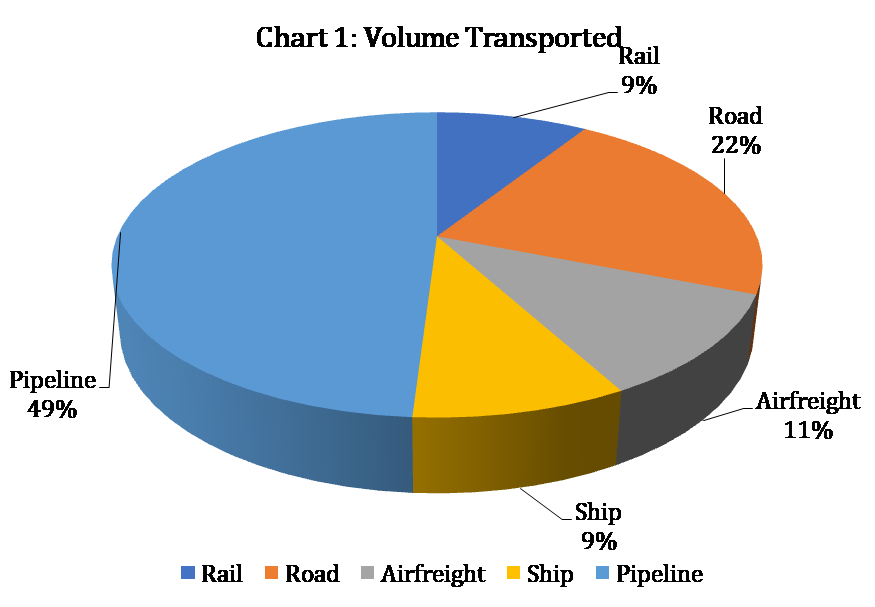
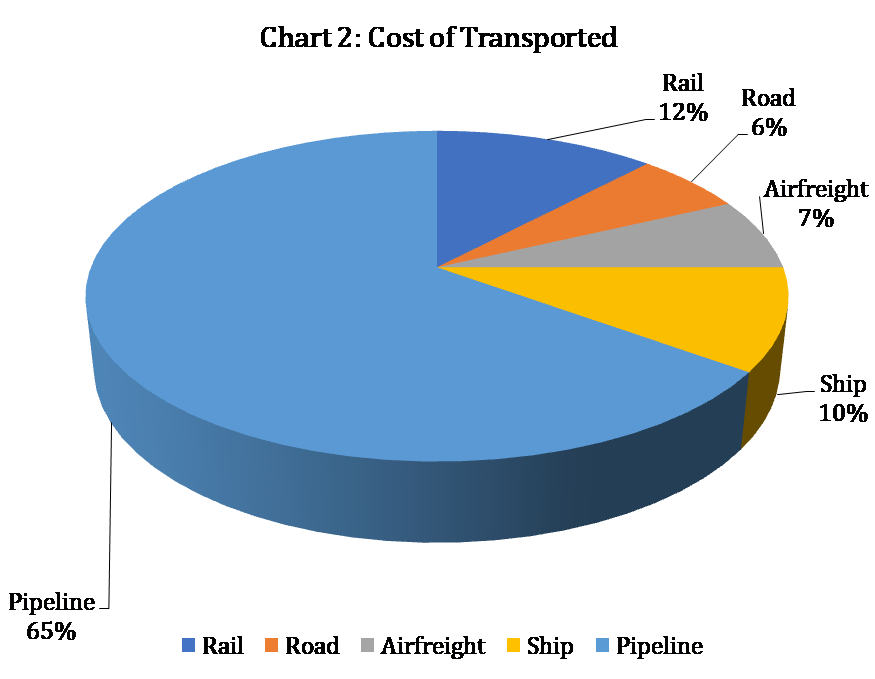
At a village mela, the following six nautankis (plays) are scheduled as shown in the table below. You wish to see all the six nautankis. Further, you wish to ensure that you get a lunch break from 12:30 p.m. to 1:30 p.m. In which of the following way can you do this?
Passage / Data
Answer the following question based on the information given below.
The questions are based on the pie charts given below. Chart 1 shows the distribution of twelve million tons of crude oil transported through different modes over a specific period of time. Chart 2 shows the distribution of the cost of transporting this crude oil. The total cost was Rs. 30 million.
Mrs. Ranga has three children and has difficulty remembering their ages and the months of their birth. The clues below may help her remember.
A. The boy, who was born in June, is 7 years old.
B. One of the children is 4 years old, but it is not Anshuman.
C. Vaibhav is older than Suprita.
D. One of the children was born in September, but it was not Vaibhav.
E. Suprita's birthday is in April.
F. The youngest child is only 2 years old.
Based on the above clues, which one of the following statements is true?
Passage / Data
Answer the following question based on the information given below.
The questions are based on the pie charts given below. Chart 1 shows the distribution of twelve million tons of crude oil transported through different modes over a specific period of time. Chart 2 shows the distribution of the cost of transporting this crude oil. The total cost was Rs. 30 million.
The Banerjees, the Sharmas, and the Pattabhiramans each have a tradition of eating Sunday lunch as a family. Each family serves a special meal at a certain time of day. Each family has a particular set of chinaware used only for this meal. Use the clues below to answer the following question.
A. The Sharma family eats at noon.
B. The family that serves fried brinjal uses blue chinaware.
C. The Banerjee family eats at 2 o'clock.
DThe family that serves sambar does not use red chinaware.
E. The family that eats at 1 o'clock serves fried brinjal.
F. The Pattabhiraman family does not use white chinaware.
G. The family that eats last likes makkai-ki-roti.
Which one of the following statements is true?
Passage / Data
Answer the following question based on the information given below.
The questions are based on the pie charts given below. Chart 1 shows the distribution of twelve million tons of crude oil transported through different modes over a specific period of time. Chart 2 shows the distribution of the cost of transporting this crude oil. The total cost was Rs. 30 million.
While Balbir had his back turned, a dog ran into his butcher shop, snatched a piece of meat off the counter and ran out. Balbir was mad when he realised what had happened. He asked three other shopkeepers, who had seen the dog, to describe it. The shopkeepers really didn't want to help Balbir. So each of them made a statement which contained one truth and one lie.
A. Shopkeeper Number 1 said: "The dog had black hair and a long tail."
B. Shopkeeper Number 2 said: "The dog has a short tail and wore a collar."
C. Shopkeeper Number 3 said: "The dog had white hair and no collar."
Based on the above statements, which of the following could be a correct description?
Passage / Data
Answer the following question based on the information given below.
Elle is three times older than Yogesh. Zaheer is half the age of Wahida. Yogesh is older than Zaheer.
Which of the following can be inferred?
Passage / Data
Answer the following question based on the information given below.
Elle is three times older than Yogesh. Zaheer is half the age of Wahida. Yogesh is older than Zaheer.
Which of the following information will be sufficient to estimate Elle's age?
Passage / Data
Answer the following question based on the information given below.
A group of three or four has to be selected from seven persons. Among are two women: Fiza and Kavita, and five men: Ram, Shyam, David, Peter and Rahim. Ram would not like to be in the group if Shyam is also selected. Shyam and Rahim want to be selected together in the group. Kavita would like to be in the group only if David is also there. David, if selected, would not like Peter in the group. Ram would like to be in the group only if Peter is also there. David insists that Fiza be selected in case he is there in the group.
Which of the following is a feasible group of three?
Passage / Data
Answer the following question based on the information given below.
A group of three or four has to be selected from seven persons. Among are two women: Fiza and Kavita, and five men: Ram, Shyam, David, Peter and Rahim. Ram would not like to be in the group if Shyam is also selected. Shyam and Rahim want to be selected together in the group. Kavita would like to be in the group only if David is also there. David, if selected, would not like Peter in the group. Ram would like to be in the group only if Peter is also there. David insists that Fiza be selected in case he is there in the group.
Which of the following is a feasible group of four?
Passage / Data
Answer the following question based on the information given below.
A group of three or four has to be selected from seven persons. Among are two women: Fiza and Kavita, and five men: Ram, Shyam, David, Peter and Rahim. Ram would not like to be in the group if Shyam is also selected. Shyam and Rahim want to be selected together in the group. Kavita would like to be in the group only if David is also there. David, if selected, would not like Peter in the group. Ram would like to be in the group only if Peter is also there. David insists that Fiza be selected in case he is there in the group.
Which of the following statements is true?
Passage / Data
Answer the following question based on the information given below.
A group of three or four has to be selected from seven persons. Among are two women: Fiza and Kavita, and five men: Ram, Shyam, David, Peter and Rahim. Ram would not like to be in the group if Shyam is also selected. Shyam and Rahim want to be selected together in the group. Kavita would like to be in the group only if David is also there. David, if selected, would not like Peter in the group. Ram would like to be in the group only if Peter is also there. David insists that Fiza be selected in case he is there in the group.
On her walk through the park, Hansa collected 50 coloured leaves, all either maple or oak. She sorted them by category when she got home, and found the following:
A. The number of red oak leaves with spots is even and positive.
B. The number of red oak leaves without any spot equals the number of red maple leaves without spots.
C. All non-red oak leaves have spots, and there are five times as many of them as there are red spotted oak leaves.
D. There are no spotted maple leaves that are not red.
E. There are exactly 6 red spotted maple leaves.
F. There are exactly 22 maple leaves that are neither spotted nor red.
How many oak leaves did she collect?
Passage / Data
Answer the following question based on the information given below.
A group of three or four has to be selected from seven persons. Among are two women: Fiza and Kavita, and five men: Ram, Shyam, David, Peter and Rahim. Ram would not like to be in the group if Shyam is also selected. Shyam and Rahim want to be selected together in the group. Kavita would like to be in the group only if David is also there. David, if selected, would not like Peter in the group. Ram would like to be in the group only if Peter is also there. David insists that Fiza be selected in case he is there in the group.
Eight people carrying food baskets are going for a picnic on motorcycles. Their names A, B, C, D, E, F, G, and H. They have four motorcycles, M1, M2, M3 and M4 among them. They also have four food baskets O, P, Q and R of different sizes and shapes and each can be carried only on motorcycles M1, M2, M3, or M4, respectively. No more than two persons can travel on a motorcycle and no more than one basket can be carried on a motorcycle. There are two husband-wife pairs in this group of eight people and each pair will ride on a motorcycle together. C cannot travel with A or B. E cannot travel with B or F. G cannot travel with F or H or D. The husband-wife pairs must carry baskets O and P. Q is with A and P is with D. F travels on M1 and E travels on M2 motorcycles. G is with Q, and B cannot go with R. Who is travelling with H?
Passage / Data
Answer the following question based on the information given below.
A group of three or four has to be selected from seven persons. Among are two women: Fiza and Kavita, and five men: Ram, Shyam, David, Peter and Rahim. Ram would not like to be in the group if Shyam is also selected. Shyam and Rahim want to be selected together in the group. Kavita would like to be in the group only if David is also there. David, if selected, would not like Peter in the group. Ram would like to be in the group only if Peter is also there. David insists that Fiza be selected in case he is there in the group.
In a family gathering there are two males who are grandfathers and four males who are fathers. In the same gathering there are two females who are grandmothers and four females who are mothers. There is at least one grandson or a granddaughter present in this gathering. There are two husband-wife pairs in this group. These can either be a grandfather and a grandmother, or a father and a mother. The single grandfather (who wife is not present) has two grandsons and a son present. The single grandmother (whose husband is not present) has two granddaughters and a daughter present. A grandfather or a grandmother present with their spouses does not have any grandson or granddaughter present. What is the minimum number of people present in this gathering?
Passage / Data
Answer the following question based on the information given below.
A group of three or four has to be selected from seven persons. Among are two women: Fiza and Kavita, and five men: Ram, Shyam, David, Peter and Rahim. Ram would not like to be in the group if Shyam is also selected. Shyam and Rahim want to be selected together in the group. Kavita would like to be in the group only if David is also there. David, if selected, would not like Peter in the group. Ram would like to be in the group only if Peter is also there. David insists that Fiza be selected in case he is there in the group.
I have a total of Rs. 1,000. Item A costs Rs. 110, item B costs Rs. 90, item C costs Rs. 70, item D costs Rs. 40 and item E costs Rs. 45. For every item D that I purchase, I must also buy two of item B. For every item A, I must buy one of item C. For every item E, I must also buy two of item D and one of item B. For every item purchased I earn 1000 points and for every rupee not spent I earn a penalty of 1500 points. My objective is to maximise to points I earn. What is the number of items that I must purchase to maximise my points?
Passage / Data
Answer the following question based on the information given below.
A group of three or four has to be selected from seven persons. Among are two women: Fiza and Kavita, and five men: Ram, Shyam, David, Peter and Rahim. Ram would not like to be in the group if Shyam is also selected. Shyam and Rahim want to be selected together in the group. Kavita would like to be in the group only if David is also there. David, if selected, would not like Peter in the group. Ram would like to be in the group only if Peter is also there. David insists that Fiza be selected in case he is there in the group.
Four friends Ashok, Bashir, Chirag and Deepak are out shopping. Ashok has less money than three times the amount that Bashir has. Chirag has more money than Bashir. Deepak has an amount equal to the difference of amounts with Bashir and Chirag. Ashok has three times the money with Deepak. They each have to buy at least one shirt, or one shawl, or one sweater, or one jacket that are priced Rs. 200, Rs. 400, Rs. 600, and Rs. 1,000 a piece, respectively. Chirag borrows Rs. 300 from Ashok and buys a jacket. Bashir buys a sweater after borrowing Rs. 100 from Ashok and is left with no money. Ashok buys three shirts. What is the costliest item the Deepak could buy with his own money?
Passage / Data
Answer the following question based on the information given below.
A group of three or four has to be selected from seven persons. Among are two women: Fiza and Kavita, and five men: Ram, Shyam, David, Peter and Rahim. Ram would not like to be in the group if Shyam is also selected. Shyam and Rahim want to be selected together in the group. Kavita would like to be in the group only if David is also there. David, if selected, would not like Peter in the group. Ram would like to be in the group only if Peter is also there. David insists that Fiza be selected in case he is there in the group.
In a "keep-fit" gymnasium class there are fifteen females enrolled in a weight-loss program. They all have been grouped in any one of the five weight-groups W1, W2, W3, W4, or W5. One instructor is assigned to one weight-group only. Sonali, Shalini, Shubhra, and Shahira belong to the same weight-group. Sonali and Rupa are in one weight-group, Rupali and Renuka are also in one weight-group. Rupa, Radha, Renuka, Ruchika and Ritu belong to different weight-groups. Somya cannot be with Ritu, and Tara cannot be with Radha. Komal cannot be with Radha, Somya, or Ritu. Shahira is in W1 and Somya is in W4 with Ruchika. Sweta and Jyotika cannot be with Rupali, but are in a weight-group with total membership of four. No weight-group can have more than five or less than one member. Amita, Babita, Chandrika, Deepika, and Elina are instructors of weight-groups with membership sizes 5, 4, 3, 2 and 1, respectively. Who is the instructor of Radha?
Passage / Data
Answer the following question based on the information given below.
A group of three or four has to be selected from seven persons. Among are two women: Fiza and Kavita, and five men: Ram, Shyam, David, Peter and Rahim. Ram would not like to be in the group if Shyam is also selected. Shyam and Rahim want to be selected together in the group. Kavita would like to be in the group only if David is also there. David, if selected, would not like Peter in the group. Ram would like to be in the group only if Peter is also there. David insists that Fiza be selected in case he is there in the group.
A king has unflinching loyalty from eight of his ministers M1 to M8, but he has to select only four to make a cabinet committee. He decides to choose these four such that each selected person shares a liking with at least one of the other three selected. The selected persons must also hate one of the likings of any of the other three persons selected.
A. M1 likes fishing and smoking, but hates gambling.
B. M2 likes smoking and drinking, but hates fishing.
C. M3 likes gambling, but hates smoking.
D. M4 likes mountaineering, but hates drinking.
E. M5 likes drinking, but hates smoking and mountaineering.
F. M6 likes fishing, but hates smoking and mountaineering.
G. M7 likes gambling and mountaineering, but hates fishing.
H. M8 likes smoking and gambling, but hates mountaineering.
Who are the four people selected by the king?
Passage / Data
Answer the following question based on the information given below.
A and B are two sets (e.g. A = mothers, B = women). The elements that could belong to both the sets (e.g. women who are mothers) is given by the set C = A.B. The elements which could belong to either A or B, or both, is indicated by the set D = A ∪ B. A set that does not contain any elements is known as a null set, represented by Ï (for example, if none of the women in the set B is a mother, they C = A.B is a null set, or C = Ï).
Let 'V' signify the set of all vertebrates; 'M' the set of all mammals; 'D' dogs; 'F' fish; 'A' Alsatian and 'P', a dog named Pluto.
Given that X = M.D is such that X = D, which of the following is true?
Passage / Data
Answer the following question based on the information given below.
A and B are two sets (e.g. A = mothers, B = women). The elements that could belong to both the sets (e.g. women who are mothers) is given by the set C = A.B. The elements which could belong to either A or B, or both, is indicated by the set D = A ∪ B. A set that does not contain any elements is known as a null set, represented by Ï (for example, if none of the women in the set B is a mother, they C = A.B is a null set, or C = Ï).
Let 'V' signify the set of all vertebrates; 'M' the set of all mammals; 'D' dogs; 'F' fish; 'A' Alsatian and 'P', a dog named Pluto.
If Y = F. (D.V), is not a null set, it implies that
Passage / Data
Answer the following question based on the information given below.
A and B are two sets (e.g. A = mothers, B = women). The elements that could belong to both the sets (e.g. women who are mothers) is given by the set C = A.B. The elements which could belong to either A or B, or both, is indicated by the set D = A ∪ B. A set that does not contain any elements is known as a null set, represented by Ï (for example, if none of the women in the set B is a mother, they C = A.B is a null set, or C = Ï).
Let 'V' signify the set of all vertebrates; 'M' the set of all mammals; 'D' dogs; 'F' fish; 'A' Alsatian and 'P', a dog named Pluto.
If Z = (P.D) ∪ M, then
Passage / Data
Answer the following question based on the information given below.
A and B are two sets (e.g. A = mothers, B = women). The elements that could belong to both the sets (e.g. women who are mothers) is given by the set C = A.B. The elements which could belong to either A or B, or both, is indicated by the set D = A ∪ B. A set that does not contain any elements is known as a null set, represented by Ï (for example, if none of the women in the set B is a mother, they C = A.B is a null set, or C = Ï).
Let 'V' signify the set of all vertebrates; 'M' the set of all mammals; 'D' dogs; 'F' fish; 'A' Alsatian and 'P', a dog named Pluto.
If P.A = Ï and P ∪ A = D, then which of the following is true?
Passage / Data
Answer the following question based on the information given below.
A and B are two sets (e.g. A = mothers, B = women). The elements that could belong to both the sets (e.g. women who are mothers) is given by the set C = A.B. The elements which could belong to either A or B, or both, is indicated by the set D = A ∪ B. A set that does not contain any elements is known as a null set, represented by Ï (for example, if none of the women in the set B is a mother, they C = A.B is a null set, or C = Ï).
Let 'V' signify the set of all vertebrates; 'M' the set of all mammals; 'D' dogs; 'F' fish; 'A' Alsatian and 'P', a dog named Pluto.
If 09/12/2001 happens to be Sunday, then 09/12/1971 would have been a
Persons X, Y, Z and Q live in red, green, yellow or blue coloured houses placed in a sequence on a street. Z lives in a yellow house. The green house is adjacent to the blue house. X does not live adjacent to Z. The yellow house is in between the green and red houses. The colour of the house X lives in is
My bag can carry no more than ten books. I must carry at least one book each of management, mathematics, physics and fiction. Also, for every management book I carry I must carry two or more fiction books, and for every mathematics book I carry I must carry two or more physics books. I earn 4, 3, 2 and 1 points for each management, mathematics, physics and fiction book, respectively, I carry in my bag. I want to maximise the points I can earn by carrying the most appropriate combination of books in my bag. The maximum points that I can earn are
Five persons with names P, M, U, T and X live separately in any one of the following a palace, a hut, a fort, a house or a hotel. Each one likes two different colours from among the following blue, black, red, yellow and green. U likes red and blue. T likes black. The person living in a palace does not like black or blue. P likes blue and red. M likes yellow. X lives in a hotel. M lives in a
There are ten animals-two each of lion, panther, bison, bear, and deer in a zoo. The enclosures in the zoo are named X, Y, Z, P and Q and each enclosure is allotted to one of the following attendants Jack, Mohan, Shalini, Suman and Rita. Two animals of different species are housed in each enclosure. A lion and a deer cannot be together. A panther cannot be with either a deer or a bison. Suman attends to animals from among bison, deer, bear and panther only. Mohan attends to a lion and a panther. Jack does not attend to deer, lion or bison. X, Y and Z are allotted to Mohan, Jack and Rita respectively. X and Q enclosures have one animal of the same species. Z and P have the same pair of animals. The animals attended by Shalini are
Eighty kilograms (kg) of store material is to be transported to a location 10 km away. Any number of couriers can be used to transport the material can be packed in any number of units of 10, 20 or 40 kg. Courier charges are Rs. 10 per hour. Couriers travel at the speed of 10 km/hr if they are not carrying any load, at 5 km/hr if carrying 10 kg, at 2 km/hr if carrying 20 kg and at 1 km/hr if carrying 40 kg. A courier cannot carry more than 40 kg of load. The minimum cost at which 80 kg of store material can be transported will be
Passage / Data
Answer the following question based on the information given below.
ABC Ltd. produces widgets for which the demand is unlimited and they can sell all of their production. The graph below describes the monthly variable costs incurred by the company as a function of the quantity produced. In addition, operating the plant for one shift results in a fixed monthly cost of Rs. 800. Fixed monthly costs for second shift operation are estimated at Rs. 1200. Each shift operation provides capacity for producing 30 widgets per month.
Note : Average unit cost, AC = Total monthly costs/monthly production, and
Marginal cost, MC is the rate of change in total cost for unit change in quantity produced.
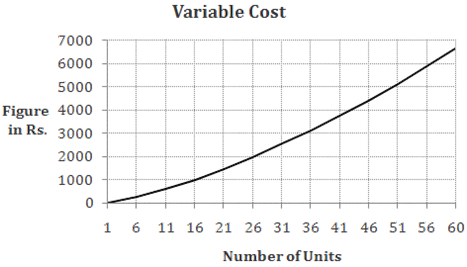
Choose 1; if the question can be answered by using one of the statements alone, but cannot be answered using the other statement alone.
Choose 2; if the question can be answered by using either statement alone.
Choose 3; if the question can be answered by using both statements together, but cannot be answered using either statement alone.
Choose 4; if the question cannot be answered even by using both statements together.
For any two real numbers
a ⊕ b = 1 if both a and b are positive or both a and b are negative.
= –1 if one of the two numbers a and b is positive and the other negative.
What is (2 ⊕ 0) ⊕ (–5 ⊕ –6)?
- a ⊕ b is zero if a is zero.
- a ⊕ b = b ⊕ a
Directions: Each question consists of five statements followed by options consisting of three statements put together in a specific order. Choose the option which indicates a valid argument, that is, where the third statement is a conclusion drawn from the preceding two statements.
Example:
A. All cigarettes are hazardous to health.
B. Brand X is a cigarette.
C. Brand X is hazardous to health.
Here, ABC is a valid option, where statement C can be concluded from statements A and B.
A. All software companies employ knowledge workers.
B. Tara Tech employs knowledge workers.
C. Tara Tech is a software company.
D. Some software companies employ knowledge workers.
E. Tara Tech employs only knowledge workers.
Directions: Each question consists of five statements followed by options consisting of three statements put together in a specific order. Choose the option which indicates a valid argument, that is, where the third statement is a conclusion drawn from the preceding two statements.
Example:
A. All cigarettes are hazardous to health.
B. Brand X is a cigarette.
C. Brand X is hazardous to health.
Here, ABC is a valid option, where statement C can be concluded from statements A and B.
A. Traffic congestion increases carbon monoxide in the environment.
B. Increase in carbon monoxide is hazardous to health.
C. Traffic congestion is hazardous to health.
D. Some traffic congestion does not cause increased carbon monoxide.
E. Some traffic congestion is not hazardous to health.
Directions: Each question consists of five statements followed by options consisting of three statements put together in a specific order. Choose the option which indicates a valid argument, that is, where the third statement is a conclusion drawn from the preceding two statements.
Example:
A. All cigarettes are hazardous to health.
B. Brand X is a cigarette.
C. Brand X is hazardous to health.
Here, ABC is a valid option, where statement C can be concluded from statements A and B.
A. Apples are not sweets.
B. Some apples are sweet.
C. All sweets are tasty.
D. Some apples are not tasty.
E. No apple is tasty.
Directions: Each question consists of five statements followed by options consisting of three statements put together in a specific order. Choose the option which indicates a valid argument, that is, where the third statement is a conclusion drawn from the preceding two statements.
Example:
A. All cigarettes are hazardous to health.
B. Brand X is a cigarette.
C. Brand X is hazardous to health.
Here, ABC is a valid option, where statement C can be concluded from statements A and B.
A. Some towns in India are polluted.
B. All polluted towns should be destroyed.
C. Town Meghana should be destroyed.
D. Town Meghana is polluted.
E. Some towns in India should be destroyed.
Directions: Each question consists of five statements followed by options consisting of three statements put together in a specific order. Choose the option which indicates a valid argument, that is, where the third statement is a conclusion drawn from the preceding two statements.
Example:
A. All cigarettes are hazardous to health.
B. Brand X is a cigarette.
C. Brand X is hazardous to health.
Here, ABC is a valid option, where statement C can be concluded from statements A and B.
A. No patriot is a criminal.
B. Bundledas is not a criminal.
C. Bundledas is a patriot.
D. Bogusdas is not a patriot.
E. Bogusdas is a criminal.
Directions: Each question consists of five statements followed by options consisting of three statements put together in a specific order. Choose the option which indicates a valid argument, that is, where the third statement is a conclusion drawn from the preceding two statements.
Example:
A. All cigarettes are hazardous to health.
B. Brand X is a cigarette.
C. Brand X is hazardous to health.
Here, ABC is a valid option, where statement C can be concluded from statements A and B.
A. Anteaters like ants.
B. Boys are anteaters.
C. Balaram is an anteater.
D. Balaram likes ants.
E. Balaram may eat ants.
Directions: Each question consists of five statements followed by options consisting of three statements put together in a specific order. Choose the option which indicates a valid argument, that is, where the third statement is a conclusion drawn from the preceding two statements.
Example:
A. All cigarettes are hazardous to health.
B. Brand X is a cigarette.
C. Brand X is hazardous to health.
Here, ABC is a valid option, where statement C can be concluded from statements A and B.
A. All actors are handsome.
B. Some actors are popular.
C. Ram is handsome.
D. Ram is a popular actor.
E. Some popular people are handsome.
Directions: Each question consists of five statements followed by options consisting of three statements put together in a specific order. Choose the option which indicates a valid argument, that is, where the third statement is a conclusion drawn from the preceding two statements.
Example:
A. All cigarettes are hazardous to health.
B. Brand X is a cigarette.
C. Brand X is hazardous to health.
Here, ABC is a valid option, where statement C can be concluded from statements A and B.
A. Modern industry is technology-driven.
B. BTI is a modern industry.
C. BTI is technology-driven.
D. BTI may be technology-driven
E. Technology driven industry is modern.
Directions: Each question consists of five statements followed by options consisting of three statements put together in a specific order. Choose the option which indicates a valid argument, that is, where the third statement is a conclusion drawn from the preceding two statements.
Example:
A. All cigarettes are hazardous to health.
B. Brand X is a cigarette.
C. Brand X is hazardous to health.
Here, ABC is a valid option, where statement C can be concluded from statements A and B.
A. All Golmal islanders are blue-coloured people.
B. Some smart people are not blue-coloured people.
C. Some babies are blue-coloured.
D. Some babies are smart.
E. Some smart people are not Golmal islanders.
Directions: Each question consists of five statements followed by options consisting of three statements put together in a specific order. Choose the option which indicates a valid argument, that is, where the third statement is a conclusion drawn from the preceding two statements.
Example:
A. All cigarettes are hazardous to health.
B. Brand X is a cigarette.
C. Brand X is hazardous to health.
Here, ABC is a valid option, where statement C can be concluded from statements A and B.
A. MBAs are in great demand.
B. Ram and Sita are in great demand.
C. Ram is in great demand.
D. Sita is in great demand.
E. Ram and Sita are MBAs.
Directions: Each question has a main statement followed by four statements labelled A, B, C and D. Choose the ordered pair of statements where the first statement implies the second, and the two statements are logically consistent with the main statement.
Either the orangutan is not angry, or he frowns upon the world.
A. The orangutan frowns upon the world.
B. The orangutan is not angry.
C. The orangutan does not frown upon the world.
D. The orangutan is angry.
Directions: Each question has a main statement followed by four statements labelled A, B, C and D. Choose the ordered pair of statements where the first statement implies the second, and the two statements are logically consistent with the main statement.
Either Ravana is a demon, or he is a hero.
A. Ravana is a hero.
B. Ravana is a demon.
C. Ravana is not a demon.
D. Ravana is not a hero.
Directions: Each question has a main statement followed by four statements labelled A, B, C and D. Choose the ordered pair of statements where the first statement implies the second, and the two statements are logically consistent with the main statement.
Whenever Rajeev uses the Internet, he dreams about spiders.
A. Rajeev did not dream about spiders.
B. Rajeev used the Internet.
C. Rajeev dreamt about spiders.
D. Rajeev did not use the Internet.
Directions: Each question has a main statement followed by four statements labelled A, B, C and D. Choose the ordered pair of statements where the first statement implies the second, and the two statements are logically consistent with the main statement.
If I talk to my professors, then I do not need to take a pill for headache.
A. I talked to my professors.
B. I did not need to take a pill for headache.
C. I needed to take a pill for headache.
D. I did not talk to my professors.
Directions: Each question has a set of four statements. Each statement has three segments. Choose the alternative where the third segment in the statement can be logically deduced using both the preceding two, but not just from one of them.
A. No cowboys laugh. Some who laugh are sphinxes. Some sphinxes are not cowboys.
B. All ghosts are florescent. Some ghost do not sing. Some singers are not florescent.
C. Cricketers indulge in swearing. Those who swear are hanged. Some who are hanged are not cricketers.
D. Some crazy people are pianists. All crazy people are whistlers. Some whistlers are pianists.
Directions: Each question has a set of four statements. Each statement has three segments. Choose the alternative where the third segment in the statement can be logically deduced using both the preceding two, but not just from one of them.
A. All good people are knights. All warriors are good people. All knights are warriors.
B. No footballers are ministers. All footballers are tough. Some ministers are players.
C. All pizzas are snacks. Some meals are pizzas. Some meals are snacks.
D. Some barkers are musk deer. All barkers are sloth bears. Some sloth bears are musk deer.
Directions: Each question has a set of four statements. Each statement has three segments. Choose the alternative where the third segment in the statement can be logically deduced using both the preceding two, but not just from one of them.
A. Dinosaurs are prehistoric creatures. Water-buffaloes are not dinosaurs. Water-buffaloes are not
prehistoric creatures.
B. All politicians are frank. No frank people are crocodiles. No crocodiles are politicians.
C. No diamond is quartz. No opal is quartz. Diamonds are opals.
D. All monkeys like bananas. Some GI Joes like bananas. Some GI Joes are monkeys.
Directions: Each question has a set of four statements. Each statement has three segments. Choose the alternative where the third segment in the statement can be logically deduced using both the preceding two, but not just from one of them.
A. All earthquakes cause havoc. Some landslides cause havoc. Some earthquakes cause landslides.
B. All glass things are transparent. Some curios are glass things. Some curios are transparent.
C. All clay objects are brittle. All XY are clay objects. Some XY are brittle.
D. No criminal is a patriot. Ram is not a patriot. Ram is a criminal.
Directions: Each question has a set of four statements. Each statement has three segments. Choose the alternative where the third segment in the statement can be logically deduced using both the preceding two, but not just from one of them.
A. MD is an actor. Some actors are pretty. MD is pretty.
B. Some men are cops. All cops are brave. Some brave people are cops.
C. All cops are brave. Some men are cops. Some men are brave.
D. All actors are pretty ; MD is not an actor ; MD is not pretty.
Directions: Each question has a set of four statements. Each statement has three segments. Choose the alternative where the third segment in the statement can be logically deduced using both the preceding two, but not just from one of them.
A. All IIMs are in India. No BIMs are in India. No IIMs are BIMs.
B. All IIMs are in India. No BIMs are in India. No BIMs are IIMs.
C. Some IIMs are not in India. Some BIMs are not in India. Some IIMs are BIMs.
D. Some IIMs are not in India. Some BIMs are not in India. Some BIMs are IIMs.
Directions: Each question has a set of four statements. Each statement has three segments. Choose the alternative where the third segment in the statement can be logically deduced using both the preceding two, but not just from one of them.
A. Citizens of Yes Islands speak only the truth. Citizens of Yes Islands are young people. Young people speak only the truth.
B. Citizens of Yes Islands speak only the truth. Some Yes Islands are in Atlantic. Some citizens of Yes Islands are in the Atlantic.
C. Citizens of Yes Islands speak only the truth. Some young people are citizens of Yes Islands. Some young people speak only the truth.
D. Some people speak only the truth. Some citizens of Yes Islands speak only the truth. Some people who speak only the truth are citizens of Yes Islands.
Directions: Each question has a set of four statements. Each statement has three segments. Choose the alternative where the third segment in the statement can be logically deduced using both the preceding two, but not just from one of them.
A. All mammals are viviparous. Some fish are viviparous. Some fish are mammals.
B. All birds are oviparous. Some fish are not oviparous. Some fish are birds.
C. No mammal is oviparous. Some creatures are oviparous and some are not. Some creatures are not mammals.
D. Some creatures are mammals. Some creatures are viviparous. Some mammals are viviparous.
Directions: Each question has a set of four statements. Each statement has three segments. Choose the alternative where the third segment in the statement can be logically deduced using both the preceding two, but not just from one of them.
A. Many singers are not writers. All poets are singers. Some poets are not writers.
B. Giants climb beanstalks. Some chicken do not climb beanstalks. Some chicken are not giants.
C. All explorers live in snowdrifts. Some penguins live in snowdrifts. Some penguins are explorers.
D. Amar is taller than Akbar. Anthony is shorter than Amar. Akbar is shorter than Anthony.
Directions: Each question has a set of four statements. Each statement has three segments. Choose the alternative where the third segment in the statement can be logically deduced using both the preceding two, but not just from one of them.
A. A few farmers are rocket scientists. Some rocket scientists catch snakes. A few farmers catch snakes.
B. Poonam is a kangaroo. Some kangaroos are made of teak. Poonam is made of teak.
C. No bulls eat grass. All matadors eat grass. No matadors are bulls.
D. Some skunks drive Cadillacs. All skunks are polar bears. Some polar bears drive Cadillacs.
Passage / Data
Directions: Answer the questions based on the following information.
Ten coins are distributed among four people P, Q, R and S such that one of them gets one coin, another gets two coins, the third gets three coins and the fourth gets four coins. It is known that Q gets more coins than P, and S gets fewer coins than R.
If the number of coins distributed to Q is twice the number distributed to P, then which one of the following is necessarily true?
Passage / Data
Directions: Answer the questions based on the following information.
Ten coins are distributed among four people P, Q, R and S such that one of them gets one coin, another gets two coins, the third gets three coins and the fourth gets four coins. It is known that Q gets more coins than P, and S gets fewer coins than R.
If R gets at least two more coins than S, then which one of the following is necessarily true?
Passage / Data
Directions: Answer the questions based on the following information.
Ten coins are distributed among four people P, Q, R and S such that one of them gets one coin, another gets two coins, the third gets three coins and the fourth gets four coins. It is known that Q gets more coins than P, and S gets fewer coins than R.
If Q gets fewer coins than R, then which one of the following is not necessarily true?
Passage / Data
Directions: Answer the questions based on the following information.
A, B, C, D, E and F are a group of friends from a club. There are two housewives, one lecturer, one architect, one accountant and one lawyer in the group. There are two married couples in the group. The lawyer is married to D who is a housewife. No lady in the group is either an architect or an accountant. C, the accountant, is married to F who is a lecturer. A is married to D and E is not a housewife.
What is the profession of E?
Passage / Data
Directions: Answer the questions based on the following information.
A, B, C, D, E and F are a group of friends from a club. There are two housewives, one lecturer, one architect, one accountant and one lawyer in the group. There are two married couples in the group. The lawyer is married to D who is a housewife. No lady in the group is either an architect or an accountant. C, the accountant, is married to F who is a lecturer. A is married to D and E is not a housewife.
How many members of the group are male?
Passage / Data
Direction : Answer the questions based on the following information.
Seven university cricket players are to be honoured at a special luncheon. The players will be seated on the dais along one side of a single rectangular table.
I. A and G have to leave the luncheon early and must be seated at the extreme right end of the table, which is closest to the exit.
II. B will receive the Man of the Match Award and must be in the centre chair.
III. C and D who are bitter rivals for the position of wicketkeeper, dislike one another and should be seated as far apart as possible.
IV. E and F are best friends and want to sit together.
Which of the following may not be seated at either end of the table?
Passage / Data
Direction : Answer the questions based on the following information.
Seven university cricket players are to be honoured at a special luncheon. The players will be seated on the dais along one side of a single rectangular table.
I. A and G have to leave the luncheon early and must be seated at the extreme right end of the table, which is closest to the exit.
II. B will receive the Man of the Match Award and must be in the centre chair.
III. C and D who are bitter rivals for the position of wicketkeeper, dislike one another and should be seated as far apart as possible.
IV. E and F are best friends and want to sit together.
Which of the following pairs may not be seated together?
Passage / Data
Direction : Answer the questions based on the following information.
Seven university cricket players are to be honoured at a special luncheon. The players will be seated on the dais along one side of a single rectangular table.
I. A and G have to leave the luncheon early and must be seated at the extreme right end of the table, which is closest to the exit.
II. B will receive the Man of the Match Award and must be in the centre chair.
III. C and D who are bitter rivals for the position of wicketkeeper, dislike one another and should be seated as far apart as possible.
IV. E and F are best friends and want to sit together.
Which of the following may not be seated at either end of the table?
Passage / Data
Direction : Answer the questions based on the following information.
Seven university cricket players are to be honoured at a special luncheon. The players will be seated on the dais along one side of a single rectangular table.
I. A and G have to leave the luncheon early and must be seated at the extreme right end of the table, which is closest to the exit.
II. B will receive the Man of the Match Award and must be in the centre chair.
III. C and D who are bitter rivals for the position of wicketkeeper, dislike one another and should be seated as far apart as possible.
IV. E and F are best friends and want to sit together.
Abraham, Border, Charlie, Dennis and Elmer, and their respective wives recently dined together and were seated at a circular table. The seats were so arranged that men and women alternated and each woman was three places away from her husband. Mrs Charlie sat to the left of Mr Abraham. Mrs Elmer sat two places to the right of Mrs Border. Who sat to the right of Mr Abraham?
Direction: In the question below, the main statement is followed by four sentences. Select the pair of sentences that relates logically to the given statement.
Either Sita is sick or she is careless.
A. Sita is not sick.
B. Sita is not careless.
C. Sita is sick.
D. Sita is careless.
Direction: In the question below, the main statement is followed by four sentences. Select the pair of sentences that relates logically to the given statement.
Ram gets a swollen nose whenever he eats hamburgers.
A. Ram gets a swollen nose.
B. Ram does not eat hamburgers.
C. Ram does not get a swollen nose.
D. Ram eats hamburgers.
Direction: In the question below, the main statement is followed by four sentences. Select the pair of sentences that relates logically to the given statement.
Either the employees have no confidence in the management or they are hostile by nature.
A. They are not hostile by nature.
B. They are hostile by nature.
C. They have confidence in the management.
D. They have no confidence in the management.
Direction: In the question below, the main statement is followed by four sentences. Select the pair of sentences that relates logically to the given statement.
Whenever Ram reads late into the night, his father beats him.
A. His father does not beat Ram.
B. Ram reads late into the night.
C. Ram reads early in the morning.
D. Ram's father beats him in the morning.
Direction: In the question below, the main statement is followed by four sentences. Select the pair of sentences that relates logically to the given statement.
All irresponsible parents shout if their children do not cavort.
A. All irresponsible parents do not shout.
B. Children cavort.
C. Children do not cavort.
D. All irresponsible parents shout.
Direction: The question contains four arguments of three sentences each. Choose the set in which the third statement is a logical conclusion of the first two.
A. Some Xs are Ps. Some Ps are Ys. Some Xs are Ys.
B. All Sonas are bright. Some bright are crazy. Some Sonas are crazy.
C. No faith is strong. Only strong have biceps. No faith has biceps.
D. All men are weak. Some weak are strong. Some strong are weak.
Direction: The question contains four arguments of three sentences each. Choose the set in which the third statement is a logical conclusion of the first two.
A. Some icicles are cycles. All cycles are men. Some icicles are men.
B. All girls are teeth. No teeth is yellow. No girls are yellow.
C. No hand is foot. Some foot are heads. Some hands are heads.
D. Every man has a wife. All wives are devoted. No devoted has a husband.
Direction: The question contains four arguments of three sentences each. Choose the set in which the third statement is a logical conclusion of the first two.
A. No sun is not white. All moon is sun. All moon is white.
B. All windows are open. No open space is allocated. All window is closed space.
C. No German can fire. All Americans bombard. Both, Germans and Americans can fight.
D. No X is Z. No Z is Y. No X is Y.
Direction: The question contains four arguments of three sentences each. Choose the set in which the third statement is a logical conclusion of the first two.
A. All Ts are square. All squares are rectangular. All Ts are rectangular.
B. Some fat are elongated. Some elongated things are huge. Some fat are huge.
C. Idiots are bumblers. Bumblers fumble. Idiots fumble.
D. Water is good for health. Health foods are rare. Water is rare.
Passage / Data
Direction: Answer the questions based on the following information.
Mr Bankatlal acted as a judge for the beauty contest. There were four participants, viz. Ms Andhra Pradesh, Ms Uttar Pradesh, Ms West Bengal and Ms Maharashtra. Mrs Bankatlal, who was very anxious about the result, asked him about it as soon as he was back home. Mr Bankatlal just told that the one who was wearing the yellow saree won the contest. When Mrs Bankatlal pressed for further details, he elaborated as follows:
- All of them were sitting in a row.
- All of them wore sarees of different colours, viz. green, yellow, white, red.
- There was only one runner-up and she was sitting beside Ms. Maharashtra.
- The runner-up was wearing the green saree.
- Ms West Bengal was not sitting at the ends and was not the runner up.
- The winner and the runner-up are not sitting adjacent to each other.
- Ms Maharashtra was wearing white saree.
- Ms Andhra Pradesh was not wearing the green saree.
- Participants wearing yellow saree and white saree were at the ends.
Who wore the red saree?
Passage / Data
Direction: Answer the questions based on the following information.
Mr Bankatlal acted as a judge for the beauty contest. There were four participants, viz. Ms Andhra Pradesh, Ms Uttar Pradesh, Ms West Bengal and Ms Maharashtra. Mrs Bankatlal, who was very anxious about the result, asked him about it as soon as he was back home. Mr Bankatlal just told that the one who was wearing the yellow saree won the contest. When Mrs Bankatlal pressed for further details, he elaborated as follows:
- All of them were sitting in a row.
- All of them wore sarees of different colours, viz. green, yellow, white, red.
- There was only one runner-up and she was sitting beside Ms. Maharashtra.
- The runner-up was wearing the green saree.
- Ms West Bengal was not sitting at the ends and was not the runner up.
- The winner and the runner-up are not sitting adjacent to each other.
- Ms Maharashtra was wearing white saree.
- Ms Andhra Pradesh was not wearing the green saree.
- Participants wearing yellow saree and white saree were at the ends.
Ms. West Bengal was sitting adjacent to
Passage / Data
Direction: Answer the questions based on the following information.
Mr Bankatlal acted as a judge for the beauty contest. There were four participants, viz. Ms Andhra Pradesh, Ms Uttar Pradesh, Ms West Bengal and Ms Maharashtra. Mrs Bankatlal, who was very anxious about the result, asked him about it as soon as he was back home. Mr Bankatlal just told that the one who was wearing the yellow saree won the contest. When Mrs Bankatlal pressed for further details, he elaborated as follows:
- All of them were sitting in a row.
- All of them wore sarees of different colours, viz. green, yellow, white, red.
- There was only one runner-up and she was sitting beside Ms. Maharashtra.
- The runner-up was wearing the green saree.
- Ms West Bengal was not sitting at the ends and was not the runner up.
- The winner and the runner-up are not sitting adjacent to each other.
- Ms Maharashtra was wearing white saree.
- Ms Andhra Pradesh was not wearing the green saree.
- Participants wearing yellow saree and white saree were at the ends.
Which saree was worn by Ms Andhra Pradesh?
Passage / Data
Direction: Answer the questions based on the following information.
Mr Bankatlal acted as a judge for the beauty contest. There were four participants, viz. Ms Andhra Pradesh, Ms Uttar Pradesh, Ms West Bengal and Ms Maharashtra. Mrs Bankatlal, who was very anxious about the result, asked him about it as soon as he was back home. Mr Bankatlal just told that the one who was wearing the yellow saree won the contest. When Mrs Bankatlal pressed for further details, he elaborated as follows:
- All of them were sitting in a row.
- All of them wore sarees of different colours, viz. green, yellow, white, red.
- There was only one runner-up and she was sitting beside Ms. Maharashtra.
- The runner-up was wearing the green saree.
- Ms West Bengal was not sitting at the ends and was not the runner up.
- The winner and the runner-up are not sitting adjacent to each other.
- Ms Maharashtra was wearing white saree.
- Ms Andhra Pradesh was not wearing the green saree.
- Participants wearing yellow saree and white saree were at the ends.
Who was the runner-up?
Passage / Data
Direction: Answer the question based on the following information.
The following operations are defined for real numbers.
a # b = a + b, if a and b both are positive else a # b = 1
a ∇ b = (a × b)a + b if a × b is positive else a ∇ b = 1.
Passage / Data
Direction: Answer the question based on the following information.
The following operations are defined for real numbers.
a # b = a + b, if a and b both are positive else a # b = 1
a ∇ b = (a × b)a + b if a × b is positive else a ∇ b = 1.
Passage / Data
Direction: Answer the question based on the following information.
The following operations are defined for real numbers.
a # b = a + b, if a and b both are positive else a # b = 1
a ∇ b = (a × b)a + b if a × b is positive else a ∇ b = 1.
then which of the following must be true?
Passage / Data
Direction: Answer the question based on the following information.
The following operations are defined for real numbers.
a # b = a + b, if a and b both are positive else a # b = 1
a ∇ b = (a × b)a + b if a × b is positive else a ∇ b = 1.
P, Q, R and S are four statements. Relation between these statements is as follows.
I. If P is true, then Q must be true.
II. If Q is true, then R must be true.
III. If S is true, then either Q is false or R is false.
Which of the following must be true?
Passage / Data
Direction: Answer the questions based on the following information.
A, B, C and D are to be seated in a row. But C and D cannot be together. Also B cannot be at the third place.
Which of the following must be false?
Passage / Data
Direction: Answer the questions based on the following information.
A, B, C and D are to be seated in a row. But C and D cannot be together. Also B cannot be at the third place.
If A is not at the third place, then which of the following options does C have?
Passage / Data
Direction: Answer the questions based on the following information.
A, B, C and D are to be seated in a row. But C and D cannot be together. Also B cannot be at the third place.
If A and B are together, then which of the following must be necessarily true?
Passage / Data
Direction: Answer the questions based on the following information.
Amar, Akbar and Anthony are three friends. Only three colours are available for their shirts, viz. red, green and blue. Amar does not wear red shirt. Akbar does not wear green shirt. Anthony does not wear blue shirt.
If Akbar and Anthony wear the same colour of shirts, then which of the following is not true?
Passage / Data
Direction: Answer the questions based on the following information.
Amar, Akbar and Anthony are three friends. Only three colours are available for their shirts, viz. red, green and blue. Amar does not wear red shirt. Akbar does not wear green shirt. Anthony does not wear blue shirt.
If two of them wear the same colour, then how many of the following must be false?
I. Amar wears blue and Akbar does not wear green
II. Amar does not wear blue and Akbar wears blue
III. Amar does not wear blue and Akbar does not wear blue
IV. Amar wears green, Akbar does not wear red, Anthony does not wear green
Direction: Each of the following questions contains six statements followed by four sets of combinations of three. You have to choose that set in which the third statement logically follows from the first two.
A. No bird is viviparous.
B. All mammals are viviparous.
C. Bats are viviparous.
D. No bat is a bird.
E. No bird is a mammal.
F. All bats are mammals.
Direction: Each of the following questions contains six statements followed by four sets of combinations of three. You have to choose that set in which the third statement logically follows from the first two.
A. No mother is a nurse.
B. Some nurses like to work.
C. No woman is a prude.
D. Some prude are nurses.
E. Some nurses are women.
F. All women like to work.
Direction: Each of the following questions contains six statements followed by four sets of combinations of three. You have to choose that set in which the third statement logically follows from the first two.
A. Oranges are sweet.
B. All oranges are apples.
C. Some sweet are apples.
D. Some oranges are apples.
E. All sweet are sour.
F. Some apples are sour.
Direction: Each of the following questions contains six statements followed by four sets of combinations of three. You have to choose that set in which the third statement logically follows from the first two.
A. Zens are Marutis.
B. Zens are fragile.
C. Marutis are fragile.
D. Opels are fragile.
E. Marutis are Opels.
F. Opels are stable.
Direction: Each of the following questions contains six statements followed by four sets of combinations of three. You have to choose that set in which the third statement logically follows from the first two.
A. Dogs sleep in the open.
B. Sheep sleep indoors.
C. Dogs are like sheep.
D. All indoors are sheep.
E. Some dogs are not sheep.
F. Some open are not sheep.
Direction: In each of the following sentences, the main statement is followed by four sentences each. Select a pair of sentences that relate logically to the given statement.
Either Sam is ill, or he is drunk.
A. Sam is ill.
B. Sam is not ill.
C. Sam is drunk.
D. Sam is not drunk.
Direction: In each of the following sentences, the main statement is followed by four sentences each. Select a pair of sentences that relate logically to the given statement.
Whenever Ram hears of a tragedy, he loses sleep.
A. Ram heard of a tragedy.
B. Ram did not hear of a tragedy.
C. Ram lost sleep.
D. Ram did not lose sleep.
Direction: In each of the following sentences, the main statement is followed by four sentences each. Select a pair of sentences that relate logically to the given statement.
Either the train is late, or it has derailed.
A. The train is late.
B. The train is not late.
C. The train is derailed.
D. The train is not derailed.
Direction: In each of the following sentences, the main statement is followed by four sentences each. Select a pair of sentences that relate logically to the given statement.
When I read a horror story I have a nightmare.
A. I read a story.
B. I did not read a horror story.
C. I did not have a nightmare.
D. I had a nightmare.
Direction: In each of the following sentences, the main statement is followed by four sentences each. Select a pair of sentences that relate logically to the given statement.
When I eat berries I get rashes.
A. I ate berries.
B. I did not get rashes.
C. I did not eat berries.
D. I got rashes.
Passage / Data
Direction: Answer the questions based on the following information.
The first table gives the percentage of students in MBA class, who sought employment in the areas of finance, marketing and software. The second table gives the average starting salaries of the students per month, (rupees in thousands) in these areas. The third table gives the number of students who passed out in each year.
First table
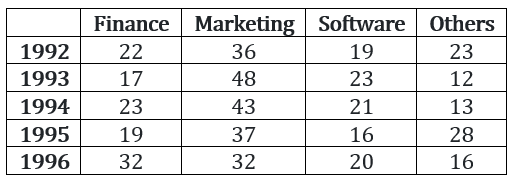
Second table
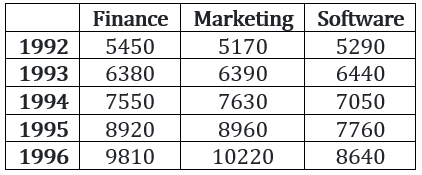
Third table
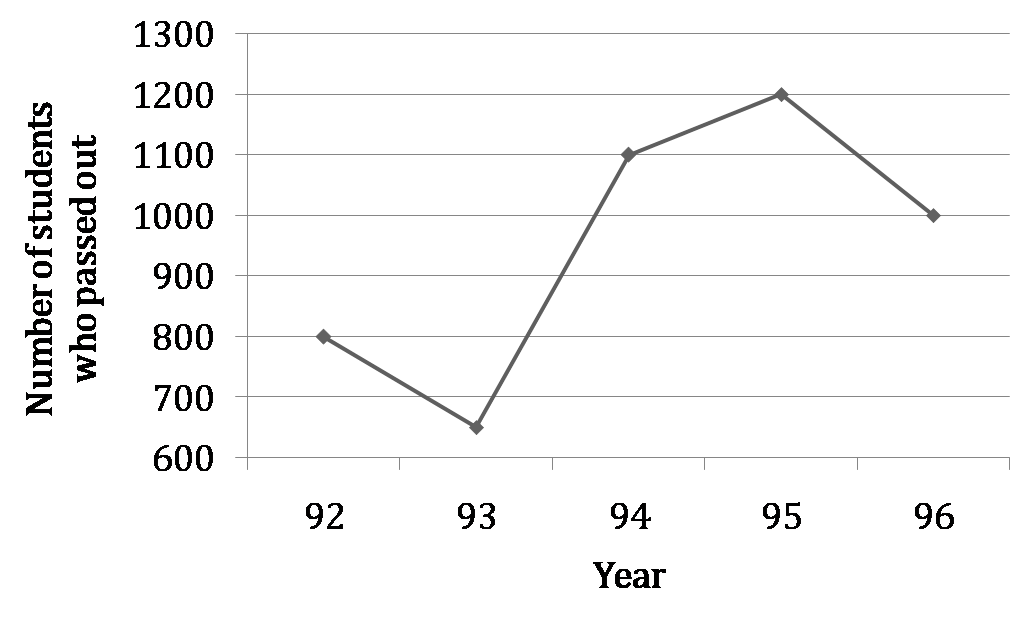
Direction: Given below are six statements followed by sets of three. You are to mark the option in which the statements are most logically related.
1. Some pins are made of tin
2. All tin is made of copper
3. All copper is used for pins
4. Some tin is copper
5. Some pins are used for tin
6. Some copper is used for tin
Passage / Data
Direction: Answer the questions based on the following information.
The first table gives the percentage of students in MBA class, who sought employment in the areas of finance, marketing and software. The second table gives the average starting salaries of the students per month, (rupees in thousands) in these areas. The third table gives the number of students who passed out in each year.
First table
Second table
Third table
Direction: Given below are six statements followed by sets of three. You are to mark the option in which the statements are most logically related.
1. An ostrich lays eggs
2. All birds lay eggs
3. Some birds can fly
4. An ostrich cannot fly
5. An ostrich is a bird
6. An ostrich cannot swim
Passage / Data
Direction: Answer the questions based on the following information.
The first table gives the percentage of students in MBA class, who sought employment in the areas of finance, marketing and software. The second table gives the average starting salaries of the students per month, (rupees in thousands) in these areas. The third table gives the number of students who passed out in each year.
First table
Second table
Third table
Direction: Given below are six statements followed by sets of three. You are to mark the option in which the statements are most logically related.
1. Some paper is wood
2. All wood is good
3. All that is good is wood
4. All wood is paper
5. All paper is good
6. Some paper is good
Passage / Data
Direction: Answer the questions based on the following information.
The first table gives the percentage of students in MBA class, who sought employment in the areas of finance, marketing and software. The second table gives the average starting salaries of the students per month, (rupees in thousands) in these areas. The third table gives the number of students who passed out in each year.
First table
Second table
Third table
Direction: Given below are six statements followed by sets of three. You are to mark the option in which the statements are most logically related.
1. All bricks are tricks
2. Some tricks are shrieks
3. Some that are shrieks are bricks
4. Some tricks are not bricks
5. All tricks are shrieks
6. No tricks are shrieks
Passage / Data
Direction: Answer the questions based on the following information.
The first table gives the percentage of students in MBA class, who sought employment in the areas of finance, marketing and software. The second table gives the average starting salaries of the students per month, (rupees in thousands) in these areas. The third table gives the number of students who passed out in each year.
First table
Second table
Third table
Direction: Given below are six statements followed by sets of three. You are to mark the option in which the statements are most logically related.
1. Some sand is band
2. All sandal is band
3. All band is sandal
4. No sand is sandal
5. No band is sand
6. Some band is sandal
Passage / Data
Direction: Answer the questions based on the following information.
The first table gives the percentage of students in MBA class, who sought employment in the areas of finance, marketing and software. The second table gives the average starting salaries of the students per month, (rupees in thousands) in these areas. The third table gives the number of students who passed out in each year.
First table
Second table
Third table
Direction: Given below are six statements followed by sets of three. You are to mark the option in which the statements are most logically related.
1. No wife is a life
2. All life is strife
3. Some wife is strife
4. All that is wife is life
5. All wife is strife
6. No wife is strife
Passage / Data
Direction: Answer the questions based on the following information.
The first table gives the percentage of students in MBA class, who sought employment in the areas of finance, marketing and software. The second table gives the average starting salaries of the students per month, (rupees in thousands) in these areas. The third table gives the number of students who passed out in each year.
First table
Second table
Third table
Direction: Given below are six statements followed by sets of three. You are to mark the option in which the statements are most logically related.
1. Some crows are flies
2. Some flies are mosquitoes
3. All mosquitoes are flies
4. Some owls are flies
5. All owls are mosquitoes
6. Some mosquitoes are not owls
Passage / Data
Direction: Answer the questions based on the following information.
The first table gives the percentage of students in MBA class, who sought employment in the areas of finance, marketing and software. The second table gives the average starting salaries of the students per month, (rupees in thousands) in these areas. The third table gives the number of students who passed out in each year.
First table
Second table
Third table
Direction: Given below are six statements followed by sets of three. You are to mark the option in which the statements are most logically related.
1. Six is five
2. Five is not four
3. Some five is ten
4. Some six is twelve
5. Some twelve is five
6. Some ten is four
Passage / Data
Direction: Answer the questions based on the following information.
The first table gives the percentage of students in MBA class, who sought employment in the areas of finance, marketing and software. The second table gives the average starting salaries of the students per month, (rupees in thousands) in these areas. The third table gives the number of students who passed out in each year.
First table
Second table
Third table
Direction: Given below are six statements followed by sets of three. You are to mark the option in which the statements are most logically related.
1. Poor girls want to marry rich boys
2. Rich girls want to marry rich boys
3. Poor girls want to marry rich girls
4. Rich boys want to marry rich girls
5. Poor girls want to marry rich girls
6. Rich boys want to marry poor girls
Passage / Data
Direction: Answer the questions based on the following information.
The first table gives the percentage of students in MBA class, who sought employment in the areas of finance, marketing and software. The second table gives the average starting salaries of the students per month, (rupees in thousands) in these areas. The third table gives the number of students who passed out in each year.
First table
Second table
Third table
A cube of side 12 cm is painted red on all the faces and then cut into smaller cubes, each of side 3 cm. What is the total number of smaller cubes having none of their faces painted?
Passage / Data
Direction: Answer the questions based on the following information.
The first table gives the percentage of students in MBA class, who sought employment in the areas of finance, marketing and software. The second table gives the average starting salaries of the students per month, (rupees in thousands) in these areas. The third table gives the number of students who passed out in each year.
First table
Second table
Third table
In a watch, the minute hand crosses the hour hand for the third time exactly after every 3 hr 18 min and 15 s of watch time. What is the time gained or lost by this watch in one day?
Six statements are given followed by four sets of combinations of three. You have to choose that set in which the statements are logically related.
1. Some bubbies are not dubbles
2. Some dubbles are not bubbles
3. Noone who is rubbles is dubbles
4. All dubbles are rubbles
5. Some dubbles are bubbles
6. Some who are rubbles are not bubbles
Six statements are given followed by four sets of combinations of three. You have to choose that set in which the statements are logically related.
1. Some men are bad
2. All men are sad
3. All bad things are men
4. All bad things are sad
5. Some sad things are men
6. Some sad things are bad
Six statements are given followed by four sets of combinations of three. You have to choose that set in which the statements are logically related.
1. All Toms are bright
2. No bright Toms are Dicks
3. Some Toms are Dicks
4. Some Dicks are bright
5. No Tom is a Dick
6. No Dick is a Tom
Six statements are given followed by four sets of combinations of three. You have to choose that set in which the statements are logically related.
1. All witches are nasty
2. Some devils are nasty
3. All witches are devils
4. All devils are nasty
5. Some nasty are devils
6. No witch is nasty
Six statements are given followed by four sets of combinations of three. You have to choose that set in which the statements are logically related.
1. No tingo is a bingo
2. All jingoes are bingoes
3. No jingo is a tingo
4. Some jingoes are not tingoes
5. Some tingoes are jingoes
6. Some bingoes are not tingoes
Passage / Data
Read the text and the numbered statements carefully and answer the questions given at the end.
Four people of different nationalities live on the same side of a street in four houses each of different color. Each person has a different favorite drink. The following additional information is also known:
- The Englishman lives in the red house.
- The Italian drinks tea.
- The Norwegian lives in the first house on the left.
- In the second house from the right they drink milk.
- The Norwegian lives adjacent to the blue house.
- The Spaniard drinks fruit juice.
- Tea is drunk in the blue house.
- The white house is to the right of the red house.
The color of the Norwegian’s house is
Passage / Data
Read the text and the numbered statements carefully and answer the questions given at the end.
Four people of different nationalities live on the same side of a street in four houses each of different color. Each person has a different favorite drink. The following additional information is also known:
- The Englishman lives in the red house.
- The Italian drinks tea.
- The Norwegian lives in the first house on the left.
- In the second house from the right they drink milk.
- The Norwegian lives adjacent to the blue house.
- The Spaniard drinks fruit juice.
- Tea is drunk in the blue house.
- The white house is to the right of the red house.
Milk is drunk by
Passage / Data
Read the text and the numbered statements carefully and answer the questions given at the end.
Four people of different nationalities live on the same side of a street in four houses each of different color. Each person has a different favorite drink. The following additional information is also known:
- The Englishman lives in the red house.
- The Italian drinks tea.
- The Norwegian lives in the first house on the left.
- In the second house from the right they drink milk.
- The Norwegian lives adjacent to the blue house.
- The Spaniard drinks fruit juice.
- Tea is drunk in the blue house.
- The white house is to the right of the red house.
The Norwegian drinks
Passage / Data
Read the text and the numbered statements carefully and answer the questions given at the end.
Four people of different nationalities live on the same side of a street in four houses each of different color. Each person has a different favorite drink. The following additional information is also known:
- The Englishman lives in the red house.
- The Italian drinks tea.
- The Norwegian lives in the first house on the left.
- In the second house from the right they drink milk.
- The Norwegian lives adjacent to the blue house.
- The Spaniard drinks fruit juice.
- Tea is drunk in the blue house.
- The white house is to the right of the red house.
Which of the following is not true?
Passage / Data
Refer to the following information and answer the questions that follow.
“Kya – Kya” is an island in the South Pacific. The inhabitants of “Kya – Kya” always answer any question with two sentences, one of which is always true and the other always false.
You find that your boat is stolen. You question three inhabitants of the island and they reply as follows:
John says, “I didn’t do it. Mathew didn’t do it.”
Mathew says. “I didn’t do it. Krishna didn’t do it.”
Krishna says. “I didn’t do it. I don’t know who did it.”
Who stole your boat?
Passage / Data
Refer to the following information and answer the questions that follow.
“Kya – Kya” is an island in the South Pacific. The inhabitants of “Kya – Kya” always answer any question with two sentences, one of which is always true and the other always false.
There is only one pilot on the island. You interview three men, Koik, Lony and Mirna. You also notice that Koik is wearing a cap.
Mirna says, “Lony’s father is the pilot. Lony is not the priest’s son.”
Koik says, “I am the priest. On this island, only priests can wear caps.”
Lony says, “I am the priest’s son. Koik is not the priest.”
Which of the following is true?
Passage / Data
Refer to the following information and answer the questions that follow.
“Kya – Kya” is an island in the South Pacific. The inhabitants of “Kya – Kya” always answer any question with two sentences, one of which is always true and the other always false.
You are walking on the road and come to a fork. You ask the inhabitants Ram, Laxman and Lila. ”Which road will take me to the village?”
Ram says, “I never speak to strangers. I am new to these parts.”
Laxman says, “I am married to Lila. Take the left road.”
Lila says, “I am married to Ram. He is not new to this place.”
Which of the following is true?
Passage / Data
Refer to the following information and answer the questions that follow.
“Kya – Kya” is an island in the South Pacific. The inhabitants of “Kya – Kya” always answer any question with two sentences, one of which is always true and the other always false.
You want to speak to the chief of the village. You question three inhabitants. Amar, Bobby and Charles. Only Bobby is wearing a red shirt.”
Amar says. “I am not Bobby’s son. The chief wears a red shirt.”
Bobby says, “I am Amar’s father. Charles is the chief.”
Charles says, “The chief is one among us. I am the chief.”
Who is the chief?
Passage / Data
Use the following information:
Swetha, Swarna, Sneha and Soumya are four sisters who have an agreement that they share all snacks equally among themselves. One day, uncle Prem gave a box of cookies to Swetha. Since the other sisters were not around, Swetha divided the cookies into four parts, ate her share and put the rest into the box. As she was closing the box, Swarna came in, She took all the cookies from the box and divided them into four equal parts. Swetha and Swarna ate one part each and put the rest into the box. Just then Sneha walked in. She took all the cookies from the box, divided them into four equal parts. The three of them ate their respective shares and put the rest into the box. Later, when Soumya came, she divided all the cookies into four equal parts and all the four sisters ate their respective shares. In total, Soumya ate 3 cookies.
How many cookies, in total, did Sneha eat?
Passage / Data
Use the following information:
Swetha, Swarna, Sneha and Soumya are four sisters who have an agreement that they share all snacks equally among themselves. One day, uncle Prem gave a box of cookies to Swetha. Since the other sisters were not around, Swetha divided the cookies into four parts, ate her share and put the rest into the box. As she was closing the box, Swarna came in, She took all the cookies from the box and divided them into four equal parts. Swetha and Swarna ate one part each and put the rest into the box. Just then Sneha walked in. She took all the cookies from the box, divided them into four equal parts. The three of them ate their respective shares and put the rest into the box. Later, when Soumya came, she divided all the cookies into four equal parts and all the four sisters ate their respective shares. In total, Soumya ate 3 cookies.
How many cookies did uncle Prem give to Swetha?
Passage / Data
Use the following information:
Swetha, Swarna, Sneha and Soumya are four sisters who have an agreement that they share all snacks equally among themselves. One day, uncle Prem gave a box of cookies to Swetha. Since the other sisters were not around, Swetha divided the cookies into four parts, ate her share and put the rest into the box. As she was closing the box, Swarna came in, She took all the cookies from the box and divided them into four equal parts. Swetha and Swarna ate one part each and put the rest into the box. Just then Sneha walked in. She took all the cookies from the box, divided them into four equal parts. The three of them ate their respective shares and put the rest into the box. Later, when Soumya came, she divided all the cookies into four equal parts and all the four sisters ate their respective shares. In total, Soumya ate 3 cookies.
How many cookies, in total, did Swetha eat?
Passage / Data
Use the following information:
Swetha, Swarna, Sneha and Soumya are four sisters who have an agreement that they share all snacks equally among themselves. One day, uncle Prem gave a box of cookies to Swetha. Since the other sisters were not around, Swetha divided the cookies into four parts, ate her share and put the rest into the box. As she was closing the box, Swarna came in, She took all the cookies from the box and divided them into four equal parts. Swetha and Swarna ate one part each and put the rest into the box. Just then Sneha walked in. She took all the cookies from the box, divided them into four equal parts. The three of them ate their respective shares and put the rest into the box. Later, when Soumya came, she divided all the cookies into four equal parts and all the four sisters ate their respective shares. In total, Soumya ate 3 cookies.
How many cookies, in total, did Swarna eat?
Each of these questions contains six statements followed by four sets of combinations of three. Choose the set in which the statements are logically related.
- No attendants are qualified.
- Some nurses are qualified.
- Some nurses are not qualified.
- All nurses are attendants.
- All attendants are qualified.
- Some attendants are qualified.
This question contains six statements followed by four sets of combinations of three. Choose the set in which the statements are logically related.
- Mary is John’s wife.
- Mary and John danced together.
- Mary wears John’s ring.
- Husband and wives danced the last waltz.
- John loves Mary.
- John danced last with Mary
This question contains six statements followed by four sets of combinations of three. Choose the set in which the statements are logically related.
- All roses are fragrant.
- All roses are majestic.
- All roses are plants.
- All plants need air.
- All roses need air.
- All plants need water.
This question contains six statements followed by four sets of combinations of three. Choose the set in which the statements are logically related
- Laxman is a man.
- Meera is Laxman’s wife.
- Some women are islands.
- No man is an island.
- Meera is not an island.
- Laxman is not a island.
This question contains six statements followed by four sets of combinations of three. Choose the set in which the statements are logically related
- College students are intelligent.
- Intelligence is a collegian’s attribute.
- Ram’s sister is a college student.
- Ram is a college student.
- All intelligent persons go to college.
- Ram is an intelligent person.
This question contains six statements followed by four sets of combinations of three. Choose the set in which the statements are logically related
- Smoking causes cancer.
- All cigarettes are hazardous to health.
- Smoking doesn’t cause cancer sometimes.
- One brand of cigarettes is cham – cham.
- Brand X causes cancer.
- Cham – cham is bad for health
This question contains six statements followed by four sets of combinations of three. Choose the set in which the statements are logically related
- All good bridge players play good chess.
- Many good chess players are not bridge players.
- Goren is a good bridge player.
- Goren plays chess well.
- Spassky plays chess well.
- Spassky plays bridge badly.
This question contains six statements followed by four sets of combinations of three. Choose the set in which the statements are logically related
- All snakes are reptiles.
- All reptiles are not snakes.
- All reptiles are cold blooded.
- All snakes lay eggs.
- All reptiles lay eggs.
- Snakes are cold blooded.
This question contains six statements followed by four sets of combinations of three. Choose the set in which the statements are logically related
- All leaves are green.
- All leaves have chlorophyll.
- Chlorophyll is green.
- All plants have leaves.
- All plants have chlorophyll.
- Only leaves have chlorophyll.
This question contains six statements followed by four sets of combinations of three. Choose the set in which the statements are logically related
- Some men are bald.
- Bald people are intelligent.
- Raman is a man.
- Raman is bald.
- Raman is intelligent.
- All men are intelligent.
This question contains six statements followed by four sets of combinations of three. Choose the set in which the statements are logically related
- No barbarian is gentleman.
- Some gentlemen are barbarians.
- Some gentlemen are rude.
- No gentlemen are rude.
- Some barbarians are not rude.
- All barbarians are rude.
This question contains six statements followed by four sets of combinations of three. Choose the set in which the statements are logically related
- Metal is good material for desks.
- Desks are made of metal.
- This object is not a desk.
- This object is a desk.
- This object is not made of metal.
- This is made of metal.
This question contains six statements followed by four sets of combinations of three. Choose the set in which the statements are logically related
- Mathew and Paul are brothers.
- Siblings are known to quarrel often.
- Mathew and Paul don’t quarrel.
- All those who quarrel are siblings.
- Paul and Mathew quarrel often.
- Mathew and Paul cannot be siblings.
This question contains six statements followed by four sets of combinations of three. Choose the set in which the statements are logically related
- Painting and music is art.
- Art is symptom of culture.
- Culture and art are complementary.
- Music is a form of art.
- Painting is a form of art.
- Music shows culture.
This question contains six statements followed by four sets of combinations of three. Choose the set in which the statements are logically related
- Different hues are obtained from primary colours.
- A rainbow consists of several hues.
- Blue and red can give different hues.
- Red is a primary color.
- Blue can give different hues.
- Red can give different hues.
Passage / Data
Study the following graph and answer questions that follow. The x – axis denotes the years from 1983 to 1991.
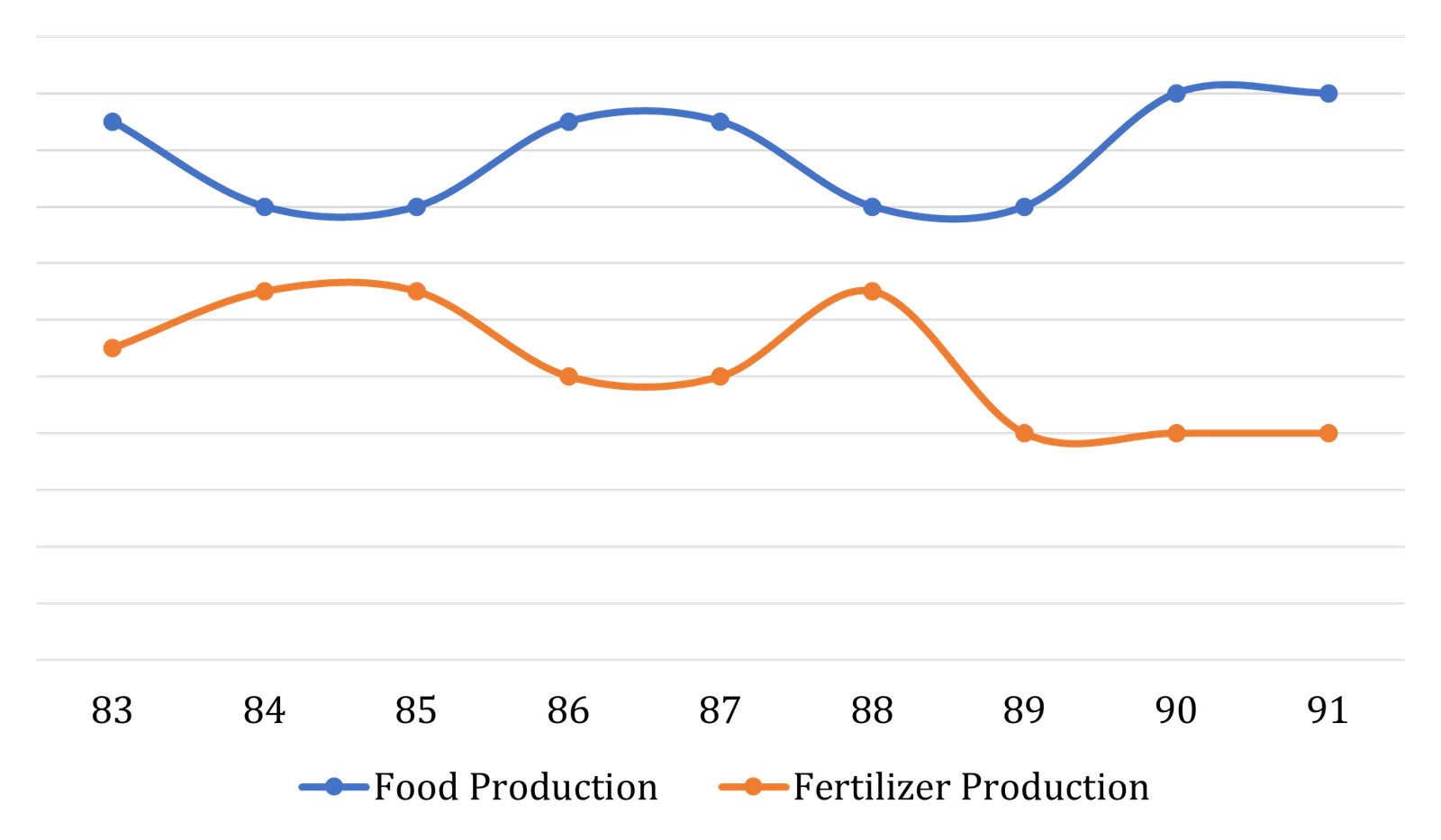
A man starting at a point walks one km east, then two km north, then one km east, then one km north, then one km east and then one km north to arrive at the destination. What is the shortest distance from the starting point to the destination?
Passage / Data
Study the following graph and answer questions that follow. The x – axis denotes the years from 1983 to 1991.
If 8 + 12 = 2, 7 + 14 = 3 then 10 + 18 = ?