Basics (Functions) — CAT Previous-Year Questions
44 previous-year questions on Basics (Functions) from CAT, with full solutions. Practise free — check answers as you go; sign in to save your progress.
Basics (Functions) · CAT PYQs
Consider two sets A = {2, 3, 5, 7, 11, 13} and B = {1, 8, 27}. Let f be a function from A to B such that for every element b in B, there is at least one element a in A such that f(a) = b. Then, the total number of such function f is
A function f maps the set of natural numbers to whole numbers, such that f(xy) = f(x)f(y) + f(x) + f(y) for all x, y and f(p) = 1 for every prime number p. Then, the value of f(160000) is
For any non-zero real number x, let f(x) + 2f(1/x) = 3x. Then, the sum of all possible values of x for which f(x) = 3, is
Suppose f(x, y) is a real-valued function such that f(3x + 2y, 2x - 5y) = 19x, for all real numbers x and y. The value of x for which f(x, 2x) = 27, is
For any real number x, let [x] be the largest integer less than or equal to x. If = 25, then N is
Among 100 students, x1 have birthdays in January, x2 have birthdays in February, and so on. If x0 = max(x1, x2, …., x12), then the smallest possible value of x0 is
If f(x + y) = f(x)f(y) and f(5) = 4, then f(10) – f(-10) is equal to
For any positive integer n, let f(n) = n(n + 1) if n is even, and f(n) = n + 3 if n is odd. If m is a positive integer such that 8 f(m + 1) − f(m) = 2, then m equals
Consider a function f satisfying f(x + y) = f(x) f(y) where x, y are positive integers and f(1) = 2. If f(a + 1) + f(a + 2) +…+ f(a + n) = 16(2n – 1) then a is equal to
Let f be a function such that f(mn) = f(m) × f(n) for every positive integers m and n. If f(1), f(2) and f(3) are positive integers, f(1) < f(2), and f(24) = 54, then f(18) equals
If f(x + 2) = f(x) + f(x + 1) for all positive integers x, and f(11) = 91, f(15) = 617, then f(10) equals
Let f(x) = min {2x2, 52 − 5x}, where x is any positive real number. Then the maximum possible value of f(x) is
Let f(x) = max {5x, 52 – 2x2}, where x is any positive real number. Then the minimum possible value of f(x) is
If f(ab) = f(a)f(b) for all positive integers a and b, then the largest possible value of f(1) is
Let f(x) = 2x – 5 and g(x) = 7 – 2x. Then |f(x) + g(x)| = |f(x)| + |g(x)| if and only if
Let f(x) be a function satisfying f(x) × f(y) = f(xy) for all real x, y. Let f(2) = 4, then what is the value of
A function f(x) satisfies f(1) = 3600, and f(1) + f(2) + ... + f(n) = n²f(n), for all positive integers n > 1. What is the value of f(9)?
Let f(x) = max (2x + 1, 3 − 4x), where x is any real number. Then the minimum possible value of f(x) is:
Let f(x) = ax2 – b|x|, where a and b are constants. Then at x = 0, f(x) is
The number of non-negative real roots of 2x – x – 1 = 0 equals
Let g(x) = max(5 − x, x + 2). The smallest possible value of g(x) is
Suppose, for any real number x, [x] denotes the greatest integer less than or equal to x. Let L(x, y) = [x] + [y] + [x + y] and R(x, y) = [2x] + [2y]. Then it’s impossible to find any two positive real numbers x and y for which of the following?
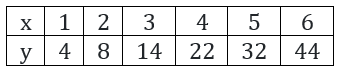
In the above table, for suitably chosen constants a, b and c, which one of the following best describes the relation between y and x?
Passage / Data
Answer the following question based on the information given below.
For real numbers x, y, let
f(x, y) = Positive square-root of (x + y), if (x + y)0.5 is real
= (x + y)2, otherwise
g(x, y) = (x + y)2, if (x + y)0.5 is real
= –(x + y), otherwise
Which of the following expressions yields a positive value for every pair of non-zero real number (x, y)?
Passage / Data
Answer the following question based on the information given below.
For real numbers x, y, let
f(x, y) = Positive square-root of (x + y), if (x + y)0.5 is real
= (x + y)2, otherwise
g(x, y) = (x + y)2, if (x + y)0.5 is real
= –(x + y), otherwise
Under which of the following conditions is f(x, y) necessarily greater than g(x, y)?
Passage / Data
Answer the following question based on the information given below.
For three distinct positive real numbers x, y and z, let
f(x, y, z) = min(max(x, y), max(y, z), max(z, x))
g(x, y, z) = max(min(x, y), min(y, z), min(z, x))
h(x, y, z) = max(max(x, y), max(y, z), max(z, x))
j(x, y, z) = min(min(x, y), min(y, z), min(z, x))
m(x, y, z) = max(x, y, z)
n(x, y, z) = min(x, y, z)
Which of the following expressions is necessarily equal to 1?
Passage / Data
Answer the following question based on the information given below.
For three distinct positive real numbers x, y and z, let
f(x, y, z) = min(max(x, y), max(y, z), max(z, x))
g(x, y, z) = max(min(x, y), min(y, z), min(z, x))
h(x, y, z) = max(max(x, y), max(y, z), max(z, x))
j(x, y, z) = min(min(x, y), min(y, z), min(z, x))
m(x, y, z) = max(x, y, z)
n(x, y, z) = min(x, y, z)
Which of the following expressions is indeterminate?
The set of all positive integers is the union of two disjoint subsets
{f(1), f(2) ....f(n),......} and {g(1), g(2),......,g(n),......}, where
f (1) < f(2) <...< f(n) ....., and g(1) < g(2) <...< g(n) ......., and
g(n) = f(f(n)) + 1 for all n ≥ 1.
What is the value of g(1)?
For all non-negative integers x and y, f(x, y) is defined as below
f(0, y) = y + 1
f(x + 1, 0) = f(x, 1)
f(x + 1,y + 1) = f(x, f(x + 1, y))
Then, what is the value of f(1, 2)?
Passage / Data
Directions: Answer the questions based on the following information.
Let x and y be real numbers and let
f (x,y) = |x + y| , F(f (x,y)) = −f (x,y)
and G(f (x, y)) = −F(f (x, y))
Which of the following statements is true?
Passage / Data
Direction: Answer the questions based on the following information.
For these questions the following functions have been defined.
la(x, y, z) = min(x + y, y + z)
le(x, y, z) = max (x − y, y − z)
ma(x, y, z) = [le(x, y, z) + la(x, y, z)]
Given that x > y > z > 0. Which of the following is necessarily true?
Passage / Data
Direction: Answer the questions based on the following information.
For these questions the following functions have been defined.
la(x, y, z) = min(x + y, y + z)
le(x, y, z) = max (x − y, y − z)
ma(x, y, z) = [le(x, y, z) + la(x, y, z)]
What is the value of ma(10, 4, le(la(10, 5, 3), 5, 3))?
Passage / Data
Direction: Answer the questions based on the following information.
For these questions the following functions have been defined.
la(x, y, z) = min(x + y, y + z)
le(x, y, z) = max (x − y, y − z)
ma(x, y, z) = [le(x, y, z) + la(x, y, z)]
For x = 15, y = 10 and z = 9 , find the value of le(x, min(y, x − z), le (9, 8, ma(x, y, z))).
Largest value of min(2 + x2, 6 – 3x), when x > 0, is
Passage / Data
Directions for next 4 questions: Answer the questions based on the following information.
le(x, y) = Least of (x, y)
mo(x) = |x|
me(x, y) = Maximum of (x, y)
Find the value of me(a + mo(le(a, b)); mo(a + me(mo(a), mo(b))), at a = –2 and b = –3.
Passage / Data
Directions for next 4 questions: Answer the questions based on the following information.
le(x, y) = Least of (x, y)
mo(x) = |x|
me(x, y) = Maximum of (x, y)
Which of the following must always be correct for a, b > 0?
Passage / Data
Directions for next 4 questions: Answer the questions based on the following information.
le(x, y) = Least of (x, y)
mo(x) = |x|
me(x, y) = Maximum of (x, y)
For what values of ‘a’ is me(a2 – 3a, a – 3) < 0?
Passage / Data
Directions for next 4 questions: Answer the questions based on the following information.
le(x, y) = Least of (x, y)
mo(x) = |x|
me(x, y) = Maximum of (x, y)
For what values of ‘a’ is le(a2 – 3a, a – 3) < 0?
Passage / Data
Answer the next 2 questions based on the following information:
If
md(x) = x ,
mn(x,y) = minimum of x and y and
Ma(a,b,c,...) = maximum of a,b,c…
Value of Ma[md(a),mn(md(b),a),mn(ab,md(ac))] where a = -2, b = -3, c = 4 is
Passage / Data
Answer the next 2 questions based on the following information:
If
md(x) = x ,
mn(x,y) = minimum of x and y and
Ma(a,b,c,...) = maximum of a,b,c…
Given that a > b then the relation Ma[md(a), mn(a,b)] = mn[a, md(Ma(a,b))] does not hold if
The maximum possible value of y = min (1/2 – 3x2/4, 5x2/4) for the range 0 < x < 1 is
A function can sometimes reflect on itself, i.e. if y = f(x), then x = f(y). Both of them retain the same structure and form. Which of the following functions has this property?
If y = f(x) and f(x) = , which of the following is true?
Let Y = minimum of {(x + 2), (3 – x)}. What is the maximum value of Y for 0 ≤ x ≤ 1?