Basics of TSD/Proportinality — CAT Previous-Year Questions
32 previous-year questions on Basics of TSD/Proportinality from CAT, with full solutions. Practise free — check answers as you go; sign in to save your progress.
Basics of TSD/Proportinality · CAT PYQs
A bus starts at 9 am and follows a fixed route every day. One day, it traveled at a constant speed of 60 km per hour and reached its destination 3.5 hours later than its scheduled arrival time. Next day, it traveled two-thirds of its route in one-third of its total scheduled travel time, and the remaining part of the route at 40 km per hour to reach just on time. The scheduled arrival time of the bus is
A train travelled a certain distance at a uniform speed. Had the speed been 6 km per hour more, it would have needed 4 hours less. Had the speed been 6 km per hour less, it would have needed 6 hours more. The distance, in km, travelled by the train is
Brishti went on an 8-hour trip in a car. Before the trip, the car had travelled a total of x km till then, where x is a whole number and is palindromic, i.e., x remains unchanged when its digits are reversed. At the end of the trip, the car had travelled a total of 26862 kms till then, this number again being palindromic. If Brishti never drove at more than 110 kmph, then the greatest possible average speed at which she drove during the rip, in kmph was?
Leaving home at the same time, Amal reaches office at 10:15 am if he travels at 8 km/hr, and at 9:40 am if he travels at 15 km/hr. Leaving home at 9:10 am, at what speed, in km/hr, must he travel so as to reach office exactly at 10 am?
A train travelled at one-thirds of its usual speed, and hence reached the destination 30 minutes after the scheduled time. On its return journey, the train initially travelled at its usual speed for 5 minutes but then stopped for 4 minutes for an emergency. The percentage by which the train must now increase its usual speed so as to reach the destination at the scheduled time, is nearest to
The distance from B to C is thrice that from A to B. Two trains travel from A to C via B. The speed of train 2 is double that of train 1 while traveling from A to B and their speeds are interchanged while traveling from B to C. The ratio of the time taken by train 1 to that taken by train 2 in travelling from A to C is
Vimla starts for office every day at 9 am and reaches exactly on time if she drives at her usual speed of 40 km/hr. She is late by 6 minutes if she drives at 35 km/hr. One day, she covers two-thirds of her distance to office in one-thirds of her usual time to reach office, and then stops for 8 minutes. The speed, in km/hr, at which she should drive the remaining distance to reach office exactly on time is
Two cars travel the same distance starting at 10:00 am and 11:00 am, respectively, on the same day. They reach their common destination at the same point of time. If the first car travelled for at least 6 hours, then the highest possible value of the percentage by which the speed of the second car could exceed that of the first car is
One can use three different transports which move at 10, 20, and 30 kmph, respectively. To reach from A to B, Amal took each mode of transport for 1/3 of his total journey time, while Bimal took each mode of transport for 1/3 of the total distance. The percentage by which Bimal’s travel time exceeds Amal’s travel time is nearest to
The wheels of bicycles A and B have radii 30 cm and 40 cm, respectively. While traveling a certain distance, each wheel of A required 5000 more revolutions than each wheel of B. If bicycle B traveled this distance in 45 minutes, then its speed, in km per hour, was
Point P lies between points A and B such that the length of BP is thrice that of AP. Car 1 starts from A and moves towards B. Simultaneously, car 2 starts from B and moves towards A. Car 2 reaches P one hour after car 1 reaches P. If the speed of car 2 is half that of car 1, then the time, in minutes, taken by car 1 in reaching P from A is
The distance from A to B is 60 km. Partha and Narayan start from A at the same time and move towards B. Partha takes four hours more than Narayan to reach B. Moreover, Partha reaches the mid-point of A and B two hours before Narayan reaches B. The speed of Partha, in km per hour, is
Points A and B are 150 km apart. Cars 1 and 2 travel from A to B, but car 2 starts from A when car 1 is already 20 km away from A. Each car travels at a speed of 100 kmph for the first 50 km, at 50 kmph for the next 50 km, and at 25 kmph for the last 50 km. The distance, in km, between car 2 and B when car 1 reaches B is
A man leaves his home and walks at a speed of 12 km per hour, reaching the railway station 10 minutes after the train had departed. If instead he had walked at a speed of 15 km per hour, he would have reached the station 10 minutes before the train's departure. The distance (in km) from his home to the railway station is:
Arun drove from home to his hostel at 60 miles per hour. While returning home he drove half way along the same route at a speed of 25 miles per hour and then took a bypass road which increased his driving distance by 5 miles, but allowed him to drive at 50 miles per hour along this bypass road. If his return journey took 30 minutes more than his onward journey, then the total distance traveled by him is
Rahim plans to drive from city A to station C, at the speed of 70 km per hour, to catch a train arriving there from B. He must reach C at least 15 minutes before the arrival of the train. The train leaves B, located 500 km south of A, at 8:00 am and travels at a speed of 50 km per hour. It is known that C is located between west and northwest of B, with BC at 60° to AB. Also, C is located between south and southwest of A with AC at 30° to AB. The latest time by which Rahim must leave A and still catch the train is closest to
If a man cycles at 10 km/hr, then he arrives at a certain place at 1 p.m. If he cycles at 15 km/hr, he will arrive at the same place at 11 a.m. At what speed must he cycle to get there at noon?
Two straight roads R1 and R2 diverge from a point A at an angle of 120°. Ram starts walking from point A along R1 at a uniform speed of 3 km/hr. Shyam starts walking at the same time from A along R2 at a uniform speed of 2 km/hr. They continue walking for 4 hours along their respective roads and reach points B and C on R1 and R2, respectively. There is a straight line path connecting B and C. Then Ram returns to point A after walking along the line segments BC and CA. Shyam also returns to A after walking along line segments CB and BA. Their speeds remain unchanged. The time interval (in hours) between Ram’s and Shyam’s return to the point A is:
Passage / Data
Answer the following question based on the information given below.
The petrol consumption rate of a new model car 'Palto' depends on its speed and may be described by the graph below
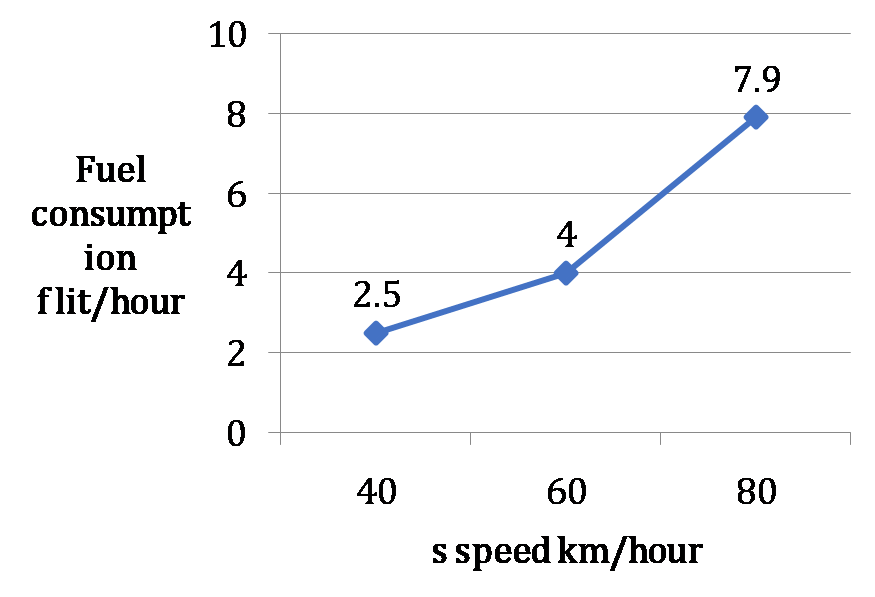
Manasa makes the 200 km trip from Mumbai to Pune at a steady speed of 60 km/hour. What is the amount of petrol consumed for the journey?
Passage / Data
Answer the following question based on the information given below.
The petrol consumption rate of a new model car 'Palto' depends on its speed and may be described by the graph below
Manasa would like to minimize the fuel consumption for the trip by driving at the appropriate speed. How should she change the speed?
Passage / Data
Directions: Answer the questions based on the following information.
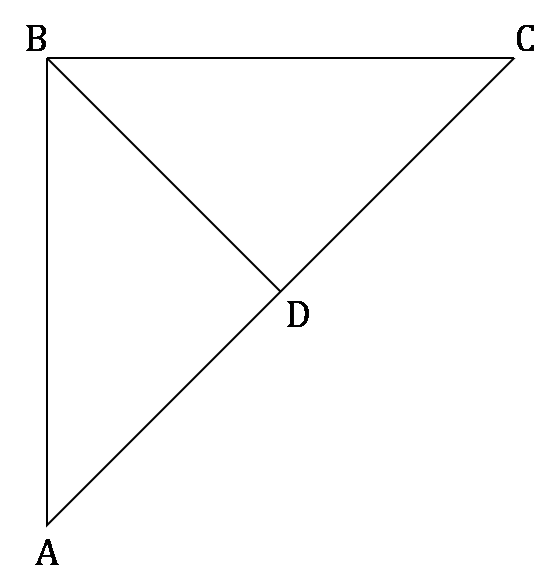
A road network (shown in the figure below) connects cities A, B, C and D. All road segments are straight lines. D is the mid-point on the road connecting A and C. Roads AB and BC are at right angles to each other with BC shorter than AB. The segment AB is 100 km long.
Ms X and Mr Y leave A at 8.00 a.m., take different routes to city C and reach at the same time. X takes the highway from A to B to C and travels at an average speed of 61.875 kmph. Y takes the direct route AC and travels at 45 kmph on segment AD. Y’s speed on segment DC is 55 kmph.
What is the average speed of Y?
Passage / Data
Directions: Answer the questions based on the following information.
A road network (shown in the figure below) connects cities A, B, C and D. All road segments are straight lines. D is the mid-point on the road connecting A and C. Roads AB and BC are at right angles to each other with BC shorter than AB. The segment AB is 100 km long.
Ms X and Mr Y leave A at 8.00 a.m., take different routes to city C and reach at the same time. X takes the highway from A to B to C and travels at an average speed of 61.875 kmph. Y takes the direct route AC and travels at 45 kmph on segment AD. Y’s speed on segment DC is 55 kmph.
The total distance travelled by Y during the journey is approximately
Passage / Data
Directions: Answer the questions based on the following information.
A road network (shown in the figure below) connects cities A, B, C and D. All road segments are straight lines. D is the mid-point on the road connecting A and C. Roads AB and BC are at right angles to each other with BC shorter than AB. The segment AB is 100 km long.
Ms X and Mr Y leave A at 8.00 a.m., take different routes to city C and reach at the same time. X takes the highway from A to B to C and travels at an average speed of 61.875 kmph. Y takes the direct route AC and travels at 45 kmph on segment AD. Y’s speed on segment DC is 55 kmph.
What is the length of the road segment BD?
Passage / Data
Answer the next 3 questions based on the following information.
A certain race is made up of three stretches: A, B and C, each 2 km long, and to be covered by a certain mode of transport. The following table gives these modes of transport for the stretches, and the minimum and maximum possible speeds (in km/hr) over these stretches. The speed over a particular stretch is assumed to be constant. The previous record for the race is 10 min.
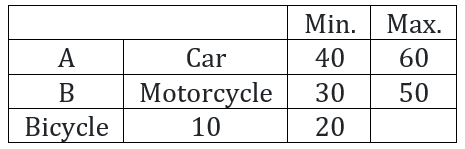
Anshuman travels at minimum speed by car over A and completes stretch B at the fastest speed. At what speed should he cover stretch C in order to break the previous record?
Passage / Data
Answer the next 3 questions based on the following information.
A certain race is made up of three stretches: A, B and C, each 2 km long, and to be covered by a certain mode of transport. The following table gives these modes of transport for the stretches, and the minimum and maximum possible speeds (in km/hr) over these stretches. The speed over a particular stretch is assumed to be constant. The previous record for the race is 10 min.
Mr Hare completes the first stretch at the minimum speed and takes the same time for stretch B. He takes 50% more time than the previous record to complete the race. What is Mr Hare's speed for the stretch C?
Passage / Data
Answer the next 3 questions based on the following information.
A certain race is made up of three stretches: A, B and C, each 2 km long, and to be covered by a certain mode of transport. The following table gives these modes of transport for the stretches, and the minimum and maximum possible speeds (in km/hr) over these stretches. The speed over a particular stretch is assumed to be constant. The previous record for the race is 10 min.
Mr Tortoise completes the race at an average speed of 20 km/hr. His average speed for the first two stretches is four times that for the last stretch. Find the speed over stretch C.
Passage / Data
Direction: Answer the questions based on the following information.
Boston is 4 hr ahead of Frankfurt and 2 hr behind India. X leaves Frankfurt at 6 p.m. on Friday and reaches Boston the next day. After waiting there for 2 hr, he leaves exactly at noon and reaches India at 1 a.m. On his return journey, he takes the same route as before, but halts at Boston for 1hr less than his previous halt there. He then proceeds to Frankfurt.
If his journey, including stoppage, is covered at an average speed of 180 mph, what is the distance between Frankfurt and India?
Passage / Data
Direction: Answer the questions based on the following information.
Boston is 4 hr ahead of Frankfurt and 2 hr behind India. X leaves Frankfurt at 6 p.m. on Friday and reaches Boston the next day. After waiting there for 2 hr, he leaves exactly at noon and reaches India at 1 a.m. On his return journey, he takes the same route as before, but halts at Boston for 1hr less than his previous halt there. He then proceeds to Frankfurt.
If X had started the return journey from India at 2.55 a.m. on the same day that he reached there, after how much time would he reach Frankfurt?
Passage / Data
Direction: Answer the questions based on the following information.
Boston is 4 hr ahead of Frankfurt and 2 hr behind India. X leaves Frankfurt at 6 p.m. on Friday and reaches Boston the next day. After waiting there for 2 hr, he leaves exactly at noon and reaches India at 1 a.m. On his return journey, he takes the same route as before, but halts at Boston for 1hr less than his previous halt there. He then proceeds to Frankfurt.
What is X's average speed for the entire journey (to and fro)?
A man travels three-fifths of a distance AB at a speed 3a, and the remaining at a speed 2b. If he goes from B to A and return at a speed 5c in the same time, then
A man travels from A to B at a speed x km/hr. He then rests at B for x hours. He then travels from B to C at a speed 2x km/hr and rests for 2x hours. He moves further to D at a speed twice as that between B and C. He thus reaches D in 16 hr. If distances A-B, B-C and C-D are all equal to 12 km, the time for which he rested at B could be
Shyam went from Delhi to Shimla via Chandigarh by car. The distance from Delhi to Chandigarh is times the distance from Chandigarh to Shimla. The average speed from Delhi to Chandigarh was half as much again as that from Chandigarh to Shimla. If the average speed for the entire journey was 49 kmph. What was the average speed from Chandigarh to Shimla?