XAT 2011 — QA & DI Question 29
Answer the following question based on the information given below.
From a group of 545 contenders, a party has to select a leader. Even after holding a series of meetings, the politicians and the general body failed to reach a consensus. It was then proposed that all 545 contenders be given a number from 1 to 545. Then they will be asked to stand on a podium in a circular arrangement, and counting would start from the contender numbered 1. The counting would be done in a clockwise fashion. The rule is that every alternate contender would be asked to step down as the counting continued, with the circle getting smaller and smaller, till only one person remains standing. Therefore the first person to be eliminated would be the contender numbered 2.
There are 240 second year students in a B-School. The Finance area offers 3 electives in the second year. These are Financial Derivatives, Behavioural Finance, and Security Analysis. Four students have taken all the three electives, and 48 students have taken Financial Derivatives. There are twice as many students who study Financial Derivatives and Security Analysis but not Behavioural Finance, as those who study both Financial Derivatives and Behavioural Finance but not Security Analysis, and 4 times as many who study all the three. 124 students study Security Analysis. There are 59 students who could not muster courage to take up any of these subjects. The group of students who study both Financial Derivatives and Security Analysis but not Behavioural Finance, is exactly the same as the group made up of students who study both Behavioural Finance and Security Analysis. How many students study Behavioural Finance only?
Answer & solution
Correct answer: 29
29
- B
30
- C
32
- D
35
- E
None of the above
There are 240 students in all, out of which 59 do not study any subject out of the given three.
∴ 181 study one or more of Financial Derivatives (FD), Behavioral Finance (BF) and Security Analysis (SA).
No. of students who study both FD and SA but not BF
= 4 × no. of students who study all three = 4 × 4 = 16
= 2 × no. of students who study both FD and BF but not SA
Also, no. of students who study both FD and SA but not BF = no. of students who study both BF and SA = 16
∴ We have the following:
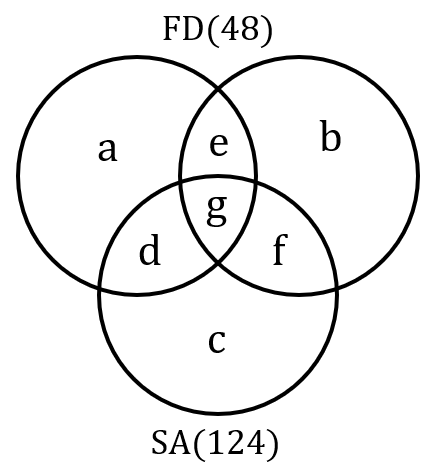
∴ No. of students who study only BF
= 181 – 124 – 20 – 8 = 29
Hence, option (a).
Related Simple Equations questions
- In which year was the increase in spending on CSR, vis-à-vis the previous…
- Of the years indicated below, in which year was the ratio of CSR/Assets the maxi…
- What was the maximum value of spending on CSR activities in the period 2004-2009…
- In which year, did the spending on CSR (measured in Rs) decline, as compared to …
- The level in which the Ex-Defence Servicemen are highest in percentage terms is:…
- If the company decides to abolish all vacant posts at all levels, which level wo…